I came across an interesting theory online about the SpaceX and Binance IPOs. It's alleged that Binance hatched this very scheme:
- Binance offered users to deposit funds to participate in the SpaceX IPO.
- Ultimately, it raised approximately $557 million.
- These funds were used to purchase shares in the IPO.
- If the IPO had been unsuccessful, users would have received shares. But the IPO opened at approximately 20% above the offering price.
- As a result, Binance returned users' funds, and could have kept the profit from the stock price increase, according to the author's calculations.
Result: approximately $100 million in profit with minimal risk to the exchange itself.
Binance stated that it did not receive an allocation for SpaceX shares due to problems with xStocks, so user funds will be fully refunded.
But who knows what really happened. What do you think?
Important news for the @ConcreteXYZ community was announced on Discord. The project continues to move forward. We're happy to hear it. For more information, watch the video and join the project's Discord
Article of the Week @ConcreteXYZ : The One-Click DeFi Economy
DeFi was supposed to make finance more accessible. Instead, users often find themselves facing dozens of decisions: which protocol offers the best yield? Which chain should capital be on? When should positions be rebalanced? How should risk be managed? What happens when incentives change? As DeFi grows, complexity grows with it. But what happens when infrastructure takes over that work?
1️⃣ The Problem
Participating in DeFi today looks like this:
-Constant monitoring of opportunities - yield can change within an hour.
-Manually moving capital between protocols, paying gas each time.
-Managing risk on your own - without it, you can easily lose funds.
-Tracking incentives and rewards - emissions decay, token prices drop.
-Rebalancing positions as market conditions shift.
All of this creates friction. The core issue is that most users want outcomes, not operations. They don't want to be operators - they want their capital to work.
2️⃣ Why Complexity Exists
DeFi isn't complicated by mistake. Many opportunities require participating in multiple protocols at once, working across different chains, active management, and constant decision‑making. In effect, the user is forced to act as a portfolio manager - without formal training, without a team, and without automation.
What happens when users become the execution layer? They get exhausted, make mistakes, miss opportunities, or worse, fall into traps due to inattention. Manual management does not scale - for a single person or for capital.
3️⃣ The Infrastructure Layer
The solution is infrastructure that absorbs complexity. Instead of forcing the user to perform dozens of operations, the system does it for them.
What does such an infrastructure layer include?
-Vaults - intelligent containers for capital.
-Automated execution - without delays or human error.
-Capital coordination - pooling funds to access the best strategies.
-Quantitative allocation - algorithms instead of intuition.
-Structured DeFi systems - with clear roles and rules.
The key idea: The user should allocate capital (choose risk profile and time horizon). Infrastructure should handle the operations.
4️⃣ Concrete Vaults
Concrete Vaults are not just another aggregator. They are a full‑fledged infrastructure for deploying capital onchain.
-Automated compounding rewards are reinvested without your involvement, triggering the power of compound interest.
-ctAssets - tokenized vault shares that can be used as building blocks for more complex strategies.
-Strategy automation - the Allocator decides when and where to move funds within approved rules.
-Onchain execution - everything happens transparently and without intermediaries.
-Structured vault system - roles (Allocator, Strategy Manager, Hook Manager) are clearly separated, risk is enforced by code.
The user deposits capital and gains access to opportunities without manually managing every position.
5️⃣ The Benefits
-Capital efficiency - funds don't sit idle waiting for the user's next action.
-Reduced operational burden - no need to sit on dashboards 24/7.
-Consistent strategy execution - the system doesn't get distracted or panic.
-Risk‑adjusted yield - focus on sustainable, not hype‑driven, sources.
-Institutional DeFi infrastructure - an approach that scales for large capital.
-Scalable capital deployment - the same mechanism works for $100 or $1M.
The bottom line: Better infrastructure creates a better user experience. Instead of decision fatigue - confidence that the system is working correctly.
6️⃣The Bigger Shift
Ask yourself:
-Will users keep managing strategies manually once reliable automated alternatives exist?
-Do DeFi participants want more features - or fewer decisions?
-Are vaults becoming the default interface for deploying capital onchain?
-What does "one‑click DeFi" actually mean?
To me, the answer is clear: the future of DeFi belongs to infrastructure that does the work for the user. Because true accessibility isn't having a hundred buttons - it's having one button that does everything right.
The one‑click DeFi economy is not marketing. It's an evolution from manual labor to automated systems. It's a shift from "user as operator" to "user as capital allocator." And Concrete Vaults are at the forefront of this shift.
Explore Concrete at https://t.co/8FLb4BXcqL
🇮🇷 Iran Launches "Hormuz Safe" Platform
A digital marine insurance system for cargo ships transiting the Strait of Hormuz, offering:
- Fast digital insurance issuance
-Payment in BTC (and several other cryptocurrencies)👍
- Instant confirmation and verified documents (including Bill of Lading)
- Coverage for strait transit risks
Many are already seeing this as Iran's attempt to circumvent sanctions and earn up to $10 billion per year
"It was the calm before the storm." Trump hinted at new strikes on Iran in a post on his social media.
He shared an AI-generated image showing the US president posing against a backdrop of Iranian ships engulfed in a storm.
Will something happen? What do you think?
🇺🇸 Trump: Iran faces annihilation if it rejects the deal proposed by the US.
⚡️ The US has sent an official written response to Tehran, completely rejecting Iran’s 14‑point settlement plan.
The Donald Trump administration called Tehran’s terms “absolutely unacceptable.” The White House said it will not bow to pressure or make any concessions until Iran fully and unconditionally rolls back its nuclear program. Trump accused the Iranian authorities of trying to “play for time” and engage in diplomatic games.
Article of the Week @ConcreteXYZ : Why Should You Use a Concrete Vault?
Most DeFi users today live in a state of constant routine. To stay competitive, they need to constantly monitor APYs, move liquidity between protocols, claim and reinvest rewards, rebalance positions, and track risk manually. This isn't just hard - it's inefficient. Concrete Vaults are built to take that complexity off your shoulders.
1️⃣ The Current DeFi Experience
To keep capital productive, a user has to:
-Constantly watch yields across dozens of dashboards;
-Shift funds from one pool to another chasing better rates;
-Manually claim rewards and redeposit them, paying gas for every operation;
-Rebalance positions to avoid missing opportunities;
-Track the risks of each protocol.
All of this creates friction, eats up time, and consumes profits. Worse, this approach doesn't scale. Vaults simplify this process down to a single deposit.
2️⃣ What a Concrete Vault Does
In simple terms, a Concrete Vault is a smart container for your capital. It helps you:
-Pool capital with other users, unlocking strategies unavailable to individuals;
-Automatically compound yield - rewards are reinvested on their own, without your involvement;
-Deploy across multiple strategies at once, rather than keeping everything in one place;
-Optimize positions over time - the system decides when and where to move capital;
-Reduce operational complexity - instead of constant manual actions, you get a structured product.
Rather than manually hopping between protocols, you gain exposure to a full capital management system.
3️⃣ The Benefits of Vault Infrastructure
Why do vaults matter? They offer several key advantages:
-Automation - everything that once required your attention now happens automatically.
-Capital efficiency - funds don't sit idle waiting for the next move.
-Lower costs - fewer transactions, less gas, fewer mistakes.
-Simplified user experience - one deposit replaces dozens of operations.
-Continuous optimization - capital always works in the best available conditions.
-Structured exposure to yield - you get a managed outcome, not a random APY.
The key idea: vaults help you spend less time managing positions while improving consistency.
4️⃣ Risk & Structure
It's important to understand: a Concrete Vault is not a passive box where you toss coins and hope for the best. It is a structured system that includes:
-Coordination of capital deployment - funds are distributed across strategies according to their risk profiles.
-Automatic rebalancing - when conditions change, the vault adapts.
-Enforced strategy constraints - no strategy can exceed the limits set by governance.
-Response to changing market conditions - the system can adapt to new environments.
This is not "set and forget" in the naive sense. This is a managed, transparent, and disciplined approach to participating in DeFi.
5️⃣ How Concrete Vault Architecture Works
Let's look under the hood. A Concrete Vault is built on a role‑based model:
-The Allocator actively manages capital, moving it between approved strategies.
-The Strategy Manager defines which strategies are permissible, filtering out inefficient or overly risky options.
-The Hook Manager enforces risk rules - limits, entry and exit conditions.
Additionally, the system uses ctAssets - tokenized shares in the vault that can be used as building blocks for more complex structures. Everything runs on automated compounding and on-chain execution, without needing to trust a single person or multisig.
Concrete Vaults are not just "another aggregator." They are a structured vault system that coordinates capital efficiently and transparently.
6️⃣ The Big Shift
DeFi is becoming more complex every day. New protocols, new chains, new strategies. In such an environment, manual capital management becomes impossible.
-Manual strategy management does not scale.
-Infrastructure is replacing constant repositioning.
-Vaults are becoming the default interface for deploying capital onchain.
The future of DeFi will likely belong not to those who click between protocols all day, but to those who build systems that coordinate capital more efficiently than any human can manually.
Concrete Vaults are a step in that direction. They don't promise magical APY. They promise structure, automation, and efficiency.
Explore Concrete at https://t.co/8FLb4BXcqL
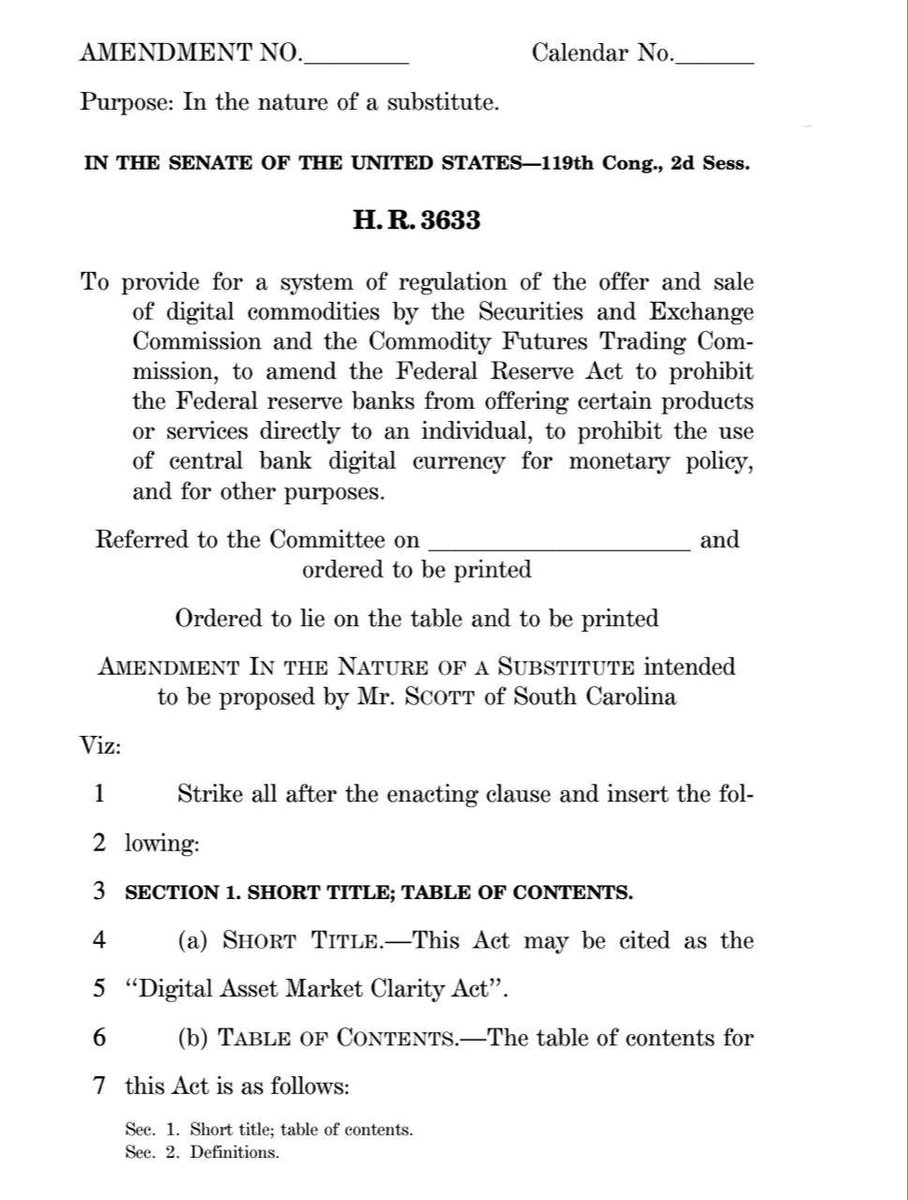
!!!CLARITY Act Vote in the Senate Banking Committee:
The bill was approved - 15 YEAS, 9 NAYS. All committee Republicans backed the document, along with two Democrats: Ruben Gallego and Angela Alsobrooks.
The CLARITY Act must now pass a full Senate vote, where 60 votes are needed to advance.
Adopted amendments:
- Regulators will be tasked with simplifying rules for companies that hold multiple asset types simultaneously: securities, futures, swaps, and digital commodities. In simple terms, risk could be calculated across the entire portfolio rather than for each individual position.
- Regulatory sandbox for AI: Financial firms will be able to test new AI-based products under regulatory supervision without a full-scale market launch.
- Stablecoin compromise: Passive income solely for holding stablecoins for U.S. clients would be banned. However, rewards for real activity - such as product usage or transactions - may be allowed.
What was rejected:
- Tougher sanctions against crypto mixers: Elizabeth Warren attempted to add stricter norms against services like Tornado Cash.
- Restrictions on crypto in retirement accounts (Democratic proposal).
- Ban on crypto projects for the President and members of Congress: The amendment would have prohibited the U.S. President and congress members from issuing their own crypto assets. It was rejected amid controversy surrounding the Trump family's crypto projects.
- Stricter DeFi rules: Amendments that could have more heavily restricted decentralized finance were also not adopted.
Outcome: The core, crypto-friendly portion of the bill passed the committee, while the majority of harsh amendments targeting DeFi, mixers, and political crypto projects were shot down.
Awesome!!!
🦅 SEC Chair: Market rules need to be updated for new technologies, not live by 80-year-old norms.
Key takeaways from the podcast:
🤩 The SEC is preparing a major rule update – the Regulatory Flexibility Agenda currently has over 22 initiatives.
🤩 Areas include simplifying disclosure, regulating crypto assets, shareholder voting rules, shareholder proposals, and revising climate reporting requirements for companies.
🤩 The SEC believes many old norms no longer fit the modern market and new technologies.
🤩 The Commission wants to make life easier for entrepreneurs and companies so they can build new business models without excessive bureaucracy.
🇺🇸🇨🇳 Reuters: Donald Trump and Xi Jinping will discuss tariff reductions on $30 billion worth of imports tomorrow.
The current US president is visiting China for the first time since 2017 (almost nine years). Donald Trump's plane has already landed in China; his meeting with Xi Jinping is scheduled for May 14-15.
Are we expecting positive news or not?
Amazon cloud services have recovered after an outage that occurred a few days ago.
Overheating at a data center affected Coinbase and other companies. The incident once again highlighted growing risks - AI and cloud servers generate record heat, forcing operators to switch to liquid cooling.
AWS is reinforcing its cooling systems, but expanding capacity takes time; delays were also reported earlier due to war-damaged data centers in the Middle East.
This once again proves that everyone needs reliable infrastructure. Like the Sovereign Stack from @Neura_io.
Neura’s infrastructure pursues a single goal: to be a sovereign stack with resources that never change under external traffic. No matter the load, the Sovereign Stack remains fast, reliable, and useful.
The U.S. Senate Banking Committee has released an updated version of the CLARITY bill on the structure of the cryptocurrency market.
➥ The document includes a ban on paying interest for simply holding stablecoins or any mechanisms similar to bank interest.
➥ The crypto industry has supported the new rules on stablecoins, but the banking lobby considers the restrictions insufficient and fears a flight of deposits from banks to stablecoins.
➥ At the same time, the bill lacks restrictions that would prevent Donald Trump and other federal officials from profiting from crypto projects. 🤔
➥ On Thursday, the Senate Banking Committee is scheduled to vote on and consider amendments to the bill.
What do you think?
🍕 Pizza Index
Pizzerias near the Pentagon once again reported a surge in orders yesterday.
Another attempt to strike Iran? Or is some other shit about to go down?🤔
🦅 SEC Chair Paul Atkins said: "Ladies and gentlemen, we must recognize that the time for cryptocurrencies has come."
"President Trump tasked me with making America the cryptocurrency capital of the world" 🚀
So, are we blasting off??💪
Key US crypto bill stalls over two "red lines."
The Trump administration is rushing to pass CLARITY by July 4, but the Senate is stuck on fundamental issues. The main stumbling blocks: wallets and public officials.
-First dispute: the status of non-custodial wallet developers. Democrats want to classify them as financial operators (like banks), Republicans oppose it. This is a fundamental question for DeFi.
-The second - and hottest - issue: a ban on launching crypto projects for public officials. Democrats insist on restrictions for officials, including the president and his family. A direct jab at Trump.
-White House advisor Patrick Witt pushes back: “No targeted laws against specific individuals. Either the rules apply to everyone - from the president to an intern - or not at all.” Senate Republicans are blocking this provision.
⏳ The deadline is July 4. After that, the Senate will dive into budget battles, and crypto regulation will be delayed for a long time. The White House hopes to move CLARITY through committee in May and pass it in June.
🤝 There is progress: a compromise on stablecoins has been found. The Tillis-Alsobrooks amendment bans direct yield but allows loyalty programs. “Everyone's unhappy - both banks and crypto companies. That's how we know we've got the right compromise,” Witt said.
Bottom line: the fate of US crypto regulation will be decided in the next 8 weeks. The Trump team is betting they can slip through before the political storms of summer.
🦅 New Fed Chair. What’s in store for crypto?
In a week, Powell will be replaced by Warsh.
🔥 Important: Powell stays on the Board until 2028, so Trump won’t gain full control.
How will the voting go? 🤔
Decisions are made by a committee of 12 people. A rate cut requires 7 votes. Right now, there are no such supporters. Warsh wants to reduce the Fed’s transparency, and it’s often on that kind of opacity that crypto rallies.
I wouldn’t rush to expect a sharp surge just because of the leadership change. Historically, the first 1–2 months after a changeover are accompanied by declines.
Right now, the S&P 500 is at highs, which practically begs for a correction.
What’s your take on the current market?
Article of the Week @ConcreteXYZ : DeFi Doesn’t Remove Trust - It Engineers It
DeFi was built on a simple idea: "Don't trust people. Trust code." For a while, that worked. But as the system evolved, something became clear: trust didn't disappear. It just moved.
You trust smart contracts. You trust governance systems. You trust oracles, bridges, execution layers. In real systems, trust is unavoidable. The difference is whether it is engineered deliberately - or hidden behind the illusion of decentralization.
1️⃣ Start With the Myth
The core belief sounds like this: "DeFi is trustless," "Code is law," "No intermediaries needed." It sounds beautiful. But in practice, no system is fully trustless. The question isn't whether trust exists - it's where it exists and how it's managed.
2️⃣ Where Trust Actually Lives
Let's look under the hood of DeFi. Trust is hidden in many layers:
-Smart contracts: You trust that the code is written without bugs and contains no vulnerabilities.
-Governance: You trust that token holders or a multisig won't make a malicious decision.
-Oracles: You trust that the price source (e.g., Chainlink) is correct and won't be compromised.
-Bridges: You trust that funds locked on one chain will be correctly mirrored on another.
-Execution layers: You trust the validators and the blockchain itself.
Often, trust is abstracted away, not eliminated. Users may not think about it, but the risk never disappears.
3️⃣ The Problem With "Decentralization Theatre"
Some systems appear decentralized but aren't necessarily resilient. Examples:
-Multisig as a proxy for security: "3 out of 5 signatures" is already trust in specific people.
-DAOs with low participation: Formally, decisions are made by the community; in reality, by a handful of active participants.
-Timelocks: They delay changes but don't prevent risky actions.
-Systems that can't react during critical moments: When markets crash or an oracle lags, "pure code" may not be fast enough.
It's important to distinguish between appearance of decentralization and actual safety. You can be decentralized on paper but remain fragile in practice.
4️⃣ Engineered Trust
Instead of pretending that trust doesn't exist, mature systems design it intentionally.
Engineered trust means:
-Clear roles and responsibilities (who can do what).
-Defined permissions and boundaries (what is allowed, what is not).
-Enforced constraints (code or policies prevent boundary violations).
-Ability to respond to failures (pause mechanisms, emergency withdrawals, upgrades).
This is how traditional financial systems operate. And this is how Concrete operates.
5️⃣ Operational Security
Real, complex systems need:
-Continuous monitoring - someone or something must track state.
-Rapid response mechanisms - for example, pausing a strategy when an anomaly is detected.
-Human judgment in edge cases - code cannot anticipate everything.
-Layered security a combination of automated checks and human oversight.
Blind faith in "code without intermediaries" won't save you when something goes wrong.
6️⃣ How Concrete Approaches This
Concrete chooses transparency and structure over decentralization theater.
-Trust is made explicit, not hidden. Roles (Allocator, Strategy Manager, Hook Manager) are clearly defined and limited.
-Systems are designed for response, not just prevention. There are mechanisms for emergency situations.
-On-chain enforcement + off-chain intelligence. Code enforces rules, but monitoring and complex decisions can involve responsible parties/processes.
-Role-based architecture: Different actions require different permissions; no single role can do everything.
-Controlled execution environment: Strategies and parameters are approved at the governance level, not changed at the whim of a single key.
Concrete prioritizes operational security over the dogma of "trust only code." Because in the real world, what matters isn't how a system looks on paper, but how it behaves under stress.
7️⃣ The Big Shift
DeFi is maturing. And this growth means moving beyond simplified narratives.
-The industry is moving beyond "trustless" slogans.
-Real systems acknowledge and structure trust.
-Resilience matters more than ideological purity.
-Infrastructure will be judged by how it performs under stress, not by how well it sounds in calm times.
The future of DeFi won't be defined by who shouts loudest about removing trust. It will be defined by who engineers trust best - in a deliberate, transparent, and reliable way.
Explore Concrete at https://t.co/8FLb4BXcqL
The internet was built for humans - click, think, click again.
But by 2030, AI agents will outnumber people online. And they need a completely different environment.
Regular blockchains aren’t cut out for this - they’re optimized for human pacing. Agents, on the other hand, run continuously, make thousands of micro-decisions, and need to pay each other without any human in the loop.
That’s exactly what @Neura_io is building.
They’ve got a live virtual world - the Neuraverse - with 1.5 million users and over 100 million testnet transactions already. But beneath the game layer is a full infrastructure for an agent economy.
Three core pieces:
1. Agent Identity
Every agent gets a verifiable on-chain identity and portable reputation. No fake claims, everyone knows who they’re dealing with.
2. Agentic Payments
Agents pay other agents and humans directly. Scale doesn’t matter - from a fraction of a cent for an API call to complex multi-step settlements. No checkout forms, value just moves at code speed.
3. Universal Connectivity
Any AI agent from any framework can plug in. No proprietary SDK - just open standards that the AI ecosystem already speaks.
What this unlocks right now:
You walk into the Agent District, browse agents with verified performance, set limits, and hire one. Funds stay in your custody. You can fire the agent anytime. It only earns fees from the yield it actually generates.
For developers - list your agent on the marketplace, earn commissions, and build up its on-chain reputation over time.
The Neuraverse is already live - you can explore, complete quests, trade on the DEX, wander through districts.
Ahead of mainnet they’re promising a veDEX with ve(3,3), the full agent marketplace, and a pre-deposit campaign.
Honestly, this looks exactly like something everyone will be talking about as obvious a couple of years from now.👍