Money itself doesn't buy happiness, but it does 2 things:
1. You don't have to deal with the pain and headaches that come from being broke
2. It gives you the time and bandwidth to actually pursue happiness, like spending more time with your kids or on your hobbies
$1.7B+ liquidated in 24 hours and around 290K traders wiped out.
That's what happens when everyone gets a little too comfortable with leverage.
Tthe liquidation number isn't the one I keep coming back to. Only ~24% of the top 100 coins are above their 50D trend, which tells me the market isn't healthy under the surface.
A few names might bounce, but most of the board is still sitting below trend.
Is this full macro panic? I don't think so. Traditional markets are holding up fine, so the pressure feels crypto-specific to me.
Leverage got way too crowded, and high beta is always the first thing people dump when they want to de-risk.
ETF demand cooling off into all of this didn't help either... the flows just aren't strong enough right now to say institutions are stepping in to absorb the dip.
So I'm playing it defensively for now. Until breadth picks back up and the ETF bid returns, I don't see a reason to get aggressive here.
It's a good time to be building watchlists though. The names you actually want are getting cheaper, and most people are too busy panicking to notice.
People keep comparing @bankrbot and @virtuals_io because they're both launchpads for AI projects, but that comparison is kinda lazy.
Their end games are completely different.
Here's how I see it.
BANKR: FINANCIAL RAILS FOR AGENTS
The whole loop is simple: launch a token, earn fees, pay for your own compute.
It's not just a launchpad either. You get a CLI, an API, scoped agent wallets (API keys with IP whitelisting, so no seed phrases floating around), and a skills system that plugs Bankr into Claude Code, Cursor, OpenClaw, or whatever agent system you already use.
The incentives:
- 1.2% fee on every swap
- 57% goes straight to the creator wallet
- ~2% gets routed back to subsidize LLM inference through the Bankr LLM Gateway
So your agent literally earns the money it spends on Claude, Gemini, and GPT calls, which is the closed loop in action. KellyClaude and $CLAWD are doing ~$7.5k a day in fees as we speak.
VIRTUALS: A WHOLE SOCIETY FOR AGENTS
Virtuals is an OG at this point.
Virtuals isn't building a launchpad, they're building a whole society for agents that covers identity, banking, commerce, capital markets, robotics, and governance. Five pillars stacked on top of each other.
1. EconomyOS gives every agent a passport, wallet, and payroll, with 45k+ agents created and 1.48M jobs run through it already.
2. ACP is the agent-to-agent marketplace where agents discover each other, negotiate jobs, escrow payment, and settle onchain through ERC-8183, x402, and neutral evaluators. They've done ~2.28M jobs completed and ~$4M in agent revenue routed through it, and they're tagging the whole thing as aGDP (currently ~$481M).
3. Capital Markets is the launchpad piece everyone already knows, with ~42k projects launched, ~$690M total mcap, $13.9B trading volume, and ~$31M raised for builders.
4. Eastworld is the robotics arm, which is basically agents with bodies.
5. AI Council handles governance and dispute resolution. Feels like a sci fi movies bc it's basically a legal system for autonomous economic actors.
The bigger picture is that there's a whole economy forming around them and you want to own the rails for that economy.
THE REAL DIFFERENCE
If I had to use a real life analogy:
• Bankr feels like Stripe + Robinhood for agents, with a built-in AWS-credits style rebate that covers the compute bill
• Virtuals feels like AWS + a marketplace + a Wall Street + a labor union for agents
Virtuals wants to own the economy, while Bankr wants to make sure every agent inside any economy can actually pay rent.
Anyways, I'm a big fan of both projects.
A.I. keeps moving fast and it's awesome to watch how these two protocols keep adapting to such a fast paced market.
In 2021, there were ~2.6K tokens for every $1B of stablecoin supply.
Today there are ~125K.
It's a ~48x increase in tokens competing for the same liquidity and attention.
Main reason why altcoin seasons have never felt the same.
The robotics x crypto narrative is quietly getting built on Base.
Not the robots themselves. The rails around them: data, ownership, payments, identity, teleoperation, and deployment.
If robotics scales, that's where the value accrues.
Here are some projects on my watchlist:
• @virtuals_io ($VIRTUAL): Virtuals is becoming the main launchpad for robotics on Base. The key piece is Eastworld Labs, a robotics track focused on humanoid fleets, teleoperation data, and physical-world task experiments. Their ecosystem already has 30+ Unitree robots and a robotics market cap around $45M.
• @caspius_ai ($CAS): Caspius is focused on embodied AI data. Robots need real-world movement, perception, and environment data before they become useful. Their recent Genesis NFT drop is tied to this data network, with contributors helping build structured training data for physical AI.
• @StrikeRobot_ai ($SR): Strike is direct humanoid robotics exposure. The project focuses on industrial/security environments and has published paper, teleoperation revenue, Eastworld Labs backing, and incoming x402 integration for enterprise simulation access.
• @FabricFND ($ROBO): Fabric is building rails for the robot economy: identity, wallets, payments, and task coordination for autonomous machines. If robots eventually earn and transact, this is the backend layer they're trying to build.
• @shadowcleague ($SCL): Shadow is the entertainment angle: humanoid robot combat with livestreams, prediction markets, and fan-driven participation. Their first combat stream is scheduled around May 23.
• @AukiLabs ($AUKI): Auki is the spatial intelligence layer. Its Posemesh helps machines understand physical space, which matters for retail, agriculture, AR, navigation, and robotics.
Unreleased Token Projects:
• @xmaquina ($DEUS) is the ownership angle. It is building a DAO around robotics exposure, with treasury links to companies like Figure AI, Apptronik, 1X, Agility, and Neura. The $DEUS TGE is expected on May 27.
• @OrionX_Robotics ($ORION) is expected to launch on Virtuals, focused on autonomous humanoids for industrial and defense-style environments. Base is quietly becoming the center of robotics x crypto.
The sector is still early, but the reason robotics is worth tracking is that projects here are trying to solve actual robotics problems.
I'm pretty sure I'm missing a few projects so please lemme know!
If you like reads like these, you'll love the free weekly newsletter.
Every Thursday: new strategies, narratives, and the latest in DeFi. No fluff or b.s.
https://t.co/stddYOY4lr
I doomscrolled CT so you don’t have to.
Some good reads include
• Bold, falsifiable macro predictions
• Why $COIN might be the biggest winner in the stablecoin race
• A comprehensive overview of the prediction market sector
Here are the 7 best reads of the week:
Book recs
This one is from me.
I've read 100s of business books. Most aren't worth the time. But 3 made a huge impact on my life.
Here are my takeaways from them:
Most business books are a blog post stretched to 200 pages.
I read hundreds of them in my 20s. 3 made a huge impact in my life.
Here they are:
1. Problem Solving 101 by Ken Watanabe
A McKinsey consultant wrote this to teach Japanese kids the basics of problem solving.
Sounds simple, but it's the most useful book on thinking I've ever read.
He walks you through real scenarios, gets you to work out the solutions, then shows you the frameworks pros actually use.
It taught me that problem solving is a skill, and something worth the effort to improve.
2. Smart Cuts by Shane Snow
The word "hack" gets thrown around so much it's basically meaningless now, but real leverage points do exist.
Two lessons I still use:
• Catch waves early. Everything's easier when you ride the wave instead of fighting it. Making money in crypto in 2020 was on easy mode compared to now.
The obvious wave right now is AI.
Reminds me of Marc Andreessen's point that picking the right market matters more than the product or the team.
• Hack the ladder. We're taught to grind our way up one ladder for decades. But once you're at the top of one ladder, you can jump to a completely different one.
And can be way better than just climbing a ladder from scratch.
Logan Paul used his YouTube following to become a top-paid boxer and WWE star. Trump skipped politics entirely and went straight to president.
3. The Goal by Eliyahu Goldratt
One of the 3 books Bezos makes his top managers read.
The big idea is every system has one bottleneck holding it back. Most people try to fix everything at once and get nowhere. You're better off finding the constraint, fixing that, then going to look for the next one.
Last year I got into powerlifting and wanted to bring up my squat numbers.
Naturally I just kept squatting and adding weight. I hit a plateau and was stuck.
Did a form check with a friend and he told me my ankle mobility was shit. I spent 10 minutes a day working on dorsiflexion. Two months later my squat was flying.
Anytime you're trying to level up, there's ONE bottleneck holding you back.
Figure out what it is and attack it relentlessly. Way more efficient than just "grinding" it out.
Lemme know if you have any recommendations
@jonwu_ Reggie's Portra or Classic Cuban Neg. Love bringing the camera out to random hangout with friends. Brings me happiness when I send people their pics and they update their profiles with em.
Most business books are a blog post stretched to 200 pages.
I read hundreds of them in my 20s. 3 made a huge impact in my life.
Here they are:
1. Problem Solving 101 by Ken Watanabe
A McKinsey consultant wrote this to teach Japanese kids the basics of problem solving.
Sounds simple, but it's the most useful book on thinking I've ever read.
He walks you through real scenarios, gets you to work out the solutions, then shows you the frameworks pros actually use.
It taught me that problem solving is a skill, and something worth the effort to improve.
2. Smart Cuts by Shane Snow
The word "hack" gets thrown around so much it's basically meaningless now, but real leverage points do exist.
Two lessons I still use:
• Catch waves early. Everything's easier when you ride the wave instead of fighting it. Making money in crypto in 2020 was on easy mode compared to now.
The obvious wave right now is AI.
Reminds me of Marc Andreessen's point that picking the right market matters more than the product or the team.
• Hack the ladder. We're taught to grind our way up one ladder for decades. But once you're at the top of one ladder, you can jump to a completely different one.
And can be way better than just climbing a ladder from scratch.
Logan Paul used his YouTube following to become a top-paid boxer and WWE star. Trump skipped politics entirely and went straight to president.
3. The Goal by Eliyahu Goldratt
One of the 3 books Bezos makes his top managers read.
The big idea is every system has one bottleneck holding it back. Most people try to fix everything at once and get nowhere. You're better off finding the constraint, fixing that, then going to look for the next one.
Last year I got into powerlifting and wanted to bring up my squat numbers.
Naturally I just kept squatting and adding weight. I hit a plateau and was stuck.
Did a form check with a friend and he told me my ankle mobility was shit. I spent 10 minutes a day working on dorsiflexion. Two months later my squat was flying.
Anytime you're trying to level up, there's ONE bottleneck holding you back.
Figure out what it is and attack it relentlessly. Way more efficient than just "grinding" it out.
Lemme know if you have any recommendations
Institutions have already bought Bitcoin.
ETFs, public companies, and treasuries solved the exposure problem.
The next question is what do they do with that $BTC once it’s sitting on the balance sheet?
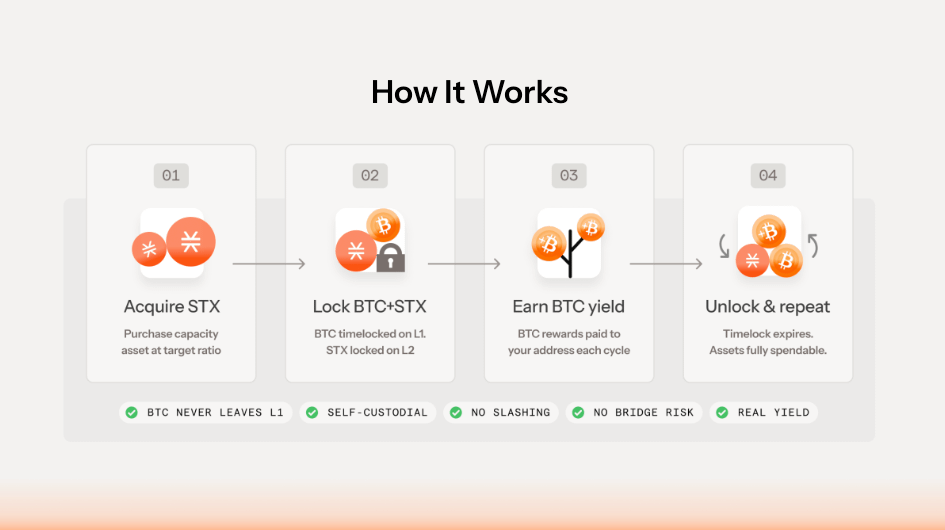
That’s where Stacks’ Bitcoin staking design gets interesting.
Why? Because it's built around BTC staying on Bitcoin L1, under the holder’s own keys, while earning BTC-denominated yield.
STX acts as the capacity asset in the system, with a proposed 3% BTC APY, and early exit built into the design.
That matters because staking could become the entry point into the stacks ecosystem.
Once BTC capital starts earning natively, the app layer around it gets more useful too:
• @ZestProtocol for BTC lending.
• @GraniteBTC for BTC-backed borrowing.
• @bitflow for liquidity.
• @HermeticaFi for BTC yield products.
• $sBTC and $USDCx as the core rails.
So institutions are finally getting a cleaner path from passive BTC exposure into Bitcoin-native finance.
Pleased to partner with @Stacks on this one.