@markpoloncarz Teddy Roosevelt regularly staged boxing matches in the White House. He lost sight in one eye from a detached retina because he himself was fighting at the White House in one of these matches.
And the Founding Fathers regularly dueled with pistols, one of them died doing so.
I cannot tell you how many hours upon hours of research have gone into this column for @WSJFreeEx.
Watching Bluey with my children has convinced me of two things: that it is the best kids’ show on TV right now (by a country mile!), and also that it is right wing art.
https://t.co/QJGsTuRyNa
Protesting is actually about petitioning the government for a redress of grievances. The word for traumatizing kids at church to effect political ends is "terrorism."
BREAKING: President Trump announces steps to ban large institutional investors from buying single-family homes.
"People live in homes, not corporations." - President Donald J. Trump 🇺🇸
There was a line from Zohran Mamdani’s inaugural address yesterday that took my breath away. He said he intended to replace “the frigidity of rugged individualism with the warmth of collectivism.” Collectivism in its various forms is responsible for the deaths of at least one hundred million people in the last century. Socialist and Communist forms of government around the world today—Venezuela, Cuba, North Korea, etc.—are disastrous. Catholic social teaching has consistently condemned socialism and has embraced the market economy, which people like Mayor Mamdani caricature as “rugged individualism.” In fact, it is the economic system that is based upon the rights, freedom, and dignity of the human person. For God’s sake, spare me the “warmth of collectivism.”
A friend of mine who teaches theology shared with me a post about CS Lewis's Mere Christianity, which discusses foundational Christian logic across denominations. It reminded me of Dale's tweet below, and I wanted to share some thoughts here regarding modesty and respectability, which often become hot topics on Twitter.
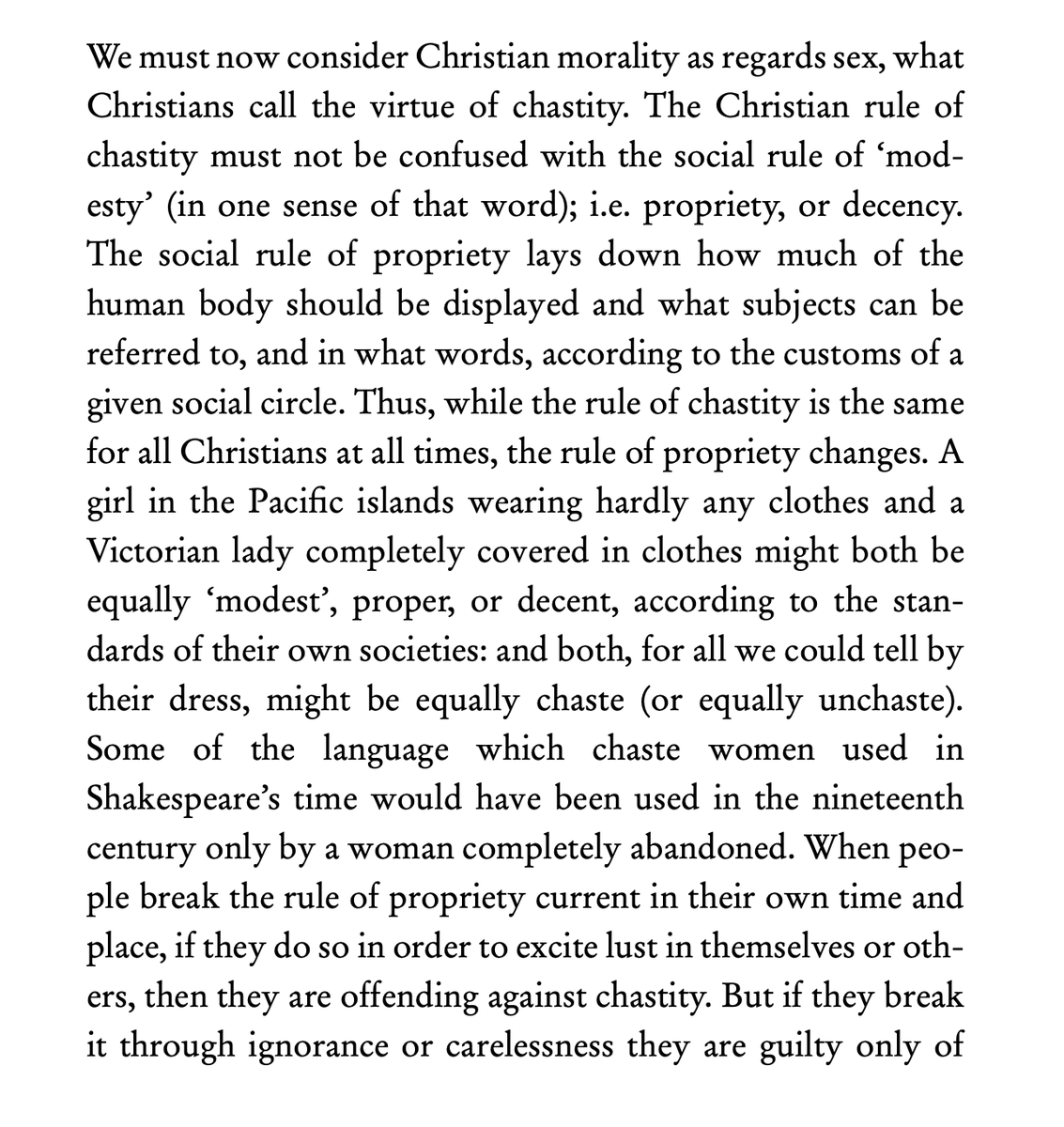
Let's first visit the excerpts. Adapted from a series of BBC radio talks he delivered during the last few years of the Second World War, CS Lewis's Mere Christianity touches on some big topics — the meaning of the universe, Christians beliefs, and what is considered proper Christian behavior. Regarding behavior, there's a chapter on sexual morality that begins with one of the least popular Christian virtues: modesty. Here's what CS Lewis had to say:
Lewis points out something interesting here: modesty has to be understood within the matter of context. A woman in the Pacific Islands, he notes, can be modest while wearing barely any clothes, while a Victorian woman will have different standards for the same idea.
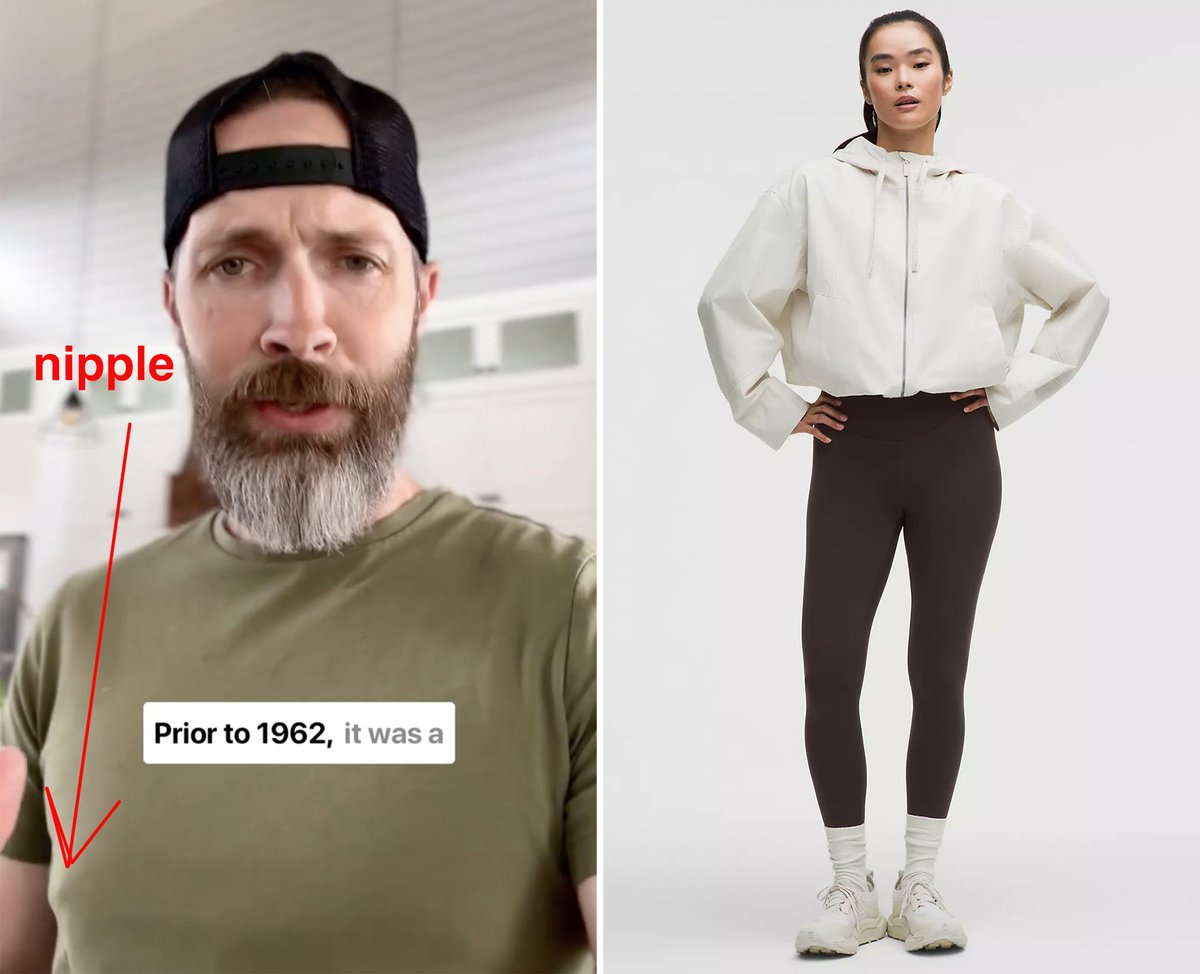
In my original reply to Dale, I noted that he was wearing a thin jersey t-shirt, which revealed the outline of his nipple (a well-known erogenous zone, even for men). The t-shirt, of course, was once considered underwear. In the 19th century, a proper gentleman would have worn a coat and waistcoat — the shirt was hardly ever seen except for the collar and cuffs. In the 20th century, the waistcoat was eventually dropped, but the button-up shirt remained. It wasn't until about the 1940s and 50s that it became increasingly common to see men wearing t-shirts in public. The style ascended partly because it was sexually suggestive (think of Marlon Brando in The Wild One).
Of course, no one thinks t-shirts are underwear anymore, and it's no longer considered improper to wear one in public. The same is true of leggings. Most people would be shocked if a woman appeared in public in her actual underwear (by today's definition). Unless they were being performative, no one would act that way when they see a woman dressed like that on the right. Thus, modesty has to be contextual.
Let's move on with the rest of the passage.
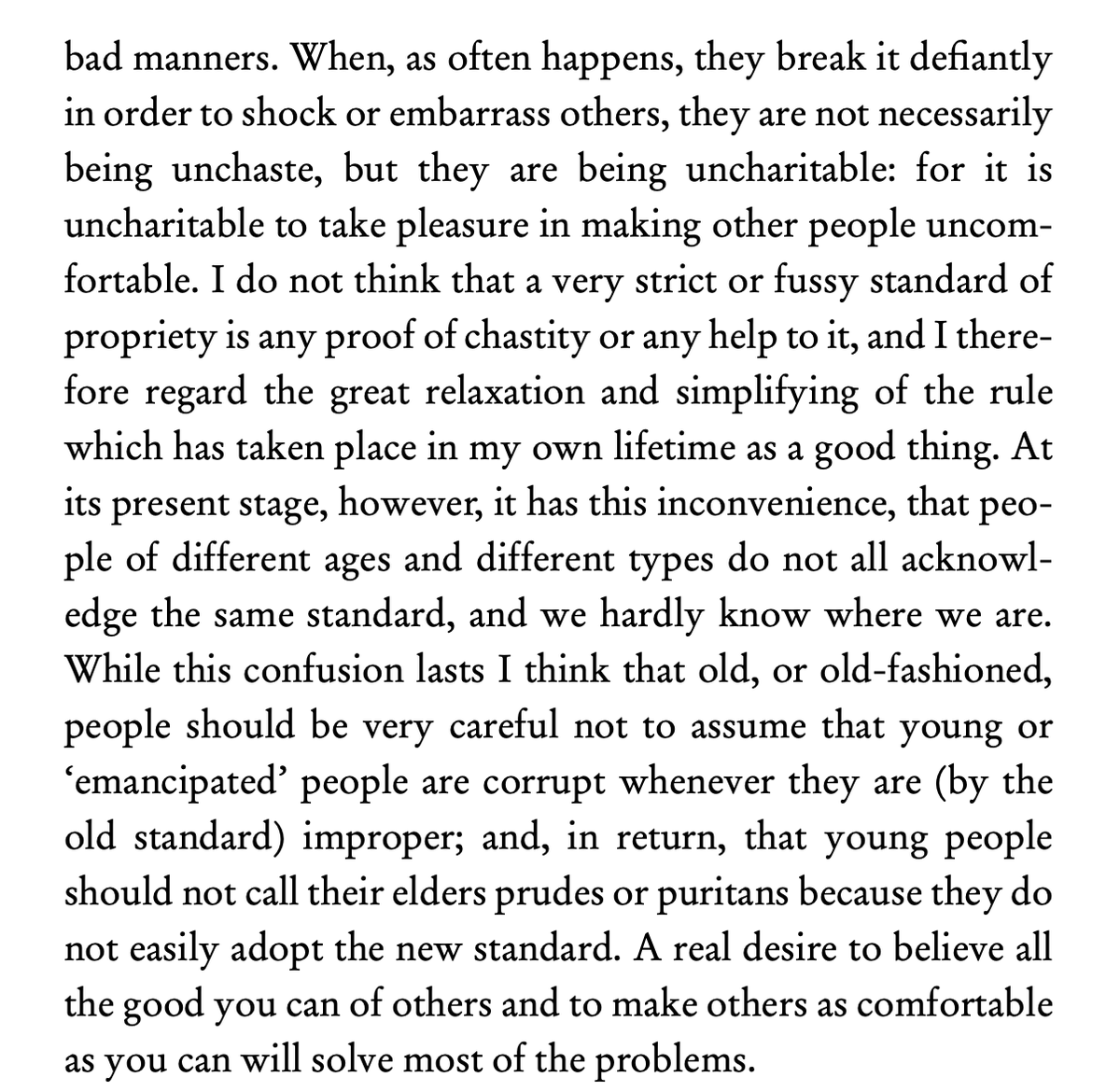
Lewis recognizes that modesty raises thorny issues, but he sweeps them aside to focus on the more important spirit. I want to bring your attention to the last sentence: "A real desire to believe all the good you can of others and to make others as comfortable as you can will solve most of the problems."
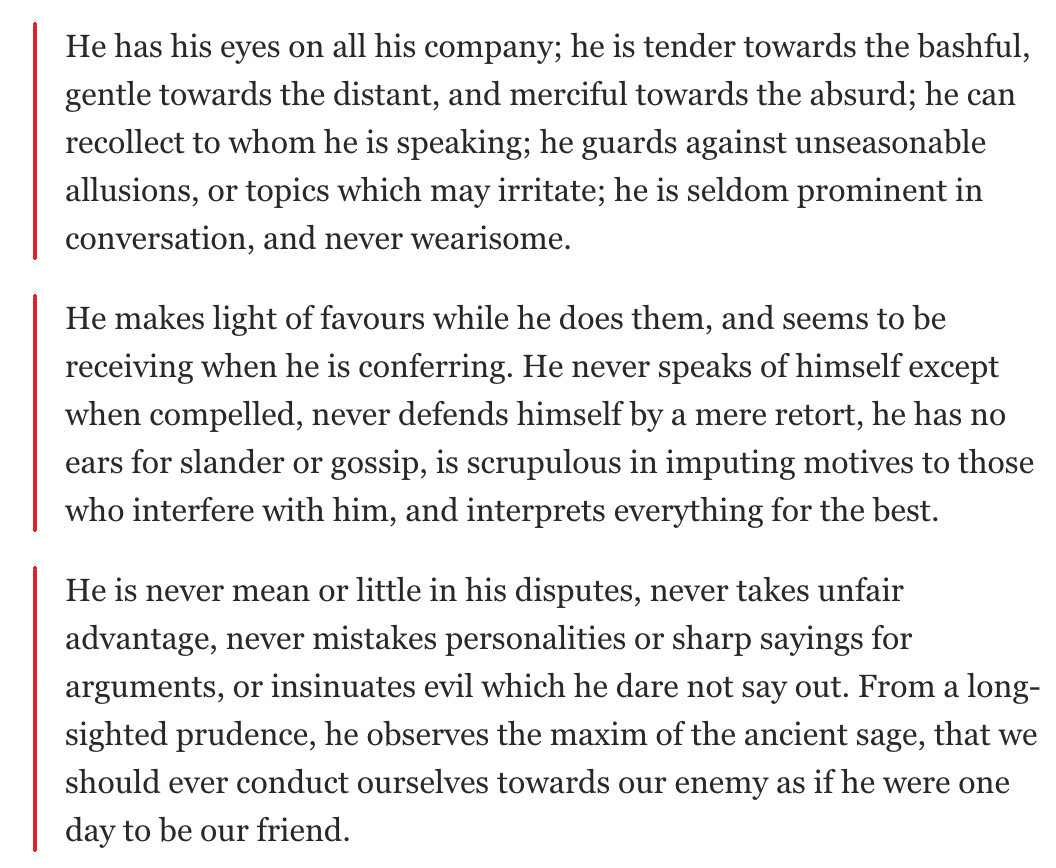
This reminds me of Cardinal John Henry Newman's book Definition of a Gentleman (which, like CS Lewis's Mere Christianity, is adapted from a series of lectures). I often cite Newman's book because it's so instructive. The term gentleman is so overwrought and frequently abused, but to the degree it means anything at all, I think Newman captures it here:
On Twitter, there are often debates about how to dress respectably (and the importance of doing so). These discussions usually get uncomfortable because they touch on class and race. Just this morning, I saw someone say they are glad young black men are "wearing quarter zips" and putting away "Jordans," which they say are associated with "ratchet behavior."
On matters of respectable dress, it's helpful to separate two distinct acts. The first is how you decide to dress; the second is how you judge others by their dress. It's true that the world judges us based on appearance. And if you wish to show respect in certain contexts — such as attending a wedding or funeral — it's worth considering what your attire is communicating. This is why I think people should shop for a suit well in advance of when they need one. You don't want to be the guy wearing a weird outfit during those important occasions, as they can send the wrong message (e.g., "I don't care about you").
But then there's the second decision: how you judge others based on their dress. If being gentlemanly means anything at all, it should mean what Newman outlines above. Or what Lewis wrote in Mere Christianity: "A real desire to believe all the good you can of others and to make others as comfortable as you can will solve most of the problems." There are two acts here: how you decide to dress (e.g., making others feel comfortable) and how you treat others (e.g., "desire to believe all the good you can of others").
My friend and fellow menswear writer Bruce Boyer is fond of saying that clothes are more important than most people think, but less important than fashion people think. I'm of the same mind. I think it's perfectly fine to use the language of clothing. But on issues such as respectability and morality, I think you should judge people by their deeper, more important actions. That doesn't mean how they dress, but rather how they treat others on a more meaningful level.
Anyway, I will probably reference CS Lewis's book in the future. Thanks to M for the reference.
Build something useful, enduring, beautiful. When we first bought our factory, it was cold metal and concrete. We made it a cozy and inviting place we’re excited to come to work each day.
This Election Day, we remember President Reagan’s landslide wins—today in 1980, and again this Thursday in 1984. These overwhelming victories reshaped the political landscape and signaled a renewed direction for the nation.
The reason one knows this can’t be legally correct isn’t due to this or that rule of positive law, but because it contradicts the very nature and purpose of a republic.
Excited to learn what kind of deal we've struck with our great authoritarian rival to safeguard the app they built that makes us all hate each other.
https://t.co/kmFte74GsL
Since the French Revolution, the revolutionary left is inextricably linked to violence. Burke called it an “armed doctrine,” what we understand as ideology. Since the early decades of the 20th C Marxists have identified anything that is non-Marxist as “fascist.” Whoever the perceived enemy is is “fascist.” They aren’t following a political science classroom definition, but are using it as propaganda to identify and delegitimize the enemy they see as a hindrance to their cause. Again, this isn’t a matter of logical debate team discourse, but revolutionary action at its most visceral. Recognize the charge for what it is and understand it is not made in good faith.