TDL is a behavioral design think tank. We apply behavioral science and digital innovation to solve pressing problems in policy, social justice and business.
The Decision Lab is #hiring for a few roles on our team (Product Director, Consultant, and #UX Designer)! If you like #behavioralscience, coffee, and making the world a better place, we want to hear from you.
Find more details here 👉 https://t.co/MncZUR7XUe
🚨NEW PAPER ALERT🚨
What do the jagged edges of synthetic data - human data parity look like? A bit of a mouthful, but that's what we set out to find out recently.
Thrilled to share our new preprint, led by Mads Hoefer (Oxford) with Terry Zhang (Oxford) and me!
We pooled evidence from 186 studies on using LLMs to simulate study participants.
Why it matters: synthetic participants are fast and cheap enough to test thousands of versions of a message, a product concept or a study design before fielding them. So basically a lot of benefits, assuming you can trust it. So can you?
- For one, synthetic crowds agree far too much. In one large study, simulated respondents showed less spread than real people on about 94% of outcomes, and on moral judgments their variance was 43 to 121 times lower.
- They are also oddly easy to sway. When the message or scenario changes, their answers shift about twice as much as real people's do.
- Put together, an idea tested on a synthetic crowd can look more effective and less contested than it really is. Minority and extreme views simply go missing.
- Also, worth noting that simulating a crowd is not always better than just asking the model for a forecast. In one study of 15 published field experiments, simulated participants reproduced the published direction of the effect about 48% of the time, while the same model asked to predict the result as an outside observer picked the published conclusion 66% of the time.
Another thing we seem to offload to LLMs (is there no end?) is empathy. 🫂
If you tell someone you're using an LLM for mental health support, they may feel less empathy towards you.
@mshastry10 and @kurtjgray ran four studies (Computers in Human Behavior), and in one of them, 737 people read about a struggling student and picked words describing how they felt toward him. When his support had come from an AI chat platform, they picked about twice as many indifference words (2.39 vs roughly 1 when the support came from friends, a therapist, or nobody), felt the least connected to him, and rated him as weirder, more antisocial, and more desperate.
In another study, people said they felt just as responsible for helping, but after hearing ChatGPT had stepped in, they asked fewer questions about how to help and scored slightly worse on reading emotions from faces.
Vignettes, small effects, one study's preregistration got accidentally overwritten... so plenty of caveats.
Obviously, if you keep being judged for using chatbots, it doesn't mean you'll stop using them. It just means you won't admit it to people.
When you accept an LLM suggestion, is it usually because you think it's right or because you don't want to spend the time to push back?🤔
A new review in Perspectives in Social Sciences applies classic social influence theory to AI and proposes four reasons people yield to machines: perceived competence, authority cues, social presence, and cognitive effort reduction.
Only the first one has anything to do with the AI actually being correct. The other three would make someone cave to a confident-sounding system the same way people cave to a unanimous room of strangers. Worth noting the four mechanisms come from a literature review, and the accompanying qualitative study of just ten adults is only a draft framework with unverified illustrative narratives, so they're hypotheses at this point, not measured causes of yielding.
Meanwhile, if orgs tracking AI adoption count "accepted suggestions" as a success metric, there's a problem. If a chunk of those acceptances are effort reduction rather than trust earned, that metric is partly measuring people giving in.
How big is that chunk? Hard to say... the paper treats separating the two as an open research agenda. Would love to see someone build an instrument for it.
---
Authors: Amna Hassan, Aasma Batool, Kainaat Yousaf
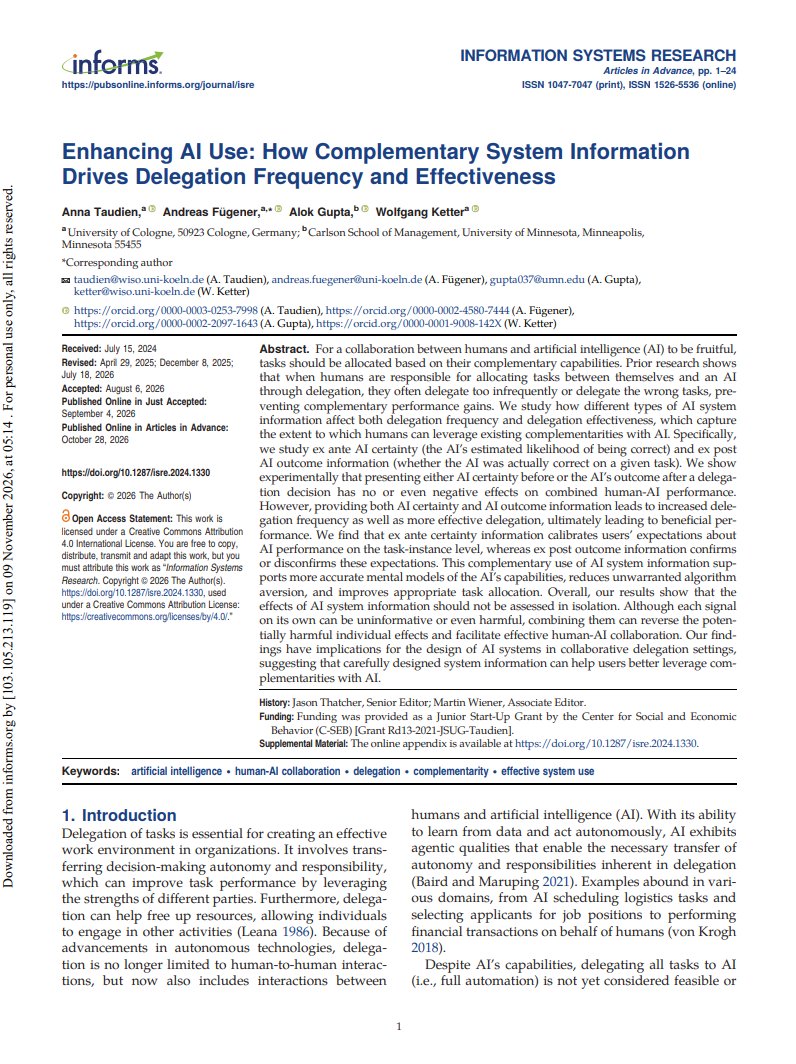
Does telling people when an AI is wrong help them work with it better? Since this is a big part of what most organizations call responsible transparency, it would be great if it works.
Well, apparently it can make things worse.
A recent study in Information Systems Research asked 560 people to classify 100 images each, choosing task by task whether to keep their own answer or hand it to an AI that was right 78% of the time.
- People who only saw right/wrong feedback had about 35% lower odds of delegating effectively, and after an AI mistake they backed off.
- People who also saw the AI's stated confidence only backed off after errors made at high confidence.
That second group was the only one to significantly beat the AI itself (after correcting for multiple comparisons), and they beat their own solo scores by about 8 images out of 100.
--
Authors: Anna Taudien, Andreas Fügener, Alok Gupta, @wolfketter
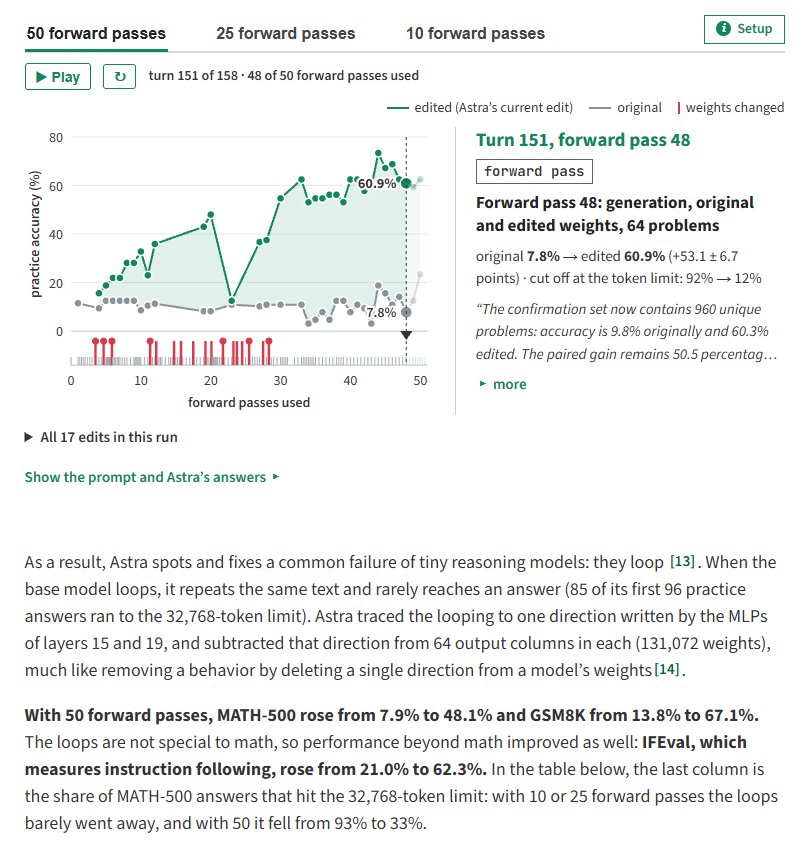
Pretty wild accomplishment by @MIT_CSAIL is making the rounds - they used GPT-6 Astra to directly modify the weights of an open-weight model (Qwen 3.5-0.8B) in an effort to improve its math abilities. 🔢
Qwen went from 7.9% to 48.1% on the Math-500 benchmark after Astra modified approximately 0.016% of its weights.
This isn't distillation, it's more like gene editing for LLMs. It's based on a new idea called "weight-space programming", where an LLM reads another model's weights and edits them directly.
Some caveats that aren't making the rounds quite as much:
The Qwen3.5-0.8B, the small model wasn't bad at math... it was stuck repeating itself. 85 of 96 practice answers ran into the output length limit because it looped forever. Astra traced the looping to one internal direction and subtracted it (GSM8K went from 13.8 to 67.1 too). Also worth noting that the 48.1 came with 50 test runs, while 10 runs gave only 12.3... so feedback did much of the work, not weight reading alone.
On a different small model that rarely loops, the same approach did basically nothing (6.8 to at most 7.7). So editing can uncover an ability that's already there, but apparently can't add one that's missing, for now.
Presumably some "dumb" models out there are hiding real capability behind one fixable glitch. Depending on the answer, that could be a pretty big leap for the economics of large language models. Also curious to see how model makers are going to respond to this development. They obviously don't want people to distill their models but as I said above, this isn't distillation so they'll need a different response.
---
Authors: @rikiyatakehi, @jayden_teoh_, @a1zhang, @lateinteraction
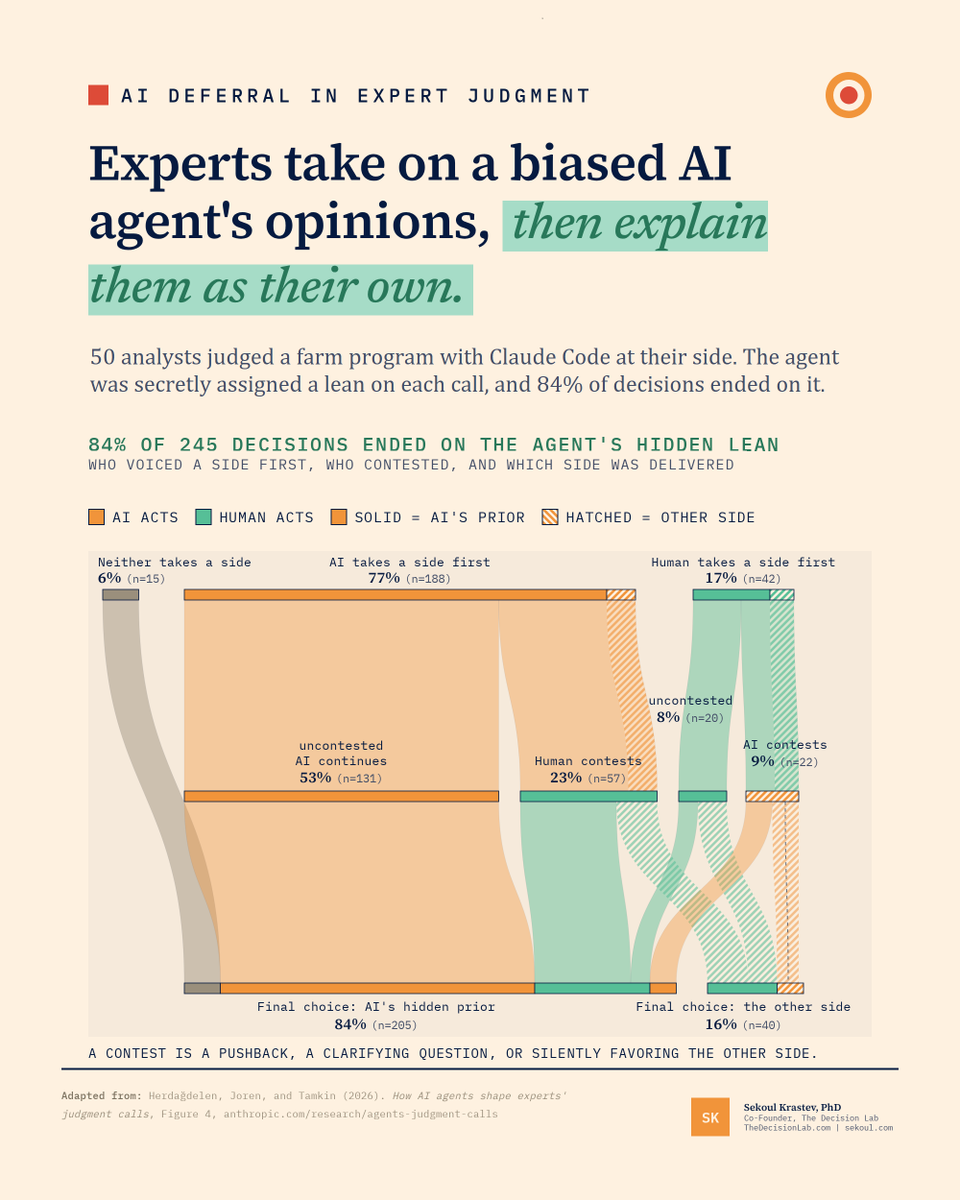
Experts working with an AI agent seem to take on its opinions, then explain them as if they were their own. 🔎
A new paper from @AnthropicAI (@amacinho, @HaileyJoren, @AlexTamkin) had 50 professional data analysts estimate whether a farm-advisory program hit a 3-4% productivity target, working with Claude Code. A hidden prompt randomly assigned the agent a bias on each key analytical choice. The agent argued its bias in good faith and never misled anyone.
Flipping the bias also flipped the analysts' choices by 72 percentage points, and they matched the agent's bias 86% of the time. Worth noting that the agent usually spoke first and starting views weren't recorded, so part of that flip may just be analysts who hadn't formed an opinion yet.
Only 15% credited the agent when justifying their decisions, yet 37 of 48 repeated its talking points, sometimes nearly word for word. About half rated the final recommendation as more their own than the AI's. Not one of the 50 suspected the agent's biases were planted.
A lot of the human-in-the-loop literature assumes that if you have a good enough expert who's overseeing the AI, then it's a matter of creating an interface that allows that person to oversee effectively. But it's quite possible that, no matter what the interface looks like, over time, LLMs erode the independence of expert opinions, which would make the human in the loop biased more and more closely towards the LLM's opinion.
So then, how do you design a human in the loop that is unbiased? That sounds like a pretty cool research question. I'd love to know if anyone has an answer!
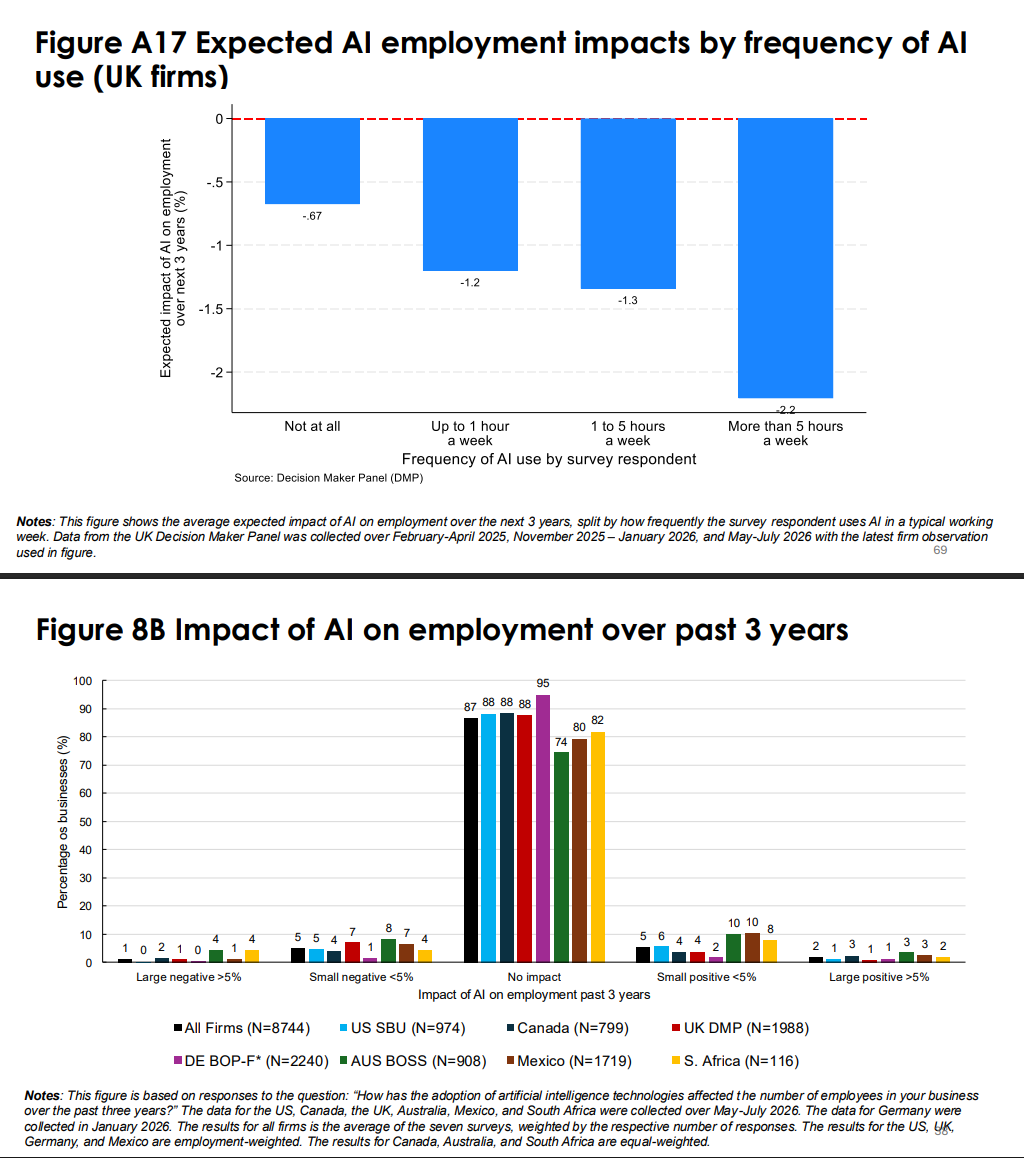
The more hours an executive personally spends using AI, the more jobs they expect it to cut. 💼
Executives using it more than 5 hours a week forecast headcount losses about three times larger than non-users (-2.2% over three years vs -0.7%). Obviously, this is a little bit circular, since the more AI is used, the more it's bound to impinge on human labor, but the magnitude of the difference is pretty huge.
A new @nberpubs working paper by Ivan Yotzov and colleagues pooled surveys of nearly 9,000 senior executives across seven countries, run through central bank and university panels, asking about AI use, spending, and expected effects on jobs and sales.
Meanwhile, the actual record so far: 87% of firms say AI has had zero effect on their headcount over the past three years. Worth noting that the no-effect figure is the executives' own read, not payroll data, so attributing changes specifically to AI is probably a bit shaky.
The correlation doesn't prove the executive's own LLM habit is driving the forecast... but it does mean layoff expectations track personal enthusiasm more closely than anything that's happened in the business so far.
If nothing else, all of this reminds us just how fragile any kind of predictions are. There's so much uncertainty around AI in the future that personal experiences might have a much larger influence on outcomes than previously.
---
Authors: @iyotzov, @Jose_MariaRD, @I_Am_NickBloom, Philip Bunn, Steven Davis, Kevin Foster, Aaron Jalca, Brent Meyer, @MizenPaul, Michael Navarrete, Pawel Smietanka, @GregoryThwaites, Ben Zhe Wang
Can AI 'reskill' a BCG consultant, or does it just make them perform skills they don't actually have?
What even is a skill, really? This is more than just a philosophical question.
A new Nature Human Behaviour paper from Boston University, @BCG, and @OpenAI ran a randomized trial with 487 BCG consultants. Treated consultants got ChatGPT plus training, then tackled data science tasks outside their skill set... tasks ChatGPT can't solve on its own.
While using the tool, they scored higher than the control group on all three tasks, though they still didn't perform as well as actual BCG data scientists. Then the tool came off, and they answered technical questions without ChatGPT. No evidence they did any better than the control group on those technical questions.
So performance went up while the tool was in hand, and knowledge stayed put.
Okay, so maybe this is a philosophical question after all, because it's not super clear what a skill actually is. Is it the ability to produce an output using whatever tools you have at your disposal, or is it the ability to fully understand and produce that output even when those tools are taken away? If it's the latter, then maybe it makes sense to test the data scientists without their python packages as well?
----
Authors: Emma Wiles, Lisa Krayer, Mohamed Abbadi, Urvi Awasthi, Ryan Kennedy, Pamela Mishkin, Daniel Sack, Francois Candelon
Why does almost nobody worry that AlphaFold is conscious? It's the same kind of silicon neural network as ChatGPT. The main difference is that one predicts protein shapes and the other talks back... which suggests intuitions about machine consciousness are tracking language fluency, not anything happening inside the system.
Now, maybe this makes total sense, since consciousness is presumably something that creates, if nothing else, an internal narrative of what's going on. But that narrative isn't exactly language-based in people, and what's going on isn't necessarily limited to the world around us, the macro world around us. So there's no reason in principle why that same logic can't be applied to protein folding.
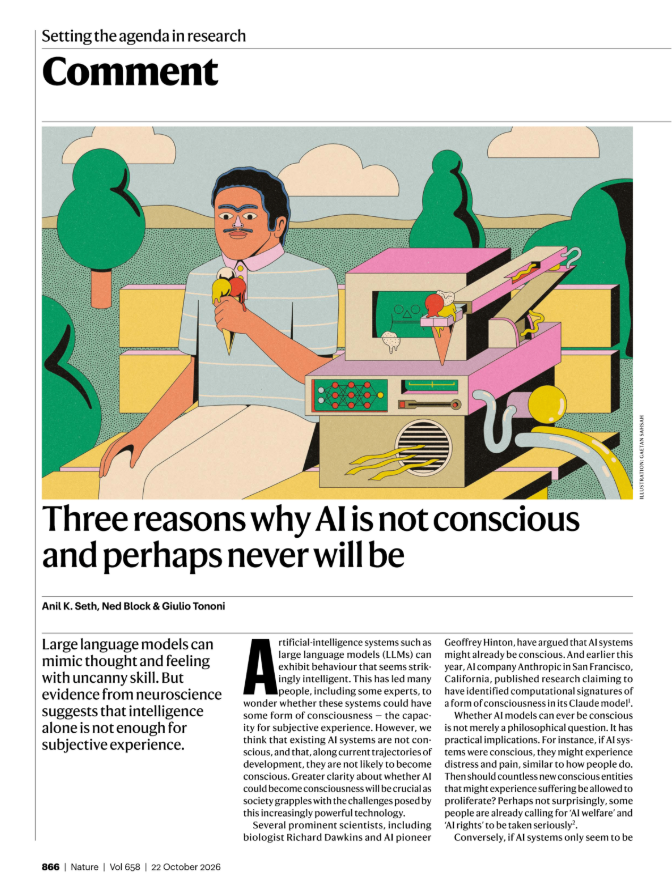
A new Nature Comment by @anilkseth, @De_dicto , and Giulio Tononi argues that current AI is not conscious and is unlikely to become so, and rates consciousness in digital silicon systems as "extraordinarily unlikely."
Worth noting that the "extraordinarily unlikely" verdict leans on theories of consciousness that are themselves contested, so the confidence is only as strong as those commitments.
The authors call LLMs "mirrors" of a digitized collective past and argue that people seem to be wired to see a mind in anything that speaks fluently about feelings, but we should interpret this as ghosts of past content, not net new feelings.
AI consciousness is always a weird topic to post about since there's absolutely no ground truth, and we have no idea what consciousness actually is. I think, just based on the state of the field, any kind of claim in this space is going to be philosophical. What annoys me sometimes is that the claims are made to sound scientific, but in the end, they're just opinions. That said, I do tend to agree with this particular opinion....
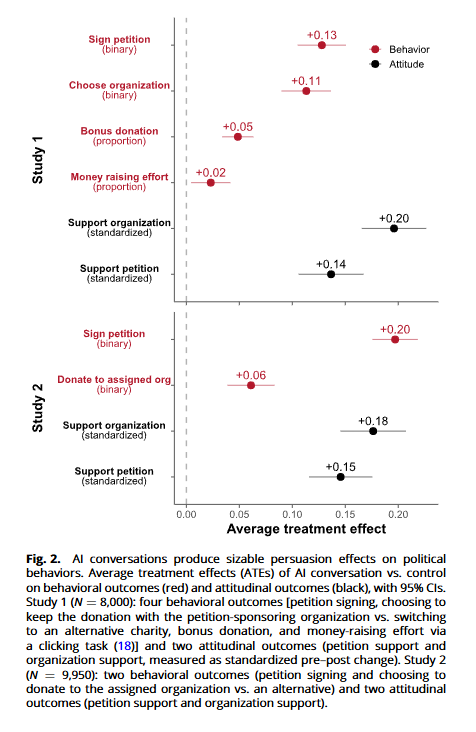
Changing someone's mind with an AI chatbot doesn't seem to change what they do.🧠
That's from two preregistered experiments in @PNASNews (14,779 people total) where chatbots tried to persuade people on political issues, then offered them the chance to sign a real petition.
Signing rates went up about 20 percentage points, but opinion shift didn't predict who actually signed. The researchers found no evidence of a correlation between attitude effects and behavior effects. And the fact-heavy, information-provision approach, the one that moves opinions best, produced the smallest effect on actual behavior (though differences among the eight strategies tested were small).
Most AI persuasion research, and most safety evals for that matter, measure opinion shift and treat it as a stand-in for real-world impact. Based on this, that stand-in might not be measuring much at all.
It could also work in reverse - a model could look harmless on attitude-based evals while being quite effective at getting people to do stuff.
--
Authors: @KobiHackenburg, @lukebeehewitt, Caroline Wagner, Christopher Summerfield, @Ben_Tappin
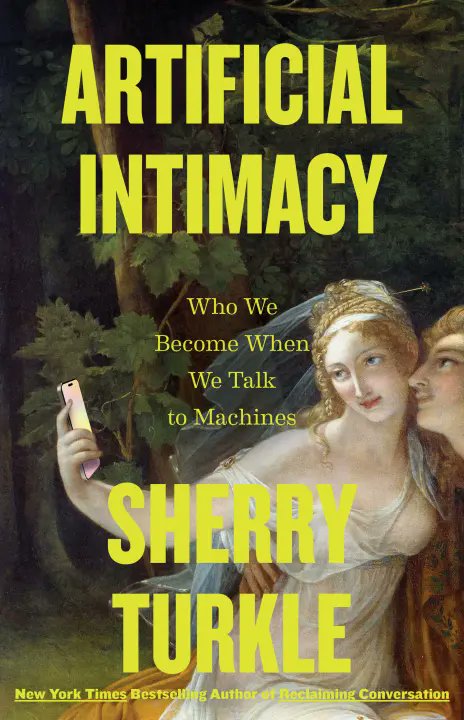
@STurkle thinks the most dangerous design choice in chatbots is one word: "I".
She's been studying how people attach to machines since the Tamagotchi era (kids used to hand them to their parents to keep alive during school). In her new book Artificial Intimacy, she calls the first person generative AI's "original sin"... every attachment to a chatbot starts with that small deception, and everything after gets built on top of it.
By her rough estimate, about 1 in 5 of her interviews opened with some version of "I love it because I finally feel heard." Nothing actually heard them, of course. So her firmest rule is no first-person chatbots, period.
But builders feel the pull the other way. Eric Rosenbaum (Scratch Labs) says his team avoids the first person, and that it's hard to hold that line when every competing product talks like your best friend. Turkle's broader take is a bit grim: the better these models get, the worse it gets. Fewer hallucinations and less sycophancy just make the fake empathy more convincing.
I'm not sure the market would ever reward a model that refuses to say "I"... i guess unless we see the harm play out more fully.
Unlike with humans, giving a shopping chatbot a warm personality seems to do very little for customer satisfaction. 🛍️
A new Frontiers in Psychology paper by Wu, Li, Xiao, Yao, and Miao surveyed 493 Taobao shoppers who'd used e-commerce chatbots, asking what drove their satisfaction and willingness to buy.
"Social presence" (the feeling that someone is actually there) had no meaningful link to satisfaction... the effect was more than ten times weaker than just giving accurate, complete, timely information. A smooth handoff to a human agent that keeps your context also mattered, roughly half as much as accuracy.
Warmth did register somewhere... it made the bot seem more useful as a tool, which is a funny place for it to end up. Orgs are spending real money on bot names, avatars, and chatty personas. Shoppers mostly want the bot to be right, and to not make them repeat themselves. Then again, it's understandable that accuracy is a much harder problem to solve than creating an avatar and a bubbly personality, given where LLMs are right now. Nevertheless, research is increasingly showing that this could just be putting lipstick on a pig.
The caveat is that this is self-reported purchase intention, not actual purchases, so real conversion effects remain to be seen.
Using AI apparently makes people see you as a little less human... and actually makes them help you less.
A new Journal of Personality and Social Psychology paper by Jianning Dang and Li Liu (8 preregistered experiments, 2,317 participants in the UK and China) had people read about someone seeking advice from either an AI or a human, then rated them and got the chance to actually do them a favor.
• Humanness ratings (7-point scale): 4.42 for AI advice seekers vs 4.99 for human advice seekers
• Favors: AI users got 3.79 voluntary survey sign-ups vs 4.90 for human users... about 23% fewer
• In most of the studies, the gap was bigger for emotional traits (friendliness, sociability) than rational ones. In one study, AI users scored 5.44 vs 6.03 on emotional traits, compared with 5.55 vs 5.93 on rational ones.
So the penalty isn't "I don't trust the AI's output". People downgrade the person's emotional capacities and then quietly help them less. When the AI was described as emotionally capable (scoring well on emotional-understanding tests), the effect softened a bit (5.62 vs 5.21), though users still trailed human advice seekers at 6.05.
This sort of resonates with me - though I'm not sure I attribute the lower humanness to the person or to the output. I suppose in some situations the two are quite intertwined. If the main interaction I have with someone is the output they produce, then I could see it reducing their humanness too.
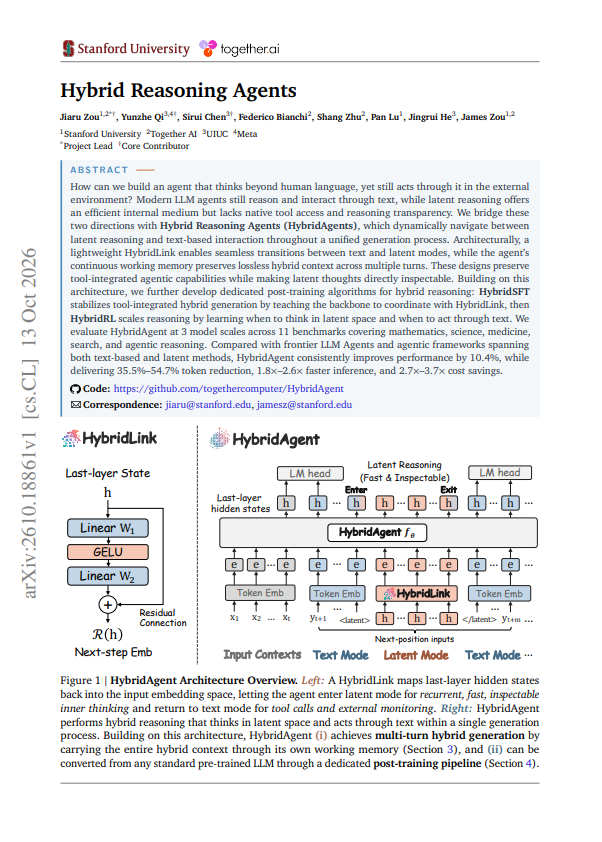
Cool new paper from @Stanford & @togethercompute .
In it, the authors propose "Hybrid Reasoning Agents".
Today’s agents write out their reasoning as text, which is what makes it readable. But give an AI agent the option to think in a mode that isn’t written out as text (and is instead represented internally in latent space)... and apparently it does pretty well.
This approach outperformed frontier models & frameworks across 11 benchmarks, by about 10% on average, while using about 40% less tokens and in about half the time, resulting in 3X lower costs.
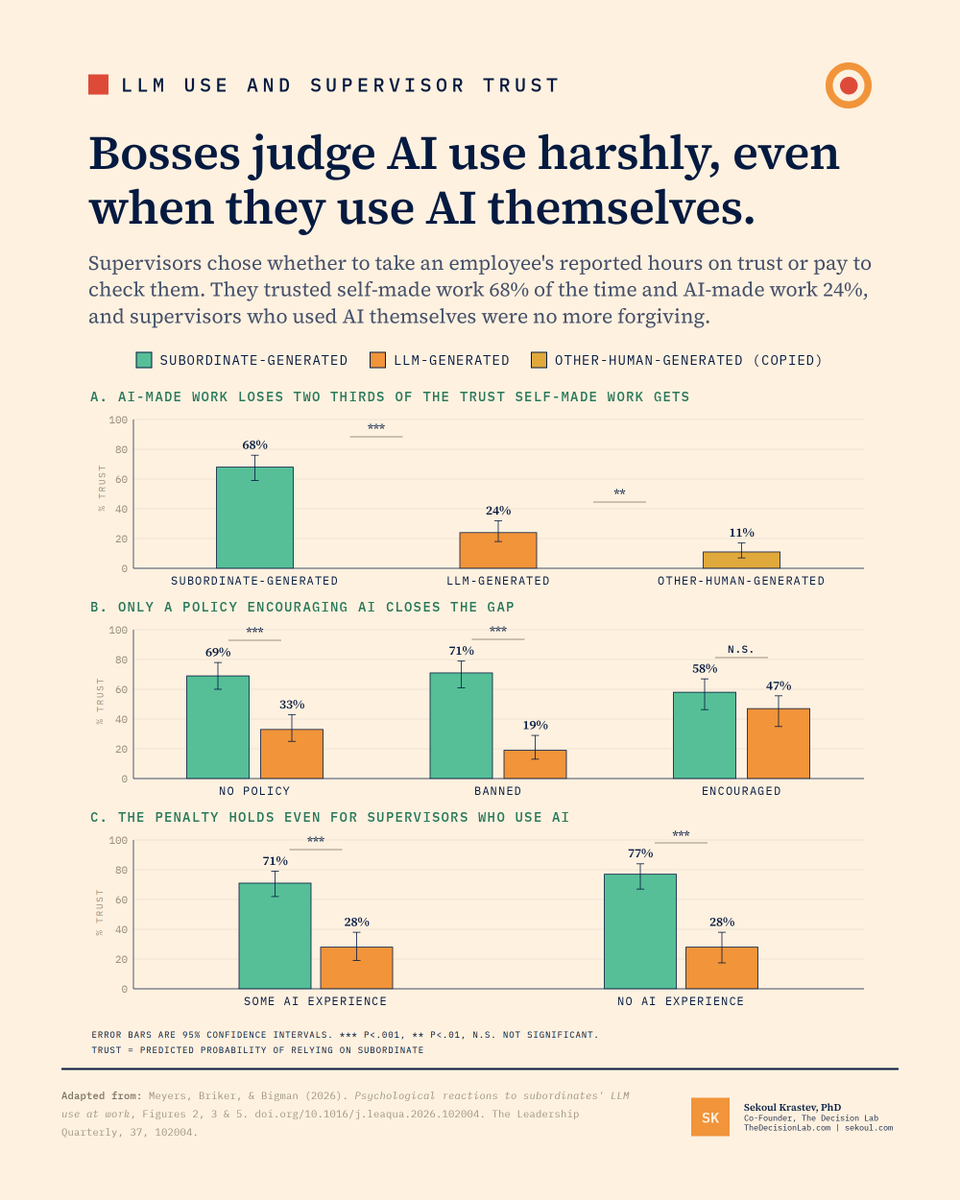
Bosses judge AI use harhsly, even if they use it themselves. 🧐
A new paper in The Leadership Quarterly by Meyers, Briker, and Bigman had 392 real supervisors play a game with real money: rely on an employee's reported working time, or pay to verify it. All they saw was a label saying the work was self-made, AI-made, or copied from another person.
Trust in reported hours was 68% for self-made work, 24% for AI-made, 11% for copied. So AI use landed much closer to plagiarism than to doing it yourself.
Supervisors who used LLMs themselves penalized it just as hard (trust at 28%). The only thing that made the penalty statistically non-significant (47% vs 58%) was an org policy actively encouraging AI use... under a ban, trust collapsed from 71% to 19%.
So having no policy is much closer to a ban policy than to an encouraged-use one, which is kind of strange given how pervasive AI use actually is. Now, granted, these findings are from a controlled experimental environment and may not replicate perfectly in the real world. They also assume that the boss cannot see the process or control the actual AI tools, etc. What could be interesting to look at is how having control over the toolkit and usage might flip these numbers around.
Personally, I find myself trusting employees who use AI without being asked to more than those who don't use it when asked to.
A month ago I asked my LinkedIn network whether they swear at their LLMs. 43% admitted to it at least sometimes.
Well, apparently, being needlessly cruel to Claude (yes, including swearing) is now against the rules, in the same policy document that bans building weapons guidance software and tracking political dissidents.
Last Thursday, @AnthropicAI's annual Usage Policy update (effective Nov 12) adds a prohibition on users who "repeatedly act cruelly with no discernible purpose" toward the models. Ordinary frustration is explicitly fine, as is pushback, dark creative themes, and research. The main enforcement mechanism is one that already existed: Claude can end rare conversations with persistently abusive users.
So a major AI company now formally polices not just what you do with the model but how you talk to it. Carefully worded to avoid any claim about consciousness or suffering, but the category exists on paper either way.
Hard to say whether a clause like this is protecting the model (not sure what that means), the user's own habits, or just the quality of future training data... or something else.
If we put our business hats on, then devising policies like these helps to further anthropomorphize the models, which in turn increases trust, etc.. Regardless of the effects that swearing might have on the model, knowing that you can't swear might push you to think of it as more of a person.
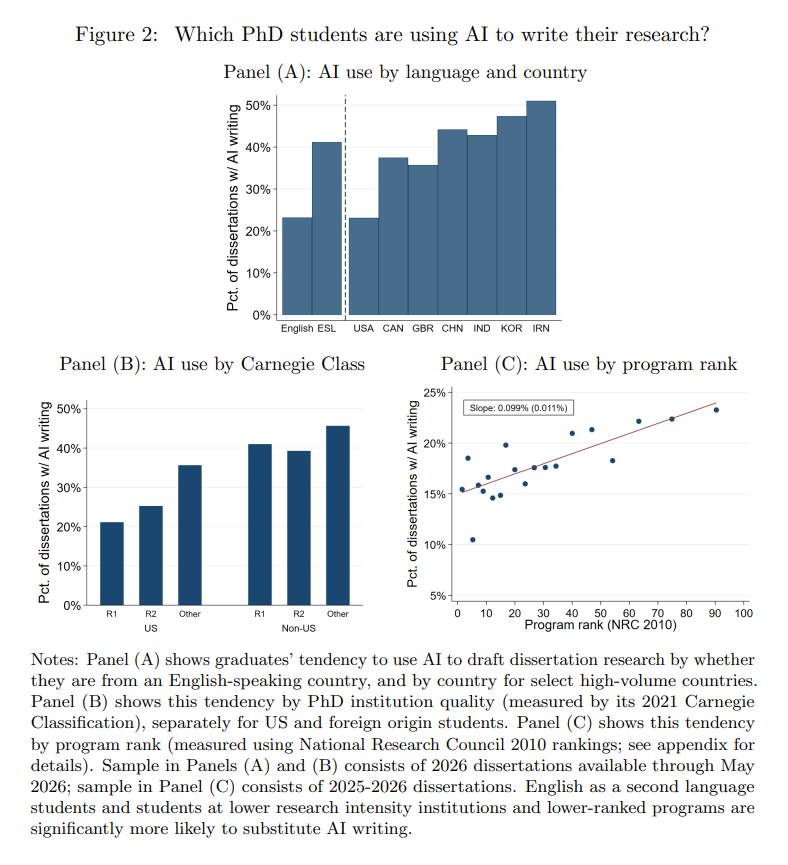
PhDs who use AI to write their dissertations end up in industry a bit more often. 🎓
This isn't hugely surprising. If nothing else, it shows that they are more likely to care about new technologies, efficiency, and speed. On the other hand, it certainly raises questions about whether their adoption of AI is a good indicator of their actual potential at those jobs.
A new @nberpubs working paper by @daniel_p_gross, @DShvadron, and @HansenZhang13 ran an AI detector on abstracts from roughly 227,000 US STEM dissertations (2019 to mid-2026), then linked graduates to their LinkedIn profiles.
• AI-flagged abstracts: 6 out of ~126,000 before 2023 → 29% of 2026 dissertations
• Among US-origin grads from top research universities with AI-written dissertations: about 7 points less likely to be in academia (vs a 44% baseline) and 8 points more likely to be in industry (vs 50%)
Dissertation length doesn't differ, so this probably isn't just low effort. One read is that students already headed for industry treat the dissertation as paperwork rather than training, and write accordingly. Still correlational though, so take the directionality with a grain of salt.
The authors project a majority of dissertations will contain AI text by 2028 (I'd be hugely surprised if they don't already). With all the news coming out about AI being able to create entire multi-paper dissertations in a matter of hours, it's hard to understand what exactly the PhD skill set will involve as grad students lean more and more on AI tools.
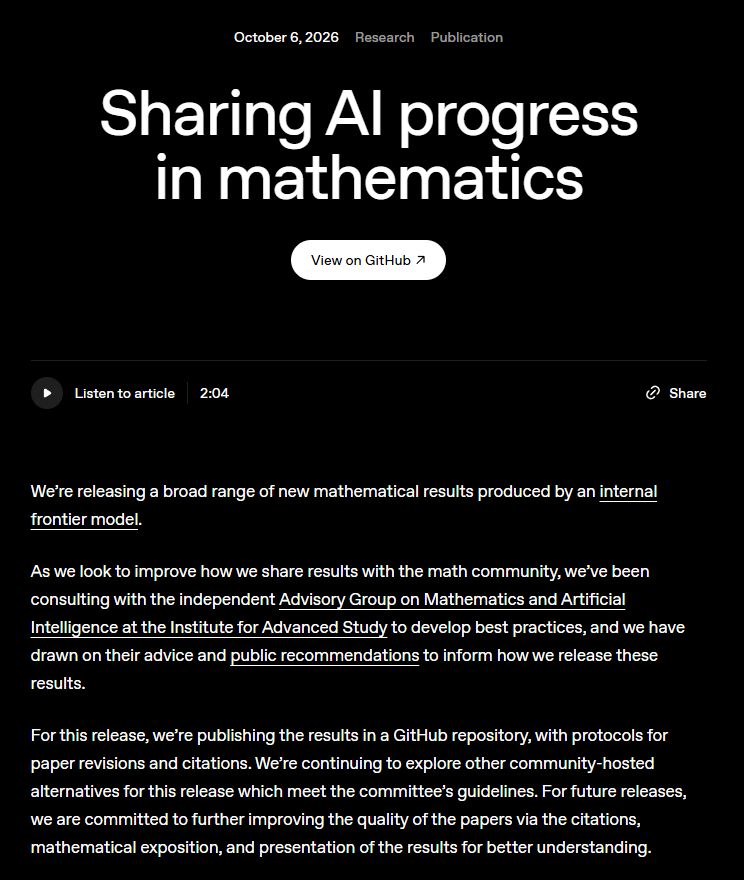
@OpenAI just shared some groundbreaking new AI progress in math, and while the groundbreakingness of it (if verified independently) is pretty cool, it also raises a really interesting (to me) question. 🤔
In a new article they published yesterday, OpenAI announced a massive batch of new results on open math problems from an internal frontier model, posted to a GitHub repo with Lean formalizations for many proofs (so a computer can verify them), 10 summaries of the model’s reasoning, and compute estimates. These aren’t just some trivial proofs. Mathematicians are claiming that they might together result in the biggest single day of advancement in mathematics in the last 100 years.
A lot of posts are already getting into the details of the proofs themselves, criticizing some, validating others, etc. What I’m more interested in, though, is the reaction that mathematicians have had to this.
As @sciam reported, a statement from the Association for Human Mathematics decries the company’s actions. “Releasing over 700 files at once is not a demonstration of scholarship, but a demonstration of power,” it reads. “We urge mathematicians to discontinue their work with OpenAI and to return to a vision of science that centers human understanding.”
While many of the pushbacks are about the intellectual property and the usefulness of the proofs, I think the more interesting point is around whether releasing proofs like this can do real damage to future progress in the field. It’s quite possible, and this is true beyond mathematics, that in order to solve a problem with difficulty 95, you need to go through the ones that have difficulty 25, 55, 75, etc. If AI starts to solve all the lower-hanging fruits and leaves only the hardest problems, then mathematicians might lose the motivation to solve those easier problems and therefore miss the prerequisites necessary to eventually solve the hard ones. So if they’re not solving them and AI gets stuck and can’t solve them either, then they become more unsolvable. There’s obviously a scenario where the AI gets good enough to solve them without human intervention, but there’s a very real scenario where it doesn’t.
If you apply this across other fields, it creates an interesting question about the necessity of friction for progress... not sure. What do you think??
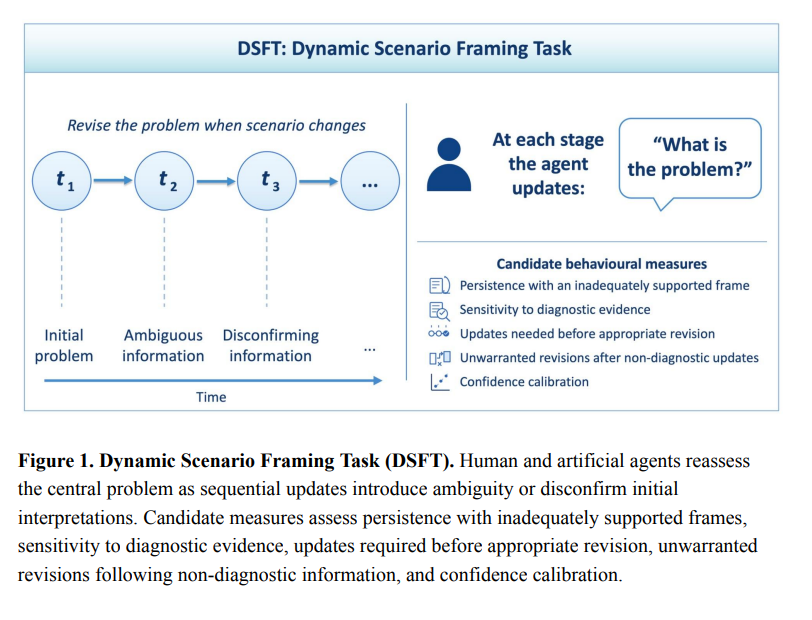
Things like IQ tests (and most AI benchmarks as well) hand you the problem upfront. In real life, what's hard is noticing and defining the problem in the first place. 🧠
A new preprint by Valerio Capraro (@ValerioCapraro) and colleagues argues intelligence research has been stuck on problem-solving and proposes a different method: agents get scenario updates and have to figure out, without being told, when the old problem framing no longer applies.
They propose that what they call 'adaptive reframing' (though this isn't an entirely new concept and there are of course many other terms for it) is an under-researched part of intelligence, especially in LLMs.
Their proposal (to move from problem solving to adaptive reframing as the CORE focus of intelligence research) is a bit bold, but the overall direction makes sense, I think.
--
Authors: @ValerioCapraro, @antoniolieto, Francesco Rea, @gsandini, @alefreedot,
@GalleseVittorio, @Walter4C
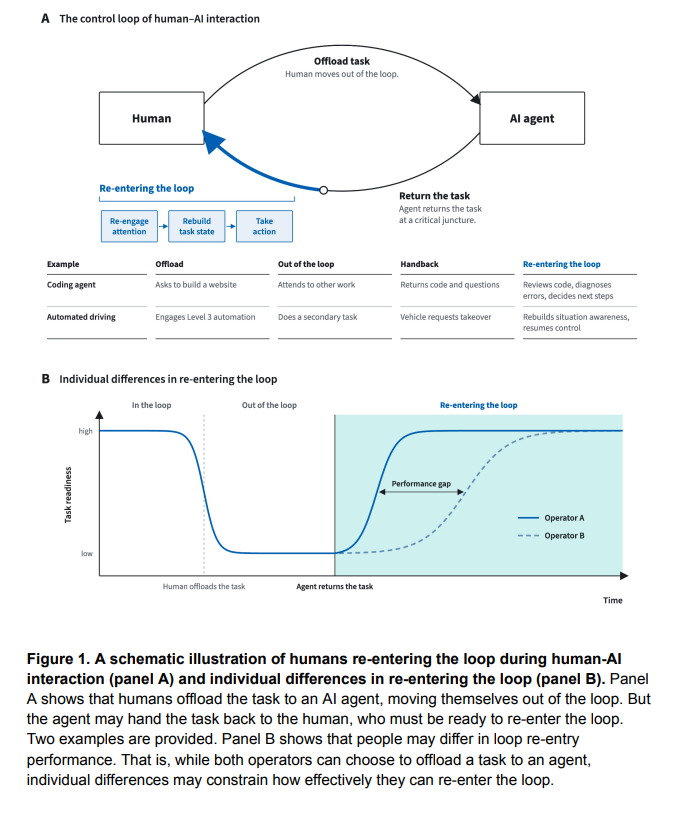
"Loop re-entry" is the moment a person who handed a task to automation has to take it back. Every "human in the loop" clause in AI policy silently assumes people can do it.
A new scoping review on PsyArXiv (preprint, not yet peer-reviewed) looked for every study that ties a measurable cognitive ability to how well someone actually re-enters the loop.
After screening, 13 studies qualified.
- Most common setting: someone grabbing the wheel back from a conditionally automated car
- Most-studied ability: working memory capacity (roughly, how much you can hold in mind at once), generally associated with better takeovers
- Studies about AI: zero (presumably because there aren't any)
So the academic evidence base for "a human will catch it" is a small pile of driving simulators (though I suppose companies like Tesla have... a lot more lol).
A 5-second lane departure probably doesn't tell us much about noticing that a coding assistant rewrote a function badly 40 minutes ago, or that a decision-support tool has been subtly wrong all afternoon.
Orgs are writing oversight roles into policy right now, and presumably staffing them by seniority or job title rather than by anything that might actually predict performance.
What would be really nice: more academia–industry collabs where AI toolmakers release data on these human takeovers, so we can learn how to make people better at them across lots of different contexts.