What if an AI could handle your Works, Solve Problems and Grow your Business Without lifting a finger ?
Sound impossible ? It’s not Because #AIAgent are now Here and They’re Rewriting the Rules!
A 🧵
Most stablecoins already solved one big problem:
They made digital dollars easy to move.
But let me ask a different question:
What should stablecoins do when they stop moving?
That is the core idea behind @realfi_co.
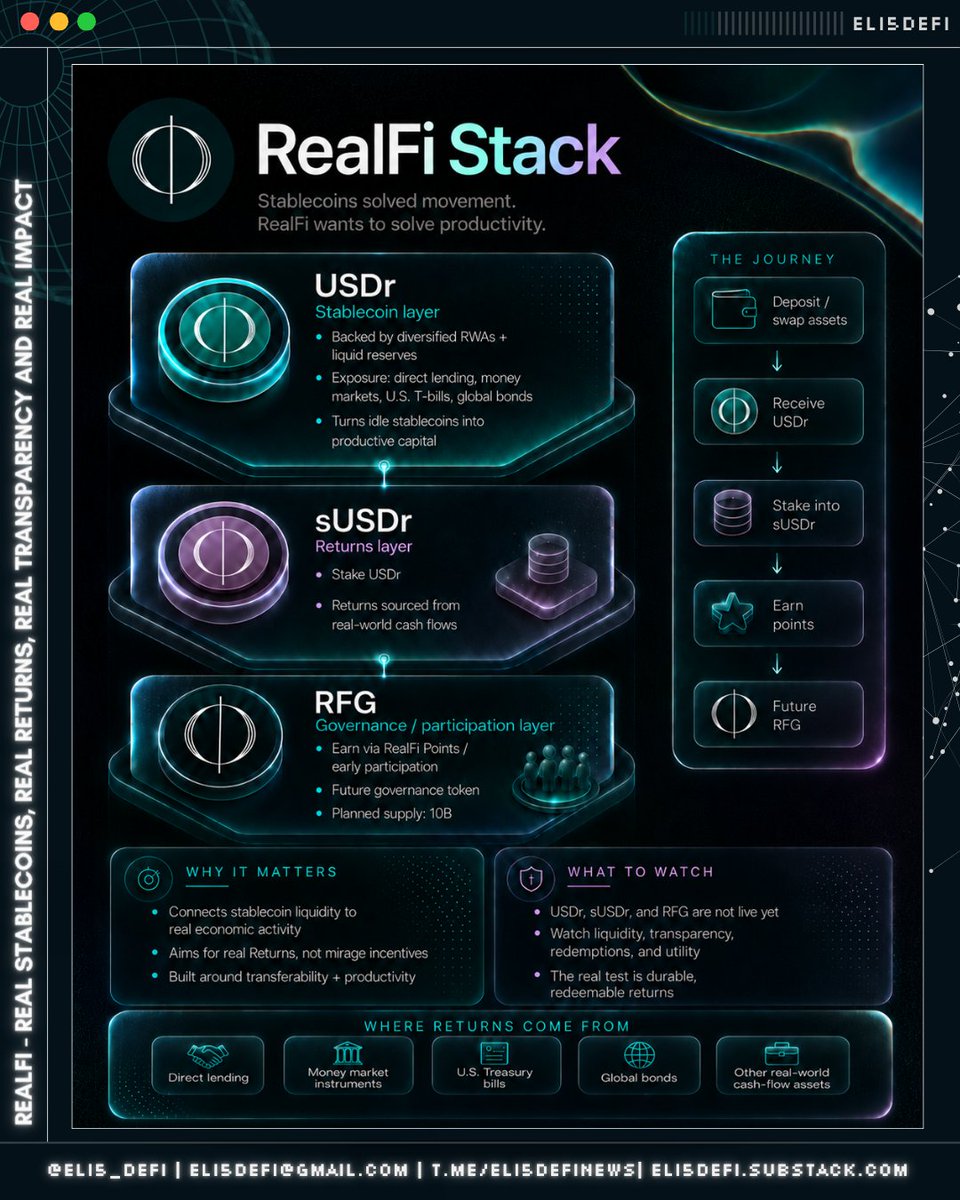
At the simplest level, RealFi is building a DeFi platform around USDr, a stablecoin designed to be backed by liquid reserves, with real-world asset exposure delivered through sUSDr.
The idea is not just to create another dollar asset. It is to turn idle stablecoin capital into real productive capital.
Instead of relying mainly on token incentives, leverage loops, or purely crypto-native returns, RealFi is designed to connect staked liquidity (sUSDr) to real economic activity.
Think:
→ Direct lending
→ Money market instruments
→ U.S. Treasury bills
→ Global bonds
→ Real-world cash-flow assets
And many more real economic activities and this is why the RealFi thesis is interesting.
Stablecoins are already one of crypto’s strongest products. People use them to trade, settle, bridge, save, and move value globally. But most of the time, the value sits idle.
RealFi’s stack is:
❶ $USDr → stablecoin layer
❷ sUSDr → staked layer
❸ $RFG → governance / participation layer
The flow is fairly simple:
→ Users deposit or swap assets
→ Receives USDr
→ USDr is designed to be backed by liquid, near-cash reserves, with RWA exposure delivered through sUSDr
→ Users can stake into sUSDr for yield exposure
→ RFG eventually gives participants a say in the protocol’s future
One key catch: USDr, sUSDr, and RFG still aren’t live and set to launch on July 6th, if you want updates join the waitlist (see the post below).
The bigger point is that RealFi isn’t manufacturing yield out of nowhere.
The returns come from deploying capital into real-world, cash‑producing assets, well beyond the crypto echo chamber.
That can improve the upside, but it also rewires the risk profile. With RealFi, you’re not just chasing flashy APYs or points campaigns, you’re underwriting the asset itself and the cash flows it generates.
---
➠ My Final Take (NFA. DYOR)
RealFi’s USDr stands out with a different structure from most RWA-backed stablecoins, while mainstream stablecoins nailed transferability, RealFi is aiming to unlock real returns and productivity.
It sits at the intersection of digital assets and traditional credit, with the goal of offering real transparency and real-world market access through on-chain infrastructure.
The protocol builds on Cardano’s security foundation and focuses on generating returns from real economic activity, rather than circular crypto mechanisms.
It also plans a multi-chain launch on EVM shortly after going live on Cardano.
The best stablecoins aren’t the ones screaming the highest APY, they’re the ones built to hold up without leaning on mirage returns.
That’s the standard USDr is chasing.
Web3 has produced more failed launches in the last 24 months than any previous cycle
According to our thesis, 97% of Web3 protocols launching this year will be forgotten by Q4!
The common variable is never the technology, it has always been about distribution
Walk with us 🧵