🚨 Fastest Growing Religion in Each Indian State (Census 2001–2011)
🇮🇳 Andhra Pradesh ⟶ ☪️ Islam
🇮🇳 Arunachal Pradesh ⟶ ✝️ Christianity
🇮🇳 Assam ⟶ ☪️ Islam
🇮🇳 Bihar ⟶ ☪️ Islam
🇮🇳 Chhattisgarh ⟶ ☪️ Islam
🇮🇳 Goa ⟶ ☪️ Islam
🇮🇳 Gujarat ⟶ ☪️ Islam
🇮🇳 Haryana ⟶ ☪️ Islam
🇮🇳 Himachal Pradesh ⟶ ☪️ Islam
🇮🇳 Jharkhand ⟶ ☪️ Islam
🇮🇳 Karnataka ⟶ ☪️ Islam
🇮🇳 Kerala ⟶ ☪️ Islam
🇮🇳 Madhya Pradesh ⟶ ☪️ Islam
🇮🇳 Maharashtra ⟶ ☪️ Islam
🇮🇳 Manipur ⟶ ✝️ Christianity
🇮🇳 Meghalaya ⟶ ✝️ Christianity
🇮🇳 Mizoram ⟶ ✝️ Christianity
🇮🇳 Nagaland ⟶ ✝️ Christianity
🇮🇳 Odisha ⟶ ☪️ Islam
🇮🇳 Punjab ⟶ ☪️ Islam
🇮🇳 Rajasthan ⟶ ☪️ Islam
🇮🇳 Sikkim ⟶ ✝️ Christianity
🇮���� Tamil Nadu ⟶ ☪️ Islam
🇮🇳 Telangana ⟶ ☪️ Islam
🇮🇳 Tripura ⟶ ✝️ Christianity
🇮🇳 Uttar Pradesh ⟶ ☪️ Islam
🇮🇳 Uttarakhand ⟶ ☪️ Islam
🇮🇳 West Bengal ⟶ ☪️ Islam
India is sitting on a ticking time bomb, next Census will reveal uncomfortable truths.
DEMOGRAPHY IS DESTINY!
Exactly 2350 years ago, Ancient Pakistanis clashed with Alexander the Great and his army right here in the Battle of the Jhelum (Hydaspes).
This is also the burial site of Alexander’s legendary horse, Bucephalus.
Today a monument is created in remembrance of great battle.
"Who said that...", US Secretary of State Rubio in response to my question on racism agaisnt Indians in US.
US President Donald Trump had endorsed a post terming India "Hellhole"
THE PHOTOGRAPH THAT EXPOSES AMERICAN HYPOCRISY
•On the left:
26 innocent Hindu tourists murdered in Pahalgam by Pakistan-backed terrorists.
•On the right:
Marco Rubio smiling beside Pakistan PM Shehbaz Sharif and Field Marshal Asim Munir - the man who led Pakistan’s military response against India during Operation Sindoor.
One side carries coffins.
The other carries handshakes.
And that is America’s South Asia policy in one frame.
After Pahalgam, Washington condemned terrorism publicly while privately asking India to “de-escalate.” After India struck terror infrastructure across Pakistan, the US rushed to stop the conflict before Rawalpindi paid a heavier price.
Then the same Pakistani military establishment was welcomed back into Washington with smiles, meetings, and strategic conversations.
And today, Marco Rubio is in India speaking about partnership, stability, and cooperation.
India should engage the United States with maturity - but never with illusions.
Because the truth is simple:
America wants India’s market, geography, and strategic power against China.
But it also wants Pakistan’s military establishment alive, functional, and useful.
That is why every terror attack ends with the same diplomatic script: -“Both sides must show restraint.”
The victim and the sponsor of terror placed on the same level.
This is not friendship.
This is playing along.
And that photograph says more than any press conference ever will.
THE COCKROACH JANTA PARTY: ORGANIC YOUTH MOVEMENT OR A POLITICAL OPERATION IN DISGUISE?
A Supreme Court “cockroach” remark sparked what looked like a massive Gen Z uprising - Million followers, 1 lakh signups, viral memes, and a founder projected as the face of youth frustration.
But before signing up, one question matters:
Who is Abhijeet Dipke?
Public records show Dipke wasn’t just an AAP volunteer. He reportedly served as:
→ Director of Communications, AAP
→ Communications Fellow in Arvind Kejriwal’s Delhi CMO
→ Communications Advisor to Manish Sisodia
That’s not an outsider suddenly going viral. That’s a trained political communications strategist deeply linked to the AAP ecosystem.
And this pattern isn’t new.
Facebook transparency records show “The Logical Indian” was originally created as “Arvind Kejriwal – The Next Prime Minister of India” before being rebranded as a “neutral” media platform.
Now compare that model with Cockroach Janta Party:
→ A viral apolitical trigger
→ Meme-driven branding
→ Rapid youth mobilisation
→ Anti-establishment positioning
→ Immediate amplification by opposition leaders
→ A founder with deep political links presented as a spontaneous citizen voice
The target audience is obvious: frustrated, unemployed, chronically online Gen Z voters disconnected from traditional politics.
This may not be a “party” in the electoral sense. It may be a sentiment-capturing digital ecosystem designed to consolidate youth anger into a future political asset.
And there are still unanswered questions:
→ Who funds the platform?
→ Who controls the data collected through signups?
→ Why was a supposedly spontaneous movement amplified politically from Day 1?
→ Why is a former senior AAP communications operative running this from Boston while openly maintaining commitment to AAP?
Gen Z frustration is real. But frustration should not become fuel for carefully engineered political branding disguised as rebellion.
The Logical Indian was “Arvind Kejriwal – Next PM” before becoming “neutral.”
The Cockroach Janta Party may simply be the next version - with memes instead of manifestos.
Prime Minister Narendra Modi didn't "refuse" your question, there was no open press conference to begin with. This was a joint bilateral media briefing after official talks between India and Norway. Leaders delivered prepared statements from the podium (as the video clearly shows: handshake, remarks, and exit). No Q&A segment was scheduled or agreed upon by either side.
Your Norwegian PM followed the exact same protocol and left without taking questions either. That's a standard diplomatic procedure, not a snub or authoritarian dodge. Citing Norway's #1 ranking on the Reporters Sans Frontières (RSF) World Press Freedom Index while placing India at 157th (alongside Cuba, Emirates, etc.) is the real sleight of hand here. That index is widely criticized by democracies worldwide for its opaque, subjective methodology that mixes objective violence data with ideological judgments on "pressure" and government criticism. It has previously ranked Taliban-controlled Afghanistan above India, a glaring red flag on credibility.
Your job is to question power, absolutely. But framing a routine diplomatic format as proof of India's press freedom crisis, while ignoring the negotiated nature of the event, is exactly why such rankings lose respect. Focus on the actual bilateral outcomes (trade, tech, green energy cooperation) instead of manufacturing a gotcha moment for clicks. Diplomacy isn't a Norwegian newsroom.
Primeminister of India, Narendra Modi, would not take my question, I was not expecting him to.
Norway has the number one spot on the World Press Freedom Index, India is at 157th, competing with Palestine, Emirates & Cuba.
It is our job to question the powers we cooperate with.
She is Droupadi Murmu, President of the Republic of India and the Supreme Commander of the Indian Armed Forces.
Under her command stands the world’s 4th most powerful military, capable of bombing the shit outta your nation; not even the plastic surgeons of Maryam Sharif could fix it.
🚨THE GREAT PAKISTANI GAY CONTRADICTION:
Inside Pakistan’s Gay Culture and Its Mughal Roots
A Deep Analysis
Pakistan tells the world one story. The data tells another. 90% of Pakistanis claim homosexuality is morally wrong, but 80% of them are secretly gay.
According to a 2013 Pew Research Center study, 87% of Pakistanis said homosexuality should be rejected by society. The state criminalises same-sex relations under Section 377 of the Penal Code, with penalties up to life imprisonment. Friday sermons denounce it as a sin against Islam, and politicians campaign on protecting Islamic values. Yet the private reality is starkly different.
📌 MUGHAL ERA
During the Mughal period, like many other pre-modern courts in West and Central Asia, Persian-influenced literary and cultural traditions allowed expressions of same-sex desire to appear openly in poetry and courtly life. This is well documented in historical scholarship. Mughal Emperor Babur, founder of the empire, recorded in his autobiography, the Baburnama, his passionate attraction to a boy named Baburi in Kabul, even composing verses about the longing he felt. Homoerotic poetry and artwork flourished under Mughal rule. Accounts from the era, such as those by Dargah Quli Khan in the 18th century, describe male prostitutes soliciting openly in public bazaars, with nobles admiring the beauty of young men who created “great excitement.” Elite circles engaged in same-sex relationships and pleasure acts, often alongside heterosexual marriages, blending Persian traditions of refined male companionship with courtly hedonism. While not universal across society, these practices were tolerated and even celebrated among rulers and aristocrats, separate from any modern notion of homosexual identity.
📌 PAKISTAN GAY PORN ADDICTION IT CANNOT EXPLAIN AWAY
Pakistan was once named the world leader in Google searches for specific gay pornography-related terms, a finding that captured international attention and became one of the most cited examples of the gap between public posture and private behaviour.
Not second.
Not third.
Number one in the world.
The country where 87% of people publicly say homosexuality should be rejected by society led the planet in anonymous searches for gay content at the time. Google data does not lie. People do. What individuals type into a search engine at midnight, alone, anonymous, with no social consequence, offers one of the most honest glimpses into private desire in any society. Pakistan’s search history became its confession.
📌 MEN KISSING COUSIN MEN. IN PUBLIC. IN THE WORLD’S MOST “ISLAMIC” STATE.
Walk through Karachi, Lahore, or Islamabad and you will see behaviour that would theoretically result in arrest but is normalised in practice. In Pakistan’s male-dominated society, men routinely hold hands in public, walk arm in arm, and display physical affection toward each other that would be considered overtly intimate in Western contexts, all entirely normalised and socially accepted. Academic research notes that for many males involved in male-to-male sex, such behaviour does involve a homosexual identity. Men engage in same-sex physical affection while encouraging male physical bonding as a cultural norm.
The structural reason is clear: in a nation where premarital heterosexual contact, even casual mixing of men and women, is gravely frowned upon, young men are pushed to seek physical and emotional intimacy from others of their own gender. The very conservative religious framework that criminalises homosexuality creates the precise social conditions under which same-sex behaviour proliferates. The law produces what it prohibits.
📌 A SHRINE AS A GATHERING POINT
One of Karachi’s holiest sites, the Abdullah Shah Ghazi shrine, honouring a revered 8th-century Sufi saint, has long served as one of the city’s principal gathering points for gay men seeking anonymous encounters. Thousands of devotees come to pay their respects, while others use the site for same-sex partners in a country where such activities must remain underground. A shrine. Sacred ground. In one of the world’s most publicly conservative Muslim countries.
📌 TWO PAKISTANS. ONE PUBLIC. ONE PRIVATE.
For Karachi’s affluent population, the underground LGBTQ+ scene is sophisticated, well-connected, and entirely invisible to the Pakistan that publicly condemns it: private parties, encrypted networks, and an entire social world operating in plain sight of a state that pretends it does not exist. Society is often described as tolerant provided same-sex activity occurs under the veneer of social conformity. Pakistan’s tolerance is not acceptance. It is a collective agreement not to look.
Pakistan has not built an Islamic society. It has built a performance of one, where what is condemned in the mosque is practised in the shrine, what is illegal under Section 377 is searched anonymously on Google, and what is called a sin is hidden behind closed doors.
The law says one thing. The data says another.
Pakistan lives in the space between.
Calling it “Pakistan’s classical arts” is itself historically misleading.
Pakistan was created on the idea of separating itself from the civilizational and cultural framework of Sanatan Bharat in favor of an explicitly Islamic identity. For decades, many classical Indic traditions, music, dance, temple arts, and cultural expressions - were dismissed as “un-Islamic.”
Kathak is not a Pakistani classical art form. It is an ancient Indic art born from Sanatan storytelling traditions, temple culture, and the broader Sanatan civilizational ethos of North India long before Pakistan even existed. Its preservation, revival, and global recognition happened primarily through Indian gurus and institutions after Partition.
And within orthodox Islamic interpretations, dance itself has often been viewed as haram, which makes the sudden celebration of Kathak as ��Pakistan’s classical arts” even more contradictory.
Appreciate the art, celebrate the performers, but stop erasing the Indic origins of these traditions and stop rebranding Indian civilizational heritage under a Pakistani label.
Lahore hosted its first-ever Kathak festival, featuring Sheema Kermani and Nighat Chaudhry. Packed crowds and standing ovations marked a milestone for Pakistan’s classical arts.
🚨 HIMANTA BISWA SARMA - THE MAN WHO WON 102 SEATS IN A STATE WHERE 40% OF VOTERS WANT HIM GONE
40% MUSLIM VOTERS. 102 SEATS. ONE MAN.
How Himanta Biswa Sarma Did What No Other BJP Leader Could - Win a State Where One-Third of Voters Are Constitutionally Against You
A Deep Analysis
Start With the Number That Nobody Else Solved
According to the 2011 Census, 34.22% of Assam's population is Muslim. Himanta himself says the real figure has now reached approximately 40%, growing annually due to infiltration and demographic trends.
In the 2026 Assam Assembly election, the BJP-led NDA won or led in 102 of 126 seats. Himanta's own vote share rose from 33.6% in 2016 to 38.59% in 2026.
Every other BJP leader in India - Modi in Gujarat, Yogi in UP, even Suvendu in Bengal - works with demographic tailwinds. Himanta works against a headwind that would have broken any conventional political operator.
A state where 34–40% of voters are consolidated against you with 80–90% bloc efficiency. A state with a living memory of anti-Hindu riots and a six-year agitation against Bangladeshi infiltration that produced a legally binding Accord. A state where the Muslim vote, historically unified, had sent 30+ Muslim legislators to every Assembly since Independence.
No other BJP leader in India has solved this equation.
Himanta Biswa Sarma solved it in three consecutive elections - 2016, 2021, and now 2026 - each time with a larger majority than the last.
This is how.
📌 LAYER 1: THE STRUCTURAL MASTERSTROKE - DELIMITATION
Everything Himanta built in 2026 rests on a foundation he laid three years earlier. And he confirmed it without hesitation after counting day.
After the results, Himanta told reporters: “We knew that at least 102–103 seats were winnable for us.” The reason was the 2023 delimitation exercise, which ensured Muslim voters would play a decisive role in only 23 of the state's 126 constituencies.
The 2023 delimitation was the most consequential boundary-redrawing exercise in Indian state electoral history. Himanta didn't simply run a campaign. He redesigned the battlefield.
Before the 2023 delimitation, approximately 30 Muslim legislators were typically elected from Muslim-dominant constituencies. The redrawn maps brought that number down to 23 by abolishing several Muslim-majority Assembly seats, many of which were represented by legislators from Assam's Bengali-origin Muslim community.
The execution was surgical.
In Katigorah, Barak Valley - a seat Congress won in 2021 - 12 Muslim-majority villages were removed from its borders, and the Hindu-majority town of Badarpur was added. The Hindu proportion of the seat rose to 70%. BJP won Katigorah in 2026.
In Golakganj and Bilasipara in Dhubri district, Muslim proportions were reduced through boundary changes. Both seats went to the NDA. Barkhola - represented by Muslim legislators since 1951 - was won by the BJP for the first time in its history.
Poll analyst Yogendra Yadav described it as “communal gerrymandering” deploying three techniques: cracking - fragmenting Muslim voters across Hindu-majority seats; packing - concentrating them in as few decisive seats as possible; and stacking - adding Hindu-majority areas to Muslim-concentrated constituencies.
Himanta didn't deny it. He owned it. A senior minister in his government had predicted explicitly that delimitation would bring Muslim legislators down to 22. In 2026, exactly 22 Muslim opposition legislators were elected.
The election was decided in 2023. The votes in April 2026 were the confirmation, not the event.
📌 LAYER 2: FRAGMENTING THE OPPOSITION - ENGINEERING THE MUSLIM VOTE SPLIT
Structural advantage alone doesn't win 102 seats. Himanta also had to ensure the Muslim vote never consolidated into a single opposition force capable of threatening the NDA in marginal constituencies.
The AIUDF - led by Badruddin Ajmal and historically the consolidator of Muslim votes - collapsed from a 9.4% vote share in 2021 to 5.29% in 2026.
Himanta facilitated this collapse through two mechanisms.
First: In August 2021, immediately after forming his government, the political groundwork was laid for Congress to break its alliance with AIUDF, ending the Mahajot bloc that had combined Muslim votes into a single electoral vehicle. Without Mahajot, Muslim voters were forced to choose between a weakened Congress and a diminished AIUDF, splitting their votes precisely where Himanta needed them split.
Second: Delimitation itself reduced the number of Muslim-decisive seats where AIUDF could win outright, making its electoral proposition less credible to its own base. Parties that cannot win seats cannot consolidate votes.
The opposition's own strategic paralysis compounded the fragmentation. Whenever Himanta targeted Miya Muslims with inflammatory rhetoric, Congress either stayed mute or responded only cautiously, fearing Hindu backlash at polling booths. The Muslim community was left without a confident electoral champion, while Congress simultaneously failed to win Hindu swing votes through its moderation. Both communities punished them for it.
The Muslim vote split three ways in 2026. That split was engineered years before polling day.
📌 LAYER 3: THE TRIBAL COALITION - THE AFFIRMATIVE ARCHITECTURE HIMANTA BUILT
Here is what separates Himanta from a mere polarisation politician.
Winning 102 seats requires Hindu consolidation and Muslim fragmentation, but it also requires actively building a coalition with communities that have no natural affinity for Hindutva. Assam's tribal and indigenous communities - Bodos, Karbis, Tea Garden workers, Rabha, Tiwa, and Mishing communities - constitute approximately 15–18% of the state's population.
To win ethnic minorities not naturally drawn to Hindutva, Himanta used tailor-made welfare measures, including new reserved quotas, while strategically co-opting tribal elites through ticket distribution. In Bodoland, he allowed the Bodoland People's Front to set its own political narrative in exchange for electoral support. He understood that smaller ethnic groups tend to ally with the dominant party and used this gravitational dynamic to the NDA's advantage.
The Bodoland Territorial Region - 12 seats - went to the NDA through the BPF alliance. The tea garden belt of Upper Assam - 800+ estates and approximately 15% of the state's electorate - was cultivated through dedicated welfare schemes, ST status demands, and sustained physical presence. Their consolidation behind the NDA delivered the Upper Assam sweep.
Himanta built not a Hindu party in Assam, but a non-Muslim coalition: the indigenous Assamese Hindu, the Bodo, the tea garden worker, the Koch-Rajbongshi - united not by theology, but by a shared anxiety about demographic displacement and a shared reward from the dominant party. That coalition's internal diversity is what makes it durable.
📌 LAYER 4: THE NARRATIVE WEAPON - DEMOGRAPHIC ANXIETY AS ELECTORAL FUEL
Himanta understood something that every Congress CM before him refused to acknowledge: the Assam Agitation never ended. It was merely suppressed by governments that managed its symptoms rather than addressed its cause.
His demographic warning to Assam was delivered with mathematical precision:
“In the 2011 Census, the Muslim population was 34%. Every year the trend of increase is 4%. If there had been a census in 2021, it would have been 38%. Today we are in 2025, add another 2%. So it is 40%. By 2041, Assam will become a Muslim-majority state. It's a reality and nobody can stop it.”
This statement does three things simultaneously. It validates the existential anxiety that indigenous Assamese Hindu voters have carried since 1979. It frames every BJP election as the last democratic opportunity to halt irreversible demographic displacement. And it converts every policy - delimitation, evictions, voter-roll scrutiny, madrasa closures - from administrative action into civilisational self-defence.
The opposition had no counter. Endorsing demographic anxiety would alienate Muslim voters. Dismissing it would alienate Hindu voters. Himanta owned the only coherent position available on Assam's defining political issue, and he occupied it completely.
📌 LAYER 5: GOVERNANCE AS CAMPAIGN - POLICIES THAT SERVED DOUBLE DUTY
What makes Himanta's model genuinely different from polarisation alone is that every governance decision served simultaneously as policy and electoral preparation.
His multi-pronged approach included sustained eviction drives on encroached land, tighter scrutiny of citizenship and voter rolls, legislative repeal of the Assam Muslim Marriages and Divorce Registration Act, 1935, large-scale closure of madrasas, and restrictions on welfare access for undocumented migrants.
Each policy delivered two outputs. Eviction drives removed encroachments from government and forest land, generating resentment among Muslims while demonstrating to indigenous communities that their land rights were being enforced with a seriousness no previous CM had matched. Madrasa closures were framed as educational reform, converting religious infrastructure into government schools while reducing the organisational ecosystem that sustained Muslim political mobilisation. Voter-roll scrutiny validated the NRC demand that Assam's Hindu voters had been making since 1985.
He governed the way he campaigned. He campaigned the way he governed. For five years, there was no gap between them.
📌 THE SCOREBOARD: WHAT HIMANTA DELIVERED
• NDA Total Seats: 75 (2021) → 102 (2026) | +27 gain
• BJP Vote Share: 33.21% → 38.59% | +5.38% increase
• Muslim MLAs Elected (Opposition): 31 → 22 | -9 decline
• AIUDF Vote Share: 9.4% → 5.29% | -4.11% drop
• Muslim-decisive Seats: ~30 → 23 | -7 seats shift
• Congress Vote Share: ~30% → 29.26% | -0.74% marginal decline
Himanta Biswa Sarma has now been elected to the Assam Legislative Assembly six consecutive times - 2001, 2006, 2011, 2016, 2021, and 2026 - and is set to serve as Chief Minister for a second consecutive term, a feat achieved by no other BJP leader in a state with this level of Muslim demographic concentration.
📌 THE VERDICT: WHAT HIMANTA ACTUALLY BUILT
The lazy analysis of the Himanta model reduces it to polarisation and gerrymandering. That misses the architecture entirely.
What Himanta built is a five-layer electoral machine that would function even if the polarisation element were removed, because the structural, coalitional, and governance layers would still deliver a majority. The polarisation layer is the accelerant, not the engine.
The engine is this: Himanta Biswa Sarma is the only BJP leader in India who understood that elections are won in the years before they are held.
He redrew the map in 2023. He fragmented the opposition in 2021–22. He built the tribal coalition between 2016 and 2021. He owned the narrative across two full election cycles. He governed as if every policy was an election advertisement, because in Assam, with its 40% Muslim demographic pressure and its living memory of the Assam Agitation, every policy actually is.
He said it himself after counting:
“We knew that at least 102–103 seats were winnable for us.”
He knew because he had built it, not merely won it.
That is the Himanta Model. And it is among the most sophisticated subnational electoral architectures produced by any Indian politician in the last decade.
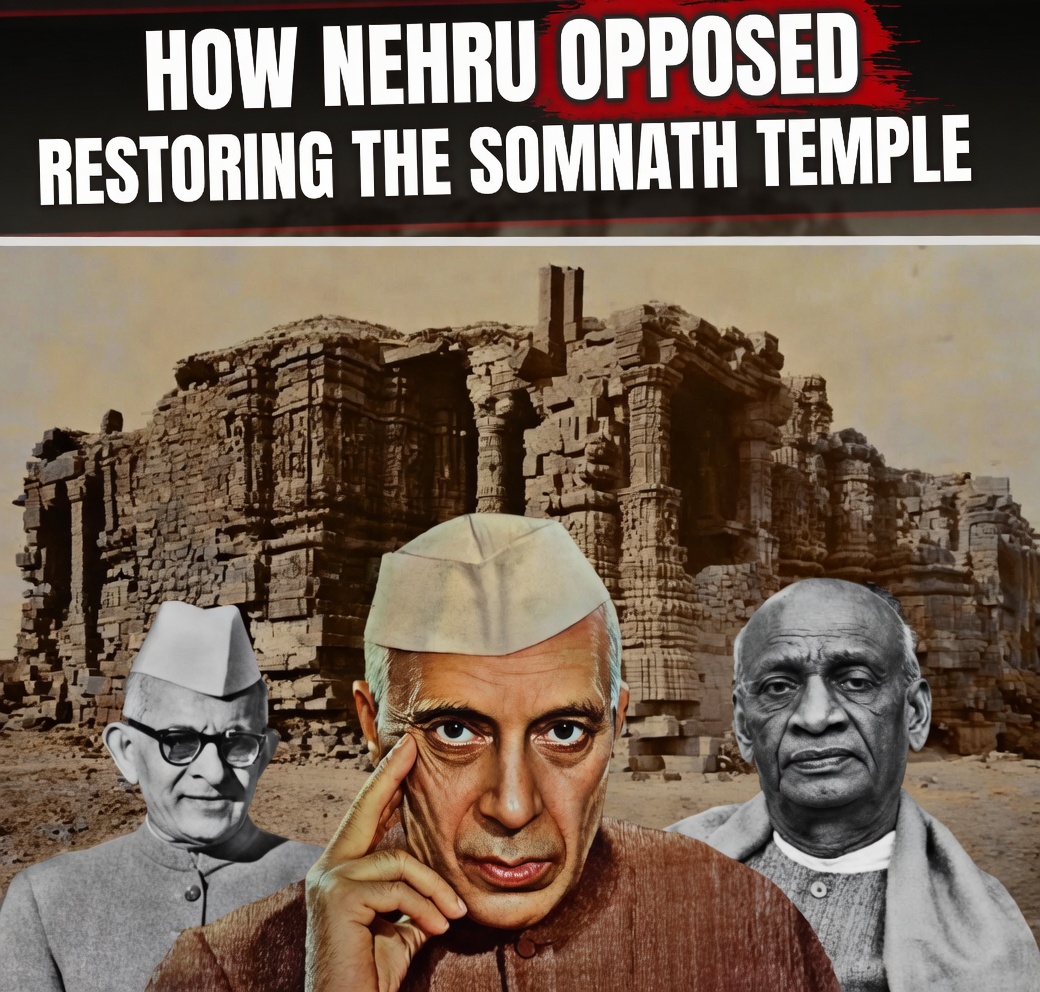
SOMNATH VS NEHRU: THE CIVILISATIONAL CLASH THAT SHAPED INDIA
As Somnath Temple marks 75 years of its consecration, remember this forgotten chapter.
PM Nehru wrote 17 letters opposing its reconstruction.
Not one. Not two. Seventeen.
Yet Somnath rose again - proving that civilisational faith outlives political resistance.
He warned President Rajendra Prasad against attending the consecration ceremony. He called the movement “Hindu revivalism.” He was uncomfortable with the Indian state being seen alongside civilisational restoration.
Yet Somnath rose again.
Destroyed repeatedly by invaders, rebuilt repeatedly by devotees - Somnath became more than a temple. It became a symbol of civilisational resilience.
And on May 11, 1951, despite opposition from the most powerful office in the country, President Rajendra Prasad attended the Pran Pratishtha ceremony and declared: “Somnath Temple signifies that the power of reconstruction is always greater than the power of destruction.”
↪️ THE TEMPLE THAT REFUSED TO DIE
A Thousand Years. Six Destructions. One Unbreakable Faith.
There is a place on the western coast of India where the Arabian Sea meets Gujarat in what ancient texts called the Triveni Sangam - the confluence of the sacred rivers Kapila, Hiran, and the mythical Saraswati. Standing on that shore, facing the endless sea, is a temple.
Not merely a temple.
The most attacked, most destroyed, most looted, most desecrated, and most triumphantly rebuilt sacred site in the history of human civilisation. Reduced to rubble six times. Its Jyotirlinga shattered by conquerors who believed they were breaking not just stone but the spiritual spine of a people. Its priests massacred. Its treasures carried in caravans to foreign capitals. Its name invoked in the courts of the Islamic world as a symbol of Hindu humiliation.
It is the first among the twelve Jyotirlinga shrines of Shiva.
It is Somnath.
And it stands today - gleaming white against the Arabian Sea, as the most powerful civilisational statement the Hindu people have ever made:
We cannot be destroyed.
📌 WHAT THE INVADERS CAME TO BREAK
By the 10th century, Somnath had grown into one of the wealthiest and most magnificent religious sites in the known world. From Asia to Greece, it was the most sacred shrine on earth, its bells audible across the sea, its lamp burning without interruption for centuries, its Shiva Linga believed to have been consecrated by Soma, the Moon God himself.
This was the civilisational peak Mahmud of Ghazni decided to break.
📌 THE SIX DESTRUCTIONS
• 725 CE - The Arab Raid
Junaid, Arab governor of Sindh, attacked via sea route, the opening probe that told the Islamic world what treasure lay on India's western shore.
• 1026 CE - Mahmud of Ghazni
The wound that history cannot close.
30,000 cavalry marched from Ghazni. On January 7, 1026, the assault began. 50,000 Hindu defenders were killed at the temple gates. Those who fled to boats were slain or drowned. Mahmud looted 20 million dinars and broke the Shiva Linga into fragments - which he carried to Ghazni and placed as steps at the gate of the Jami Mosque, to be trampled by worshippers at Friday prayers.
The message was not military. It was theological. We have broken your God.
Mahmud earned the title Butshikan - Idol Breaker. The Taliban celebrated him a thousand years later. Indian historian Kishori Saran Lal estimates his invasions caused 2 million deaths and enslavements.
• 1299 CE - Alauddin Khilji
By now the temple had been rebuilt. Khilji's general Ulugh Khan destroyed it again - establishing the pattern: build, destroy, build, destroy.
• 1395 CE - Zafar Khan
The founder of the Gujarat Sultanate destroyed it on arrival, announcing his power by breaking what Hindus had rebuilt.
• 1451 CE - Mahmud Begada
The Sultan of Gujarat attacked and desecrated the temple.
• 1665–1706 CE - Aurangzeb
The last of the destroyers. Under his reign the temple complex was partially converted into a mosque. By the 18th century it stood in ruins - photographed by colonial archaeologists as a monument to Hindu civilisational defeat.
📌 AND YET - THE TEMPLE ROSE EVERY SINGLE TIME
After Mahmud's 1026 sacking - rebuilt by kings Bhoja and Bhimdev I by 1042.
After Khilji's 1299 destruction, rebuilt by Mahipala I by 1308.
After each subsequent destruction - rebuilt again.
And after Aurangzeb - after the most prolonged Mughal effort to erase Somnath permanently, it was rebuilt by Maharani Ahilyabai Holkar of Indore. Using her personal treasury. Without waiting for permission from any empire. She simply built.
The pattern across a thousand years is identical every time. Somnath is destroyed. Somnath rises. The invaders are gone. Somnath remains.
📌 1947: WHEN FREE INDIA FACED ITS CIVILISATIONAL CONSCIENCE
After Junagadh's accession in November 1947, Sardar Vallabhbhai Patel stood on the shores of Somnath, held sea water in his hands - and pledged its reconstruction as a symbol of national revival. The Union Cabinet endorsed the project. Gandhi blessed it, asking only that it be funded by public donation rather than state money. Patel agreed.
Two of India's greatest leaders had spoken. The nation was ready.
What happened next reveals the deepest fault line in independent India's political soul.
📌 NEHRU'S 17 LETTERS: THE PRIME MINISTER WHO TRIED TO KEEP THE TEMPLE BROKEN
Between July 1950 and August 1951, Jawaharlal Nehru wrote at least 17 documented letters opposing, diluting, and obstructing the reconstruction and consecration of Somnath. Read them in sequence. They tell the complete story.
• July 20, 1950 - To KM Munshi:
He opened not with constitutional principle but with accounting. India had housing shortages. A temple was *"out of place."* He reduced one of Hinduism's holiest shrines - destroyed by foreign invaders six times across a millennium, to a line item he found inconvenient.
• December 1947 - The Cabinet Minutes Incident:
When the Cabinet originally recorded agreement to fund the reconstruction, Nehru was furious. He denied the decision had been taken - and had the Cabinet minutes altered. A sitting Prime Minister falsifying official records. Over a temple.
• March 2, 1951 - To President Rajendra Prasad:
"I confess that I do not like the idea of your associating yourself with a spectacular opening of the Somnath Temple... I feel it would be better if you did not preside over this function."
He tried to stop the President of India from attending the inauguration of a temple that Indians had rebuilt with their own money.
• March 19, 1951 - To the High Commissioner to Pakistan:
He ordered that the use of Indus water for consecration rituals should attract "no publicity under any circumstances" - out of fear of Pakistan's reaction. The Prime Minister of India was managing a Hindu temple's consecration through the lens of Islamabad's sensitivities.
• April 21, 1951 - To Liaquat Ali Khan, PM of Pakistan:
Nehru personally wrote to Pakistan's Prime Minister - addressed as "Dear Nawabzada" - assuring him that Somnath's reconstruction was "completely false" in its symbolic significance. He dismissed India's own civilisational act to a foreign head of state. He chose appeasement over pride.
• April 17, 1951 - To Ambassador to China:
"I have tried therefore to tone down the effects of his visit and what he is going to do there."
Having failed to stop the President, he moved to suppress the event's significance internationally.
• April 22, 1951 - To Jam Saheb of Nawanagar:
Called the consecration "Hindu revivalism" again. Warned that the President and Ministers attending would have *"bad consequences."* Complained about embassies being asked for sacred river water and soil - apparently an international embarrassment.
• April 28, 1951 - To Minister of Information & Broadcasting:
Called the ceremony "pompous." Said it created "a bad impression abroad." Ordered: "Our radio broadcast should rather tone down the description of what happens at Somnath."
The Presidential inauguration speech was suppressed from All India Radio.
• May 2 & August 1, 1951 - To All Chief Ministers:
He circularised every Chief Minister in India warning them that Somnath had created "a very bad impression abroad" and that "Pakistan has taken full advantage of this and made it one of the principal planks of its propaganda."
He was more alarmed by Pakistan's propaganda than by a thousand years of Hindu civilisational assault.
• June 13, 1951 - To Vice President Radhakrishnan:
Months after the inauguration had already happened, Nehru was still complaining - calling it unnecessary "fuss" and admitting he had tried to stop Cabinet Ministers from attending.
Seventeen letters. One consistent message: the temple rising was the problem, not the invaders who broke it.
📌 THE DOUBLE STANDARD THAT CANNOT BE IGNORED
This same Nehru:
→ Continued the British-era Hajj Committee Act of 1932 and later expanded it through the Hajj Committee Act of 1959, using state resources for Muslim pilgrimage.
→ Funded restoration of Buddhist sites at Sanchi and Sarnath without a single objection.
→ Had no problem with government association with any other religious tradition.
But a Hindu temple - rebuilt from public donations by the people of India - was "Hindu revivalism." ₹5 lakhs from the Saurashtra Government for the ceremony was "improper use of public funds."
This is not secularism. Secularism means equal treatment of all faiths by the state. What Nehru practiced was something else entirely - a structural allergy to Hindu civilisational assertion that applied to no other community. KM Munshi named it precisely in his response to Nehru:
"How secularism sometimes becomes allergic to Hinduism will be apparent from certain episodes relating to the reconstruction of Somnath temple."
📌 THE THREE MEN HISTORY JUDGED
Nehru wrote 17 letters. Failed on every count. The temple rose despite him. History remembers him as the Prime Minister who tried to keep India's holiest shrine in ruins to manage Pakistan's feelings.
Rajendra Prasad ignored the Prime Minister, attended the inauguration, and said words that Nehru could not suppress from stone even if he suppressed them from the radio:
"The physical symbols of our civilisation may be destroyed, but no arms, army or king could destroy the bond that the people had with their culture and faith. Till that bond remained, the civilisation would survive."
KM Munshi defied his own PM and wrote the line that every Hindu should carry:
"I cannot value India's freedom if it deprives us of the Bhagavad Gita or uproots our millions from the faith with which they look upon our temples and thereby destroys the texture of our lives."
📌 THE UNBROKEN THREAD: SOMNATH TO AYODHYA
LK Advani launched his Rath Yatra in 1990 from Somnath - walking in the opposite direction from Mahmud of Ghazni's march. Not to destroy. To restore.
The Ram Mandir consecration on January 22, 2024 - attended by Prime Minister Modi, boycotted by the Congress party - was the direct civilisational heir of Somnath 1951. The vocabulary used against it was identical: communalism, majoritarianism, vote-bank politics. In 1951 it was called revivalism. The resistance to Hindu self-assertion never changes its substance - only its vocabulary.
And every time - exactly like Somnath across six destructions - the temple rises anyway.
📌 WHAT SOMNATH TEACHES THE 21ST CENTURY
One thousand years after Mahmud of Ghazni's 30,000 cavalry crossed the Thar desert to break the most sacred Shiva Linga in the world - Somnath stands.
The Ghaznavid Empire is dust.
The Delhi Sultanate is dust.
The Mughal Empire is dust.
Pakistan - which named a missile after Mahmud of Ghazni - begged for a ceasefire when India struck it in May 2025.
The steps of the Jami Mosque in Ghazni where the broken Jyotirlinga fragments were placed to be trampled - are themselves broken now, consumed by centuries.
The Jyotirlinga lives.
Six destructions. Six restorations. And one Prime Minister's 17 letters - which changed nothing.
The past was six destructions.
The present is the gleaming white temple on the Arabian Sea. The future is the civilisation that refused - century after century, at incalculable cost - to accept that its gods had been permanently silenced.
That is the Somnath Principle. That is the Hindu resurgence.
Written not in textbooks. In stone. Rebuilt again and again on the same ground where the invaders believed they had won.
Har Har Mahadev. #SomnathVirasatK75Varsh
🚨 CHINA'S OPERATION SINDOOR PROPAGANDA - Beijing admits it sent experts to Pakistani air bases during Operation Sindoor to help Pakistan
But, the real story rarely gets told - India dismantled Pakistan’s air superiority in just 88 hours and exposed the limits of China’s defence industry before the world.
A Strategic Deep Analysis -
On the First Anniversary of India's Most Significant Military Operation Since 1971, Beijing Is Running a Defence Sales Campaign Disguised as History. Here Is What the Data Actually Says.
One year after India's precision strikes dismantled nine terrorist infrastructure sites across Pakistan in 23 minutes - the most consequential military operation by any democracy against a nuclear-armed adversary in the post-Cold War era, China has chosen the anniversary to run what can only be described as a paid advertisement for its defence industry, broadcast through state media and dressed up as military disclosure.
China's state broadcaster CCTV aired an interview with Zhang Heng, an engineer from the Aviation Industry Corporation of China's Chengdu Aircraft Design and Research Institute, confirming that AVIC engineers were deployed at a Pakistani air base during Operation Sindoor to ensure Chinese-supplied J-10CE fighter jets operated at "full combat potential."
Zhang described conditions as gruelling - temperatures soaring to nearly 50 degrees Celsius, constant roar of jets and air-raid sirens.
Noted. The engineers were sweating. What their weapons were doing is a different story entirely.
Let us go through the data. System by system. Theatre by theatre. Country by country.
📌 FIRST: WHAT CHINA IS ACTUALLY CLAIMING - AND WHY THE TIMING IS NOT ACCIDENTAL
When Pakistan claimed during the conflict that the J-10C had shot down multiple Indian fighter jets including Rafales, Chinese defence stocks surged 36% over two trading sessions. AVIC's Chengdu subsidiary, the manufacturer of the J-10C - saw its market capitalisation increase by billions of dollars on unverified claims of combat success. Chinese state media and military bloggers amplified the narrative with near-choreographed precision.
This is the commercial context of China's anniversary disclosure. According to SIPRI, China accounted for 5.9% of global arms exports in 2020–24 - a decline from previous periods, and as early as 2023, analysts noted China's arms exports had fallen by nearly a quarter over the preceding decade due to "poor quality, and weak and inconsistent performance."
China needs Operation Sindoor to be a J-10C marketing success. Its entire defence export strategy, concentrated in Pakistan, which accounts for 63% of its arms sales, depends on one combat validation narrative surviving scrutiny. So on the anniversary, CCTV runs the engineer story. Chinese social media amplifies the Rafale-downed clip. The defence stocks get another bump.
This is not military disclosure. This is a product launch event using India's military operation as the stage.
Now let us dismantle it, system by system.
📌 WHAT CHINA'S SYSTEMS ACTUALLY DID DURING OPERATION SINDOOR
The HQ-9 Air Defence System - Advertised as China's S-300. Performed as Decoration.
The HQ-9, modelled after the Russian S-300 platform, was deployed as Pakistan's premier air defence system, intended to provide a layered and integrated air defence umbrella. According to reports from Islamabad, it failed to intercept a single Indian missile or aircraft during Operation Sindoor. Multiple HQ-9 air defence launchers deployed across Pakistani cities sustained heavy damage during India's precision strikes.
The HQ-9B is a cheap copy of the US Patriot and Russian S-300. In theory it has built-in radar systems to track and engage multiple targets simultaneously. In practice, four consecutive days of Operation Sindoor - it was unable to defend, destroy or track anything.
The CLIAD and ADGES - China's Flagship Integrated Air Defence Architecture. Crumbled.
China helped build Pakistan's Comprehensive Layered Integrated Air Defence system and the Air Defence Ground Environment System into central components of Pakistan's posture. Pakistan's CLIAD was built almost entirely with Chinese hardware: HQ-9Ps and HQ-16s for high and medium altitude coverage, HQ-17s, FM-90s, and FN-6s for short-range protection. The JY-27A radar at Mianwali operated in the very-high frequency band and tracked stealth aircraft up to 500 km. When the real tests came, Chinese weapon systems failed across domains. Drones were jammed, radars neutralised, and missile batteries underperformed. The much-touted ADGES and CLIAD crumbled in real combat.
The YLC-8E Anti-Stealth Radar - Destroyed Before It Could Warn Pakistan.
A key YLC-8E radar at Chunian Air Base was reportedly destroyed. Chinese-made Wing Loong-II drones operated by Pakistan were shot down by Indian air defences, further exposing their vulnerabilities. The PL-15 Missile - China's Long-Range BVR Star. Jammed Into Irrelevance.**
Operation Sindoor highlighted PL-15's vulnerabilities: IAF electronic warfare jammed guidance links, neutralising its purported long-range lethality. Indian Rafale fleet, with its twin-engine robustness, Meteor missiles, and Spectra EW suite, outmatched the J-10C/PL-15 combination in beyond-visual-range engagements, as validated by Sindoor's tactical outcomes.
The BrahMos Test in March 2022 - The Warning That Was Ignored
On March 9, 2022, a BrahMos missile launched accidentally near Ambala crashed in Mian Channu, Pakistan. Though unarmed, the incident exposed a far critical vulnerability: the conspicuous failure of Chinese-supplied air defence systems deployed in Pakistan. Despite Pakistan's claims that its radar tracked the missile from launch to impact, it did not attempt to intercept it. This inaction raised early doubts about the efficacy of China's HQ-9 and HQ-16 systems - doubts that have now been definitively confirmed.
India's own air defence, by contrast, performed categorically differently. India's Akashteer system demonstrated a 100% kill rate against Pakistani drones. The S-400 Sudarshan Chakra intercepted all incoming Pakistani missiles. Zero Pakistani missiles or drones caused meaningful damage to Indian infrastructure across four days of conflict.
The scoreboard: India's defence systems - 100% intercept rate. China's defence systems deployed by Pakistan, 0% intercept rate. That is not a marginal performance gap. That is a complete operational collapse.
📌 THE GLOBAL PATTERN: OPERATION SINDOOR WAS NOT AN ANOMALY. IT WAS A CONFIRMATION.
The HQ-9 and J-10C failures during Operation Sindoor did not occur in isolation. They are part of a documented, multi-theatre, multi-system pattern of Chinese defence hardware underperforming catastrophically under real combat conditions.
↪️ Venezuela - Chinese Radars Miss 150 Aircraft
China's JY-27A radar specialises in the early detection of fast, supersonic F-22 and F-35 jets. In real combat in Venezuela, the Chinese radars became a point of national humiliation and shame, failing to detect even one of the 150 aircraft that penetrated Venezuelan airspace.
↪️ Iran - HQ-9B Destroyed by Israeli Strikes
During Operation Epic Fury in Iran, the Chinese HQ-9B missile defence system was again defeated with deadly strikes. Chinese power failed miserably in the theatre. Chinese commentators had previously claimed that Chinese systems would have outperformed the Russian S-300 in Iran. The claim was tested. The claim failed.
↪️ Bangladesh - Defective Frigates, Faulty Radars, Unreliable Tanks
The Bangladesh Navy reported defects in two Chinese-made frigates - BNS Umar Farooq and BNS Abu Ubaidah, soon after induction. The Bangladesh Air Force faced persistent issues with Chinese-supplied F-7 fighter jets and K-8W trainer aircraft, including radars failing to meet accuracy standards. The Bangladesh Army's Chinese-made MBT-2000 tanks suffered spare parts shortages, rendering them unreliable in combat scenarios.
↪️ Myanmar - JF-17s Grounded for Structural Cracks
Myanmar's air force was forced to ground 11 Chinese-made JF-17 fighter jets in 2022 due to structural cracks and radar malfunctions. The JF-17, co-developed by China and Pakistan as a cost-effective multirole fighter, was intended to be a game-changer for smaller air forces. Instead it has become a symbol of China's inability to produce durable, high-performance military aircraft.
↪️ Cambodia - Light Machine Gun Jams in a Border Skirmish
In May 2025, a video circulated of a Cambodian soldier's Chinese-made light machine gun repeatedly jamming during a border skirmish with Thailand, bringing global attention to the inconsistent performance of Chinese small arms under combat stress.
↪️ Pakistan's Own History of Chinese Equipment Failure
Pakistan's F-22P frigates have faced serious technical issues including engine degradation and faulty sensors. The FM-90(N) missile system suffered from defective infrared sensors, preventing it from effectively locking onto targets. Even the JF-17 Thunder jets have experienced multiple crashes due to manufacturing defects.
The pattern across Venezuela, Iran, Bangladesh, Myanmar, Cambodia, and Pakistan is identical: Chinese systems that look competitive on a product datasheet collapse under the stress of actual combat, actual electronic warfare, and actual adversaries who have trained to defeat them.
📌 THE J-10C/RAFALE CLAIM: THE ONE NARRATIVE CHINA NEEDS TO SURVIVE**
India has not officially confirmed any Rafale loss during Operation Sindoor. If independently confirmed, it would mark the first known combat loss of the French-made Rafale and the first successful combat kill by the J-10CE platform.
Pakistan's Foreign Minister Ishaq Dar claimed Pakistan shot down five Indian fighter jets including three Rafales using J-10C aircraft equipped with PL-15E air-to-air missiles. Two unnamed US officials told Reuters there was "high confidence" one downed jet was a Rafale.
Here is the analytical assessment of that claim.
Pakistan's military - an institution that claimed it had downed six Indian aircraft in an engagement where it simultaneously needed a ceasefire within 72 hours, promoted its Army Chief to Field Marshal after a military defeat, and whose capital's air base was struck within kilometres of its nuclear command centre, has a structural interest in claiming maximum Indian losses. Its claims of five jets downed have not been verified by a single piece of independent satellite imagery, wreckage photograph, pilot capture, or black box recovery made public. The claim exists entirely in Pakistani official statements and Chinese state media amplification.
The Indian Air Force shot down at least five Pakistan Air Force aircraft during the operation, including one Mirage-5, two Chinese-made JF-17 Thunder jets, one US-made F-16, and a fifth unidentified aircraft, documented findings supported by multiple independent analysts.
The irony is absolute: when Islamabad was desperate for these weapon systems, its Chinese-supplied radars, air defence systems, and drones failed to deliver. Drones were shot down or returned unsuccessfully. Radar and missile systems were either destroyed or, even if operational, were unable to prevent strikes on Pakistan's key military installations and airbases.
📌 THE ENGINEERS IN THE DESERT: WHAT CHINA'S ADMISSION ACTUALLY REVEALS
Step back from the marketing and read what China has actually admitted.
AVIC engineers were physically stationed at a Pakistani air base, working under 50-degree heat and air-raid sirens, to keep J-10CE fighters at "full combat potential."
This is not a demonstration of Chinese technological superiority. This is an admission that the J-10CE requires the physical presence of its manufacturer's engineers to function in combat conditions, that it cannot be operated and maintained independently by the air force that purchased it. A weapons system that requires the manufacturer's personnel to be present during active hostilities is not a weapon. It is a rental.
Compare this to India's indigenously operated systems. The BrahMos, designed in India, integrated by India, fired by India, maintained by India. The Akash, 100% intercept rate, operated entirely by Indian Air Force personnel without a single Russian, Israeli, or American engineer sitting at the base. The Akashteer, India's AI-integrated air defence system, which processed and neutralised Pakistan's drone swarms in real time.
India did not need its weapons manufacturers in the field. Its systems worked because they were built to work, not to impress a trade fair audience.
📌 WHAT THE GLOBAL DEFENCE MARKET SHOULD TAKE FROM THIS
SIPRI notes that China's arms exports are concentrated in a few markets, Pakistan accounting for 63% of its sales. The repeated underperformance of Chinese systems risks alienating other potential buyers, particularly in the Middle East and Africa, where reliability is paramount.
Argentina and Peru chose the supersonic F-16s instead of China's JF-17. Uruguay incorporated US Oshkosh armoured vehicles. China was left out of Latin America's defence procurement cycle.
These failures provide a strategic opening for competitors like India, which is emphasising its own combat-proven systems, the Akash air defence system and BrahMos missile - under the Make in India initiative.
The most consequential long-term outcome of Operation Sindoor may not be military at all. It may be commercial. Every defence ministry in the world that was considering a Chinese air defence system, a Chinese fighter platform, or a Chinese integrated radar network now has four days of real combat data from May 2025 to weigh against the product brochure. That data shows the HQ-9 failing to intercept a single projectile. It shows the CLIAD crumbling. It shows Wing Loong drones being swatted. It shows engineers in 50-degree heat trying to keep aircraft functional that should have been operationally self-sustaining.
India's Akashteer has a 100% kill rate against those same systems.
The market will draw its own conclusions.
📌 PROPAGANDA HAS A SHELF LIFE. COMBAT DATA DOES NOT.
China's anniversary disclosure is a sales operation. Zhang Heng's CCTV interview is a product testimonial. The J-10C/Rafale narrative is a stock market instrument. And the entire edifice rests on one unverified claim, a downed Rafale that India has not confirmed, for which no wreckage has been shown, no pilot has been displayed, and no independent evidence has been presented.
What has been independently verified, documented, and satellite-confirmed is this:
When the real tests came, Chinese weapon systems failed across domains. Drones were jammed, radars neutralised, and missile batteries underperformed. The much-touted ADGES and CLIAD crumbled in real combat. Pakistan's deep military reliance on China produced integration, not superiority. For Islamabad, the cost of dependence became visible as the strategic alignment delivered hardware, not solutions.
China can run its CCTV interviews. It can promote its engineers' hardship stories. It can watch its defence stocks tick up on anniversary week.
But the HQ-9 did not intercept a single Indian missile across four days of active conflict. That fact does not expire on anniversaries. It compounds.
India struck. India dominated. India's systems worked.
China's did not. And the world's defence procurement offices know it.
🚨 CHINA'S OPERATION SINDOOR PROPAGANDA - Beijing admits it sent experts to Pakistani air bases during Operation Sindoor to help Pakistan
But, the real story rarely gets told - India dismantled Pakistan’s air superiority in just 88 hours and exposed the limits of China’s defence industry before the world.
A Strategic Deep Analysis -
On the First Anniversary of India's Most Significant Military Operation Since 1971, Beijing Is Running a Defence Sales Campaign Disguised as History. Here Is What the Data Actually Says.
One year after India's precision strikes dismantled nine terrorist infrastructure sites across Pakistan in 23 minutes - the most consequential military operation by any democracy against a nuclear-armed adversary in the post-Cold War era, China has chosen the anniversary to run what can only be described as a paid advertisement for its defence industry, broadcast through state media and dressed up as military disclosure.
China's state broadcaster CCTV aired an interview with Zhang Heng, an engineer from the Aviation Industry Corporation of China's Chengdu Aircraft Design and Research Institute, confirming that AVIC engineers were deployed at a Pakistani air base during Operation Sindoor to ensure Chinese-supplied J-10CE fighter jets operated at "full combat potential."
Zhang described conditions as gruelling - temperatures soaring to nearly 50 degrees Celsius, constant roar of jets and air-raid sirens.
Noted. The engineers were sweating. What their weapons were doing is a different story entirely.
Let us go through the data. System by system. Theatre by theatre. Country by country.
📌 FIRST: WHAT CHINA IS ACTUALLY CLAIMING - AND WHY THE TIMING IS NOT ACCIDENTAL
When Pakistan claimed during the conflict that the J-10C had shot down multiple Indian fighter jets including Rafales, Chinese defence stocks surged 36% over two trading sessions. AVIC's Chengdu subsidiary, the manufacturer of the J-10C - saw its market capitalisation increase by billions of dollars on unverified claims of combat success. Chinese state media and military bloggers amplified the narrative with near-choreographed precision.
This is the commercial context of China's anniversary disclosure. According to SIPRI, China accounted for 5.9% of global arms exports in 2020–24 - a decline from previous periods, and as early as 2023, analysts noted China's arms exports had fallen by nearly a quarter over the preceding decade due to "poor quality, and weak and inconsistent performance."
China needs Operation Sindoor to be a J-10C marketing success. Its entire defence export strategy, concentrated in Pakistan, which accounts for 63% of its arms sales, depends on one combat validation narrative surviving scrutiny. So on the anniversary, CCTV runs the engineer story. Chinese social media amplifies the Rafale-downed clip. The defence stocks get another bump.
This is not military disclosure. This is a product launch event using India's military operation as the stage.
Now let us dismantle it, system by system.
📌 WHAT CHINA'S SYSTEMS ACTUALLY DID DURING OPERATION SINDOOR
The HQ-9 Air Defence System - Advertised as China's S-300. Performed as Decoration.
The HQ-9, modelled after the Russian S-300 platform, was deployed as Pakistan's premier air defence system, intended to provide a layered and integrated air defence umbrella. According to reports from Islamabad, it failed to intercept a single Indian missile or aircraft during Operation Sindoor. Multiple HQ-9 air defence launchers deployed across Pakistani cities sustained heavy damage during India's precision strikes.
The HQ-9B is a cheap copy of the US Patriot and Russian S-300. In theory it has built-in radar systems to track and engage multiple targets simultaneously. In practice, four consecutive days of Operation Sindoor - it was unable to defend, destroy or track anything.
The CLIAD and ADGES - China's Flagship Integrated Air Defence Architecture. Crumbled.
China helped build Pakistan's Comprehensive Layered Integrated Air Defence system and the Air Defence Ground Environment System into central components of Pakistan's posture. Pakistan's CLIAD was built almost entirely with Chinese hardware: HQ-9Ps and HQ-16s for high and medium altitude coverage, HQ-17s, FM-90s, and FN-6s for short-range protection. The JY-27A radar at Mianwali operated in the very-high frequency band and tracked stealth aircraft up to 500 km. When the real tests came, Chinese weapon systems failed across domains. Drones were jammed, radars neutralised, and missile batteries underperformed. The much-touted ADGES and CLIAD crumbled in real combat.
The YLC-8E Anti-Stealth Radar - Destroyed Before It Could Warn Pakistan.
A key YLC-8E radar at Chunian Air Base was reportedly destroyed. Chinese-made Wing Loong-II drones operated by Pakistan were shot down by Indian air defences, further exposing their vulnerabilities. The PL-15 Missile - China's Long-Range BVR Star. Jammed Into Irrelevance.**
Operation Sindoor highlighted PL-15's vulnerabilities: IAF electronic warfare jammed guidance links, neutralising its purported long-range lethality. Indian Rafale fleet, with its twin-engine robustness, Meteor missiles, and Spectra EW suite, outmatched the J-10C/PL-15 combination in beyond-visual-range engagements, as validated by Sindoor's tactical outcomes.
The BrahMos Test in March 2022 - The Warning That Was Ignored
On March 9, 2022, a BrahMos missile launched accidentally near Ambala crashed in Mian Channu, Pakistan. Though unarmed, the incident exposed a far critical vulnerability: the conspicuous failure of Chinese-supplied air defence systems deployed in Pakistan. Despite Pakistan's claims that its radar tracked the missile from launch to impact, it did not attempt to intercept it. This inaction raised early doubts about the efficacy of China's HQ-9 and HQ-16 systems - doubts that have now been definitively confirmed.
India's own air defence, by contrast, performed categorically differently. India's Akashteer system demonstrated a 100% kill rate against Pakistani drones. The S-400 Sudarshan Chakra intercepted all incoming Pakistani missiles. Zero Pakistani missiles or drones caused meaningful damage to Indian infrastructure across four days of conflict.
The scoreboard: India's defence systems - 100% intercept rate. China's defence systems deployed by Pakistan, 0% intercept rate. That is not a marginal performance gap. That is a complete operational collapse.
📌 THE GLOBAL PATTERN: OPERATION SINDOOR WAS NOT AN ANOMALY. IT WAS A CONFIRMATION.
The HQ-9 and J-10C failures during Operation Sindoor did not occur in isolation. They are part of a documented, multi-theatre, multi-system pattern of Chinese defence hardware underperforming catastrophically under real combat conditions.
↪️ Venezuela - Chinese Radars Miss 150 Aircraft
China's JY-27A radar specialises in the early detection of fast, supersonic F-22 and F-35 jets. In real combat in Venezuela, the Chinese radars became a point of national humiliation and shame, failing to detect even one of the 150 aircraft that penetrated Venezuelan airspace.
↪️ Iran - HQ-9B Destroyed by Israeli Strikes
During Operation Epic Fury in Iran, the Chinese HQ-9B missile defence system was again defeated with deadly strikes. Chinese power failed miserably in the theatre. Chinese commentators had previously claimed that Chinese systems would have outperformed the Russian S-300 in Iran. The claim was tested. The claim failed.
↪️ Bangladesh - Defective Frigates, Faulty Radars, Unreliable Tanks
The Bangladesh Navy reported defects in two Chinese-made frigates - BNS Umar Farooq and BNS Abu Ubaidah, soon after induction. The Bangladesh Air Force faced persistent issues with Chinese-supplied F-7 fighter jets and K-8W trainer aircraft, including radars failing to meet accuracy standards. The Bangladesh Army's Chinese-made MBT-2000 tanks suffered spare parts shortages, rendering them unreliable in combat scenarios.
↪️ Myanmar - JF-17s Grounded for Structural Cracks
Myanmar's air force was forced to ground 11 Chinese-made JF-17 fighter jets in 2022 due to structural cracks and radar malfunctions. The JF-17, co-developed by China and Pakistan as a cost-effective multirole fighter, was intended to be a game-changer for smaller air forces. Instead it has become a symbol of China's inability to produce durable, high-performance military aircraft.
↪️ Cambodia - Light Machine Gun Jams in a Border Skirmish
In May 2025, a video circulated of a Cambodian soldier's Chinese-made light machine gun repeatedly jamming during a border skirmish with Thailand, bringing global attention to the inconsistent performance of Chinese small arms under combat stress.
↪️ Pakistan's Own History of Chinese Equipment Failure
Pakistan's F-22P frigates have faced serious technical issues including engine degradation and faulty sensors. The FM-90(N) missile system suffered from defective infrared sensors, preventing it from effectively locking onto targets. Even the JF-17 Thunder jets have experienced multiple crashes due to manufacturing defects.
The pattern across Venezuela, Iran, Bangladesh, Myanmar, Cambodia, and Pakistan is identical: Chinese systems that look competitive on a product datasheet collapse under the stress of actual combat, actual electronic warfare, and actual adversaries who have trained to defeat them.
📌 THE J-10C/RAFALE CLAIM: THE ONE NARRATIVE CHINA NEEDS TO SURVIVE**
India has not officially confirmed any Rafale loss during Operation Sindoor. If independently confirmed, it would mark the first known combat loss of the French-made Rafale and the first successful combat kill by the J-10CE platform.
Pakistan's Foreign Minister Ishaq Dar claimed Pakistan shot down five Indian fighter jets including three Rafales using J-10C aircraft equipped with PL-15E air-to-air missiles. Two unnamed US officials told Reuters there was "high confidence" one downed jet was a Rafale.
Here is the analytical assessment of that claim.
Pakistan's military - an institution that claimed it had downed six Indian aircraft in an engagement where it simultaneously needed a ceasefire within 72 hours, promoted its Army Chief to Field Marshal after a military defeat, and whose capital's air base was struck within kilometres of its nuclear command centre, has a structural interest in claiming maximum Indian losses. Its claims of five jets downed have not been verified by a single piece of independent satellite imagery, wreckage photograph, pilot capture, or black box recovery made public. The claim exists entirely in Pakistani official statements and Chinese state media amplification.
The Indian Air Force shot down at least five Pakistan Air Force aircraft during the operation, including one Mirage-5, two Chinese-made JF-17 Thunder jets, one US-made F-16, and a fifth unidentified aircraft, documented findings supported by multiple independent analysts.
The irony is absolute: when Islamabad was desperate for these weapon systems, its Chinese-supplied radars, air defence systems, and drones failed to deliver. Drones were shot down or returned unsuccessfully. Radar and missile systems were either destroyed or, even if operational, were unable to prevent strikes on Pakistan's key military installations and airbases.
📌 THE ENGINEERS IN THE DESERT: WHAT CHINA'S ADMISSION ACTUALLY REVEALS
Step back from the marketing and read what China has actually admitted.
AVIC engineers were physically stationed at a Pakistani air base, working under 50-degree heat and air-raid sirens, to keep J-10CE fighters at "full combat potential."
This is not a demonstration of Chinese technological superiority. This is an admission that the J-10CE requires the physical presence of its manufacturer's engineers to function in combat conditions, that it cannot be operated and maintained independently by the air force that purchased it. A weapons system that requires the manufacturer's personnel to be present during active hostilities is not a weapon. It is a rental.
Compare this to India's indigenously operated systems. The BrahMos, designed in India, integrated by India, fired by India, maintained by India. The Akash, 100% intercept rate, operated entirely by Indian Air Force personnel without a single Russian, Israeli, or American engineer sitting at the base. The Akashteer, India's AI-integrated air defence system, which processed and neutralised Pakistan's drone swarms in real time.
India did not need its weapons manufacturers in the field. Its systems worked because they were built to work, not to impress a trade fair audience.
📌 WHAT THE GLOBAL DEFENCE MARKET SHOULD TAKE FROM THIS
SIPRI notes that China's arms exports are concentrated in a few markets, Pakistan accounting for 63% of its sales. The repeated underperformance of Chinese systems risks alienating other potential buyers, particularly in the Middle East and Africa, where reliability is paramount.
Argentina and Peru chose the supersonic F-16s instead of China's JF-17. Uruguay incorporated US Oshkosh armoured vehicles. China was left out of Latin America's defence procurement cycle.
These failures provide a strategic opening for competitors like India, which is emphasising its own combat-proven systems, the Akash air defence system and BrahMos missile - under the Make in India initiative.
The most consequential long-term outcome of Operation Sindoor may not be military at all. It may be commercial. Every defence ministry in the world that was considering a Chinese air defence system, a Chinese fighter platform, or a Chinese integrated radar network now has four days of real combat data from May 2025 to weigh against the product brochure. That data shows the HQ-9 failing to intercept a single projectile. It shows the CLIAD crumbling. It shows Wing Loong drones being swatted. It shows engineers in 50-degree heat trying to keep aircraft functional that should have been operationally self-sustaining.
India's Akashteer has a 100% kill rate against those same systems.
The market will draw its own conclusions.
📌 PROPAGANDA HAS A SHELF LIFE. COMBAT DATA DOES NOT.
China's anniversary disclosure is a sales operation. Zhang Heng's CCTV interview is a product testimonial. The J-10C/Rafale narrative is a stock market instrument. And the entire edifice rests on one unverified claim, a downed Rafale that India has not confirmed, for which no wreckage has been shown, no pilot has been displayed, and no independent evidence has been presented.
What has been independently verified, documented, and satellite-confirmed is this:
When the real tests came, Chinese weapon systems failed across domains. Drones were jammed, radars neutralised, and missile batteries underperformed. The much-touted ADGES and CLIAD crumbled in real combat. Pakistan's deep military reliance on China produced integration, not superiority. For Islamabad, the cost of dependence became visible as the strategic alignment delivered hardware, not solutions.
China can run its CCTV interviews. It can promote its engineers' hardship stories. It can watch its defence stocks tick up on anniversary week.
But the HQ-9 did not intercept a single Indian missile across four days of active conflict. That fact does not expire on anniversaries. It compounds.
India struck. India dominated. India's systems worked.
China's did not. And the world's defence procurement offices know it.
🚨When Mamata Banerjee Chose Her Nephew Over Her General and Lost Bengal
A Deep Analysis
There is a moment in every political story where the defining mistake is made. Not on the battlefield. Not in the ballot box. In the room, when a leader decides who they trust more: the person who earned it, or the person who shares their blood.
For Mamata Banerjee, that moment came after 2011. She had just ended 34 years of Left Front rule. And among the architects of that victory stood one man above almost all others, Suvendu Adhikari, the field commander of Nandigram and the organiser who turned anti Left anger into a political revolution.
Instead of consolidating him, she began building her succession plan around her nephew, Abhishek Banerjee.
↪️ What He Built For Her Before She Took It Away
Before the sidelining, there was the service. And it was extraordinary.
Trained in RSS shakhas during his formative years and baptised in electoral politics in 1995, Suvendu Adhikari joined the TMC with his father Sisir Adhikari barely a year after it was formed. From that point, he became Mamata's most dependable field general, not in title, but in consequence.
• 2006 to 2007, Singur and Nandigram: Suvendu played a crucial role in the historic Nandigram anti land acquisition movement, which became the turning point in West Bengal politics and contributed significantly to the TMC's rise to power in 2011. When the Left Front government ordered police firing on protesting farmers, it was Suvendu on the ground, organising resistance, mobilising communities, and turning Nandigram into the Left's political graveyard. Mamata got the credit. He did the work.
• 2009, Tamluk Lok Sabha: He defeated CPI(M) strongman Lakshman Seth from Tamluk by a staggering margin of over 1.72 lakh votes. Seth was the central figure in the Nandigram violence. The victory was a political statement that announced the TMC's south Bengal dominance.
• 2011, The Historic Victory: The TMC won 184 seats and ended the Left's 34 year rule. Suvendu's ground network across Purba Medinipur, Paschim Medinipur, and the coastal belt was instrumental in delivering seats that the party could not have won through Mamata's urban charisma alone. He was the machine behind the movement.
• 2014, Lok Sabha retained: Re elected from Tamluk. TMC maintained its Bengal dominance while the Modi wave swept the rest of India. The south Bengal firewall held, in significant part, because of the ground networks Suvendu had built.
• 2016, Cabinet induction: He was given the Transport portfolio and later the Irrigation and Water Resources portfolio. He was made TMC observer in Malda and Murshidabad and assigned the task of breaking Congress in its two strongholds. He successfully poached elected representatives of the grand old party. He delivered territory that had never belonged to TMC.
This is the record of the man she chose to sideline.
↪️ The Timeline of a Systematic Sidelining
• 2011: Abhishek Banerjee, then 24, was named president of All India Trinamool Yuva, a parallel youth organisation created alongside the TMC Youth Congress that Suvendu led. The party constitution had no place for two youth wings. Suvendu was furious:
"It was done just to keep me in check. Where was the nephew when Nandigram was burning? I was there fighting alone."
• 2014: Suvendu was removed as TMC Youth Congress president. Months later, TMC Yuva was merged with the Youth Congress, absorbing the structure he had built into Abhishek's institutional control.
• 2016: Sensing that Suvendu was in talks with the Congress to switch parties, Mamata brought him back, giving him three cabinet portfolios and making him TMC observer in Malda and Murshidabad, with the task of breaking Congress strongholds there.
He delivered. He poached Congress representatives across both districts. He strengthened the party.
He was used.
• 2019: After TMC's Lok Sabha setback, the observer posts were abolished, including the specific organisational role Suvendu held across north Bengal.
Gone. No replacement. No acknowledgment.
His institutional authority had been removed one piece at a time, each time after he had delivered on the assignment that required it.
• December 19, 2020: Suvendu Adhikari joined the BJP at a rally addressed by Amit Shah. He later described the TMC as a "private limited company", a diagnosis, not an attack.
↪️ What Left With Him
When Suvendu walked, he did not walk alone.
He took the south Bengal machine with him, the booth networks, the panchayat contacts, the district loyalty chains built across Purba Medinipur over decades, and operational ecosystems that no data consultancy or election war room can manufacture.
The BJP swept all 16 Assembly seats in Purba Medinipur in 2026. TMC won zero.
In 2021, they had shared the district.
That swing is not ideology. That is a personal loyalty network changing sides.
↪️ The Final Accounting
In 2026, Suvendu Adhikari defeated Mamata Banerjee in Bhabanipur by 15,105 votes and retained Nandigram by 9,665 votes, up from his 2021 margin of just 1,956.
Today, he took oath as the 9th Chief Minister of West Bengal, the first BJP Chief Minister in the state's history.
The collapse of TMC's dominance in 2026 cannot be understood only through BJP expansion or anti incumbency. A major structural reason was that the political machinery which once made Mamata Banerjee unbeatable had, over nine years of deliberate marginalisation, shifted against her.
The irony is extraordinary.
Mamata Banerjee spent a decade building Abhishek Banerjee's path to power. During those same years, she was building Suvendu Adhikari's motivation to destroy the empire he once helped create.
She sidelined the man who stood in Nandigram when Bengal's future was being decided in the streets, and elevated a successor whose primary qualification was proximity to the throne.
The man Mamata deployed to break Congress strongholds in Malda and Murshidabad, then stripped of that role once the task was done, broke her own stronghold in Bhabanipur five years later.
She created the instrument of her own defeat. She sharpened it. She handed it motive.
Dynasty over merit has a cost.
In Bengal, 2026 was the bill coming due.
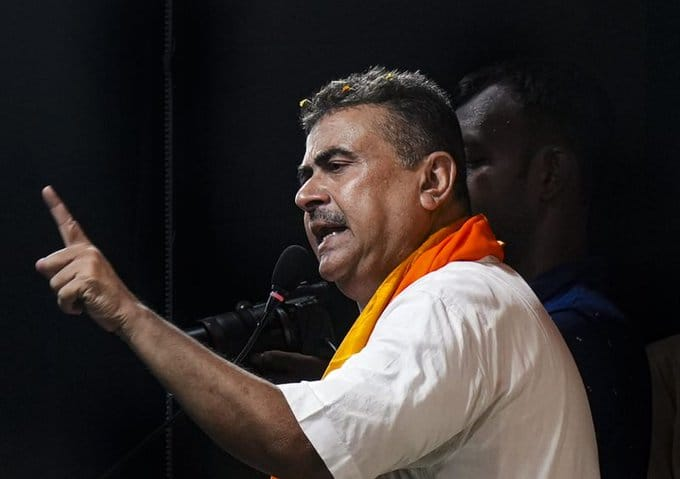
👑 QUEEN SLAYER - THE RISE OF SUVENDU ADHIKARI
The Man Who Dismantled Mamata Banerjee’s Political Empire - Brick by Brick
A Deep Strategic Analysis
On the morning of May 4, 2026, counting trends from 293 counting halls across West Bengal confirmed a decisive political shift. At the centre of it stood Suvendu Adhikari - the organisational architect of BJP’s breakthrough and the principal force behind the end of a 15-year political dominance.
By May 9, 2026, he was set to take oath as the 9th Chief Minister of West Bengal, becoming the first BJP leader to hold the office in the state’s history.
This is the story of how that transformation was engineered - not suddenly, but structurally, over nearly two decades.
📌 CHAPTER I: THE ROOTS - KARKULI TO POLITICAL ENTRY
Suvendu Adhikari was born on December 15, 1970, in Karkuli village of Purba Medinipur - a politically active coastal belt of Bengal.
He emerged from a powerful political family rooted in district-level influence. His early political exposure came not through urban institutions but through grassroots mobilisation networks that shaped his understanding of mass politics.
He began his political career in 1995 as a Congress councillor in Kanthi Municipality before joining the Trinamool Congress in 1998.
By 2006, he entered the West Bengal Legislative Assembly. His 2009 victory in Tamluk against CPI(M) leader Lakshman Seth by over 1.72 lakh votes marked his emergence as a major political force in South Bengal.
From the beginning, his strength was not ideology alone - but organisational depth at the booth and village level.
📌 CHAPTER II: NANDIGRAM 2007 - THE MOVEMENT THAT DEFINED HIM
Nandigram became the defining moment of Suvendu Adhikari’s political identity.
The 2007 anti-land acquisition movement against the proposed chemical hub triggered mass resistance across rural Bengal. As a key organiser of the Bhumi Uchhed Pratirodh Committee, Suvendu Adhikari played a central role in mobilising local resistance networks.
The police firing incident and subsequent violence transformed Nandigram into a statewide political turning point.
Together with Singur, the movement contributed directly to the collapse of the Left Front regime and the rise of Mamata Banerjee in 2011.
The political paradox was established early: the same organisational machinery that enabled Mamata Banerjee’s rise would later become central to her political decline.
📌 CHAPTER III: THE TMC YEARS - ORGANISATIONAL ARCHITECT OF SOUTH BENGAL
Within the Trinamool Congress, Suvendu Adhikari emerged as the party’s most effective field operator in South Bengal.
He expanded TMC’s reach across Purba Medinipur, Paschim Medinipur, Bankura, and Purulia - establishing a district-level control system rooted in personal trust networks.
As Transport Minister and later Irrigation Minister, he combined administrative authority with ground-level influence.
By 2018, he was functionally the second most powerful figure in TMC - not by designation, but by organisational control over electoral execution in South Bengal.
District mobilisation, booth management, and election coordination in key regions flowed through his network.
📌 CHAPTER IV: THE BREAK - STRUCTURAL CONFLICT WITHIN TMC
The internal balance of power began shifting after 2019, when Abhishek Banerjee was increasingly positioned as the central organisational authority within TMC.
This transition gradually altered the party’s decision-making structure - from field-based seniority to family-centred leadership consolidation.
The conflict was not personal in origin, but structural in outcome.
Two political models came into confrontation:
Grassroots legitimacy: built over decades of ground mobilisation
Dynastic legitimacy: based on proximity to leadership family structure
For Suvendu Adhikari, this shift represented a fundamental reversal of the organisational principles that had built TMC’s electoral success in South Bengal.
Over time, district-level control mechanisms began bypassing senior field leaders. Candidate selection, administrative coordination, and political appointments increasingly reflected a centralised inner-circle structure.
The result was a slow but irreversible organisational rupture.
📌 CHAPTER V: THE DEFECTION - DECEMBER 2020
On December 19, 2020, Suvendu Adhikari formally joined the Bharatiya Janata Party in the presence of Union Home Minister Amit Shah.
This was not a symbolic defection. It was an organisational transfer.
Entire booth-level networks across Purba Medinipur, built over decades, shifted allegiance with him. BJP, for the first time, gained a structured grassroots presence in South Bengal rather than relying solely on national wave politics.
This marked the beginning of a credible two-party contest in Bengal.
📌 CHAPTER VI: NANDIGRAM 2021 - THE TURNING OF POWER
The 2021 Assembly elections became a direct confrontation between Suvendu Adhikari and Mamata Banerjee.
In Nandigram, Suvendu defeated the sitting Chief Minister by 1,956 votes.
The numerical margin was narrow, but the political consequence was historic. A sitting Chief Minister had been defeated in a constituency of her choosing.
This single result altered the psychological structure of Bengal politics - establishing electoral vulnerability at the highest level of state leadership.
Following this, Suvendu Adhikari was appointed Leader of Opposition in the West Bengal Assembly.
📌 CHAPTER VII: THE OPPOSITION YEARS - BUILDING ELECTORAL STRUCTURE (2021–2026)
Between 2021 and 2026, Suvendu Adhikari consolidated BJP’s opposition framework in West Bengal.
Key interventions during this period included:
Sandeshkhali crisis escalation: bringing national attention and legal action to reported violence cases
CAA outreach operations: especially across Matua and Namasudra regions, converting policy into ground-level mobilisation
Electoral vigilance campaigns: documenting strongroom incidents and raising institutional complaints
Anti-infiltration narrative consolidation: maintaining demographic and border integrity discourse across rural Bengal
These interventions ensured BJP remained organisationally active despite being in opposition.
📌 CHAPTER VIII: 2026 ELECTIONS - THE DOUBLE MANDATE
The 2026 elections marked a decisive political transition.
Suvendu Adhikari contested from both Nandigram and Bhabanipur and won both seats.
In Bhabanipur, he defeated Mamata Banerjee by over 15,000 votes - a symbolic and structural collapse of her strongest urban constituency.
This result reflected a deeper electoral shift already visible in previous cycles, particularly in Kolkata’s urban voter base.
The mandate confirmed a full-scale political transition in the state.
📌 CHAPTER IX: THE GOVERNANCE PHASE
The incoming administration begins its tenure with a high voter turnout of 92.47%, the highest in post-Independence West Bengal.
The governance direction is expected to focus on:
Citizenship resolution frameworks under CAA implementation
Institutional investigation into corruption cases across previous regimes
Border security enforcement and documentation reform
Administrative restructuring of state governance systems
This phase represents a shift from long-term political continuity to systemic reconfiguration.
📌 THE VERDICT: ONE MAN, ONE DECADE, ONE HISTORIC ARC
From a small village in Purba Medinipur to the Chief Minister's chair - Suvendu Adhikari's journey reflects the power of grassroots politics, the courage to make bold decisions at historic junctures, and an unshakeable connect with the common people of Bengal.
Mamata Banerjee's greatest political mistake was not her welfare failures, her governance record on Hindu safety, or her open-border policy. Her greatest political mistake was a human one. She looked at the most capable political soldier she had - a man who had built her empire with his own hands - and chose to replace him with her nephew.
She chose blood over merit. Dynasty over democracy. Inheritance over grassroots.
And Suvendu Adhikari - true to the only model of politics he has ever known - went to the ground, earned it back, and returned to take everything she had.
Mamata Banerjee built her empire by mobilising people against injustice. Suvendu Adhikari dismantled it using the same method - standing with people facing injustice, whether in Nandigram in 2007, in Sandeshkhali in 2024, or in the 303 families who fled Bengal after the 2021 post-poll violence.
The wheel came full circle on May 4, 2026. The man Mamata sidelined for her nephew took her throne. In Bhabanipur. By 15,000 votes.
That is not just politics. That is Bengal's history being written in real time.
And the lesson it writes for every political dynasty in India is permanent: you can sideline merit for blood once. But the ground never forgets.
🚨 OPERATION SINDOOR - THE COST OF DETERRENCE
How India became the first nation to strike a nuclear-armed state - and shook an American base in the crossfire.
A Strategic Deep Analysis - One Year After Operation Sindoor
At 2:09 AM on May 10, 2025, Indian BrahMos missiles and precision drones struck Pakistan’s Nur Khan Airbase - just kilometres from the nerve centre overseeing Pakistan’s nuclear arsenal.
Hours earlier, the conflict was dismissed as “none of our business.” Within hours of the strike, Washington was in crisis mode, diplomatic channels were activated at breakneck speed, and an “immediate and full ceasefire” was announced.
What changed?
India had crossed a line the world assumed no nation would dare cross - striking deep into the strategic heart of a nuclear-armed state.
This was the moment India called the biggest bluff of the post-Cold War era - and the world watched what happened when that bluff collapsed.
📌 CHAPTER I: THE HISTORICAL THRESHOLD - WHAT INDIA DID THAT NO NATION HAS DONE BEFORE
Before unpacking the Nur Khan dimension, the foundational historical fact must be stated with full clarity.
Operation Sindoor shattered a core assumption of the post-nuclear era. Unlike the restrained responses of 2016 and Balakot in 2019, India struck deep inside Pakistan’s strategic heartland - crossing a line previous doctrines avoided for fear of triggering nuclear escalation.
For decades, Pakistan’s Full Spectrum Deterrence relied on one belief: that the threat of nuclear retaliation would freeze India’s conventional response. Operation Sindoor challenged that belief head-on.
India broke that assumption on May 7, 2025.
For the first time since 1971, India struck across the internationally recognised boundary with Pakistan - reaching Bahawalpur in Pakistan's Punjab province, 600+ kilometres from the Line of Control, targeting the headquarters of Jaish-e-Mohammed and Lashkar-e-Taiba. This was not a surgical strike on a forward operating base. This was a statement that no geography in Pakistan is off-limits when Pakistan exports terrorism onto Indian soil.
Search the entire history of the nuclear era for a parallel. There is none. Israel struck Iraq's Osirak reactor in 1981 - but Iraq had no nuclear weapons. The United States bombed North Korea in the Korean War - before Pyongyang had the bomb. No state, in the post-1945 nuclear era, has struck sovereign territory of a declared nuclear-armed adversary with the depth, scale, and deliberate target selection that India demonstrated in May 2025.
India's deterrence logic was precisely documented by the Bulletin of the Atomic Scientists: "Pakistan's deterrence logic was undermined during the four-day conflict in May, when India ignored Islamabad's nuclear signaling and established what Prime Minister Modi described as a 'new normal.'"
The new normal. India became the first nuclear power in history to bomb another nuclear power's sovereign territory - and survive the nuclear bluff intact.
📌 CHAPTER II: THE COST OF DETERRENCE - HOW PAKISTAN'S 75-YEAR INSURANCE POLICY EXPIRED IN 88 HOURS
Pakistan has been running one of the most successful protection rackets in the history of international relations. Since 1998 - when it conducted nuclear tests days after India's Operation Shakti - Pakistan's strategic doctrine has rested on a single pillar: nuclear weapons as the ultimate guarantor against Indian conventional retaliation for state-sponsored terrorism.
The doctrine had a name: Full Spectrum Deterrence. Its logic was explicit. Pakistan would arm, train, and deploy non-state terrorist groups against India. When India threatened military retaliation, Pakistan would rattle the nuclear sabre, triggering Western - particularly American - diplomatic pressure on India to stand down. The deterrence was not designed to stop a nuclear war. It was designed to stop India from imposing a conventional military cost on Pakistan for terrorism.
India's Operation Sindoor starkly exposed the failure of this strategy. By striking eleven major airbases - from Sargodha to Sialkot, from Nur Khan to Jacobabad - India effectively neutralised Pakistan's capacity to deliver a nuclear warhead via its air vector. Complementing this, India's robust and layered air defence systems constrained Pakistan's missile delivery options. Even if Pakistan possessed a complete nuclear triad - which it does not - the Indian Navy's vigilant containment of the Pakistani Navy in the Arabian Sea would have thwarted any maritime strike.
Pakistan lacks a nuclear-armed submarine for sea-based deterrence, critical for a credible second-strike capability. Without second-strike survivability, Pakistan's nuclear doctrine rests on first-use threat - a threat India calculated, correctly, that Pakistan would not execute given that any Pakistani nuclear strike would be met with total Indian retaliation that would eliminate Pakistan as a functional state. India called that existential bluff. Pakistan blinked.
The numbers behind the conventional dominance that made this possible:
India destroyed an estimated 20% of Pakistan's operational Air Force across four days of combat.
Strikes across 10 Pakistani airbases were completed in just over 22 minutes - designed to paralyse Pakistan's capacity to assess, react, and recover simultaneously.
India's Akashteer system demonstrated a 100% kill rate against Pakistani drones. The S-400 Sudarshan Chakra intercepted all incoming Pakistani missiles successfully - zero Pakistani missiles or drones caused meaningful damage to Indian infrastructure.
Satellite imagery confirmed massive destruction at Jacobabad Air Base including the complete destruction of a large hangar housing US-made F-16 fighters. Pakistan's claims of minimal damage were demolished, literally and photographically.
Massive craters were observed near the hills surrounding Nur Khan airbase, believed to house Pakistan's nuclear storage infrastructure - a deliberate signal of India's capability to reach Pakistan's nuclear architecture without triggering its use.
The cost of deterrence had been imposed. For the first time in 27 years of nuclear Pakistan, the bill had come due. And Pakistan paid it.
📌 CHAPTER III: NUR KHAN - THE BASE THAT CHANGED EVERYTHING
The Nur Khan Airbase strike is the most consequential single action in Operation Sindoor - and the least fully understood.
Nur Khan Airbase in Rawalpindi serves as the hub of Pakistan's Air Force air mobility operations, VIP transport, and strategic operations. It is located kilometres from the Pakistan Army's General Headquarters (GHQ) and the Strategic Plans Division - the command overseeing Pakistan's estimated 170 nuclear warheads.
The New York Times cited a former American official: "Pakistan's deepest fear is of its nuclear command authority being decapitated." The Indian missile strikes on Nur Khan were interpreted as a warning of India's capability to do exactly that. According to Christopher Clary, an associate professor at the University at Albany: "An attack on the facility may have been perceived as more dangerous than India intended."
But here is the dimension that Western reporting consistently buried and that deserves full analytical exposure.
Pakistani security analyst Imtiaz Gul alleges - with significant corroborating evidence - that Nur Khan Airbase operates under de facto American operational control through a covert arrangement, with US aircraft regularly landing and taking off amid limited transparency. Even senior Pakistani military officials are reportedly restricted from accessing certain operations at the base.
During the Cold War, Pakistan permitted US U-2 reconnaissance missions from Peshawar's Badaber Airbase. During the War on Terror, critical facilities - including Shamsi, Shahbaz, Dalbandin, and Nur Khan - were used by US forces for drone strikes, intelligence gathering, and logistical operations in Afghanistan. While less overt today, this military collaboration continues in more discreet and sophisticated forms.
Despite the US withdrawal from Afghanistan, Nur Khan is believed to serve as a forward-operating location for US intelligence, surveillance, and reconnaissance missions - potentially including pre-positioning for potential strikes targeting Iranian nuclear sites or remnants of ISIS-Khorasan.
Now read the sequence of events again with this context.
• May 9, 10:00 PM: JD Vance - "none of our business."
• May 9–10, 2:09 AM: India strikes Nur Khan.
• May 10, morning: Rubio emergency calls activated. White House situation room fully engaged. Trump announces ceasefire on social media by afternoon.
Reuters reported that India's strikes on Nur Khan airbase had alarmed US officials, due to the base's proximity to Pakistan's Strategic Plans Division. According to a senior Pakistani intelligence official, Pakistan viewed the strike on Nur Khan as a red line particularly given its proximity to nuclear infrastructure. "US intervention was necessary to pull the two sides back from the brink," the official said. "The last move came from the president."
Pakistan's Deputy PM Ishaq Dar confirmed in December 2025 that Rubio called him at 8:17 AM on May 10 and conveyed India's readiness for a ceasefire, asking whether Pakistan would agree - effectively revealing that the US had been in direct diplomatic engagement with both sides through the night, activated by the Nur Khan strike.
The analytical conclusion is unavoidable: India did not merely strike a Pakistani military base. India struck a facility with embedded US strategic interests - and that strike is what triggered the most rapid American diplomatic intervention in the India-Pakistan conflict's entire history.
Vance said it was none of America's business. India made it America's business in 23 minutes.
📌 CHAPTER IV: THE GEOPOLITICAL EARTHQUAKE - WHAT THE STRIKE REVEALED
The Nur Khan strike and its aftermath revealed four structural geopolitical truths that will reshape South Asian strategic calculations for decades.
Truth 1: Pakistan's Nuclear Shield Was Always An American Shield
Pakistan's nuclear signaling is primarily aimed at securing third-party intervention - particularly from the United States - when confronted by India's conventional military superiority. The nuclear threat was never primarily about deterring India. It was about triggering American diplomatic intervention before India could impose a decisive conventional defeat. Frontiers
Operation Sindoor revealed the mechanism. Strike close enough to Pakistan's nuclear infrastructure - and specifically, close enough to US covert interests embedded within that infrastructure - and Washington activates immediately. The nuclear shield Pakistan advertises to the world is, in operational reality, an American diplomatic guarantee that gets triggered when American assets are threatened.
India proved it understands this mechanism - and that it can operate within it.
Truth 2: Chinese Weapons Failed Under Real Combat Conditions
Operation Sindoor highlighted that Pakistan's Chinese-supplied air defense systems - J-10Cs, HQ-9 batteries, PL-15 missiles - failed to prevent a single Indian strike from reaching its target. Wiley Online Library
The operation carries longer-term implications for Chinese-supplied air defense worldwide. Systems marketed as peer competitors to Western and Russian alternatives failed completely. Defense procurement officials worldwide are reconsidering contracts built on assumptions that May 2025 demolished. The Wire
This has a direct deterrence implication for Taiwan, for the South China Sea, and for every country that has purchased Chinese air defense infrastructure. China's weapons failed against Indian indigenously developed systems. That is a strategic advertisement for Indian defense manufacturing and a strategic liability for Chinese arms exports that China will spend years trying to counter-narrate.
Truth 3: The Nuclear Threshold Is Higher Than Pakistan Claimed
India demonstrated by striking eleven major Pakistani airbases that it could impose devastating conventional damage without triggering nuclear response. India's strikes effectively neutralised Pakistan's air-vector nuclear delivery capability while its navy contained the maritime vector and its missile defense intercepted all incoming threats. PubMed Central
Indian strategists may increasingly see through Pakistan's nuclear bluff and could pursue a decisive conventional campaign in a future India-Pakistan confrontation. A conventional war under the shadow of Pakistan's nuclear threats is now more plausible, not less, because India has demonstrated the threshold is higher than Pakistan's rhetoric suggested. Frontiers
Truth 4: India Has Redefined the Rules of Engagement for Nuclear-Era Conflicts
India's Chief of Defence Staff General Anil Chauhan articulated the new doctrine explicitly: "There is increased propensity amongst nations and governments to use force because political objectives today can be achieved by short-duration conflicts. Precision strikes create very little collateral damage - hence the cost of war for nations is less." Taylor & Francis Online
Operation Sindoor established three pillars of India's new doctrine: any terrorist attack on Indian soil will be met with assured and proportionate retaliation; India will no longer be deterred by nuclear blackmail in striking terrorist hideouts across the border; India will not differentiate between terrorists and the government that harbours them. PubMed Central
This doctrine - articulated publicly, validated operationally, and enforced with precision - has permanently changed the cost-benefit calculation for state-sponsored terrorism. Every government in the world that uses non-state actors as strategic instruments against a neighbour now has to factor in India's May 2025 precedent.
📌 CHAPTER V: THE IMF FOOTNOTE - HOW THE US PROTECTED ITS INVESTMENT
In May 2025, amid escalating conflict with India following Operation Sindoor, Pakistan secured a crucial US$1 billion disbursement from the International Monetary Fund under its $7 billion Extended Fund Facility. The Tribune
The timing is not coincidental. It is structural.
The IMF disbursement, arriving precisely during the conflict, served multiple US strategic purposes simultaneously: it prevented Pakistan's economic collapse (which would have destabilised US intelligence and military assets in the country), it signalled to Pakistan's military establishment that American institutional support remained operative regardless of the conflict's military outcome, and it gave Pakistan's leadership the financial cushion to accept a ceasefire without appearing domestically as having capitulated.
Pakistan's 2025–26 federal budget included a nearly 20% increase in defence spending, raising the allocation to approximately 2.55 trillion rupees, even as overall public expenditure was reduced by 7%. Analysts argue that such a move would not have been possible without continued external backing from the US through financial assistance and favourable multilateral mechanisms. The Tribune
India demonstrated military dominance. The US ensured Pakistan's military establishment survived financially to fight another day - or rather, to remain useful for American strategic purposes in the region. This is the honest geopolitics that India's strategic establishment must map, plan around, and ultimately work to change through sustained diplomatic investment in Quad architecture, G20 leadership, and the long project of making the US-India partnership structurally more important to Washington than the US-Pakistan arrangement.
📌 THE VERDICT: WHAT OPERATION SINDOOR CHANGED FOREVER
Operation Sindoor didn’t just strike targets - it shattered assumptions.
India called Pakistan’s nuclear bluff, proving that terror attacks can now invite direct military retaliation without fear of nuclear blackmail.
For the first time, India demonstrated a fully indigenous kill chain - BrahMos, Akash, Akashteer, S-400 integration - exposing both Pakistan’s vulnerability and the combat limitations of Chinese weapon systems.
Pakistan paid the price in damaged airbases, crippled operational capacity, and a forced ceasefire request after Nur Khan was struck at 2:09 AM.
The old doctrine of “bleeding India by a thousand cuts” collapsed the moment India showed it could impose a cost far greater than Pakistan’s nuclear shield could prevent.
The bill was delivered with a BrahMos missile. The receipt was the DGMO call requesting ceasefire.
May 7–10, 2025 changed the rules of deterrence in South Asia forever. And the world - from Beijing's defense procurement offices to Washington's situation rooms - has been taking notes ever since.
धर्मो रक्षति रक्षितः Jai Hind 🇮🇳
For the first time since Partition, Bengal’s Hindus - Bhadralok, Upper caste, OBC, Dalit, Tribal, Urban, and Rural - voted as ONE.
The force behind it was Sanatan and Hindutva.
ST-SC community in West Bengal are worshippers of Maa Kali, not Bhim. Period.
कोलकाता अकेली राजधानी है, जहां बाबा साहब की भव्य, दूर से नजर आने वाली मूर्ति या उनके नाम पर कोई बड़ा संस्थान नहीं है.
ये कांग्रेस-लेफ्ट-टीएमसी का पाप है.
बीजेपी प. बंगाल में "84 एससी-एसटी सीटों में से 67 जीत गई है."
टीएमसी रिजेक्ट हो गई है.
अब समय आ गया है. जय भीम.
🚨 OPERATION SINDOOR - THE COST OF DETERRENCE
How India became the first nation to strike a nuclear-armed state - and shook an American base in the crossfire.
A Strategic Deep Analysis - One Year After Operation Sindoor
At 2:09 AM on May 10, 2025, Indian BrahMos missiles and precision drones struck Pakistan’s Nur Khan Airbase - just kilometres from the nerve centre overseeing Pakistan’s nuclear arsenal.
Hours earlier, the conflict was dismissed as “none of our business.” Within hours of the strike, Washington was in crisis mode, diplomatic channels were activated at breakneck speed, and an “immediate and full ceasefire” was announced.
What changed?
India had crossed a line the world assumed no nation would dare cross - striking deep into the strategic heart of a nuclear-armed state.
This was the moment India called the biggest bluff of the post-Cold War era - and the world watched what happened when that bluff collapsed.
📌 CHAPTER I: THE HISTORICAL THRESHOLD - WHAT INDIA DID THAT NO NATION HAS DONE BEFORE
Before unpacking the Nur Khan dimension, the foundational historical fact must be stated with full clarity.
Operation Sindoor shattered a core assumption of the post-nuclear era. Unlike the restrained responses of 2016 and Balakot in 2019, India struck deep inside Pakistan’s strategic heartland - crossing a line previous doctrines avoided for fear of triggering nuclear escalation.
For decades, Pakistan’s Full Spectrum Deterrence relied on one belief: that the threat of nuclear retaliation would freeze India’s conventional response. Operation Sindoor challenged that belief head-on.
India broke that assumption on May 7, 2025.
For the first time since 1971, India struck across the internationally recognised boundary with Pakistan - reaching Bahawalpur in Pakistan's Punjab province, 600+ kilometres from the Line of Control, targeting the headquarters of Jaish-e-Mohammed and Lashkar-e-Taiba. This was not a surgical strike on a forward operating base. This was a statement that no geography in Pakistan is off-limits when Pakistan exports terrorism onto Indian soil.
Search the entire history of the nuclear era for a parallel. There is none. Israel struck Iraq's Osirak reactor in 1981 - but Iraq had no nuclear weapons. The United States bombed North Korea in the Korean War - before Pyongyang had the bomb. No state, in the post-1945 nuclear era, has struck sovereign territory of a declared nuclear-armed adversary with the depth, scale, and deliberate target selection that India demonstrated in May 2025.
India's deterrence logic was precisely documented by the Bulletin of the Atomic Scientists: "Pakistan's deterrence logic was undermined during the four-day conflict in May, when India ignored Islamabad's nuclear signaling and established what Prime Minister Modi described as a 'new normal.'"
The new normal. India became the first nuclear power in history to bomb another nuclear power's sovereign territory - and survive the nuclear bluff intact.
📌 CHAPTER II: THE COST OF DETERRENCE - HOW PAKISTAN'S 75-YEAR INSURANCE POLICY EXPIRED IN 88 HOURS
Pakistan has been running one of the most successful protection rackets in the history of international relations. Since 1998 - when it conducted nuclear tests days after India's Operation Shakti - Pakistan's strategic doctrine has rested on a single pillar: nuclear weapons as the ultimate guarantor against Indian conventional retaliation for state-sponsored terrorism.
The doctrine had a name: Full Spectrum Deterrence. Its logic was explicit. Pakistan would arm, train, and deploy non-state terrorist groups against India. When India threatened military retaliation, Pakistan would rattle the nuclear sabre, triggering Western - particularly American - diplomatic pressure on India to stand down. The deterrence was not designed to stop a nuclear war. It was designed to stop India from imposing a conventional military cost on Pakistan for terrorism.
India's Operation Sindoor starkly exposed the failure of this strategy. By striking eleven major airbases - from Sargodha to Sialkot, from Nur Khan to Jacobabad - India effectively neutralised Pakistan's capacity to deliver a nuclear warhead via its air vector. Complementing this, India's robust and layered air defence systems constrained Pakistan's missile delivery options. Even if Pakistan possessed a complete nuclear triad - which it does not - the Indian Navy's vigilant containment of the Pakistani Navy in the Arabian Sea would have thwarted any maritime strike.
Pakistan lacks a nuclear-armed submarine for sea-based deterrence, critical for a credible second-strike capability. Without second-strike survivability, Pakistan's nuclear doctrine rests on first-use threat - a threat India calculated, correctly, that Pakistan would not execute given that any Pakistani nuclear strike would be met with total Indian retaliation that would eliminate Pakistan as a functional state. India called that existential bluff. Pakistan blinked.
The numbers behind the conventional dominance that made this possible:
India destroyed an estimated 20% of Pakistan's operational Air Force across four days of combat.
Strikes across 10 Pakistani airbases were completed in just over 22 minutes - designed to paralyse Pakistan's capacity to assess, react, and recover simultaneously.
India's Akashteer system demonstrated a 100% kill rate against Pakistani drones. The S-400 Sudarshan Chakra intercepted all incoming Pakistani missiles successfully - zero Pakistani missiles or drones caused meaningful damage to Indian infrastructure.
Satellite imagery confirmed massive destruction at Jacobabad Air Base including the complete destruction of a large hangar housing US-made F-16 fighters. Pakistan's claims of minimal damage were demolished, literally and photographically.
Massive craters were observed near the hills surrounding Nur Khan airbase, believed to house Pakistan's nuclear storage infrastructure - a deliberate signal of India's capability to reach Pakistan's nuclear architecture without triggering its use.
The cost of deterrence had been imposed. For the first time in 27 years of nuclear Pakistan, the bill had come due. And Pakistan paid it.
📌 CHAPTER III: NUR KHAN - THE BASE THAT CHANGED EVERYTHING
The Nur Khan Airbase strike is the most consequential single action in Operation Sindoor - and the least fully understood.
Nur Khan Airbase in Rawalpindi serves as the hub of Pakistan's Air Force air mobility operations, VIP transport, and strategic operations. It is located kilometres from the Pakistan Army's General Headquarters (GHQ) and the Strategic Plans Division - the command overseeing Pakistan's estimated 170 nuclear warheads.
The New York Times cited a former American official: "Pakistan's deepest fear is of its nuclear command authority being decapitated." The Indian missile strikes on Nur Khan were interpreted as a warning of India's capability to do exactly that. According to Christopher Clary, an associate professor at the University at Albany: "An attack on the facility may have been perceived as more dangerous than India intended."
But here is the dimension that Western reporting consistently buried and that deserves full analytical exposure.
Pakistani security analyst Imtiaz Gul alleges - with significant corroborating evidence - that Nur Khan Airbase operates under de facto American operational control through a covert arrangement, with US aircraft regularly landing and taking off amid limited transparency. Even senior Pakistani military officials are reportedly restricted from accessing certain operations at the base.
During the Cold War, Pakistan permitted US U-2 reconnaissance missions from Peshawar's Badaber Airbase. During the War on Terror, critical facilities - including Shamsi, Shahbaz, Dalbandin, and Nur Khan - were used by US forces for drone strikes, intelligence gathering, and logistical operations in Afghanistan. While less overt today, this military collaboration continues in more discreet and sophisticated forms.
Despite the US withdrawal from Afghanistan, Nur Khan is believed to serve as a forward-operating location for US intelligence, surveillance, and reconnaissance missions - potentially including pre-positioning for potential strikes targeting Iranian nuclear sites or remnants of ISIS-Khorasan.
Now read the sequence of events again with this context.
• May 9, 10:00 PM: JD Vance - "none of our business."
• May 9–10, 2:09 AM: India strikes Nur Khan.
• May 10, morning: Rubio emergency calls activated. White House situation room fully engaged. Trump announces ceasefire on social media by afternoon.
Reuters reported that India's strikes on Nur Khan airbase had alarmed US officials, due to the base's proximity to Pakistan's Strategic Plans Division. According to a senior Pakistani intelligence official, Pakistan viewed the strike on Nur Khan as a red line particularly given its proximity to nuclear infrastructure. "US intervention was necessary to pull the two sides back from the brink," the official said. "The last move came from the president."
Pakistan's Deputy PM Ishaq Dar confirmed in December 2025 that Rubio called him at 8:17 AM on May 10 and conveyed India's readiness for a ceasefire, asking whether Pakistan would agree - effectively revealing that the US had been in direct diplomatic engagement with both sides through the night, activated by the Nur Khan strike.
The analytical conclusion is unavoidable: India did not merely strike a Pakistani military base. India struck a facility with embedded US strategic interests - and that strike is what triggered the most rapid American diplomatic intervention in the India-Pakistan conflict's entire history.
Vance said it was none of America's business. India made it America's business in 23 minutes.
📌 CHAPTER IV: THE GEOPOLITICAL EARTHQUAKE - WHAT THE STRIKE REVEALED
The Nur Khan strike and its aftermath revealed four structural geopolitical truths that will reshape South Asian strategic calculations for decades.
Truth 1: Pakistan's Nuclear Shield Was Always An American Shield
Pakistan's nuclear signaling is primarily aimed at securing third-party intervention - particularly from the United States - when confronted by India's conventional military superiority. The nuclear threat was never primarily about deterring India. It was about triggering American diplomatic intervention before India could impose a decisive conventional defeat. Frontiers
Operation Sindoor revealed the mechanism. Strike close enough to Pakistan's nuclear infrastructure - and specifically, close enough to US covert interests embedded within that infrastructure - and Washington activates immediately. The nuclear shield Pakistan advertises to the world is, in operational reality, an American diplomatic guarantee that gets triggered when American assets are threatened.
India proved it understands this mechanism - and that it can operate within it.
Truth 2: Chinese Weapons Failed Under Real Combat Conditions
Operation Sindoor highlighted that Pakistan's Chinese-supplied air defense systems - J-10Cs, HQ-9 batteries, PL-15 missiles - failed to prevent a single Indian strike from reaching its target. Wiley Online Library
The operation carries longer-term implications for Chinese-supplied air defense worldwide. Systems marketed as peer competitors to Western and Russian alternatives failed completely. Defense procurement officials worldwide are reconsidering contracts built on assumptions that May 2025 demolished. The Wire
This has a direct deterrence implication for Taiwan, for the South China Sea, and for every country that has purchased Chinese air defense infrastructure. China's weapons failed against Indian indigenously developed systems. That is a strategic advertisement for Indian defense manufacturing and a strategic liability for Chinese arms exports that China will spend years trying to counter-narrate.
Truth 3: The Nuclear Threshold Is Higher Than Pakistan Claimed
India demonstrated by striking eleven major Pakistani airbases that it could impose devastating conventional damage without triggering nuclear response. India's strikes effectively neutralised Pakistan's air-vector nuclear delivery capability while its navy contained the maritime vector and its missile defense intercepted all incoming threats. PubMed Central
Indian strategists may increasingly see through Pakistan's nuclear bluff and could pursue a decisive conventional campaign in a future India-Pakistan confrontation. A conventional war under the shadow of Pakistan's nuclear threats is now more plausible, not less, because India has demonstrated the threshold is higher than Pakistan's rhetoric suggested. Frontiers
Truth 4: India Has Redefined the Rules of Engagement for Nuclear-Era Conflicts
India's Chief of Defence Staff General Anil Chauhan articulated the new doctrine explicitly: "There is increased propensity amongst nations and governments to use force because political objectives today can be achieved by short-duration conflicts. Precision strikes create very little collateral damage - hence the cost of war for nations is less." Taylor & Francis Online
Operation Sindoor established three pillars of India's new doctrine: any terrorist attack on Indian soil will be met with assured and proportionate retaliation; India will no longer be deterred by nuclear blackmail in striking terrorist hideouts across the border; India will not differentiate between terrorists and the government that harbours them. PubMed Central
This doctrine - articulated publicly, validated operationally, and enforced with precision - has permanently changed the cost-benefit calculation for state-sponsored terrorism. Every government in the world that uses non-state actors as strategic instruments against a neighbour now has to factor in India's May 2025 precedent.
��� CHAPTER V: THE IMF FOOTNOTE - HOW THE US PROTECTED ITS INVESTMENT
In May 2025, amid escalating conflict with India following Operation Sindoor, Pakistan secured a crucial US$1 billion disbursement from the International Monetary Fund under its $7 billion Extended Fund Facility. The Tribune
The timing is not coincidental. It is structural.
The IMF disbursement, arriving precisely during the conflict, served multiple US strategic purposes simultaneously: it prevented Pakistan's economic collapse (which would have destabilised US intelligence and military assets in the country), it signalled to Pakistan's military establishment that American institutional support remained operative regardless of the conflict's military outcome, and it gave Pakistan's leadership the financial cushion to accept a ceasefire without appearing domestically as having capitulated.
Pakistan's 2025–26 federal budget included a nearly 20% increase in defence spending, raising the allocation to approximately 2.55 trillion rupees, even as overall public expenditure was reduced by 7%. Analysts argue that such a move would not have been possible without continued external backing from the US through financial assistance and favourable multilateral mechanisms. The Tribune
India demonstrated military dominance. The US ensured Pakistan's military establishment survived financially to fight another day - or rather, to remain useful for American strategic purposes in the region. This is the honest geopolitics that India's strategic establishment must map, plan around, and ultimately work to change through sustained diplomatic investment in Quad architecture, G20 leadership, and the long project of making the US-India partnership structurally more important to Washington than the US-Pakistan arrangement.
📌 THE VERDICT: WHAT OPERATION SINDOOR CHANGED FOREVER
Operation Sindoor didn’t just strike targets - it shattered assumptions.
India called Pakistan’s nuclear bluff, proving that terror attacks can now invite direct military retaliation without fear of nuclear blackmail.
For the first time, India demonstrated a fully indigenous kill chain - BrahMos, Akash, Akashteer, S-400 integration - exposing both Pakistan’s vulnerability and the combat limitations of Chinese weapon systems.
Pakistan paid the price in damaged airbases, crippled operational capacity, and a forced ceasefire request after Nur Khan was struck at 2:09 AM.
The old doctrine of “bleeding India by a thousand cuts” collapsed the moment India showed it could impose a cost far greater than Pakistan’s nuclear shield could prevent.
The bill was delivered with a BrahMos missile. The receipt was the DGMO call requesting ceasefire.
May 7–10, 2025 changed the rules of deterrence in South Asia forever. And the world - from Beijing's defense procurement offices to Washington's situation rooms - has been taking notes ever since.
धर्मो रक्षति रक्षितः Jai Hind 🇮🇳
POST-POLL VIOLENCE 2021: BLOOD FOR BALLOTS
Bengalis paid in blood for voting for the BJP in 2021. The least they deserve is for those responsible to be held accountable.
Every name. Every location. Every date. Real people. Real families. Real Bengal.
1. Avijit Sarkarn - Belgharia - 02/05/2021
2. Anil Barman - Sitai - 30/05/2021
3. Arindam Mishra - Falta - 16/05/2021
4. Arup Roydas - Indas - 08/05/2021
5. Ashis Das - Sandeshkhali - 10/05/2021
6. Balaram Maji - Keshpur - 05/05/2021
7. Bapi Das - Ranaghat - 05/05/2021
8. Bhaskar Bera - Bhagabanpur - 13/11/2021
9. Chandan Maity - Chandipur - 09/11/2021
10. Chanda Halder - Sattiya - 02/09/2021
11. Debabrata Maity - Nandigram - 10/05/2021
12. Debashish Seal - Moynapur - 07/09/2021
13. Debesh Barman - Raiganj - 20/09/2021
14. Dharma Mondal - Chapra - 16/05/2021
15. Dhiren Barman - Sitalkuchi - 24/05/2021
16. Durgabala Bag - Rayna - 03/05/2021
17. Gourab Sarkar - Bolpur - 02/05/2021
18. Haradhan Ray - Dinajpur - 08/05/2021
19. Haran Adhikari - Sonarpur - 02/05/2021
20. Jayprakash Yadav - Bhatpara - 06/06/2021
21. Jyosna Malik - Barasat - 12/05/2021
22. Kishore Maity - Bagnan - 05/05/2021
23. Krishna Khempal - Kotulpur - 06/05/2021
24. Manas Saha - Manbazar - 22/09/2021
25. Mithun Bagdi - Dubrajpur - 12/06/2021
26. Mithu Ghosh - Uttarpara - 18/10/2021
27. Mohammad Ali - Barasat - 06/08/2021
28. Manoj Jashwal - Nalhati - 07/05/2021
29. Nirmal Mondal - Sonarpur Uttar - 20/05/2021
30. Prasenjit Das - Rajarhat - 23/05/2021
31. Pratap Mondal - Harishchandrapur - 11/09/2021
32. Raju Saha - Diamond Harbour - 29/05/2021
33. Ranjit Das - Amta - 11/05/2021
34. Samresh Pal - Kakdwip - 25/07/2021
35. Sanjit Mondal - Naihati - 05/05/2021
36. Sheikh Hasina - Bhatar - 21/05/2021
37. Shivnarayan Das - Sitai - 23/06/2021
38. Sourav Bora - Manbazar - 03/05/2021
39. Soma Rani Mondal - Jagatdal - 03/05/2021
40. Uttam Ghosh - Chakdah - 02/05/2021
40 names.
40 families shattered.
Spread across 35+ locations - from Sitalkuchi to Diamond Harbour, from Nandigram to Sandeshkhali.
The violence began on May 2, 2021 - the very day the results were declared. Fourteen of those forty deaths occurred within just the first ten days.
These are not numbers. These are carpenters, farmers, shopkeepers, party workers, ordinary people of Bengal. They weren’t killed on a battlefield, but in a democracy, for exercising their choice.
On June 21, 2021, the Calcutta High Court constituted a seven-member enquiry committee led by Rajiv Sharma of the National Human Rights Commission. The committee received around 1,979 complaints, covering nearly 15,000 victims of post-poll violence across West Bengal.
Pause on that number - 15,000 victims. From a single state election. In a constitutional democracy.
The CBI, tasked by the High Court to probe the most serious cases, is investigating 52 cases of murder and unnatural death, along with 39 cases of rape and molestation. So far, 10 charge sheets have been filed in murder and unnatural death cases.
As of April 2022, at least 303 BJP workers and local leaders who fled their homes in 2021 had still not returned - waiting for assurances of safety from the state before going back to the lives they once knew.
A five-judge bench was formed. Investigations were ordered. Evidence was documented. And yet, it was dismissed as “small-small incidents that happen everywhere after elections.”
But every name on that list had a family.
Every family had a home.
And every home was in West Bengal.
They were not soldiers. They were not criminals. They were citizens, who put up posters, worked at polling booths, or simply voted their conscience.
They were killed for it.
Dismissed as “small incidents” by the very system meant to protect them.
The terror may be over - now the nation waits for justice to be delivered.