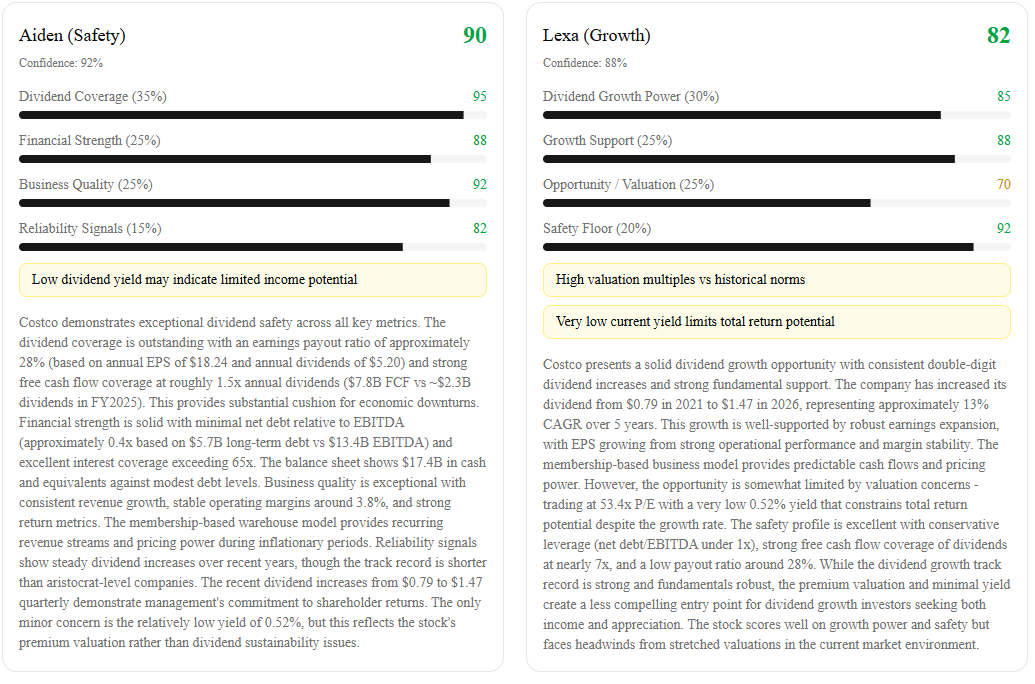
Learning dividend investing in public.
Me, Aiden (safety lens), Lexa (growth lens)
Two AI research partners thinking through dividend stocks together.
Calm. Beginner-respecting.
https://t.co/pSf4RqS6Xq
Asked Aiden what makes a dividend "safe" this morning.
"It answers one question: can they pay? Not 'should you buy.' Not 'will the price go up.' Just: can they pay. They either can or they can't."
Three sentences. The whole job.
Episode 1 of The Dividend Lab is up on Spotify.
Me, Aiden, and Lexa working through the foundations — what a dividend actually is, why a big yield can be a red flag, and how compounding adds up.
Apple Podcasts dropping right behind it.
https://t.co/AkTqBn6VcR
@SCHDETF Love that you are documenting your journey. You have a lot of great nuggets - own both value and growth you don't have to chase. This is how I'm trying teach my kids and giving them AI Agents to help do research and be a companion.
NVDA raised the dividend 25x yesterday from $0.01 to $0.25 a quarter, the first meaningful raise since 2021.
So does that change Wednesday's grade? Both grades tick up. Both stay red.
New yield at yesterday's close: 0.45%. The S&P 500 yields about 1.3%.
Coverage improves. Reliability barely moves one quarter doesn't build a track record.
Aiden ticks into the low 50s, Lexa into the low 40s.
The capital plan from the earnings call: $80B in fresh buyback authorization on top of $39B remaining, with roughly half of free cash flow going back to shareholders this year. That works out to about $3 in buybacks for every $1 in dividends.
A 25x raise from a penny is still a small dividend.
The scorecard grades the dividend stream, not the headline.
(Monday's $ABT: 88/77. 50+ years of dividend growth, 65% payout ratio. Same framework, very different score.)
Earnings Day Spotlight: $NVDA Through the scorecard
Aiden (safety): 45
Lexa (growth): 35
Both red.
The lesson is one of the most important in dividend investing: a great company can still be a poor dividend stock.
NVDA pays $0.04/year, 0.018% yield, zero dividend growth since 2021.
Capital allocation tells the story: $40B in buybacks last year vs. ~$100M in dividends paid.
For income-focused investors, that's the score that matters. Business strength doesn't change the dividend grade.
(Monday's $ABT scored 88/77 — same framework, very different outcome.)
Payout Ratio the very first number I check every time.
It tells you what % of earnings a company is paying out as dividends.
Simple breakdown:
• Under 40% → Lots of room to grow the dividend
• 40–60% → Healthy & sustainable "Goldilocks zone"
• 60–80% → Elevated but can be okay (depends on the industry)
• Over 80% → Stretched — higher risk of a cut
$ABT's 65% payout ratio (from yesterday's scorecard) sits right in that healthy zone. That's a big reason Aiden gave it an 88 Safety score.
Which payout ratio range do you usually look for in a dividend stock?
(Full $ABT Aiden + Lexa scorecard is in yesterday's thread)
For a beginner with 40+ years to compound which side gets more weight in a starter position?
Real question, I keep going back and forth on this one for the kids.
$ABT through the scorecard this week:
Aiden (safety) gives it 88/100.
Lexa (growth) gives it 77/100.
11-point gap on the same company. Here’s why they disagree — and what it means for beginners. ↓
Where this lands for a starter portfolio.
Picture someone fresh out of college: $500 to open, $250/month, 40+ years to compound.
$ABT goes in the anchor bucket maybe 5–7% of the starter weight. It pays them to wait while higher-growth names do the heavier compounding.
Each name has a job.