Invention is not a claim on the profits.
RC Cola shipped diet cola first but then Coca-Cola owned the shelf space. GE owned the hospital sales force.
Software's forward multiple fell below the S&P's in April, against a 32% average premium since 2008. https://t.co/96OBwC1EDk
August's ISM fell 1.0 to 54.6. But the only sub-index that pushed the headline up was supplier deliveries, which rises when deliveries slow. Strip it out and the demand side fell 1.35. This is a margin cycle, not a demand cycle. https://t.co/RMn1SuejFo
You don't have distribution. Your partner does.
AST signed 60+ operators, 3bn subscribers. The June quarter: $31.5m at 25% gross margin, from gateways and government - not the borrowed channel.
The sign isn't the logo slide. It's which line the revenue lands in.
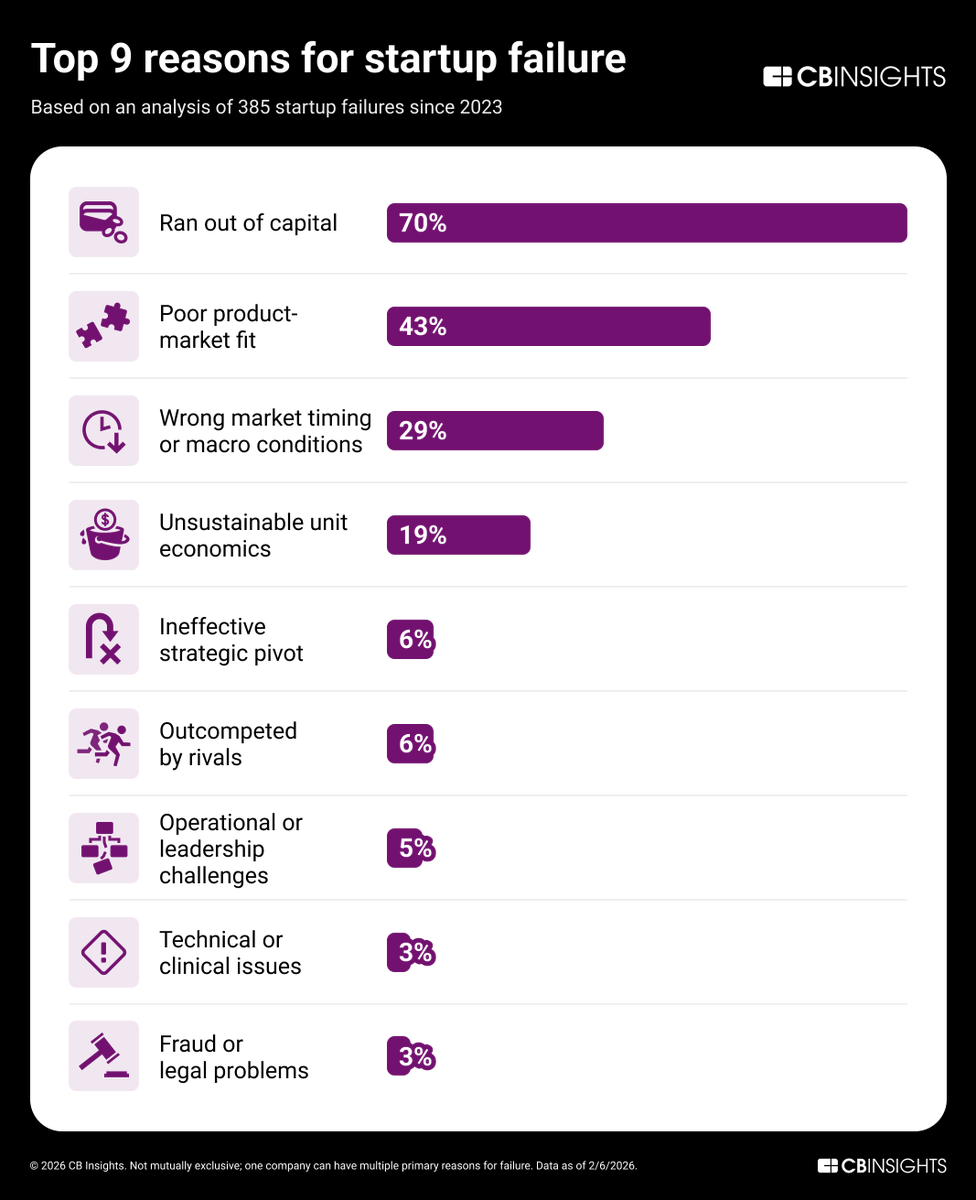
70% of dead startups say they ran out of capital. 43% say poor product-market fit.
Capital is the cause of death. The disease is picking the application your credential lives in, not the one with a desperate customer. Unless the science is the moat.
Tool or platform?
A compliant stablecoin is a zero-coupon loan to the Treasury. It can only be lent short: bills of 93 days or less, into a debt already near 22% bills.
The demand is real. Its price is set at the next refunding - the maturity Treasury gives up to take it.
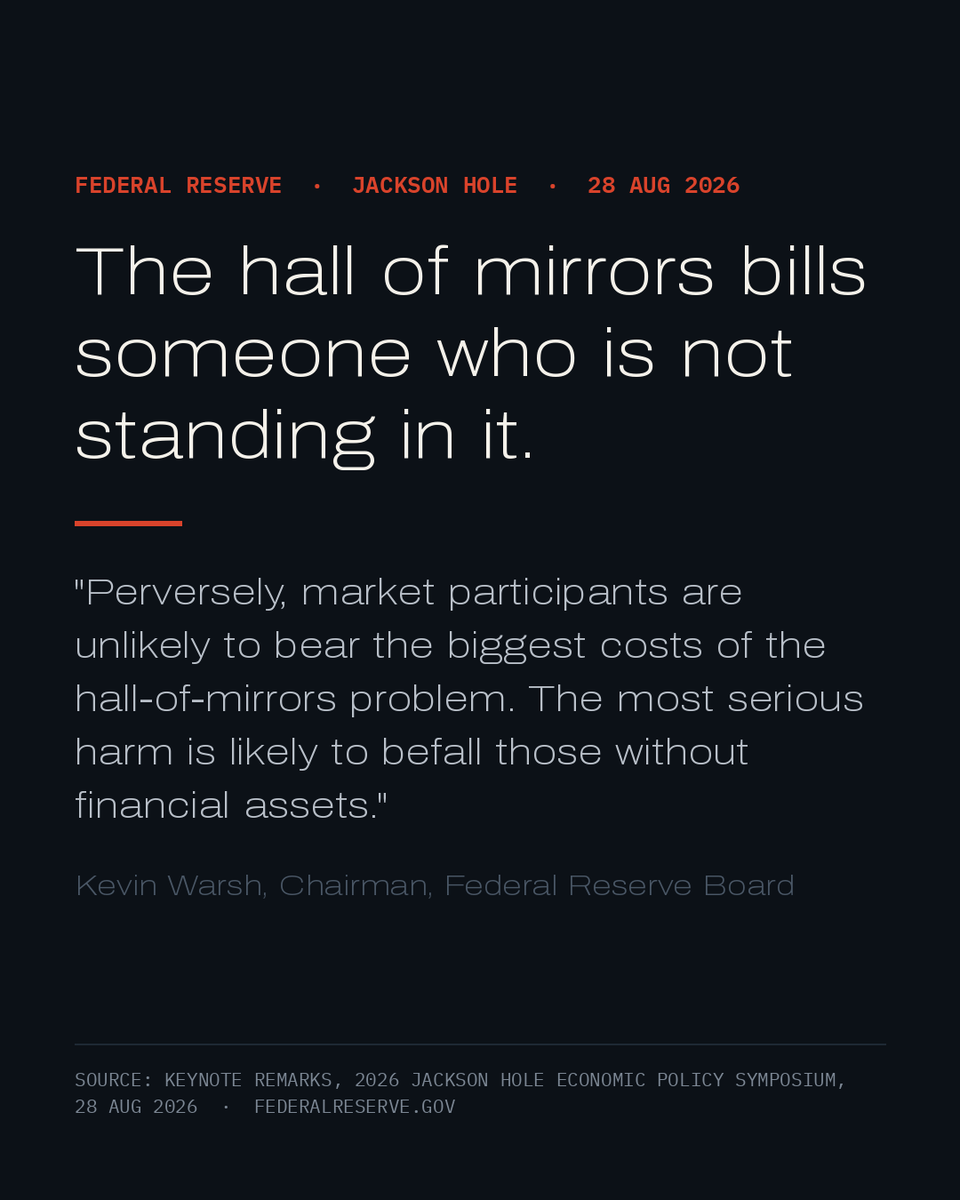
Warsh ended forward guidance because it inhibits the Fed's freedom to act. Markets heard a signal.
Fed reads the tape, tape reads the Fed, policy goes blind. The affect, falls on people with no assets.
The repricing is the market's. The error wouldn't be.
The same change hit every publisher on the internet.
The smallest lost 60% of their search traffic. The largest lost 22%.
One shock. Three bills. Nobody charges you what your traffic is worth. They charge you what you'd lose without them. https://t.co/Whd2piVZZt
Last year the US spent more servicing its debt than defending itself. $970bn, 19% of all federal revenue.
Raising rates cools demand. At 19%, it also grows the bill the government borrows to pay.
One policy, both effects. The debt ratio decides which wins.
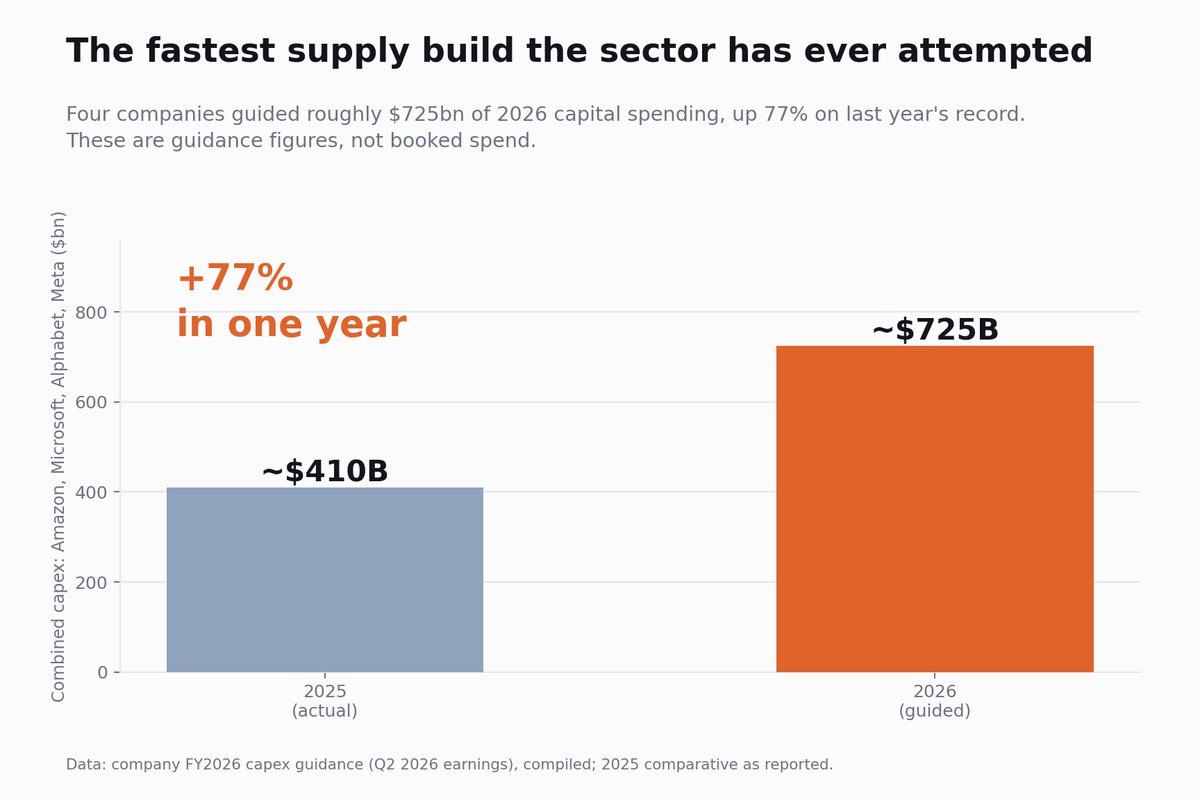
Four companies guided ~$725bn of 2026 capex. Up 77% in a year.
Returns are set on the supply side. Capital chases a return, capacity arrives, the return dies. Railway mania ran this way.
Nobody publishes how much of it is contracted. Q3 is the next chance.
Ten companies are 37% of the S&P 500. Nvidia alone is close to 8%.
Two facts, not in dispute. The fragility conclusion rests on a third: when the top ten fall, the other 490 fall with them.
That premise has never been tested at this weight. Rotation or exit?
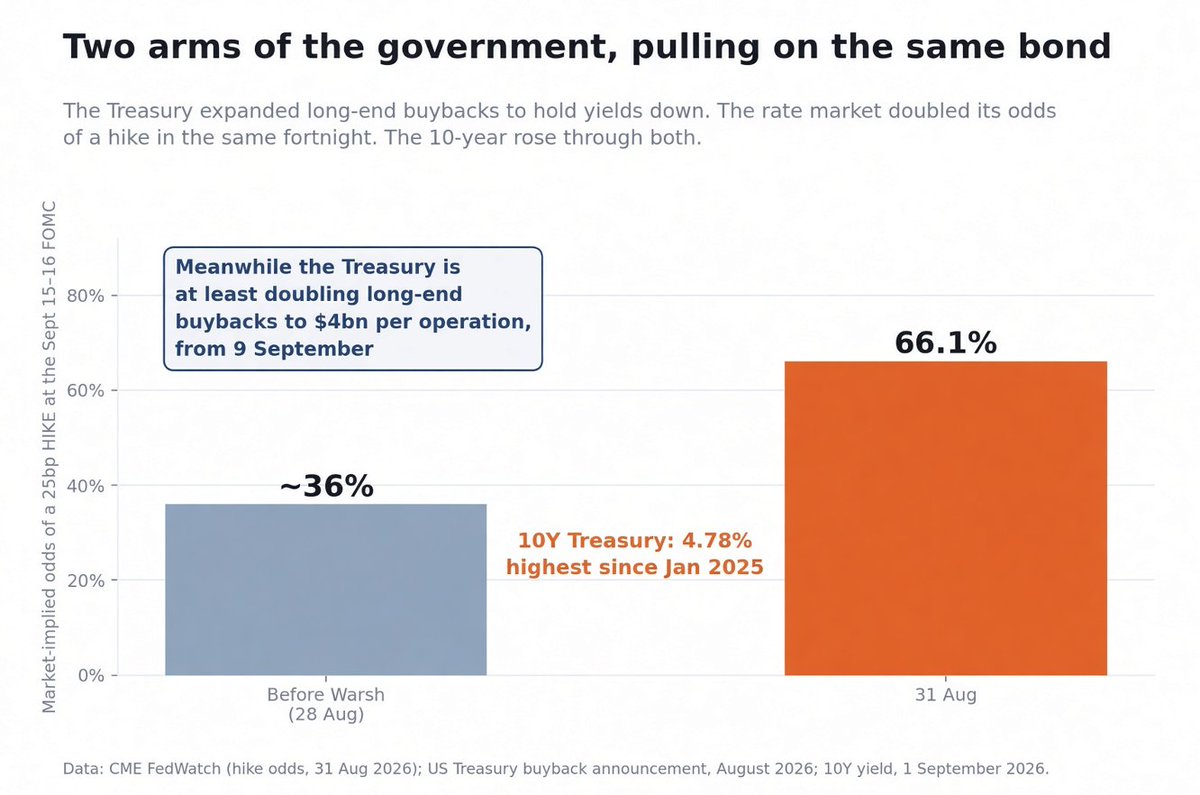
Treasury's buybacks did not fail to cap the long end. They start on September 9.
Treasury doubled its maximum buyback size. The market doubled its hike odds, to 66%. The 10-year cleared both, at 4.78%.
September 9 and September 16 settle which is stronger.
Brent at $91 is not a growth signal. It is a tax.
A supply shock lifts prices and cuts output at the same time. This one is landing on a CPI still running at 3.4%.
No policy setting fixes both legs.
Japan's 10-year pays 3% for the first time since 1996.
Its institutions bought foreign duration for thirty years because home paid nothing. Japan is still the largest foreign owner of US Treasuries, already $208bn below its 2021 peak.
Home pays now.
China's factory PMI printed 49.8. That number is an average of two economies.
High-tech manufacturing printed 52.9. Equipment, 51.4. Consumer goods, 49.
The part of China the world buys from is expanding. The part China buys from itself is not.
NVIDIA's supply commitments went from $119B to $279B in one quarter, mostly memory.
Benchmarking against physics instead of rivals doesn't end in a faster process. It ends in a purchase, and you can only afford it in proportion to your margin. https://t.co/sab3sYuor1
Three things set Nvidia's gross margin: mix, memory cost, price. Only one is Nvidia's to choose.
It guides margin to a 71-72% trough in Q4, then 72-73% "as executed, price increases take effect in Q1."
Something pays the memory bill. Q1 is where you will learn what.
Brent back above $90 on a supply shock is being priced as a Fed problem. It is an ECB one.
Euro-area energy inflation is +10.3% YoY: 9% of the basket doing 0.94pp of a 2.9% headline. August flash prints tomorrow.
Strip energy out and it is 2.2%. One rate has to cover both numbers.
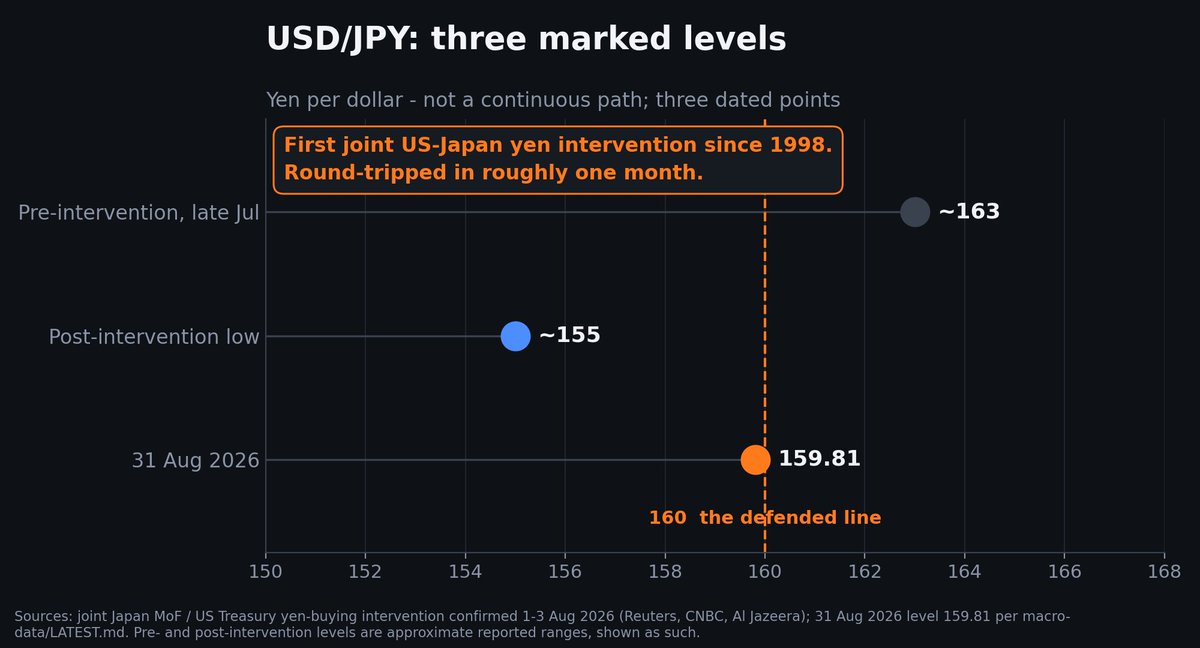
Four weeks ago the US Treasury bought yen for the first time since 1998. USD/JPY is back at 159.81.
The post-Warsh repricing finished the round trip. A September Fed hike widens the exact differential the intervention was fighting.
The only line Tokyo can hold alone is its own policy rate.
Everyone can name their binding constraint. Almost nobody has its completion rate. Of the power that asked to join the US grid from 2000 to 2020, 13% got built. A queue is not a pipeline.
It is a filter, and filters have exit rates. https://t.co/8ltDc9ahdw
7/ The asymmetry is the whole sign. The US drag is priced and mechanical, a real rate you read off a screen. The ex-US firming is real but not mature, and one signal ends it: a Caixin factory print back below 49 pulls the global engine down and hands the week to the brake.
Two economies ran last week. A hawkish Fed put the US real 10-year at 2.37% and the dollar back to 99.5, the brake. The rest of the world's biggest factories PMI crossed back above 50. The one "relief" everyone hoped for i.e. cheaper crude, is the sign that misleads.
6/ The US brake compounds where the accelerator borrows. A real 10Y above 2% lifts the discount rate every month; the AI-capex earnings story must out-run it again and again. Ex-US, credit loosens into the upswing. One engine fights its cost of capital; the other rides it.