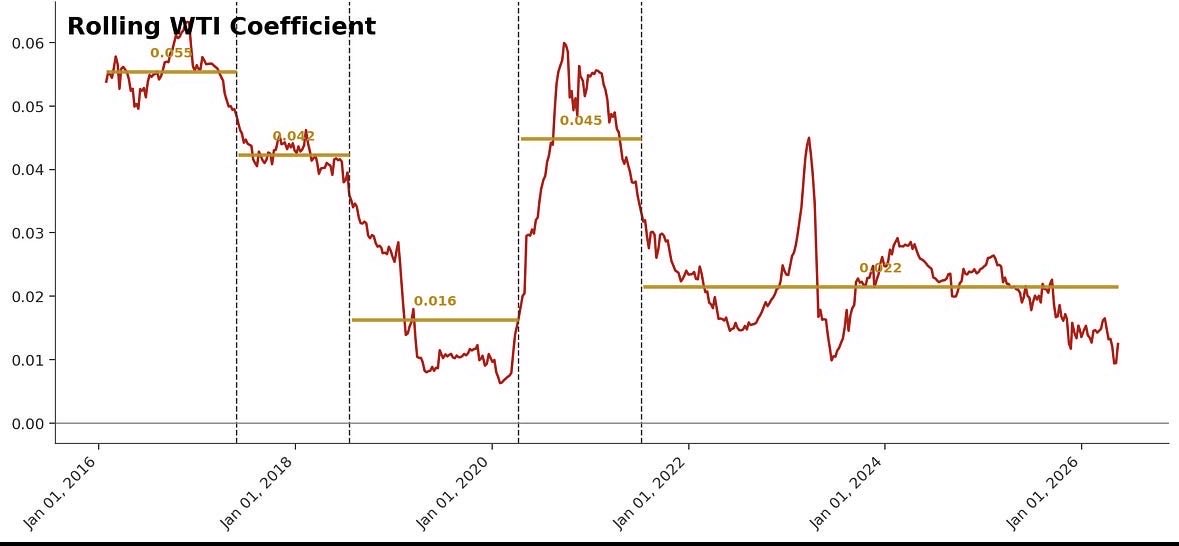
The market for compute resembles the basis issue in the U.S. natural gas market. Differing chip capabilities/differing basis conditions (storage/transport capacity + weather). Good work @TheStalwart@tracyalloway!
https://t.co/1fBq3cuEvy
Indeed the Malagasy government is hoping to move up the value chain, recent reporting showing that they’re hoping to build industrial parks like in Indo
Agreed with John on Vara Mada $UUUU. If they can't export monazite to the US, their entire rare earths strategy is in danger. Donald is a much weaker project with its own challenges.
All in all, I continue being a supporter of Energy Fuels but I'm currently out of the stock. With the execution risks they need to overcome, the risk/reward is not there for me at the current price.
🚨🇨🇳🏭📈🚨
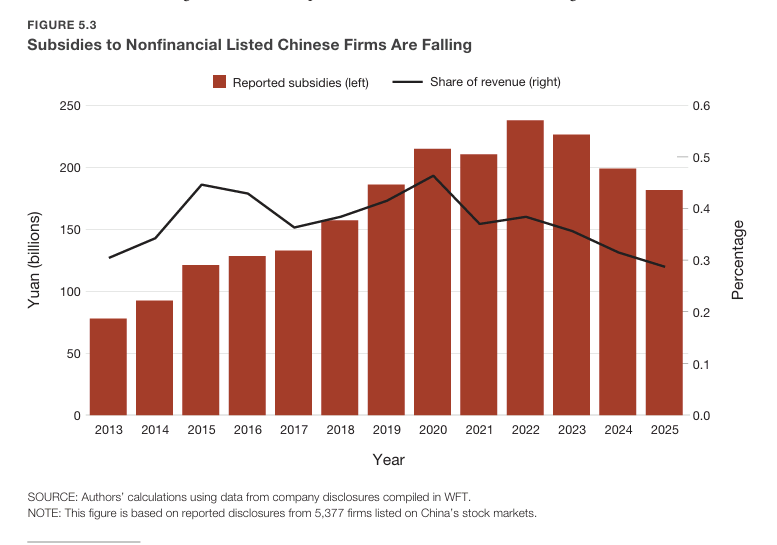
New @RANDCorporation report on China's techno-industrial policies under Xi! With @JonathonPSine and Benjamin Lenain. We detail the evolution, goals, and instruments. Lots of charts and summary tables! Please enjoy.
https://t.co/dev9o5Nn0v
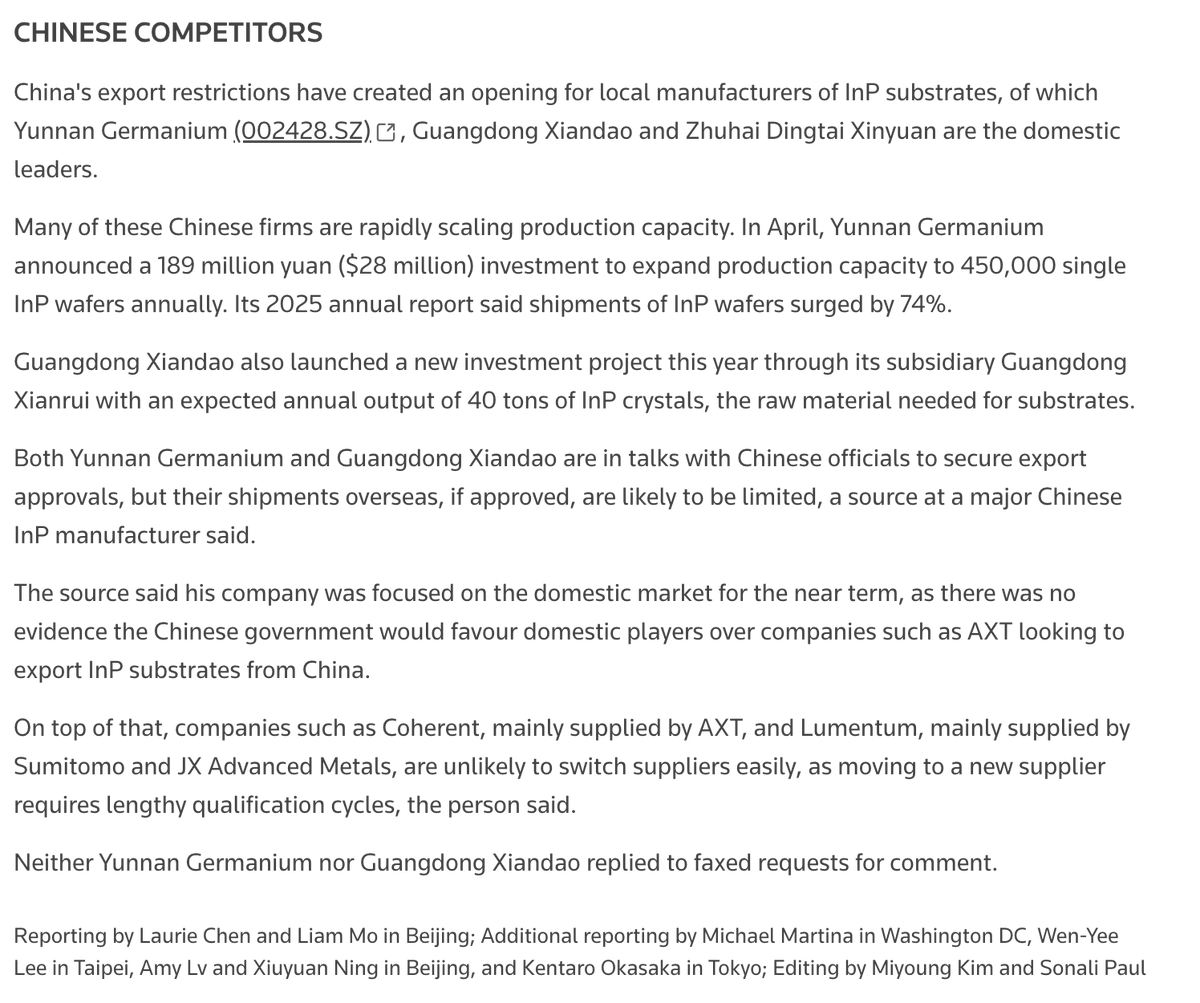
Reuters: U.S. officials have visited China multiple times and urged the Chinese side to resolve the InP export controls, but China is still causing delays in export approvals.
As a result, U.S. photonic chip manufacturers that need InP are facing difficulties.
However, China does not appear to be particularly favoring domestic Chinese companies over U.S. companies operating in China. China wants to maintain the bottleneck the U.S. is facing in InP, so most Chinese domestic InP producers are focusing on the domestic market.
Chinese InP manufacturers such as Yunnan Germanium and Guangdong Xiandao are both in talks with Chinese authorities to secure export approvals, but even if approvals are granted, overseas shipments are likely to remain limited.
This is an interesting question. My take: I do not quite accept the notion that China did not seek to "weaponize" rare earths and instead stumbled into a position of advantage. For at least 16 years, and likely more, the purpose has been an economic weapon. This is not like, say, solar or EVs, where excess capacity is sort of an accident.
Here, for example, is a semi-authoritative book cited by @JohnF_Sullivan on rare earth strategy written in 2011 for the state China Economic Publishing House the year after the Japan situation:
"What magical quality do rare earths possess that makes the usually arrogant and domineering Americans so furious? What magical quality do rare earths posses that leaves the usually wealthy and arrogant Japanese grief-stricken? China is the only country in the world capable of supplying all 17 rare earth elements, particularly holding a larger share of heavy rare earths that have prominent uses in military applications. To change China’s international position in the rare earth industry, since 2009, the Chinese government has launched a vigorous rare earth defense war, adopting a series of rectification measures including suspending approval of mining rights, controlling total mining volume, reducing export quotas, raising export tariffs and and severely cracking down on rare earth smuggling."
A key purpose of these post-2009 steps, which PRECEDE China's weaponization against Japan in 2010, was to hone a better coercive instrument.
Then there is some empirical evidence suggesting PRC action in this sector was about leverage.
First, most obviously, China used this as a coercive instrument in 2010. That shows, for at least 16 years, they have understood it as a critical leverage point.
Second, China's government has for decades manipulated the price of rare earths to prevent anyone else from achieving scale - dropping the price to kill foreign investment. Why did they do this when they already had 90% market dominance? The logic is toward control, not profit, and it is not the result of disaggregated independent Chinese market actors (which do not exist in this sector).
Third, related to that point, if this industry operated on economic logic, we would probably see more fragmentation. Indeed, for a brief time, we did see that before 2010. But then the PRC sharply consolidated the rare earths industry into state-backed companies. They shut down, arrested, harassed, and outright expropriated private actors. This was partly to ensure greater state control over external flows - the better to maintain leverage. The quote above refers to that effort.
Fourth, I do not think China's controls on rare earth minerals were modeled off U.S. controls. For example, the October controls went far beyond any U.S. controls. China's idea was any product, anywhere in the world, with .1% value coming from Chinese produced rare earths, required a license to be sold to anyone else in the world. The closest analogy -- and Chinese scholars have said this directly -- is to U.S. financial sanctions, not export controls.
Fifth, this is not a case where "there are many different actors, and they often overperform in search of particular targets." The industry has for a long time just been a few actors, tied to the state, acting at the state's direction. China's cultivation of leadership in this sector dates back to the 1960s, accelerating in the 1980s, with direct involvement of Deng's family in the 1990s and Premier Wen in the 2000s.
The empirical evidence seems to indicate a conscious desire to dominate this sector. One can debate whether or not such an intention was justifiable given U.S. control over chokepoints like finance.
But I think it is hard to advance the claim this was just the independent action of market participants that happened to accidentally create a position of extreme concentration and dominance.
With all the on again, off again news about a deal with Iran, the ongoing damage to the fertilizer market is getting lost.
It shouldn't.
How the US can use its natural gas abundance to ease rising fertilizer prices
https://t.co/MTZ7mlpxPF
1/: “Price floors could encourage the development of ex-China benchmarks as project come online…cracking China’s monopoly over mineral pricing won’t be easy given the country’s extensive vertical integration, but it can create a foundational step in the right direction”
The race for rare earths isn’t just about mines.
It’s about talent.
China has spent decades training specialists. The U.S. and its Western allies are now racing to catch up. https://t.co/e5Pt8d1aTH
We have a new piece out in the Modern War Institute at West Point (@WarInstitute) that looks at the essential role scandium plays in defense and the wider modern economy.
As is the case with many other critical minerals, China is eating our lunch, so to speak.
https://t.co/FFAw8IWk9W
Libertarian: Legalize onion futures!
Progressive: Ban onion futures!
Me, rationally viewing the world, unburdened by ideological commitments: The perishability and heterogeneity of the onion industry makes it likely that a futures market would never take off, even if legalized.
Interesting article from @ftbreakingnews on China pushing BYD to pay suppliers in cash within 60 days, forcing the restructuring of debt in the tens of billions https://t.co/Lr31ss6eQw
I'm reading how Asia will reject LNG cargos above X price and therefore NWE will get more LNG this winter. But the TTF/JKM spread should collapse in the forwards which it hasn't. Unless there is some uneconomical mechanism in LNG trading, more LNG to NWE is wishful thinking w/ the spread pointing to Asia. #LNG