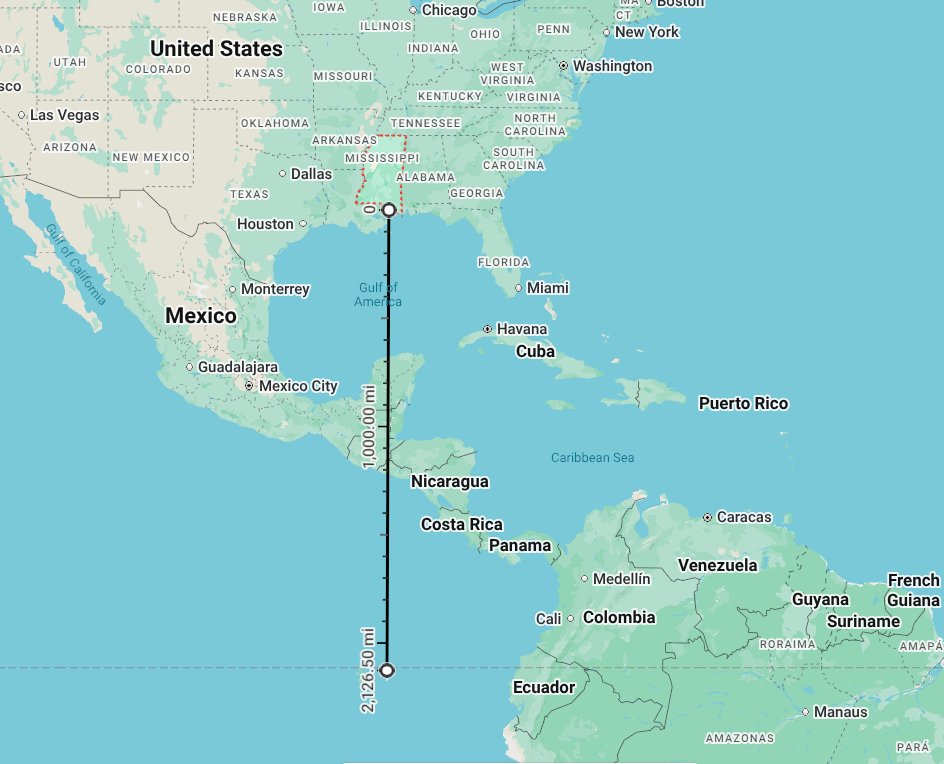
Altitude changes things a lot. Most Mexicans and Colombians live in places cooler than Mississippi.
Ocean currents also change things substantially, South Carolina and Southern California are almost at the same latitude, but very different climate.
I find it disconcerting to think that Mississippi is over 2,000 miles from the Equator.
Think about what that means in the summertime. MS is already frighteningly hot, but for 4,000 miles south, it's just as hot if not hotter. And most humans live there.
Horrifying to imagine.
At some point the mainstream intelligentsia was quite amenable to the Freakonomics theory that abortion having been legalized in the 70s explained the crime decline of the 90s.
Matt Yglesias tells an incredible story on The Argument podcast.
Apparently a pollster working for pro-choice groups told Matt that one of the best polling messages for abortion rights is that if you banned it, poor people would have more kids they couldn't take care of.
@lymanstoneky “fertility at 15-19 years marital duration for women aged 30-39 has risen ***50%*** since 2008-10!”
People married at ages 15-24 in AD 2026 are an unusual and self selected group.
From the authors’ standpoint, they’re just trying to answer the question about crime, they never really set out to elaborate on what else good could’ve come out of those people.
Their (simplified) view is something like: People raised in poor, dysfunctional, homes commit a disproportionate amount of crime and women in those circumstances are overrepresented among those who have abortions, therefore the generation after abortion is legalized will have X% fewer people more likely than average to commit crime.
@TGBED8v8@dilanesper Not really. Whether the theory is true is just a yes/no question: Was the decrease in crime in the 90s mostly explained by abortion being legalized?
Later consensus seems to be that the impact of abortion was too small to fully explain the sharp decline in crime.
As I've said before, I like Mamdani a lot, but this Latino security guard's death wasn't just about gun violence -- it was also about the failure of New York to address low-level criminality, disorder, and antisocial behavior in public spaces. Bring back broken-windows policing.
“Dispute” and “altercation” are often used in a misleading way that makes an unprovoked attack seem like it wasn’t random. Often the “dispute” consisted on the random victim realizing they were being attacked.
I realized that reading news coverage of the woman set on fire on a Chicago train a year ago. Early reports mentioned an “altercation between passengers” when it was a case of someone reacting after being doused with gasoline.
Guess it’s different if people have multiple kids and they move when the eldest is 14 and the youngest 6. Nowadays with NYC prices being what they are, it feels like families with a teenager in the city are more committed to the bit (although a terrible high school would still push them out).
@dilanesper What would you say if a candidate’s sibling was an outspoken white supremacist, and the candidate uncomfortably refused to condemn white supremacy?
The second largest trade union in France is calling for a general strike in November. We are broke and yields on French treasury bonds have been steadily rising for months, but they are demanding more spending across the board. I don't think we're going to make it to be honest.
@ajlamesa In egalitarian societies people across classes spend a much greater part of their lives in the commons: public transport, public schools, public libraries, parks etc. Therefore public order is critical. Compare to unequal societies such as LatAm with gated communities.