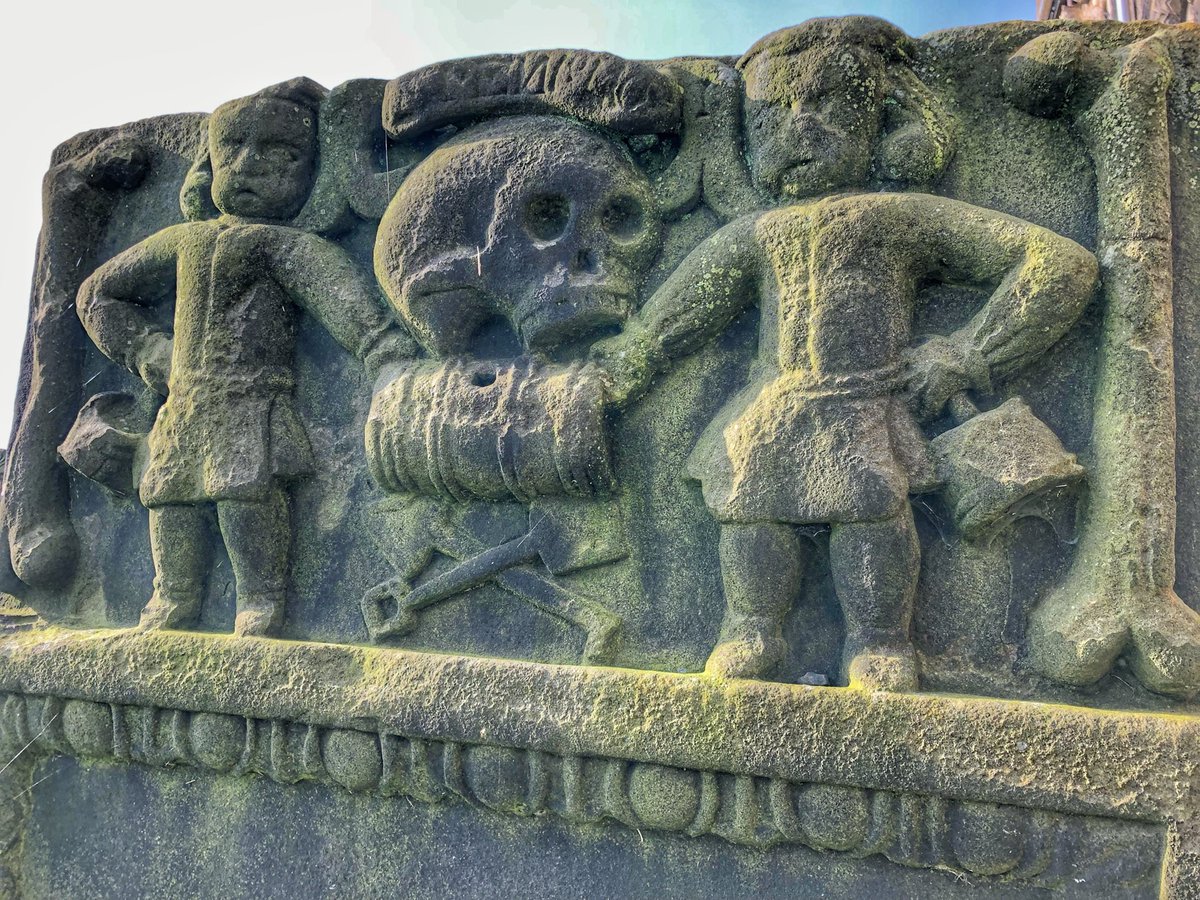
This gravestones serves us well.
What we are shown is an everyday scene of men at work, portioning out spirits from a barrel. Yet centrally positioned within that scene are reminders of Death. Indeed the scene itself is framed with bones on each side.
In life we are in death.
@TrenchTrotter@hellohistoria The first symbol on the left is an Ouroboros, a serpent swallowing its tail and forming a circle. This symbolises the circle of birth, life, death, birth again.
The elegant edges, prone hourglass, gravedigger’s spade & shovel, skull & cross bones. Even a nice full stop after the Memento mori. Lovely work.
SKULL SUNDAY
Here we are shown a skull & bones on which stands a figure holding an hourglass & a ring, with a head above & scrolling foliage & flowers down each side. Proportions don’t matter but the symbolism does. How should we read this ?
SKULL SUNDAY
This is an example of where the skull is actually the least interesting thing on the gravestone. The magnificent sailing ship, the bonnet on the woman and the ghoulish features of the man, all out rank the skull for sheer kerb appeal.
In 17th century Edinburgh it became very fashionable for skulls & bones to adorn the tombs of wealthy merchants & artisans. Today we celebrate Death at Haloween, but in the past it seems Death was considerably closer to mind all year round.
@ChristineH26289 So for example, the Parliamentary record lists the execution of Charles I on 30 January as occurring in 1648 (as the year did not end until midnight on 24 March), although later histories adjust the start of the year to 1 January and record the execution as occurring in 1649.
SKULL SUNDAY
Mourners solemnly stand by the skull of the Gardener. His rake & spade are shown propped beside the tree, symbolising the garden in which he worked and perhaps also the Garden of Eden, which stands in for heaven, where his soul now resides.
@ChristineH26289 Hi Christine, in Britain up until 1752 the start of the Legal New Year was 25 March, whilst the common New Year was 1st Jan. So on March 4th it was still 1718 for legal purposes but commonly it was already 1719.
@ianebbage1@Barb_Drummond We are being shown the navigational equipment of a Sailor. Two types of Backstaff (a predecessor of the Sextant) and dividers and a ruler used on the charts.
“Behold this Mason with his plumb line in his hand.
For he ever took sufficient pains that his foundation sure would stand”.
Here lies George McClean, a builder, who died 29th March 1760 aged 67 years. He was so very proud of his plumb line that he holds it on his gravestone.
This detail on a gravestone (raised in 1737) poses many questions. What are we being shown, what is the intended message and what drugs were the stonemason or model taking ?
@MissSarahWise@Barb_Drummond The inscription tells us that this is the family plot of a Stone Mason. They often kept their most imaginative & memorable work for their own grave marker.