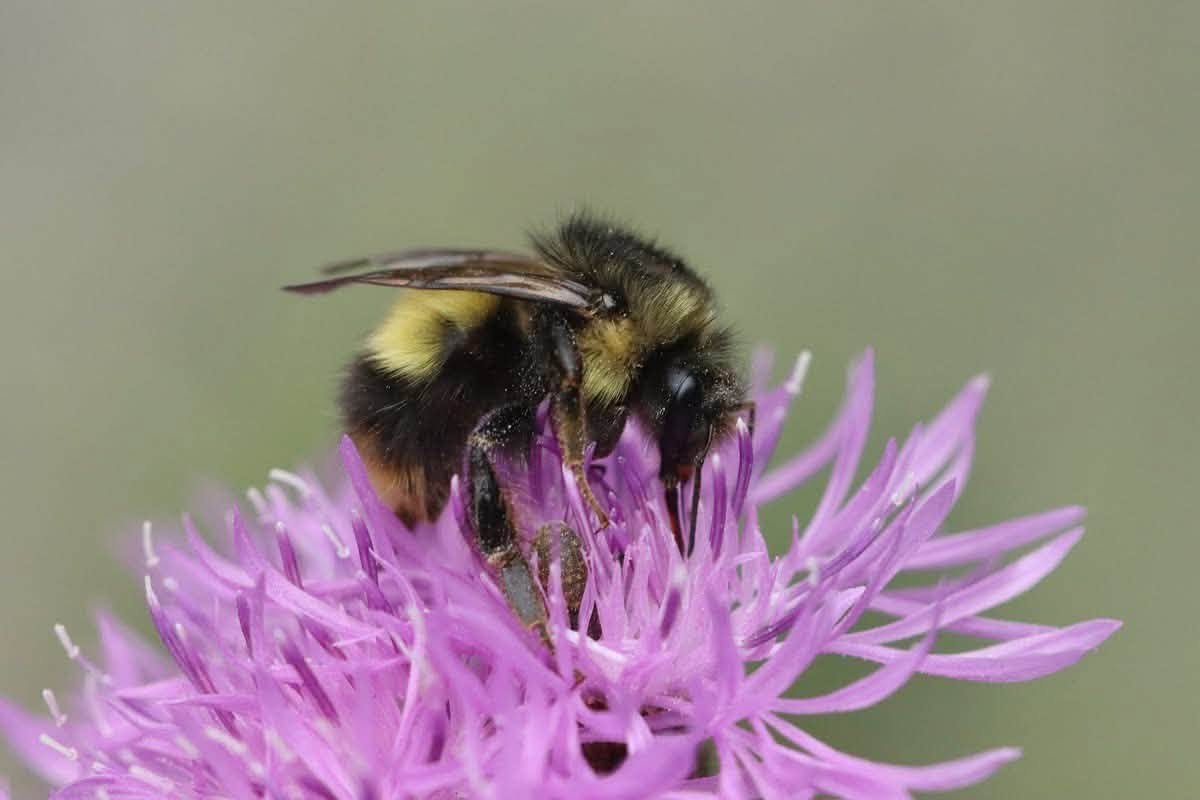
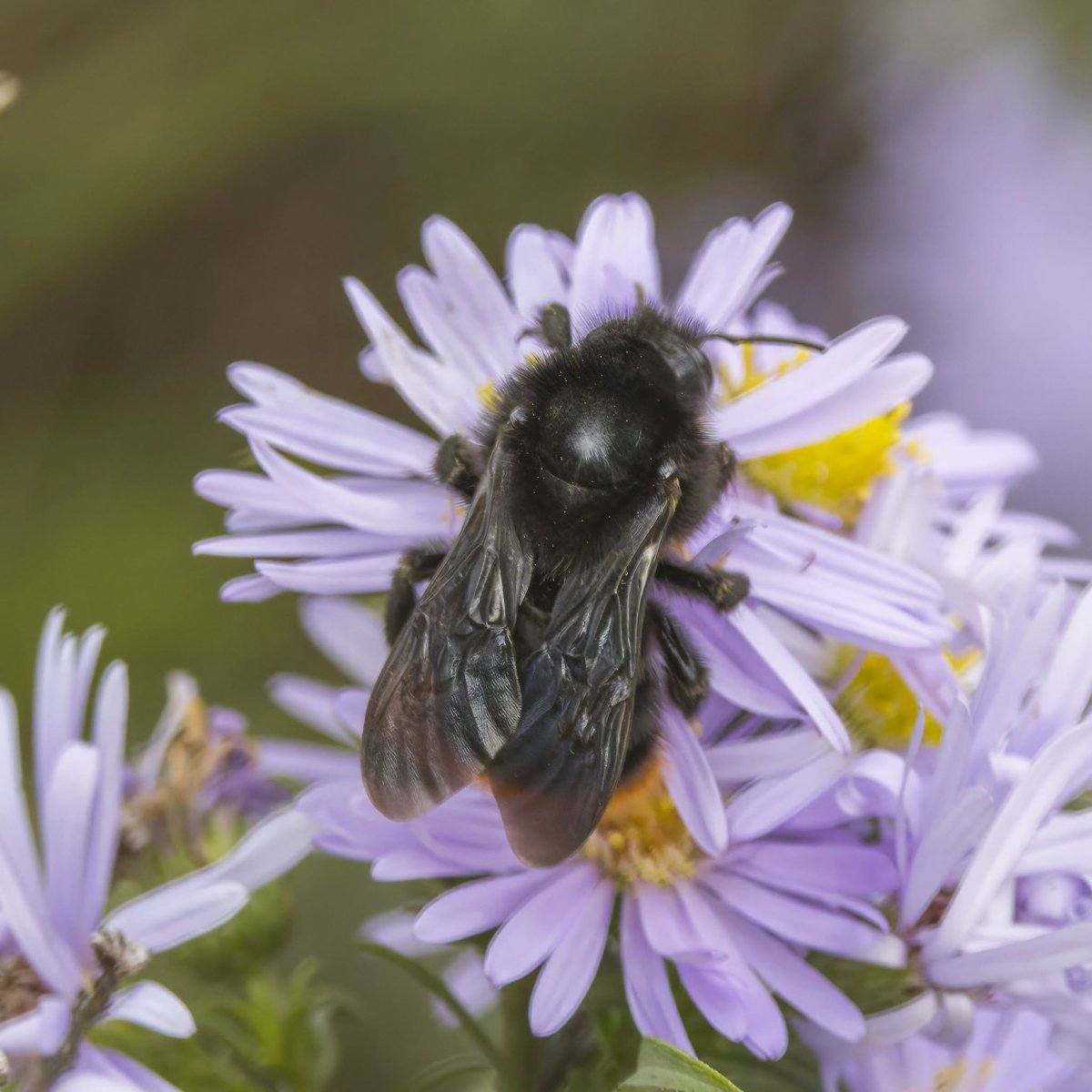
If you spot a bumble bee that's large, with a fiery red tail and very dark wings, it's probably a cuckoo, Bombus rupestris. A common feature to the cuckoo Bombus are darker-tinted wings relative to your typical bumble bee.
This one is a female, feeding on nectar to stock up on energy in preparation for her winter diapause ("hibernation"). In increasing her fat reserves she improves the chances of having more energy next spring to better overcome/overtake the nests of her host species, B. lapidarius, the red-tailed bumble bee.
This was bee of the day #346
📷Michael Bird, Orgreave
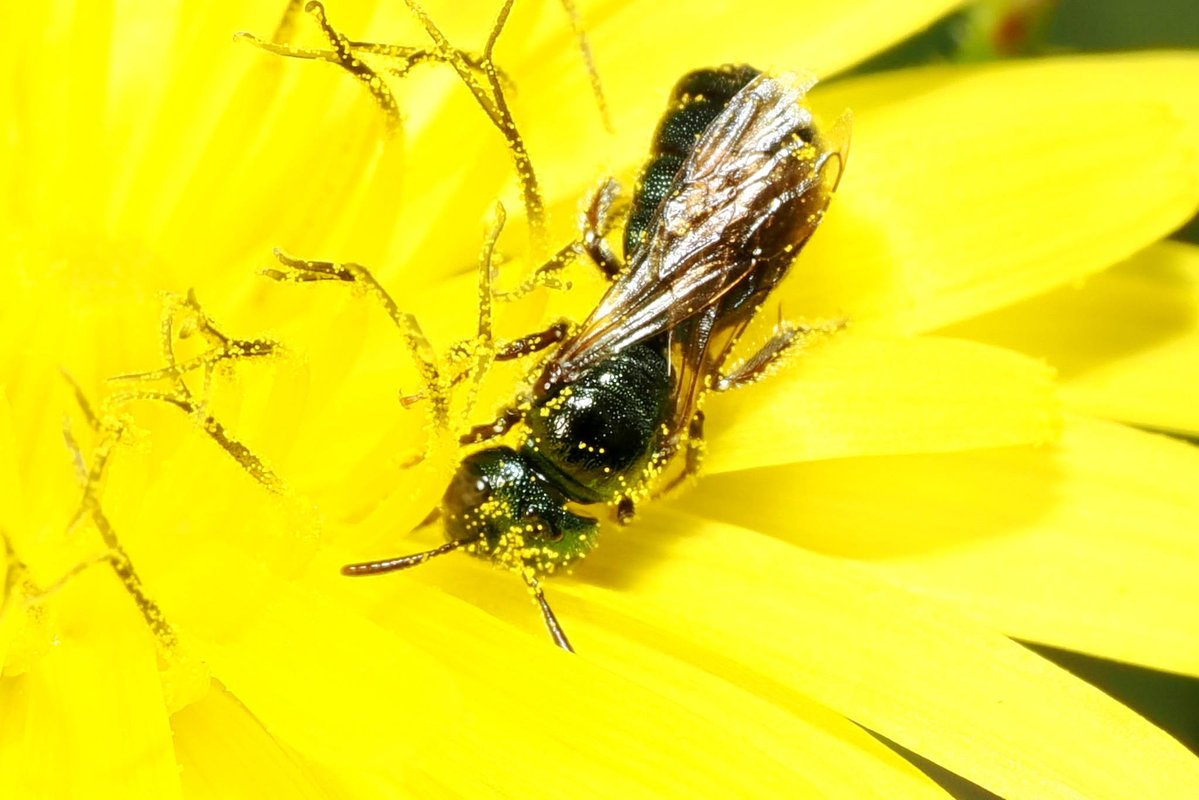
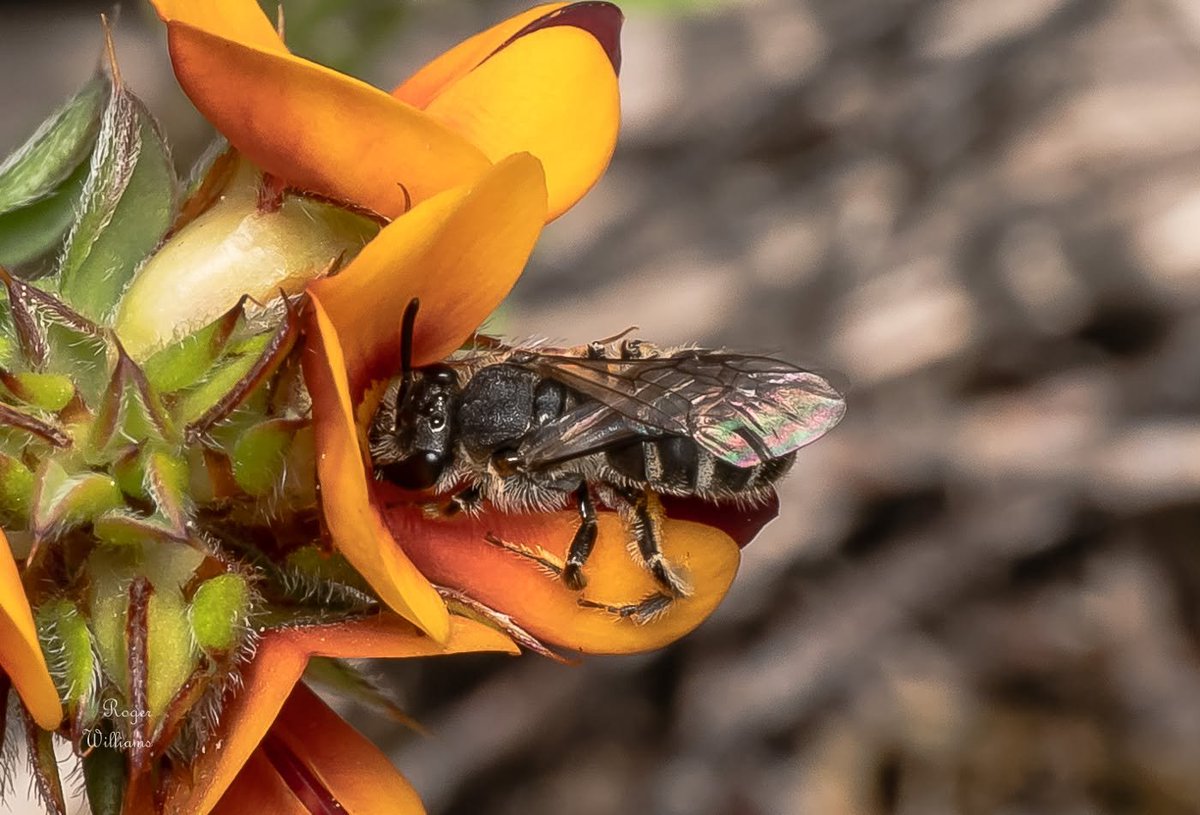
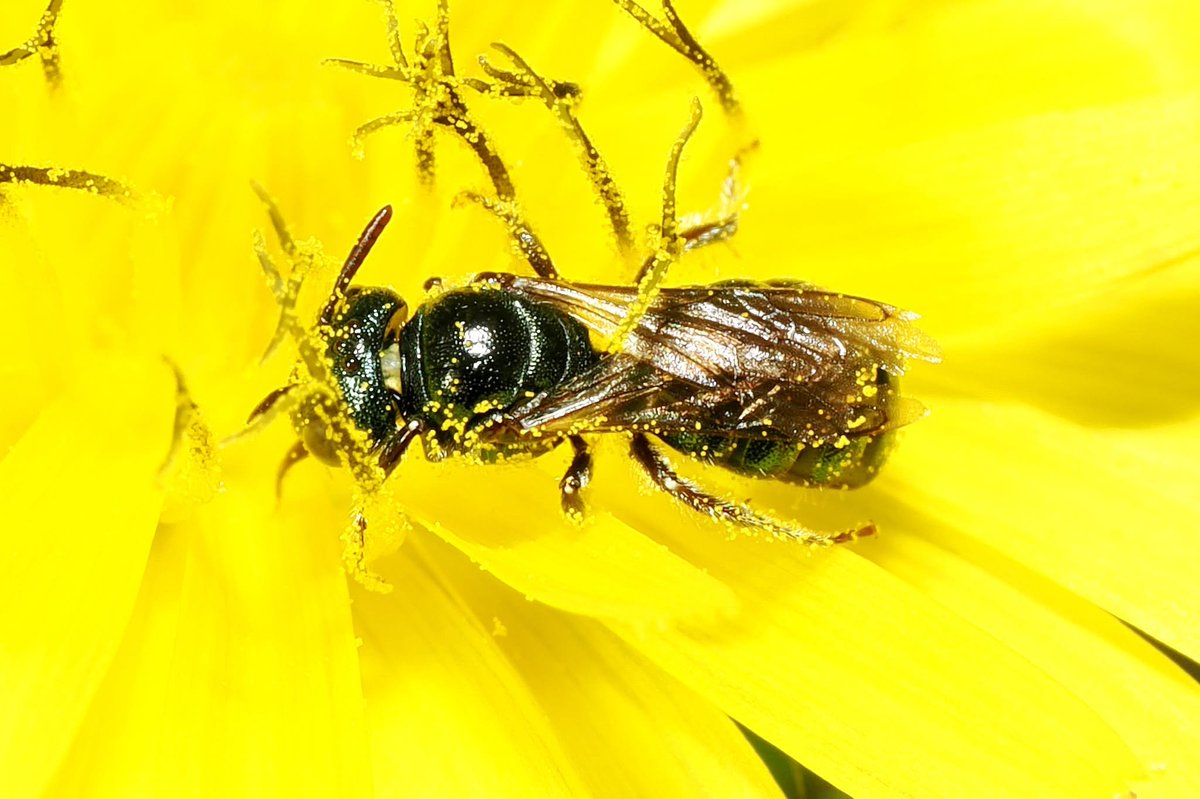
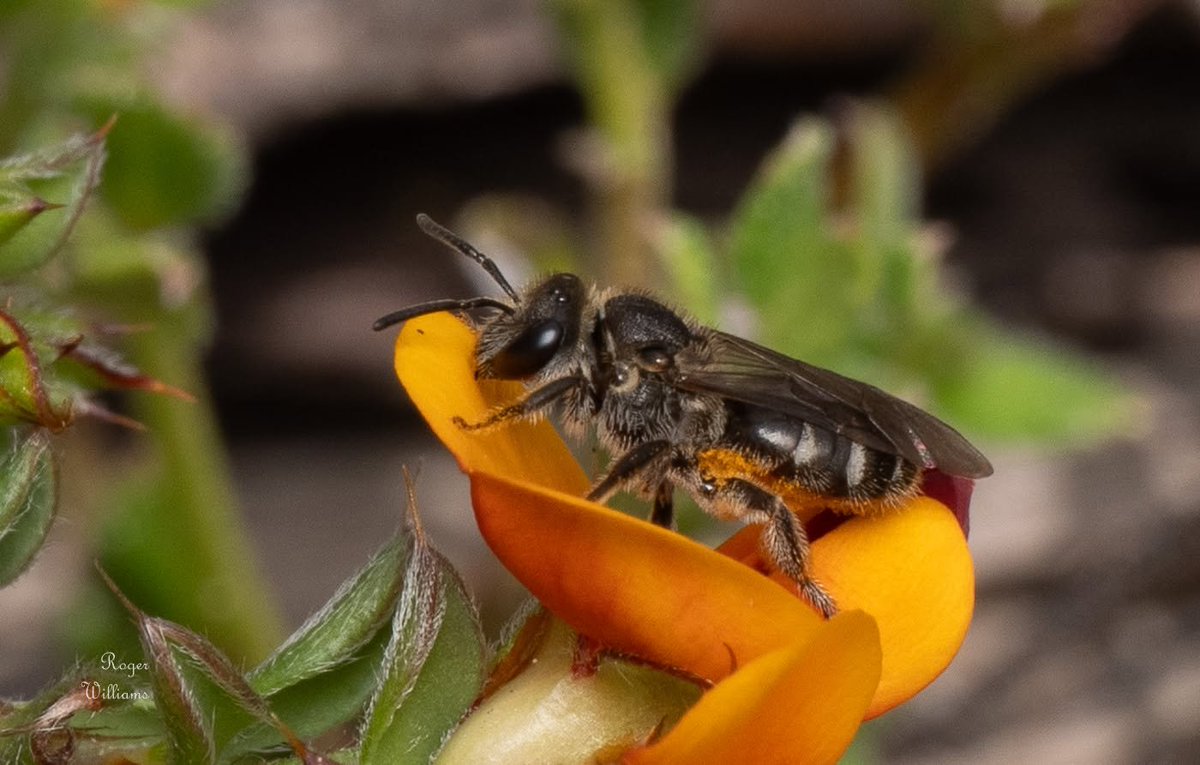
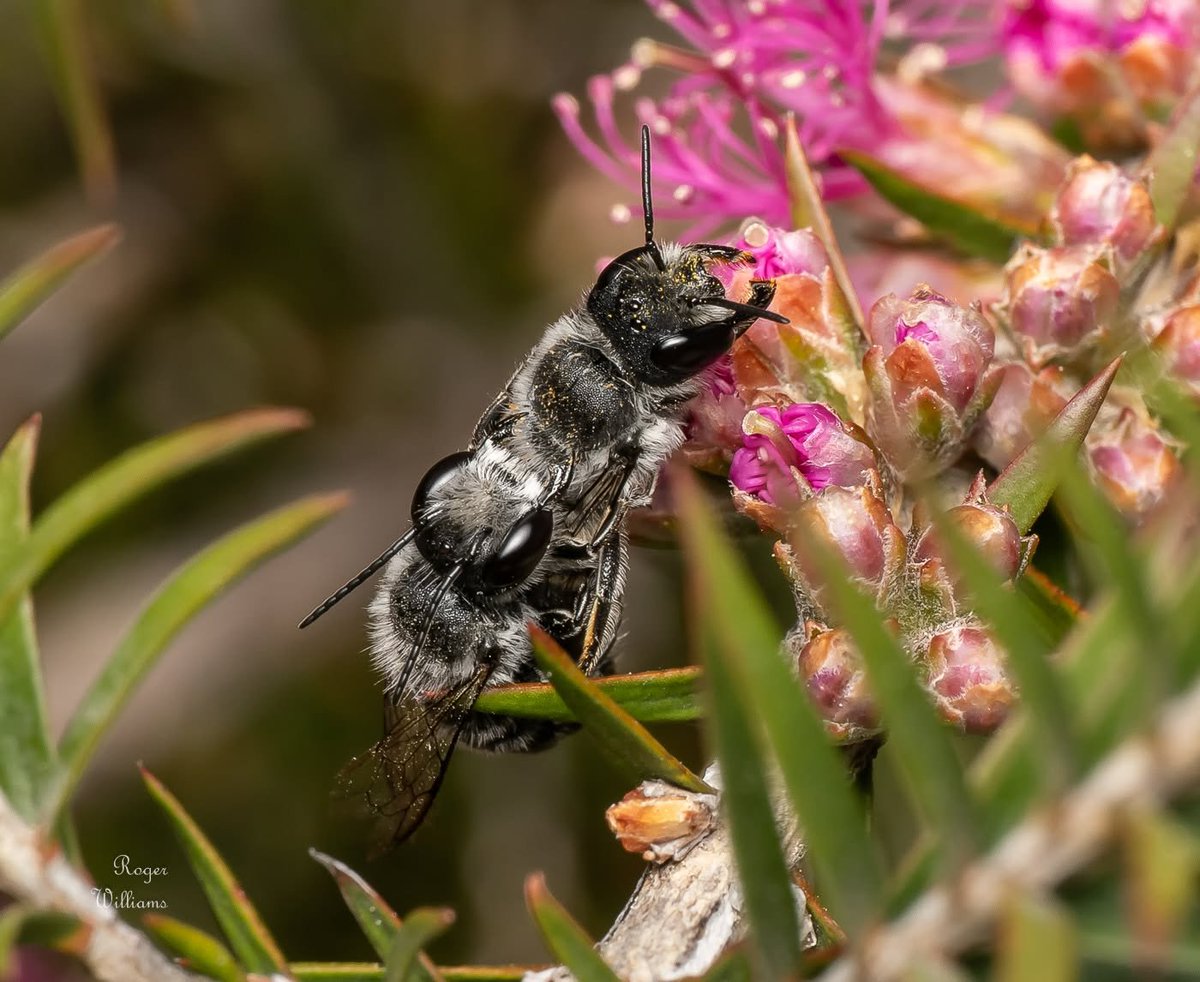
Bee of the day #345 is from a large genus of small bees: an Australian Lasioglossum (Chailaictus), with a possible species lanarium. Why the uncertainty? You'd need a microscope to confirm the ID at the species level, something about the wing venation (or male genitalia in boys).
For this bee in particular, you'd need to see the "tomentum", which is a fine coating of short and fuzzy hairs that cover its abdomen (particular T5, the 5th tergite segment).
The Chilaitcus subgenus is the largest Australian group of Halictidae ("sweat bees" family) with some ~134 species (according to Michner, citing Ken Walker). Their distinguishing feature is in the labrum ("upper lip), of which females have a broad surface with teeth on the outer edges. Otherwise, the subgenus varies greatly in appearance, with some being brightly metallic, others drab, and other resmebeling other bee genera like Homalictus
Alas, bee spotting is not like vertebrate spotting, a photo is not enough to confirm what you're seeing, but it's enough to show a pretty specimen
📷Roger Williams, Canberra
I spy with my little eye something bee-ginning with P:
Poop!
Bee of the Day #344 was caught in the act of defecating; that's the little brownish bubble at the end of her abdomen.
Bees, like birds (and many other animals) package their waste into one pallet. What you see there is a combination of what we'd call "urine" and solid wastes, for bees do not have kidneys and a separate urinary/colonic tract.
The renal-excretory role is done by the malphigian tubules, who take the wastes from the haemolymph and secret them into the gut, where they mix with the gut contents (a combination of undigested food residue, microbes & gut material ["cells"]) and are shown out the door via the anus, as you can see here.
The overrall excretory system is the same, the difference in urine composition varies according to bee diets. For a generalist forager like this Megachile sp. (oops, I only just introduced her) will have a more "average" droplet size than a specialist bee who consumes a pollen-heavy diet (or "specks" in the poop) or a nectar-heavy one (more watery poops).
What I described above is for the adults - larvae have a different time of defecation, occurring towards the end of their feeding period (which can last days or longer), or right before pupation (again, a long time). See, this painless constipation is good for the larvae, they don't have to sit in their faeces every time they eat.
📷Laurence Sanders, Emerald Queensland
If a bee is ~8 mm long, how close can you get for a clear shot? With my clunky S21, forget about it. The latest phones though? Decently close without startling her.
Then again, bees are generally relaxed and will not mind a big metal box blocking out their sun
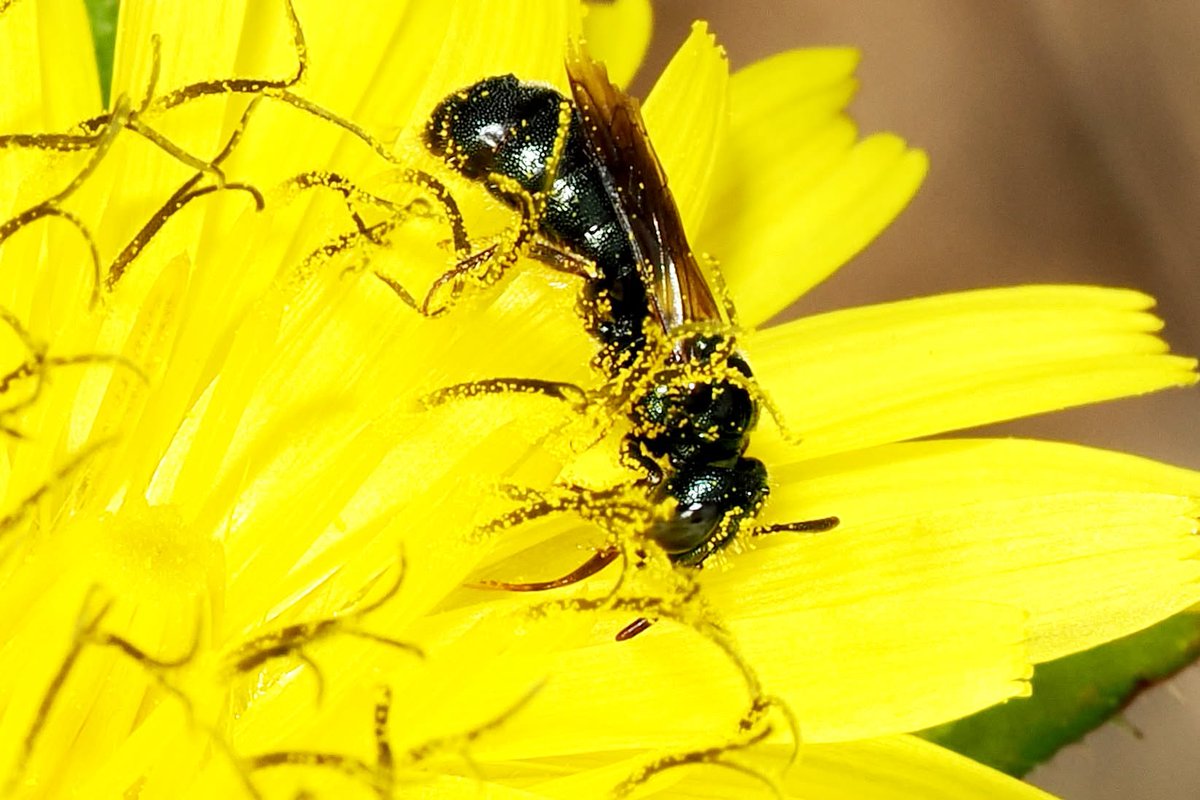
All this ramble just to introduce Bee of the Day #343 makes me feel a Guilty Spark. This is an Australian Lasioglossum bee, subgeus Homalictus. They're small ladies, some 4-7 mm in length and with 300-odd species distributed around the country.
They're generalist foragers and gather pollen on scopal hairs like the leafcutter bees, but they are not leafcutter bees (in the family Halictidae instead). Being a large genus, the nesting habits differ, however I assume these are ground rather than cavity nesters because... trust me bro. (Because the majority of the Halictidae are ground nesters)
📷&📹 Tony Vernon, Bowen North Queensland
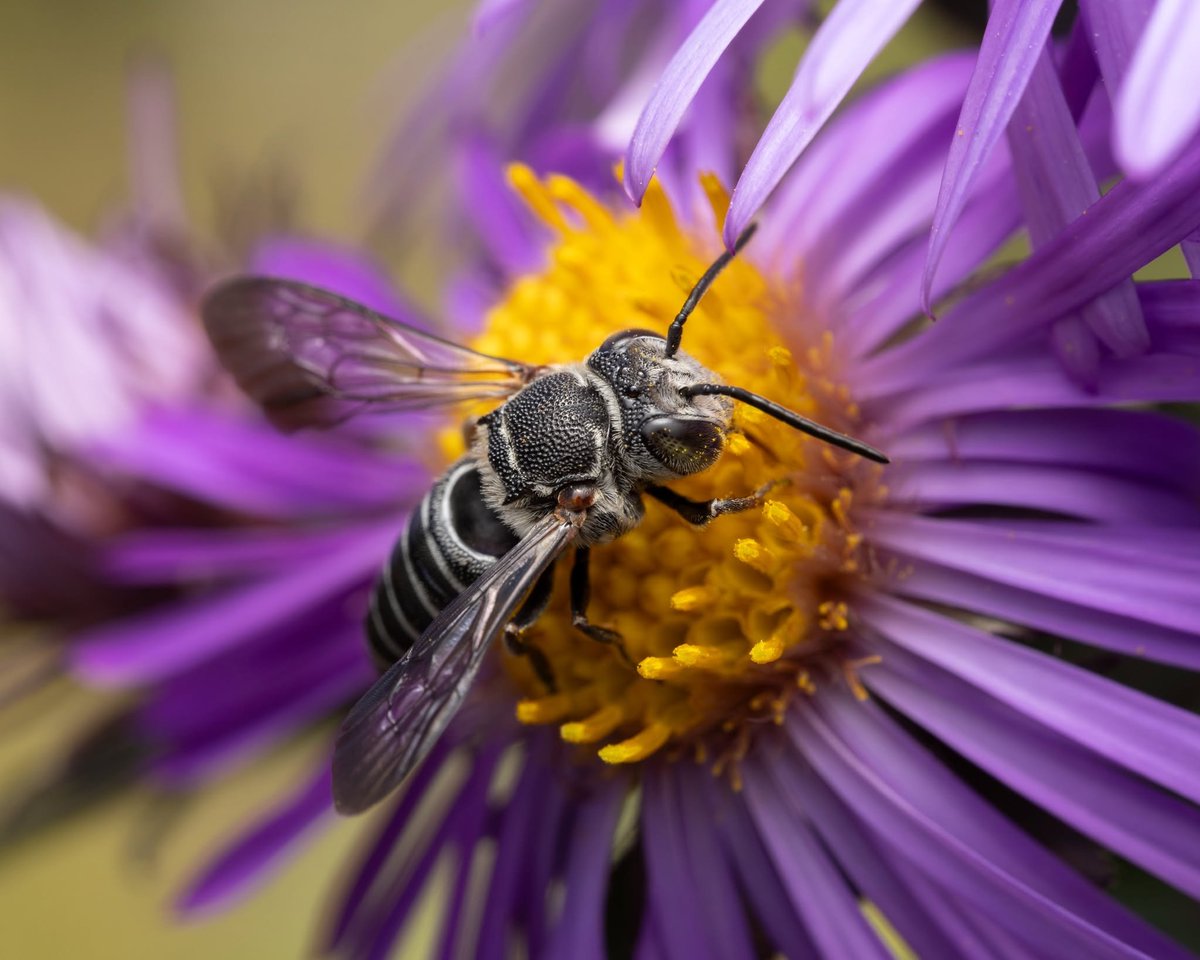
Bee of the day #342 is an armoured resin bee, Heriades sp.. the "armoured" term does not refer to spikes or an extra thick exoskeelton, rather the vernacular in the way the bees' cuticle is heavily dimpled
Zoom in on the thorax and see the "integument", the outer body wall layer which is (microscopically)_ covered in dense & deep pits that produce this armoured texture
Heriades are part of the leafcutter bee family, and instead of leaves, they use resins to construct their brood cells and nest closures. They still nest in per-existing cavities and carry pollen on the underside of their abdomens using scopal hairs
📷Vermont Pollinator Photography, Vermont (duh)
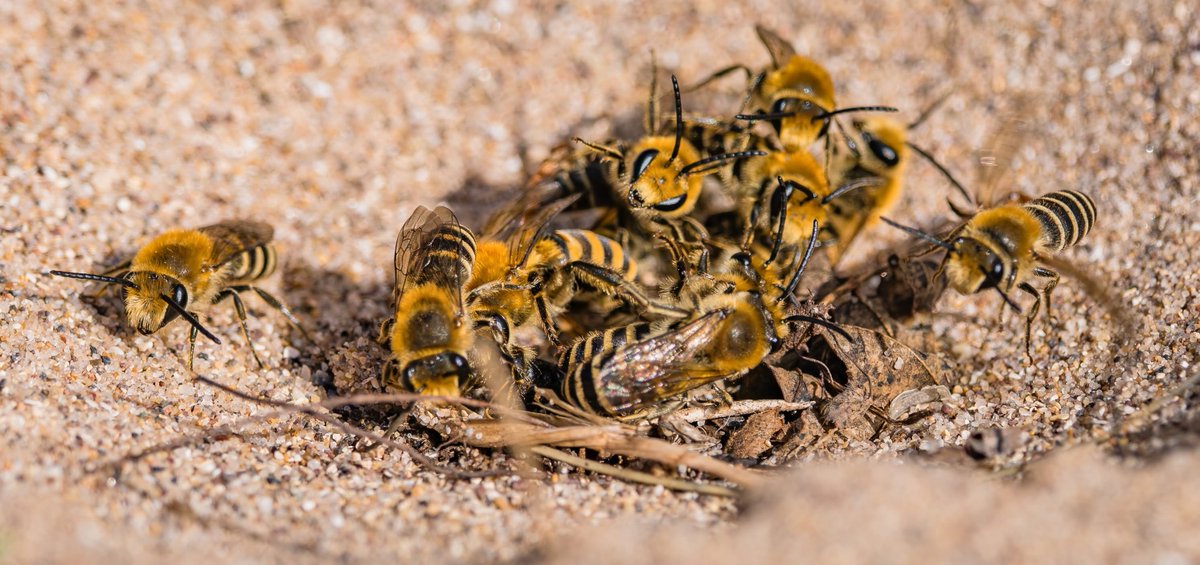
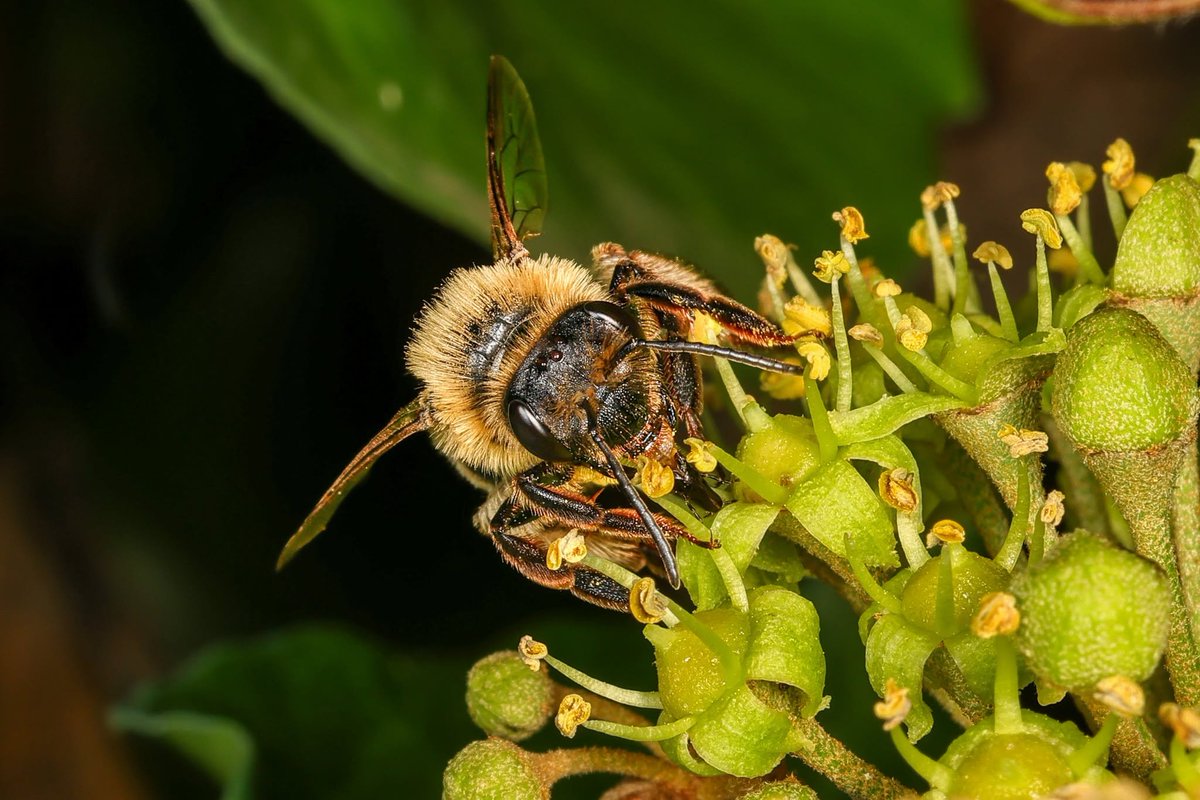
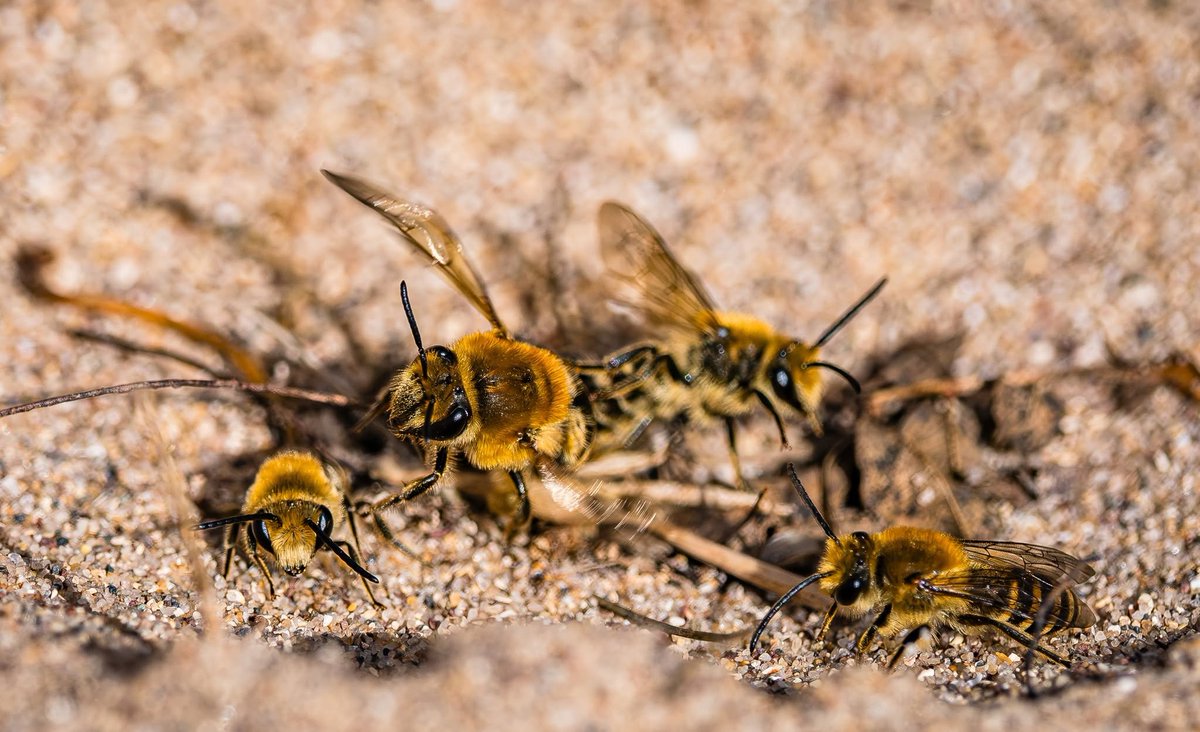
Bee(s) of the day #341 are a good example of oversupply and little demand: a number of male Ivy(?) bees (Colletes sp.) competing for one female. The result? A "mating ball"
These are solitary bees, so each male must have picked up her scent, and realised there's not many others around, so they've clustered around her (X bros, is this still hypergamy?)
it's more likely the males had a roosting aggregate, and once a female crossed into that territory, they individually detected & charged at her, each one is trying to insert parts of his abdomen into her abdomen & mate, and each one is having... fierce competition
(I believe the female is the subject of the second photo... also has a shorter antennae relative to the boys)
📷Cheryl Hewitt, Pembrokeshire
How do you tell a cuckoo bee apart from a wasp? They're both hairless, they're both "wasp-waisted" (due to a fusion of the last segment of the thorax with the first segment of the abdomen) and both consume nectar
If you ask me, I'd say "I just know" based on their flight. Wasps appear different on the wing and so I stick with my gut feeling to identify them.
That's not good enough at times, nor is that good enough for you, so we go deeper. Look at the flight times, look at the surroundings. If you see a cuckoo, odds are her host species is nearby (and if you see a male cuckoo, odds are a female is nearby and thus the host is nearby).
All this rambling stopped me from introducing Bee of the Day 340, Nomada texana, the Texan Nomad bee, a cuckoo bee belonging to a genus that parasitises ground nesting bees belonging to genera like Andrena, Agapostemon, Melitta, Eucera & Exomalopsis.
(The exact host of N. texana is not known to me, but you can safely assume it's a ground nesting bee!)
📷Roy Beckemeyer, Kansas
Bee of the day #339 is a multitasker: Pollen and Procreating, Foraging and Fornicating, Nectaring and uh.... Nutting?
If you've been following the past few days, you'll know how I harp on about the large- & strong-jawed bees. You have been following on, right anon?
Right, this is a leafcutter bee, Megachile (Hackeriapis) oblonga, spotted on the botanic gardens. Now this multitasking is nothing new in the insect world, for the act of mating demands little active attention*. The male is mounting and thrusting in the female while she carries on with her duties.
His weight is of no consequence, for a fully loaded female carries ~50-80% of her weight in pollen & nectar**, so a tailgating male (pun intended) is a light matter (oh look, a second pun)
📷Roger Williams, Wagga Wagga NSW
*You could think of it as 80% of the attention is required in the initial stages in picking a mate, the rest of it easy peasy
**The best studied examples are honey bees, go figure. There is a large spread in percentage values owing to the large variety of bees and body sizes. The smaller you get, the more forgiving the force of gravity gets
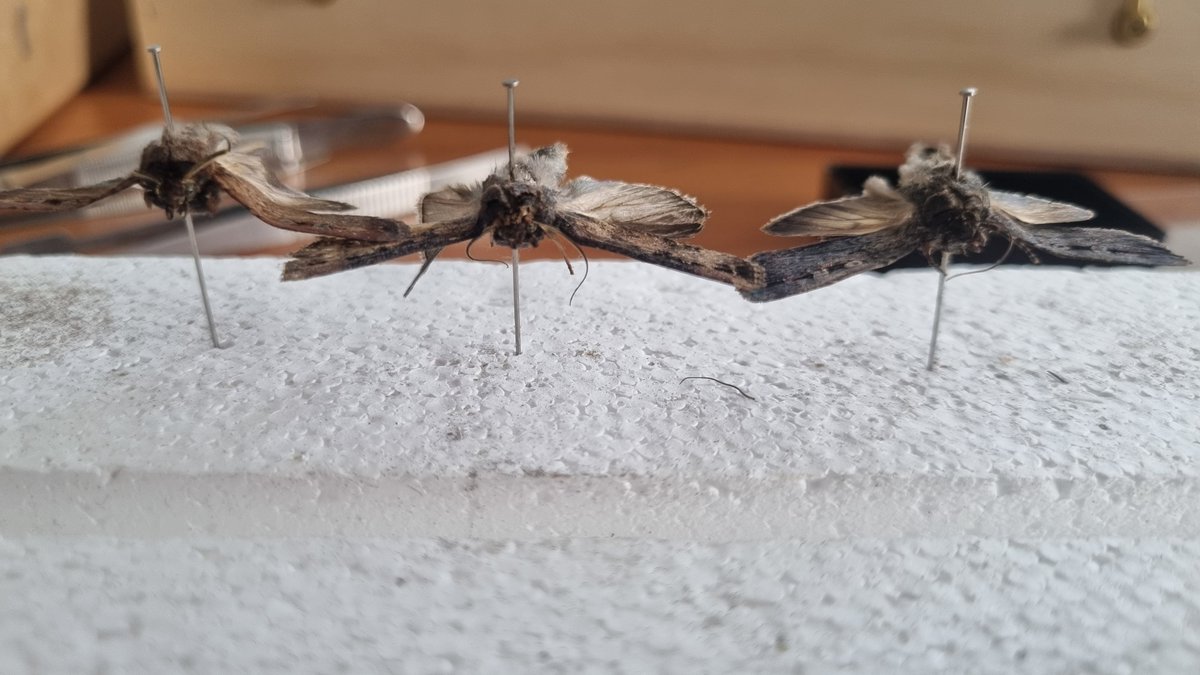
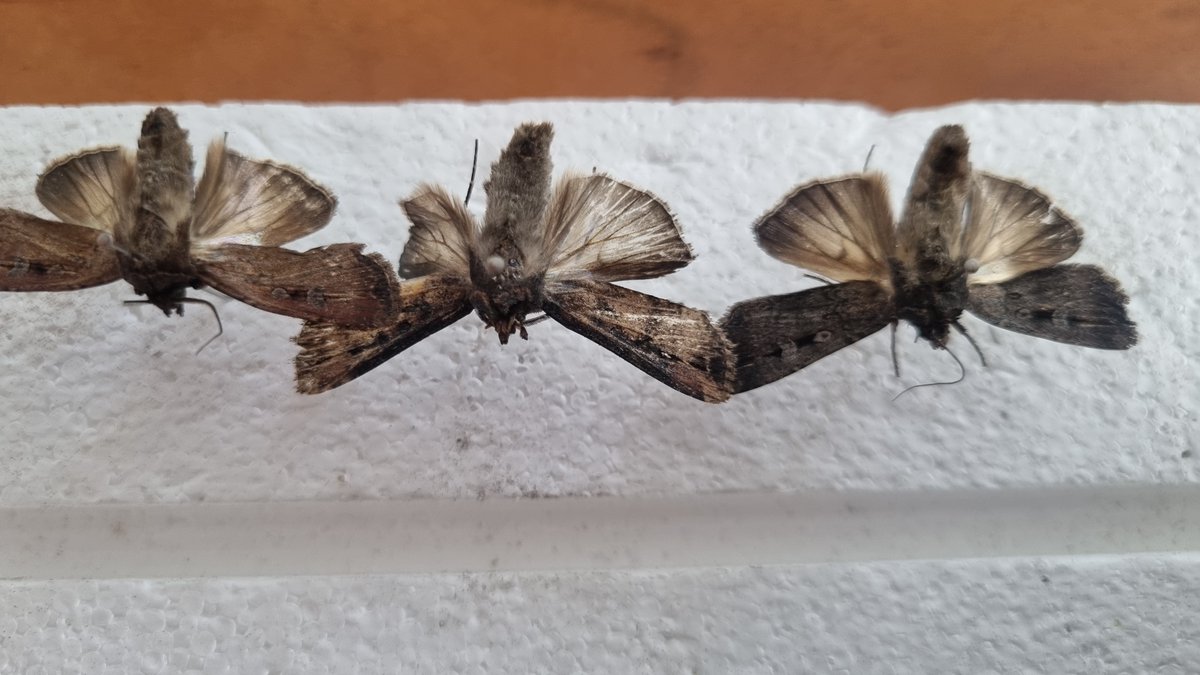
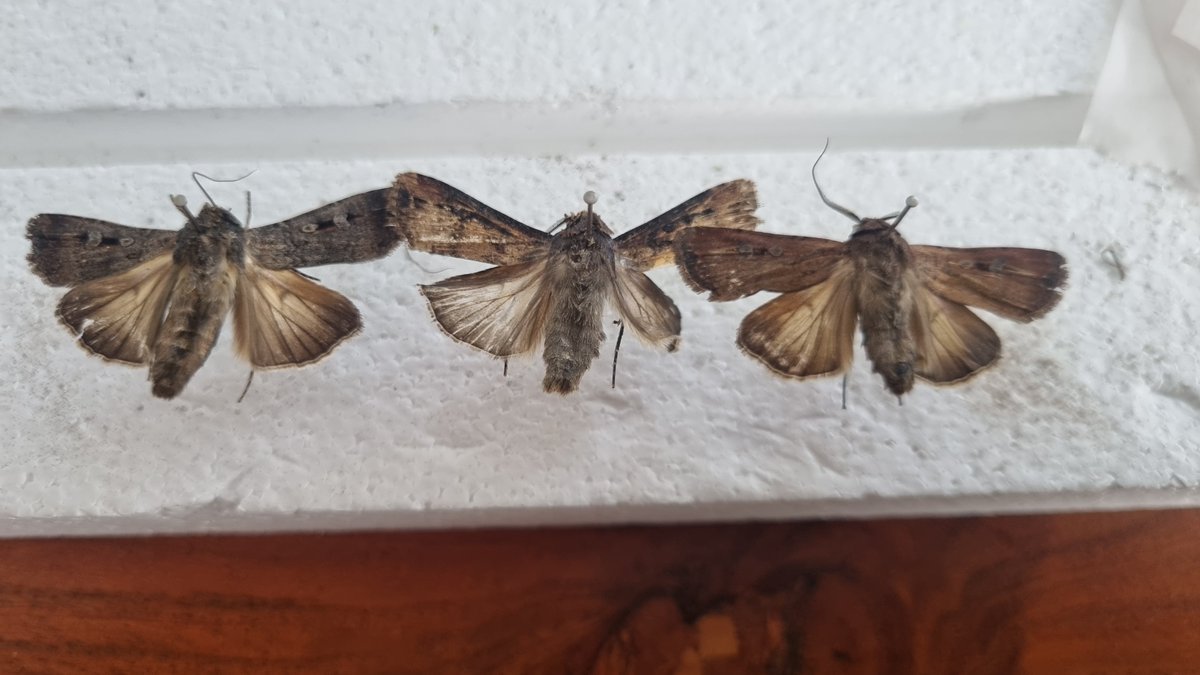
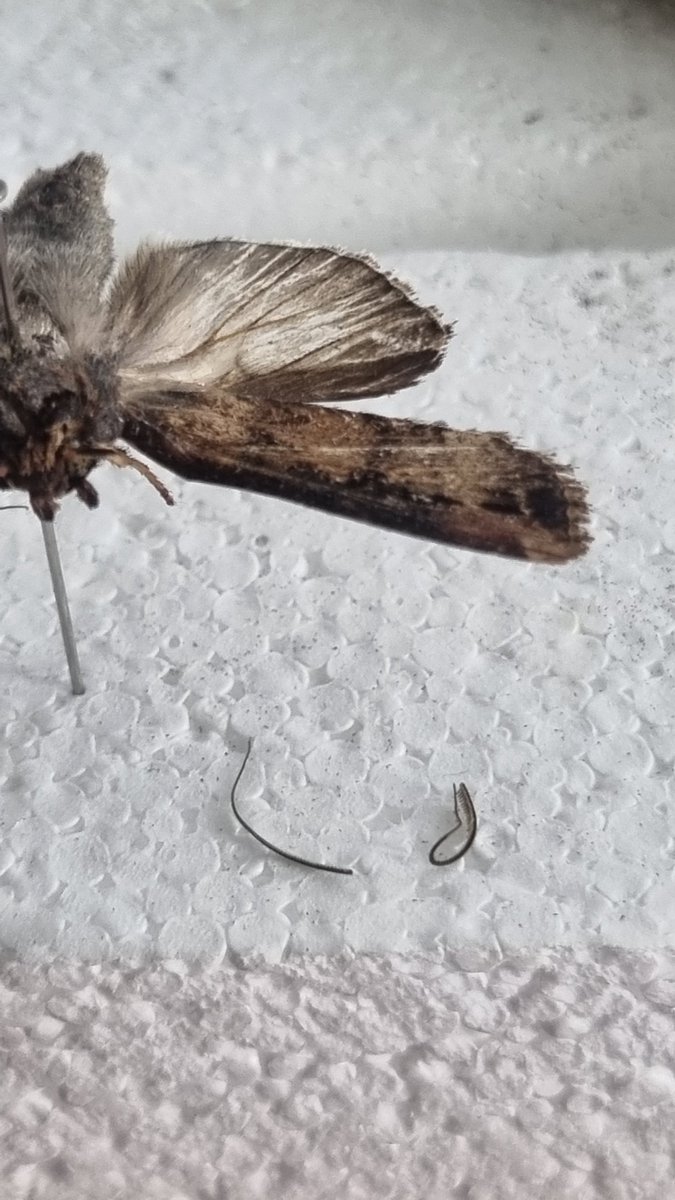
Three bogong moths (Agrotis infusa) caught the bathroom last week
Two males and one female (rightmost specimen). Slight variations between individuals, leftmost male probably discoloured due to extended time in killing jar (woops)
Getting better at pinning; antennae & forelegs still need work
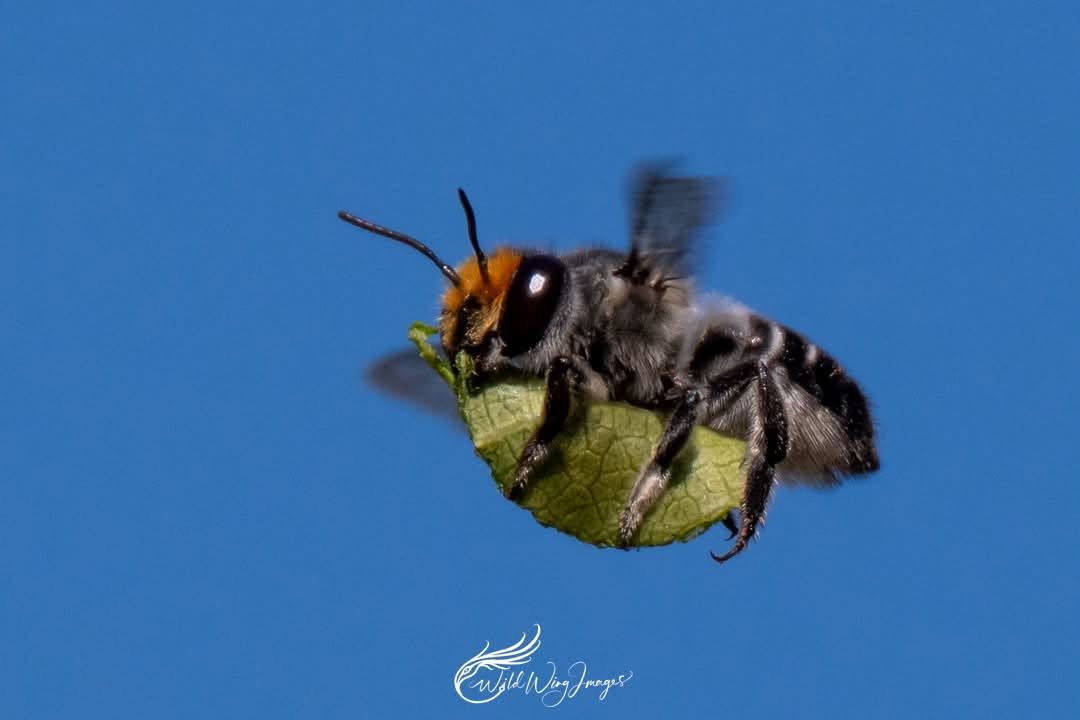
Ever wondered what a leafcutter bee looks like with her cut leaf? Wonder no more*, for here is Bee of the day #338 carrying a cutting from... a local plant (I dare say Hardenbergia, a pea family member).
This is Megachile chrysopyga, a leafcutter bee native to SE Western Australia. Females have a distinctive orange-reddish patches of hair on the frons ("forehead") and tip of their abdomen ("tergite 6", not shown here; trust me bro)
The leaf will be taken back to to line their nests, which are built into the ground (as opposed to cavity nesting, which is a more-common attribute for leafcutters**). Eventually she'll do the usual brood provisioning/egg laying/nest sealing and off she goes to continue her adult business
@macro_action a fun one for you: When the weather warms up, photograph a leafcutter bee with her leaf!
📷Melissa Zappelli, Northcliffe
*I lied, you should continue wondering. For example, what happens to the leaf when it goes back to the nest, what further alterations take place, and will she need multiple leaves or will this one suffice?
**Hang on, is a bee nesting in an "underground cavity" considered a "ground" or "cavity" nester? Questions for Plato
Bee of the day #337 is another bumble bee species from Canada, Bombus Sitkensis, the Sitka bumblebee, ("Sitka" being a smallish city in SE Alaska, the former capital city of Russian-ruled Alaska)
I've posted about lots of different Bombus species, for there are many (just do a search). What makes this one so special? No idea.
She has an extensive mass of black hairs on the thorax, but otherwise follows the standard bumble bee lifecycle: queen emerges in spring, builds a nest, lays first batch of worker brood, cares for said brood, when brood is fully developed, retires to egg laying duties until the final batch of reproductive males and females are laid and the nest naturally dies down in Autumn-ish...
(There's got a to be a more "digestible" way of summarising the bumble bee colony lifecycle)
There is an exception for B. stikensis' queen though: she can be active from the end of January to the start of December, a very long flight period that avoids the coldest parts of winter ("Winter's Heart" for my Wheel of Time fans). This is fair enough, as bumble bees are much chunkier & can better withstand lower temperatures, compared to say, Honey bees
📷Kurt Geeraerts, British Columbia
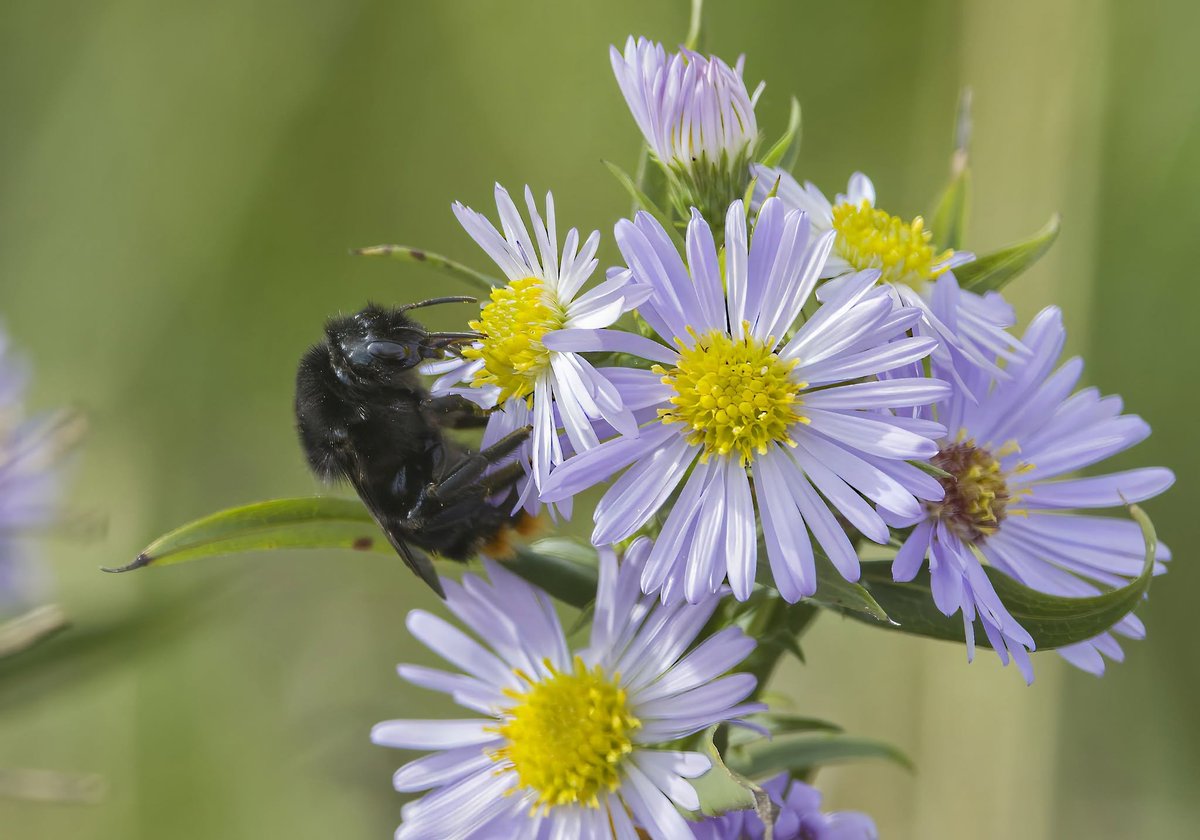
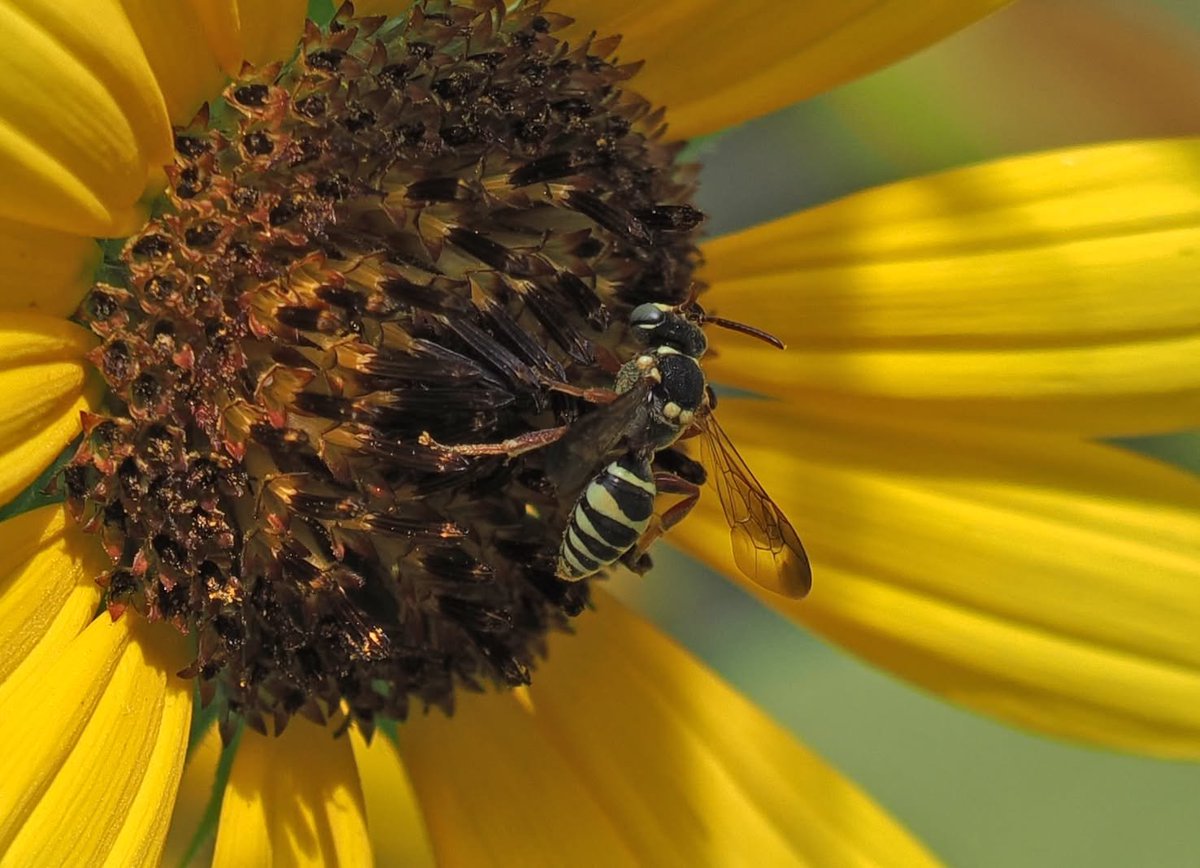
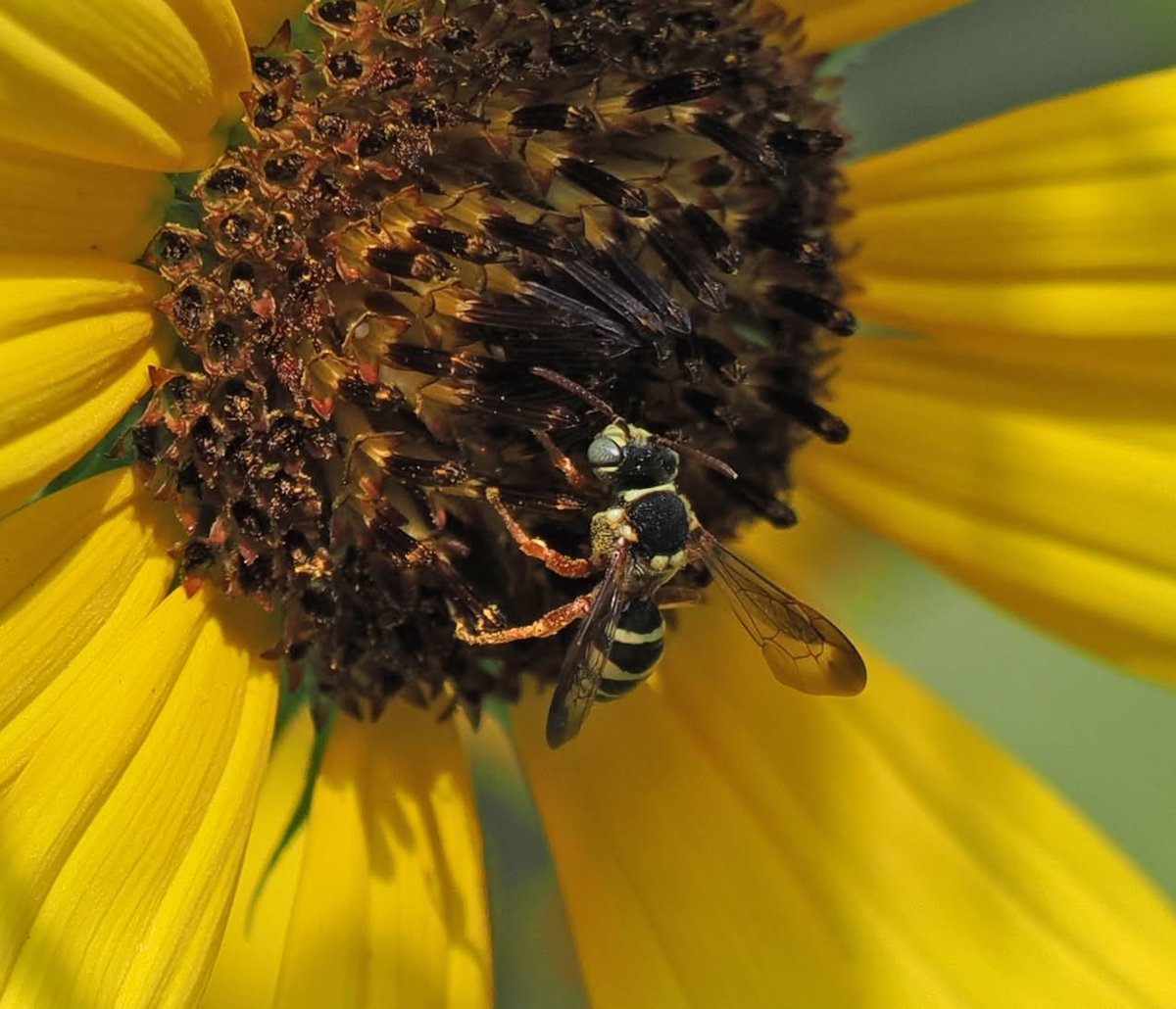
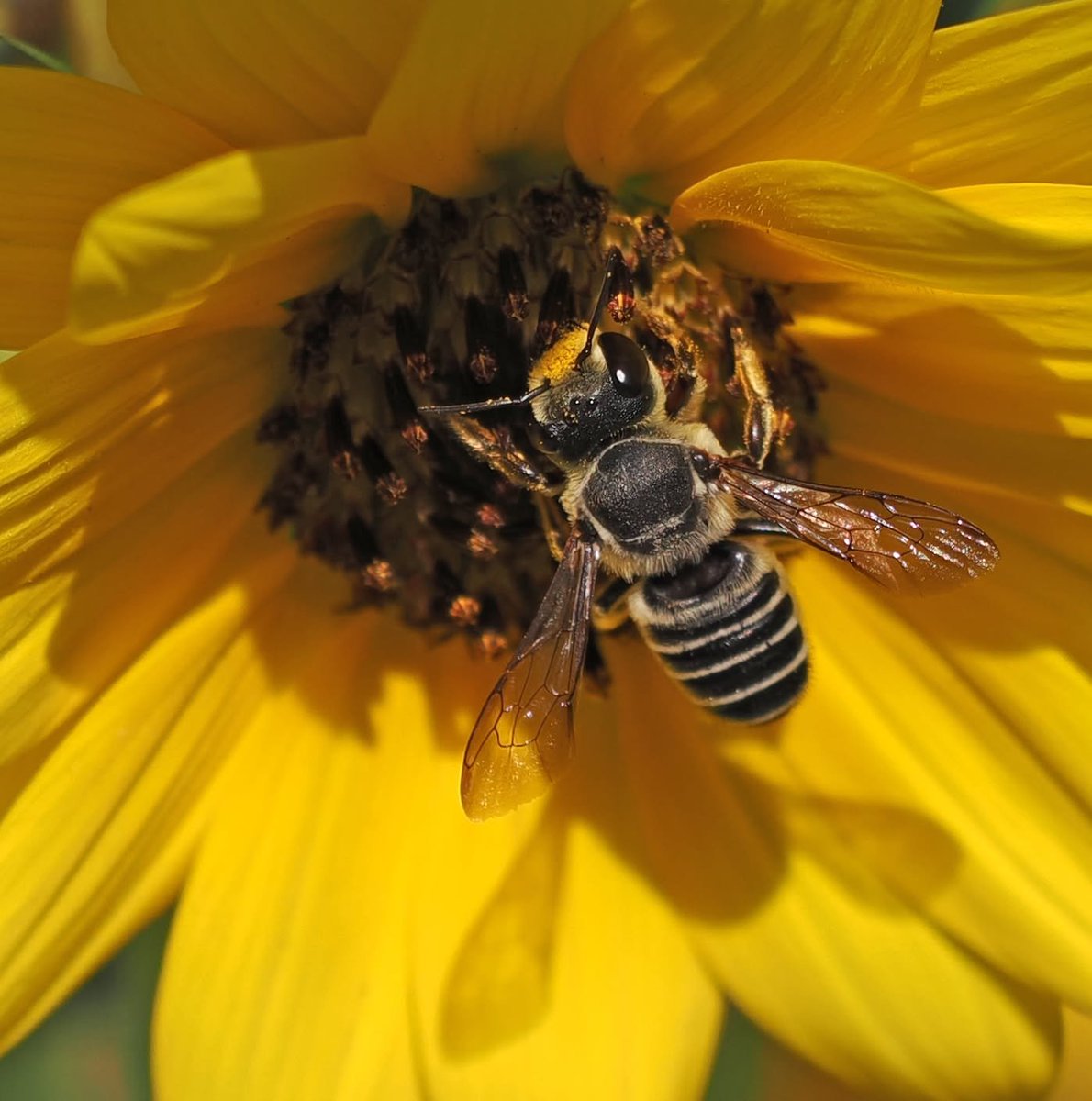
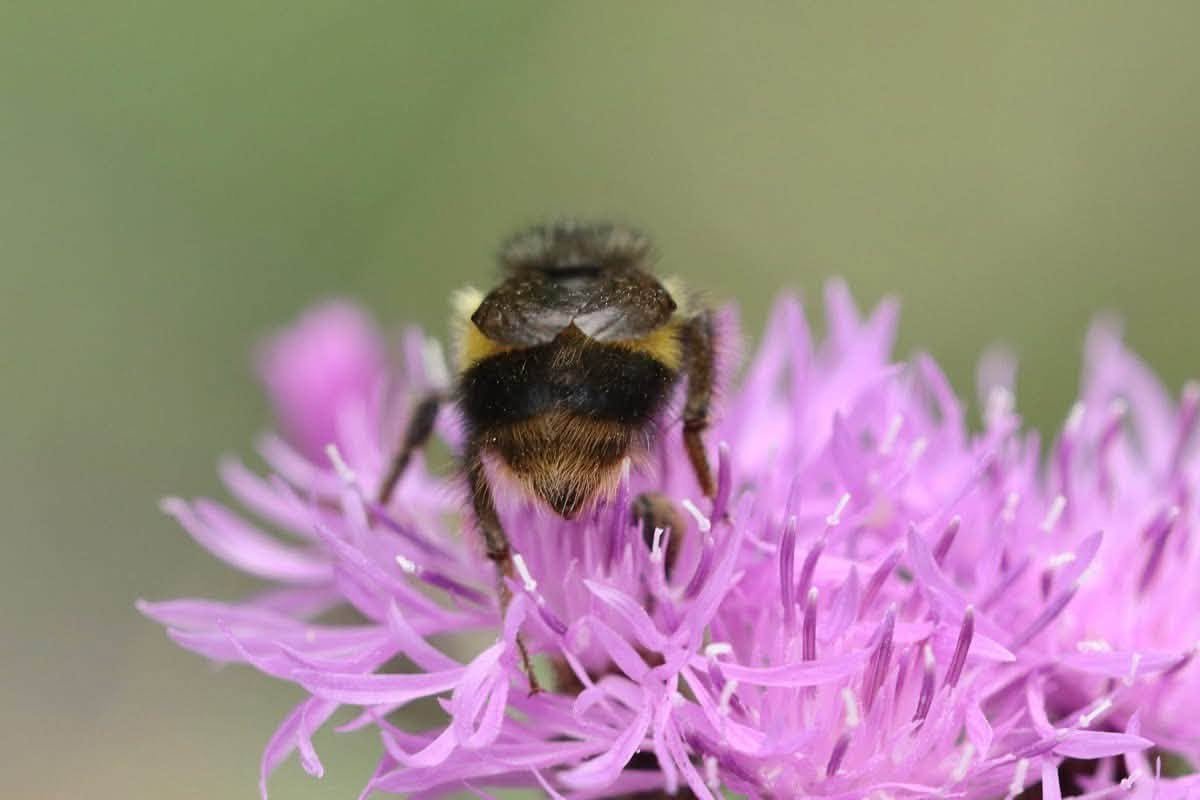
Why is she called "parallel" anyway? as in, Megachile parallela? There are few other bees with "parallel" in the species name (e.g. Palaeorhiza parallela), so what is the species name describing?
The internet search is no good, it harps on about general leafcutter bee charactersitcs
Nor is my reference "bees of the world", which tells you it's in the subgenus Argyropile,
So what can be parallel here? In taxonomy, the "parallela" can either refer to a (relatively) parallel-sided abdomen parallel margins of a body segment, parallel carinae (raised ridges) on the body, - perhaps as Michner says, it is the sixth bottom region in the abdomen with raised ridges ("S6", or "Sternite 6" [sternite referring to the ventral abdomen, as opposed to "tergite" which is the dorsal region])
Right, rambling aside, you can't see any of these feature, nor can you see the strong jaws or big hairy boot- ABDOMEN, so all up this is a poor contender for Bee of the Day #336, eh?
📷Bobby Jones, Texas
Bee of the day #335 is the blue carpenter bee who is not actually a carpenter bee: Ceratina cyanea. Now the genus Ceratina is commonly called the "small carpenter bees" in contrast to Xylocopa, the "large" carpenter bees (or just "carpenter bees"). Funny, considering that Ceratina is in the Apidae bee family as opposed to the Megachilidae leafcutter bee family.
Female C. cyanae (& the Ceratina genus as a whole) nest in plant stems, digging out the soft tissues of plants (phloem and whatnot), whereas carpenters nest in hollow branches and stems, similar beehaviour, at a larger scale.
What's interesting about these bees is that both males and females overwinter inside their cells, that is, the larvae completes its development and hatches as an adult, going into diapause as winter hits... "these young adults are fed with pollen and nectar by their mother and sometimes by a sister before overwintering" (from the introduction of Mikat & Straka, 2021)
📷Martin Elkins, Bristol
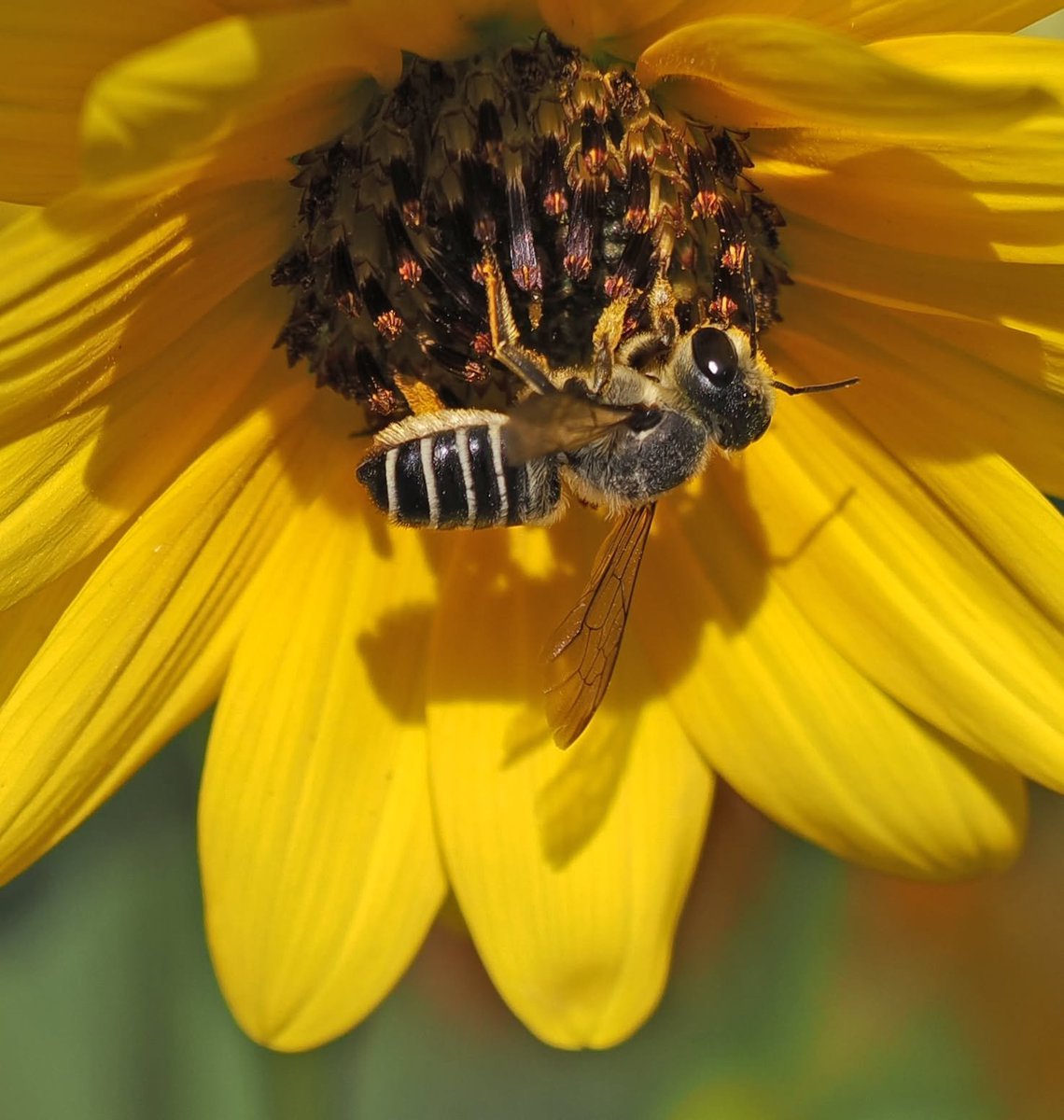
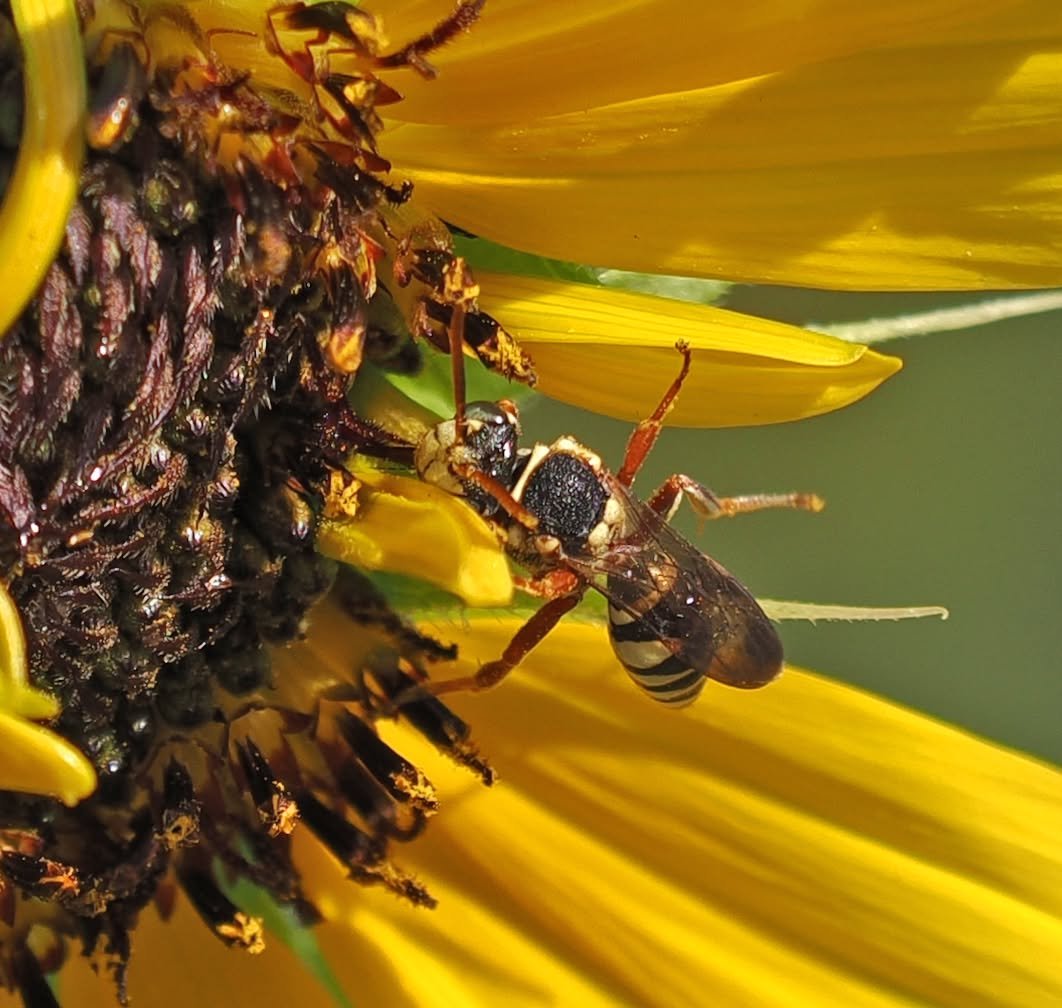
It's the shame the bee is so deep into the sunflowers, you can't see the large jaw that defines a "leafcutter" bee
Bee of the Day #330 is Megachile policaris, a rather common North American native bee with a generalist foraging habit - sunflowers, daisies, asters... any open flower really
Look at the underside of her abdomen, those thick hairs are scopae, which she uses for carrying pollen back to her nest*. As pollen accumulates on her body from foraging, she uses her legs to brush it to her body, where the pollen adheres to the hairs on the underside of her abdomen (under a microscope, pollen is very sharp and pointy, which will get stuck on other sharp and pointy things, like bee hairs).
Once fully loaded (or she's "satisfied") the female flies back to the nest, brushes it off using her legs and begins the brood-provision-making process
* The other forms of pollen transport are in hind leg baskets, as in honey bees, and internal pollen transport, like some masked bees in Australia
📷Roy Beckemeyer, Kansas
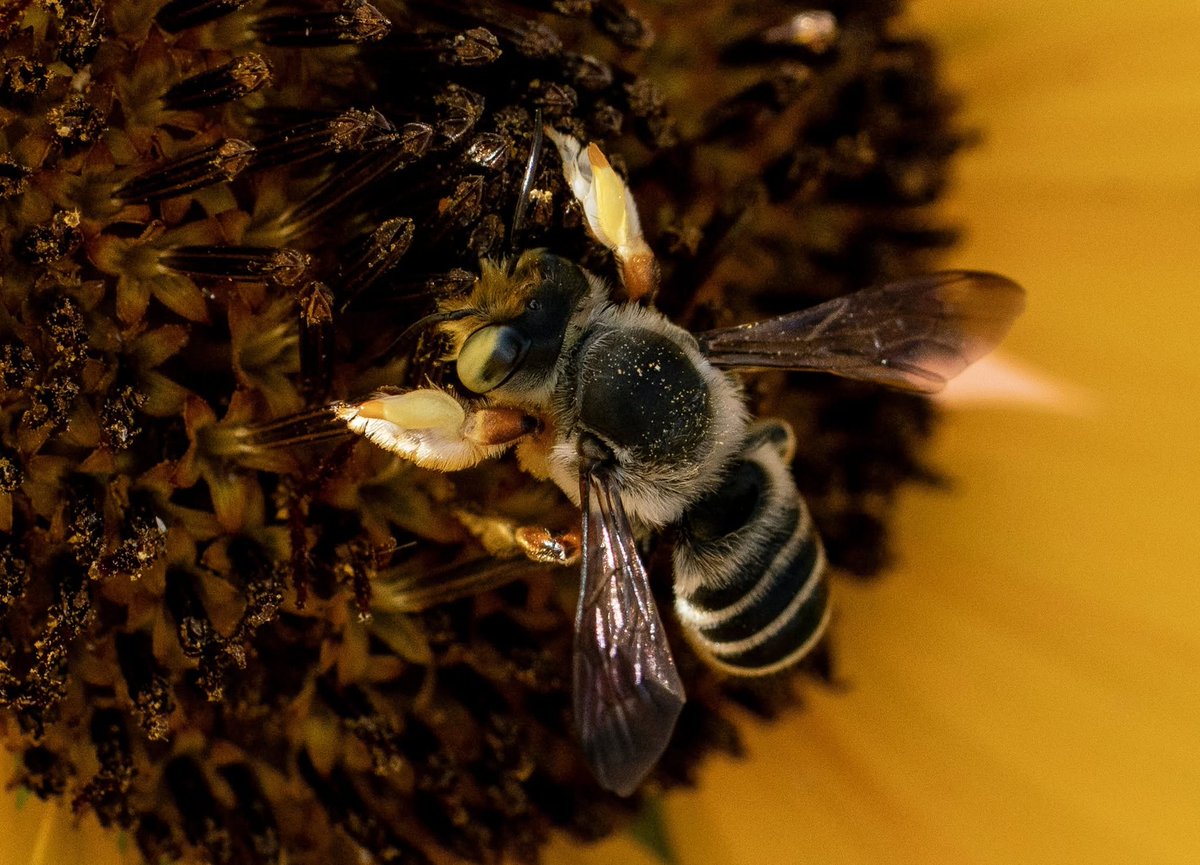
Look at those forelegs, they tell you two things: 1) this is a leafcutter bee (Megachile sp.) 2) this is a male leafcutter
3) (I lied) this is bee of the day #334, M. policaris, which compliments the female that was described in #330.
Being a boy, he lacks the pollen-collecting apparatus' of the fairer sex. His antennae is longer*, and the modified forelegs are for mating: he will grasp a female from above (or behind, or above and behind) and use his forelegs to cover her eyes**. Obscuring her vision in this manner informs her that it's 1) a male not a predator (a "male predator" does not exist in the bee world) 2) prevents her from flying off and rejecting the intercourse, thus increasing our boy's chance of successful insemination
Still, finding females is hard work, so he's stopped on a flower in the daisy family (Asteracaea) to refuel with nectar
*Over time, it becomes easier to distinguish the sexes based on the antennae size, it just "seems" slightly longer
**In some leafcutter species, the forelegs contain glands producing sexual pheromones that the female finds enticing.... enticing enough for her to stay in the courtship
📷Leslie Miller, Oklahoma
Why do some bees emerge out of season? Better yet, why do they have "seasons"?
The latter is easy: their flight ("active") time syncs with their flowers of choice. Good explanation for specialists bees, not so much for generalist bees*
Bee of the day #333 is an out-of-season English mining bee, Andrena scotica, the chocolate mining bee (for her colourations) or hawthorn bee (for -you guessed it- its plant of choice). Her normal flight time is in spring-early summer, mid March to late June, with a peak at late April and May... so what is she doing in September?
Perhaps there exists a subset in the A. scotia population that rears multiple generations of brood, as I'm told that autumn sightings are not unheard of. I wonder, if she matesand builds a nest, will that brood "overwinter", or (more likely?) die out, as they lack wintering adaptations. perhaps in European climates with milder winters, they can do so. With this YooKay individual, not so much
It was fun to see the identifications hover between different types of Andrena, until a consensus on an abnormal A. scotica was reached
*A better explanation for them could be that the "air temperature-flower balance is just right for raising the next generation"
📷Tony Short, Hampshire
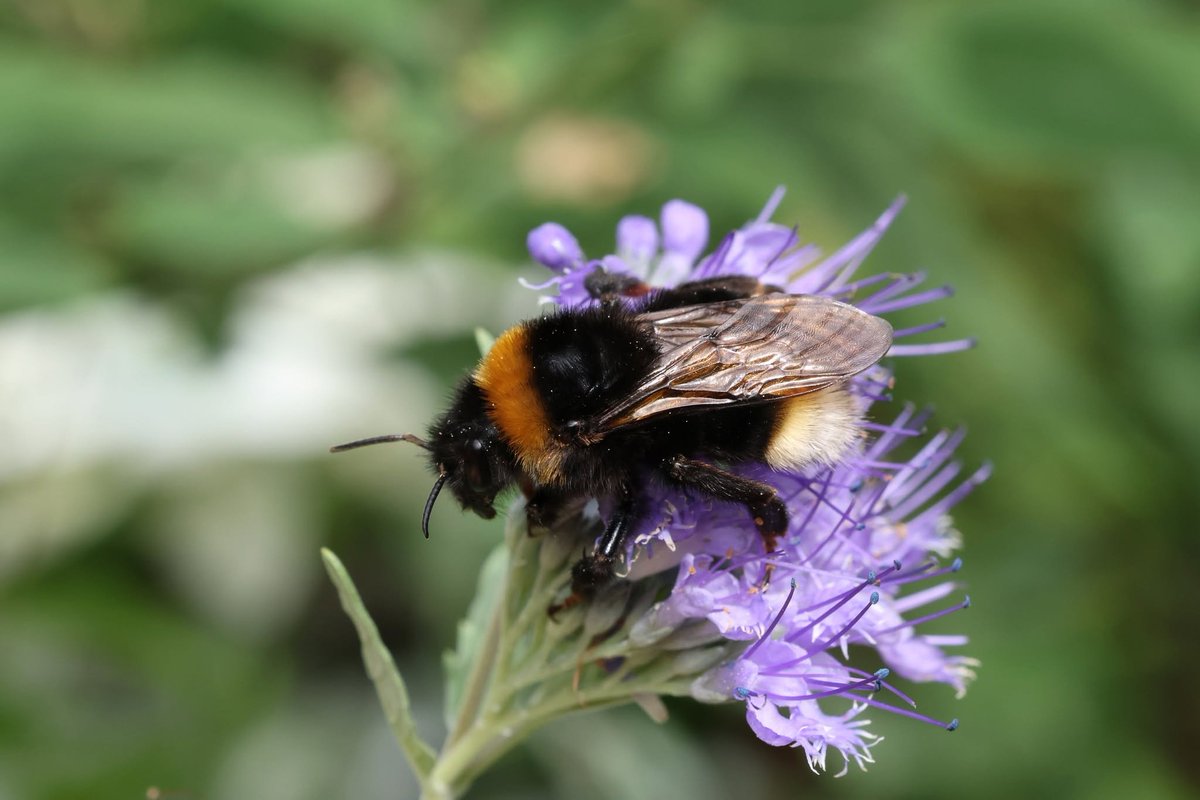
Bee of the day #322 is a female Southern Cuckoo bumble
bee, Bombus vestalis, nectaring on Caryopteris flowers. Seeing these females late into the season means they're not queens, rather "gynes" (whether this one is mated already is unknown).
As with other bumble bees, she will find a nice underground burrow to enter diapause, that process whereby she "hibernates" through the winter until next spring, where she emerges in search of a host nest to take over. (their hosts are the buff-tailed bumble bee, B. terrestris)
I wonder if this Vestal bumble bee ( along with other cuckoo bees) are genetically programmed to emerge later in the season, since if they emerge too early, there are no suitably-established nests for them to take over.
Consider that a host queen needs around ~ 1 month to build the nest, lay the first batch of brood, take care of them until they emerge, it would be more efficient for the cuckoo to emerge in mid/late spring to maximise the chances of taking over a healthy nest, in saying that, there's a counterargument: the bigger the nest/target, the more chance for the cuckoo to be spotted/killed/kicked out by the host's queen or workers... tradeoffs!
📷Nick Hollands, Kent






![TheHolyHabibee's tweet photo. I spy with my little eye something bee-ginning with P:
Poop!
Bee of the Day #344 was caught in the act of defecating; that's the little brownish bubble at the end of her abdomen.
Bees, like birds (and many other animals) package their waste into one pallet. What you see there is a combination of what we'd call "urine" and solid wastes, for bees do not have kidneys and a separate urinary/colonic tract.
The renal-excretory role is done by the malphigian tubules, who take the wastes from the haemolymph and secret them into the gut, where they mix with the gut contents (a combination of undigested food residue, microbes & gut material ["cells"]) and are shown out the door via the anus, as you can see here.
The overrall excretory system is the same, the difference in urine composition varies according to bee diets. For a generalist forager like this Megachile sp. (oops, I only just introduced her) will have a more "average" droplet size than a specialist bee who consumes a pollen-heavy diet (or "specks" in the poop) or a nectar-heavy one (more watery poops).
What I described above is for the adults - larvae have a different time of defecation, occurring towards the end of their feeding period (which can last days or longer), or right before pupation (again, a long time). See, this painless constipation is good for the larvae, they don't have to sit in their faeces every time they eat.
📷Laurence Sanders, Emerald Queensland](https://pbs.twimg.com/media/HTxP3O6bIAAm4py.jpg)

![TheHolyHabibee's tweet photo. Why is she called "parallel" anyway? as in, Megachile parallela? There are few other bees with "parallel" in the species name (e.g. Palaeorhiza parallela), so what is the species name describing?
The internet search is no good, it harps on about general leafcutter bee charactersitcs
Nor is my reference "bees of the world", which tells you it's in the subgenus Argyropile,
So what can be parallel here? In taxonomy, the "parallela" can either refer to a (relatively) parallel-sided abdomen parallel margins of a body segment, parallel carinae (raised ridges) on the body, - perhaps as Michner says, it is the sixth bottom region in the abdomen with raised ridges ("S6", or "Sternite 6" [sternite referring to the ventral abdomen, as opposed to "tergite" which is the dorsal region])
Right, rambling aside, you can't see any of these feature, nor can you see the strong jaws or big hairy boot- ABDOMEN, so all up this is a poor contender for Bee of the Day #336, eh?
📷Bobby Jones, Texas](https://pbs.twimg.com/media/HTIhG6BakAAieDk.jpg)