Today, we're announcing that we’ve raised $152 million in our Series A at a $1.35 billion post-money valuation, becoming Europe's first pure-play humanoid robotics unicorn just two years after founding. This funding brings the total raised to date to $270 million.
The round was led by @PrimeMoversLab, with participation from @SchaefflerGroup, @BoschGlobal, Fubon Financial Holding Venture Capital, and Aglaé Ventures.
The capital will support development and launch of the next-generation humanoid robot platform, the roll-out of Beta version in Q4 2026, start of mass manufacturing of wheel-based robots and the continued development of KinetIQ, our AI brain.
Humanoid's valuation reflects rapid execution and the technology's shift from research to commercial deployment, demonstrating that Europe can build and scale globally competitive Physical AI companies.
Read more here: https://t.co/3p9AYMS0Ca
I’m at CoRL this week. Our nextgen production robots will deploy imminently.
We’re hiring across VLA/RL for wheeled industrial robots and our biped.
If you’re driven to put real robots to work in real environments, let’s meet.
London · Boston · California · Vancouver
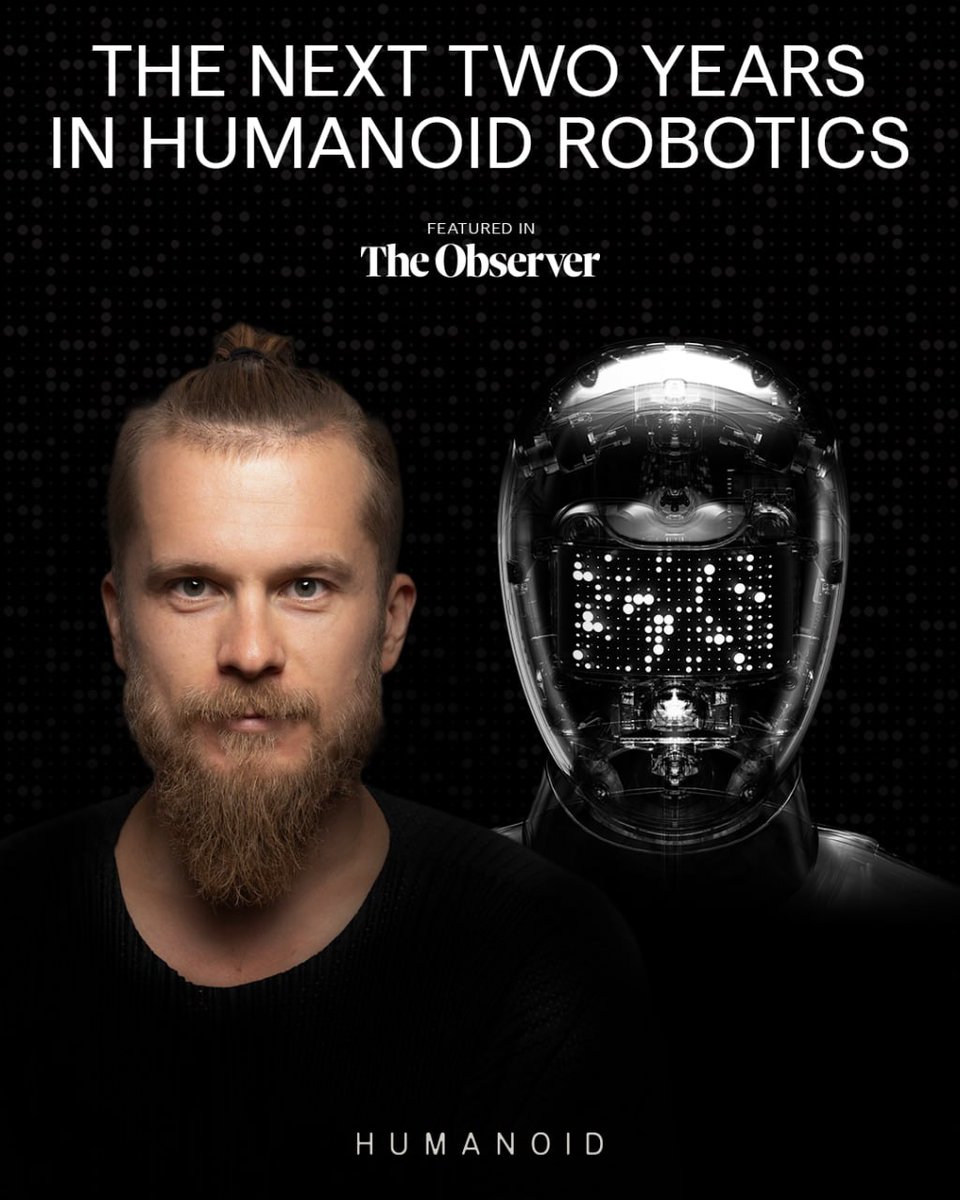
Humanoid robots could reach maturity and handle most industrial jobs within two years. Don’t believe it?
Our Founder & CEO Artem Sokolov (@ArtSokolov) explains why in his new interview with Barney Macintyre (@barneymac) at @ObserverUK.
Read it here and tell us what you think: https://t.co/KbMFTppdoW
Last week, we talked about how we’re using agentic AI across the company (check out the original post).
Here’s a more detailed example of our work accelerating policy development lifecycles: real world → simulation → robot deployment, fully agentically.
We believe this is the path forward for rapidly teaching robots new skills.
At Humanoid, we believe in riding the exponential: we leverage progress in AI to accelerate all aspects of our operations, from procurement to the policy development lifecycle. Here's how:
At Humanoid, we believe in riding the exponential: we leverage progress in AI to accelerate all aspects of our operations, from procurement to the policy development lifecycle. Here's how:
As an example, here’s a snippet of our work on accelerating policy development lifecycles: real world → simulation → robot deployment, fully agentically. We believe this is the path forward for rapidly teaching robots new skills.
Humanoid expands collaboration with @NVIDIARobotics to power our next generation of humanoid robots.
@NVIDIARobotics has been part of our stack from the beginning through NVIDIA Isaac Lab and NVIDIA Isaac Sim.
Now we’re integrating NVIDIA Jetson Thor, NVIDIA Isaac OS, NVIDIA Holoscan Sensor Bridge and Holoscan SDK.
Together, these technologies will reduce hardware and software complexity, making the platform easier to develop, test and ultimately scale.
As our Founder and CEO @ArtSokolov put it: “Together, we can unlock new levels of autonomy and bring more capable humanoid robots into the real world.”
Read more here: https://t.co/xp1i13Dpck
October 22: Sotirios Stasinopoulos (@SotStas_)
Sotirios will join Automation Meets Autonomy: Europe’s Next Era of Robotics panel.
The panel will explore how AI, simulation, digital twins, and robotics software are turning traditional automation into systems that can adapt, learn, and operate at scale.
⏰ 10:00–10:40 a.m. CEST
📍 STATION-Berlin, Session Room 5
Humanoid is heading to #NVIDIAGTC Berlin with two speaker appearances from our leadership team:
Artem Sokolov, Founder & CEO
Sotirios Stasinopoulos, Chief Product Officer
These conversations you won’t want to miss.
October 21: Artem Sokolov (@ArtSokolov)
Artem will join the #NVIDIAGTC Live Keynote Pregame for a talk about Physical & Industrial AI.
A discussion on how European companies are bringing AI that understands and acts in the physical world into the machines and systems we depend on every day.
⏰ 9:00–11:00 a.m. CEST
📺 Watch live: https://t.co/z2RbOAmj23
Our lobby turned into an agentic AI meetup this week.
On October 14th, @nvidia launched its Build-A-Claw event at 1 Triton Square, home to Humanoid’s London office, bringing together builders to create their own autonomous agents using NVIDIA-powered computers.
And that’s particularly exciting for us, since KinetIQ is built on NVIDIA compute, and we use NVIDIA technology across simulation, training, and real-world robot operation.
So our Founder & CEO @ArtSokolov and CTO @jaradcannon joined the conversation ahead of #NVIDIAGTC Berlin.
Great to have the community right on our doorstep.
Our internship program is expanding. We’re now hiring Spatial AI & Navigation Interns in London.
The challenge:
• Record the same indoor space twice on your phone,
• Build a shared 3D representation,
• Detect what moved, appeared, or disappeared,
• Describe the changes semantically or in natural language,
• Submit it as a public GitHub repo.
No real-time constraints. Use any tools, models, frameworks, or agentic workflows you think work best.
Please note: we’ll only consider applications that include the completed challenge.
Full-time, 12 weeks. London. November start. Deadline: 16 October, 23:59 BST.
Apply here: https://t.co/Idlt3l61xf
We will, of course, reject any plagiarised solutions and they’ll be very easy to spot! Rather than copying someone else’s work, it’s always much better to put the effort into creating your own. But just to help everyone resist the temptation, we recommend making the repo public closer to the deadline as we will be reviewing all applications after the deadline has passed.
Full-time, 12-24 weeks, London office, flexible start.
Open to Master's and PhD students and graduates in CS, ML, Robotics, or related fields.
Applications close 9 October, 23:59 BST.
Apply here: https://t.co/6sAMIoWLf8
We’re hiring Robot Learning Research Interns in London.
Work on RL, world models, VLA/multimodal models, sim-to-real, and real-time inference, with research that can move toward real deployment.
Here's how it works:
1) Collect your own real-world manipulation data,
2) Use it to drive a robotic manipulator in simulation,
3) Submit your solution as a public GitHub repo.
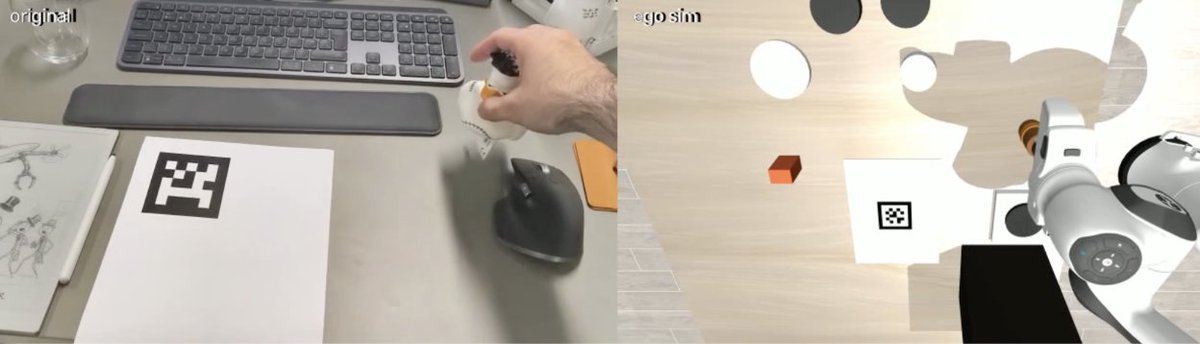
And here is an example of how it might look like:
Left: a snapshot from a ego centric hand manipulation video sample;
Right: simulation environment where we use that data to drive a Panda arm in Libero simulator with a trained policy using SmolVLA as a base.