Big thanks to Solana Breakpoint @SolanaConf for an awesome event in Abu Dhabi! 🇦🇪🙌
Even with the broader crypto market feeling shaky, Solana's energy is real — the ecosystem is alive and building.
A few takeaways:
1️⃣ Top-notch event with stellar speakers like @RaoulGMI, @novogratz & many more
2️⃣ Ecosystem momentum is strong — real progress, not just noise
3️⃣ Meme chain? Surprisingly, not really. Most projects were solid infra: perp DEXs, prediction markets, on/off ramps
4️⃣ Builders are bullish and shipping fast
5️⃣ Huge announcements: @Visa #stablecoin on Solana, $ONDO bringing tokenized stocks
6️⃣ Loved seeing the @solanamobile Seeker Phone — onboarding to #web3 done right. Can’t wait to test it!
Hope to see everyone again in #London, November 2026!
What is Liquidity? 💧📊
Start learning the basic terms with us! 📖✨
Liquidity in cryptocurrencies refers to the ease with which a cryptocurrency can be bought or sold without significantly affecting its price.
🔹 High liquidity means there are many buyers and sellers in the market, allowing for fast and stable transactions.
🔹 Low liquidity means it is harder to find a counterparty for a trade, which can lead to large price fluctuations and higher exchange costs.
Why is Liquidity Important? 🤔
✅ Smaller bid-ask spreads – Higher liquidity results in narrower price differences between buying and selling.
✅ Lower volatility – Markets with high liquidity are more stable and less prone to sudden price swings.
✅ Easier transactions – You can quickly exchange cryptocurrency for another or cash 💰.
✨ Want to enter the world of cryptocurrencies but don’t know how? Follow us! 📍🔍
📢 This post is for informational purposes only and not investment advice. Always research and consult with a financial advisor before making decisions.
#cryptocurrency #Learn2Earn
What is an Airdrop? 🌐💰
Start learning the basic terms with us! 📖✨
An airdrop in the context of cryptocurrencies is the process of distributing free 🎁 tokens or cryptocurrencies to users' wallets. It is often used by blockchain projects for promotion 📢, rewarding 🎉 the community, or encouraging people to use their platform 🚀.
Types of Airdrops: 🏆
🔹 Standard Airdrop – Users receive tokens simply for having a crypto wallet compatible with the network. 💳🔗
🔹 Loyalty Airdrop – Rewards 🎖️ for users who have previously interacted with the project.
🔹 Task-Based Airdrop – Users must complete specific tasks ✅, such as following a Twitter 🐦 account, joining a Discord 💬 group, or sharing a post.
🔹 Holder Airdrop – Tokens are distributed to users who hold 💎 a specific cryptocurrency in their wallet.
🔹 Stealth Airdrop – Users are not informed in advance; they simply receive tokens in their wallet unexpectedly 🎭.
Why Do Projects Organize Airdrops? 🤔
🚀 Promoting a new token and gaining attention.
🌍 Building a community around the project.
📈 Encouraging users to engage with the platform.
🎯 Distributing tokens to a larger number of users.
What to Watch Out For? ⚠️
❌ Scams and fraud – Some airdrops are attempts to steal private keys 🔑 or phishing scams.
💀 Fake tokens – Some tokens may be worthless or used for manipulation.
💸 Fees for claiming an airdrop – If someone asks for a payment to receive an airdrop, it’s usually a scam! 🚨
✨ Want to enter the world of cryptocurrencies but don’t know how? Follow us! 📍🔍
📢 This post is for informational purposes only and not investment advice. Always research and consult with a financial advisor before making decisions.
#cryptocurrency #Learn2Earn
What is a Whale? 🌐💰 Start learning the basic terms with us!
In the world of cryptocurrency, a whale refers to an individual or entity that holds a large amount of a specific cryptocurrency. Because of their substantial holdings, whales have the potential to influence market prices through their actions.
Why are whales important?
1️⃣ Market Impact:
When whales buy or sell large quantities of crypto, it can cause significant price swings due to the high volume of their transactions.
2️⃣ Liquidity Shifts:
Whales moving funds in or out of exchanges can impact the availability of tokens for other traders.
3️⃣ Market Signals:
Tracking whale activity (e.g., large wallet movements) can give insights into potential market trends.
How do whales operate?
Whales can make large transactions, sometimes influencing market momentum. They often use over-the-counter (OTC) trades to avoid causing noticeable price changes.
🐋 Common types of whales:
Bitcoin Whales: Early adopters or entities holding significant amounts of Bitcoin.
Institutional Whales: Companies or investment funds with major crypto investments.
Exchange Whales: Crypto exchanges holding large reserves of tokens.
⚠️ Risks associated with whales:
Whales could potentially manipulate prices by creating artificial demand or supply.
Large-scale buying or selling can lead to sudden and unpredictable price movements.
✨ You want to enter the world of cryptocurrencies, but you don’t know how? Follow us 📍
This post is for informational purposes only and not investment advice. Always research and consult with a financial advisor before making decisions.
#cryptocurrency #Learn2Earn
📊 Check out our financial market summary and stay up to date!
🔹 MACRO:
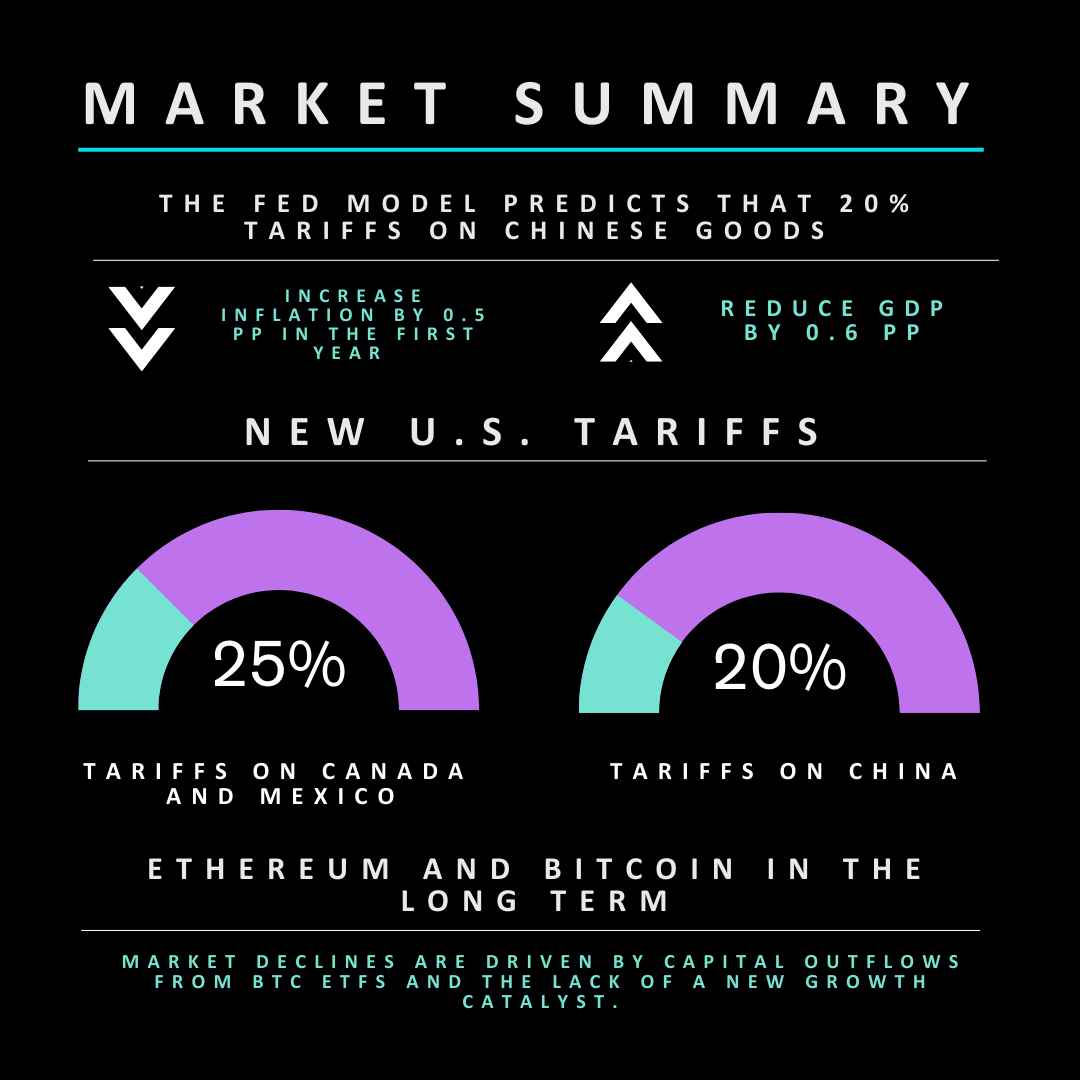
1️⃣ New U.S. Tariffs -Trump has announced new tariffs on Canada, Mexico, and China.
2️⃣ Impact of Tariffs on the U.S. Economy – The FED model predicts that 20% tariffs on Chinese goods will increase inflation by 0.5 pp in the first year and reduce GDP by 0.6 pp.
3️⃣ ECB to Cut Rates – The market fully prices in a 25 bp rate cut by the European Central Bank on March 6, 2025.
4️⃣ China Increases Deficit – To achieve 5% GDP growth, China plans its highest budget deficit in 30 years, investing trillions of yuan into the economy.
5️⃣ ISM Growth and Crypto – Forecasts indicate ISM growth, which has historically driven the crypto market; Raoul Pal suggests the current cycle could lead to strong BTC gains.
🔹 CRYPTO:
1️⃣ Uncertainty and Volatility in the Crypto Market
🔻 The lack of clear economic policy makes investors cautious and slows capital flow.
🔻 The SEC is withdrawing lawsuits, and Congress is working on market regulations, which may bring more stability.
🔻 Capital is shifting from memecoins to utility tokens, and a weakening dollar could support crypto market growth.
2️⃣ Ethereum and Bitcoin in the Long Term
🔻 ETH is undervalued, institutions are accumulating, and DeFi legalization supports its development.
🔻 Market declines are driven by capital outflows from BTC ETFs and the lack of a new growth catalyst.
🔻 BTC remains above key moving averages, while increasing money supply and a weakening dollar may support further growth.
Are you looking for market information? Follow us and stay up to date 🔝
This report offers data for personal use and informational purposes only, not as investment advice. Consult a financial advisor before any transactions.
#MarketReport #Cryptocurrency
What is a GAS Fee? ⛽💰
Start learning the basic terms with us! 📖✨
A GAS fee is the cost associated with executing a transaction on a blockchain network. It serves as a payment to miners or validators for processing and confirming transactions.
How Does GAS Work? ⚙️
🔹 Every blockchain transaction requires computing power, and GAS is the fee for using it.
🔹 GAS fees are dynamic – they depend on network congestion and transaction speed.
🔹 Ethereum (ETH) and other blockchains use GAS to pay for transactions, such as sending cryptocurrencies or executing smart contracts.
What Affects the GAS Fee Amount? 📊
✅ Network congestion – The more transactions at a given time, the higher the fees.
✅ Transaction complexity – Smart contracts require more computation, increasing GAS costs.
✅ GAS limit and price – Users can set their own GAS price; the higher the price, the faster the transaction gets confirmed.
How to Reduce GAS Fees? 💡
💰 Wait for lower network congestion – Fees are lower outside peak hours.
⚡ Use Layer 2 solutions – Platforms like Arbitrum, Optimism enable cheaper transactions.
📉 Optimize smart contracts – In DeFi and NFT projects, better coding can reduce GAS consumption.
✨ Want to enter the world of cryptocurrencies but don’t know how? Follow us! 📍🔍
📢 This post is for informational purposes only and not investment advice. Always research and consult with a financial advisor before making decisions.
#cryptocurrency #Learn2Earn
What is a Whale? 🌐💰 Start learning the basic terms with us!
In the world of cryptocurrency, a whale refers to an individual or entity that holds a large amount of a specific cryptocurrency. Because of their substantial holdings, whales have the potential to influence market prices through their actions.
Why are whales important?
1️⃣ Market Impact:
When whales buy or sell large quantities of crypto, it can cause significant price swings due to the high volume of their transactions.
2️⃣ Liquidity Shifts:
Whales moving funds in or out of exchanges can impact the availability of tokens for other traders.
3️⃣ Market Signals:
Tracking whale activity (e.g., large wallet movements) can give insights into potential market trends.
How do whales operate?
Whales can make large transactions, sometimes influencing market momentum. They often use over-the-counter (OTC) trades to avoid causing noticeable price changes.
🐋 Common types of whales:
Bitcoin Whales: Early adopters or entities holding significant amounts of Bitcoin.
Institutional Whales: Companies or investment funds with major crypto investments.
Exchange Whales: Crypto exchanges holding large reserves of tokens.
⚠️ Risks associated with whales:
Whales could potentially manipulate prices by creating artificial demand or supply.
Large-scale buying or selling can lead to sudden and unpredictable price movements.
✨ You want to enter the world of cryptocurrencies, but you don’t know how? Follow us 📍
This post is for informational purposes only and not investment advice. Always research and consult with a financial advisor before making decisions.
#cryptocurrency #Learn2Earn
📊 Check out our financial market summary and stay up to date!
MACRO:
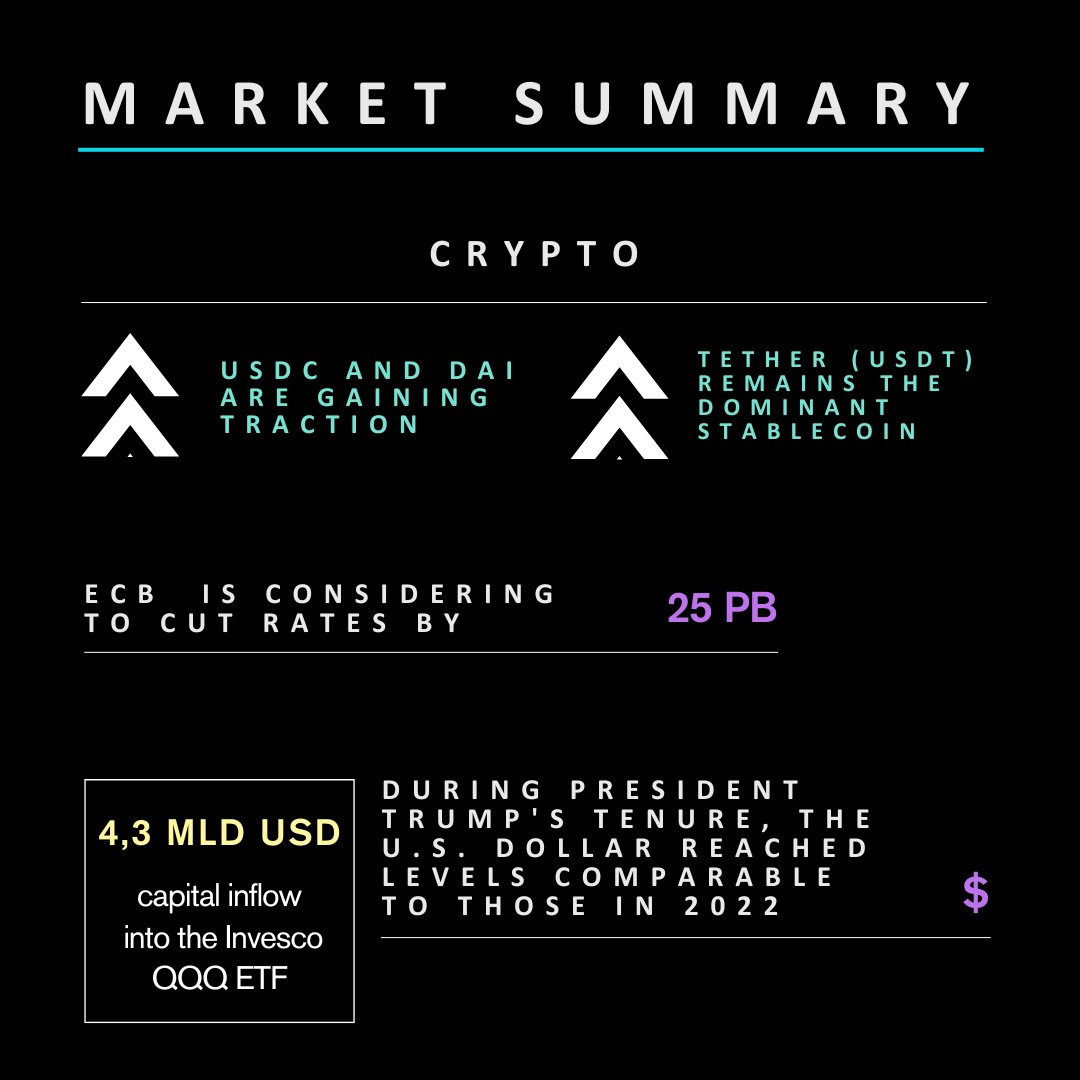
1⃣ DeepSeek, a Chinese AI model with lower hardware requirements, initially caused market reactions, followed by a rebound and the largest capital inflow into the Invesco QQQ ETF ($4.3 billion) since 2021.
2⃣ After Trump's inauguration, the dollar weakened; the new administration suggests no rush in implementing tariffs, and the dollar, after prolonged gains, reached levels from 2022 and 20 years prior.
3⃣ The Fed maintained interest rates, emphasizing the strength of the U.S. economy and planning further cuts only after encouraging data; the ECB is considering a 25 basis point rate cut.
4⃣ In January 2025, the Purchasing Managers' Index (PMI) in Europe increased, particularly in France (manufacturing) and Germany (manufacturing and services), exceeding forecasts and raising expectations for economic conditions in 2025.
5⃣ A decline in new-tenant rent inflation in the U.S. may lead to a decrease in overall inflation and a weakening of the dollar, as the reduction in new lease prices significantly diminishes inflationary pressures.
CRYPTO:
1⃣ Bitcoin's Market Dynamics: Despite limited adoption of the Lightning Network, Bitcoin continues to serve primarily as a store of value, with miners maintaining profitability due to transaction fees surpassing mining rewards in 2024, and market volatility reflecting natural investor psychology cycles rather than fundamental weaknesses.
2⃣ Stablecoins' Market Influence: Tether (USDT) remains the dominant stablecoin, while USDC and DAI are gaining traction; the supply of stablecoins correlates with Bitcoin's price, offering insights into market sentiment.
3⃣ Regulatory Developments Favoring Bitcoin: Pro-Bitcoin regulations, such as the repeal of Staff Accounting Bulletin 121 (SAB 121), are facilitating banks' ability to offer cryptocurrency-related services, thereby promoting market growth.
4⃣ Tether (USDT) remains the dominant stablecoin, while USDC and DAI are gaining significance; the correlation between the supply of stablecoins and Bitcoin's price can indicate market sentiment.
5⃣ EthStrategy's Launch: Joseph Delong, former CTO of Sushiswap DEX, has introduced EthStrategy, an open-source, on-chain protocol for decentralized Ethereum investment management, which has already secured 40,000 ETH (over $120 million) in initial commitments.
Are you looking for market information? Follow us and stay up to date 🔝
This report offers data for personal use and informational purposes only, not as investment advice. Consult a financial advisor before any transactions.
#MarketReport #Cryptocurrency
🌐💰 Start learning the basic terms with us!
HODL is a popular term in the cryptocurrency world that means holding onto your crypto assets instead of selling, regardless of price fluctuations.The term originated from a humorous misspelling of “hold” in a 2013 Bitcoin forum post and has since become a symbol of long-term commitment to cryptocurrency investments.
Why do people HODL?
1️⃣ Belief in Long-Term Value:
HODLers believe that cryptocurrencies will appreciate significantly over time, driven by adoption and innovation.
2️⃣ To Avoid Emotional Trading:
HODLing helps investors stay calm during market volatility, reducing impulsive decisions based on fear or greed.
3️⃣ To Support Decentralization:
Holding assets contributes to network stability and security, particularly in blockchain ecosystems.
💡 Benefits:
No need to constantly monitor markets.
Avoid frequent transaction fees and potential tax events.
⚠️ Risks:
Market Declines: crypto prices can be highly volatile, and some projects may lose value permanently.
HODLers may miss short-term profits during price spikes.
What is the difference between HODLing and trading?
HODLing: A long-term strategy where you keep your assets regardless of price swings.
Trading: Actively buying and selling assets to capitalize on market movements, which can be risky and time-intensive.
✨ You want to enter the world of cryptocurrencies, but you don’t know how? Follow us 📍
This entry is for personal and informational use only and not as investment advice. Consult with a financial advisor before any transactions.
#cryptocurrency #Learn2Earn
🌐💰 Start learning the basic terms with us!
Staking is the process of participating in the operation of a blockchain network by locking up your cryptocurrency to support the network’s security and functionality. In return, participants earn rewards, often in the form of additional cryptocurrency. It is typically associated with Proof-of-Stake (PoS) blockchains.
💼 How does staking work?
Instead of mining, validators are chosen to add new blocks based on the amount of cryptocurrency they stake.
💡 Benefits:
By staking, you can passively grow your holdings by earning a portion of the network's transaction fees or newly created tokens.
Staking helps maintain the blockchain’s security and decentralization.
PoS blockchains require significantly less energy than Proof-of-Work (PoW) blockchains like Bitcoin.
⚠️ Risks:
Some networks require you to lock your tokens for a set period, limiting liquidity.
The value of the staked tokens can decrease, affecting your overall earnings.
Staking means sending crypto to a smart-contract. In case of the smart-contract hack, we can potentially lose all staked assets.
Why is staking important?
Staking is key to the operation of modern blockchains, enabling scalability and sustainability while offering users opportunities to participate in and benefit from blockchain ecosystems.
✨ You want to enter the world of cryptocurrencies, but you don’t know how? Follow us 📍
This post is for informational purposes only and not investment advice. Always research and consult with a financial advisor before making decisions.
#cryptocurrency #Learn2Earn
🌐💰 Start learning the basic terms with us!
A regulator is a government or independent authority responsible for creating and enforcing rules to ensure fairness, security, and stability in financial markets, including cryptocurrency. Their role is crucial in maintaining trust and protecting consumers while fostering innovation.
⚖️ Why are regulators important?
Regulators help safeguard individuals from fraud, scams, and market manipulation.
They ensure that crypto projects follow laws and regulations, such as anti-money laundering (AML) and know-your-customer (KYC) policies.
Regulation helps reduce market volatility and fosters a safe environment for both investors and businesses.
Key roles of regulators in cryptocurrency:
1️⃣ Licensing: Approving crypto exchanges, wallets, and other service providers to operate legally.
2️⃣ Monitoring: Keeping an eye on suspicious activities and enforcing penalties for violations.
3️⃣Educating: Providing guidelines for users and businesses on how to interact safely with cryptocurrency.
🌍 Examples of regulatory bodies:
United States: SEC (Securities and Exchange Commission), CFTC (Commodity Futures Trading Commission).
European Union: ESMA (European Securities and Markets Authority).
Global: FATF (Financial Action Task Force), which sets international standards.
💡 Why does regulation matter?
Regulators help make the crypto space safer and more trustworthy, encouraging wider adoption and stability while ensuring businesses operate responsibly.
✨ You want to enter the world of cryptocurrencies, but you don’t know how? Follow us 📍
This post is for informational purposes only and not investment advice. Always research and consult with a financial advisor before making decisions.
#cryptocurrency #Learn2Earn
Looking to join @ApiologyDAO and become part of the @Berachain most wanted community? 🐻⛓️
What are the benefits? Is it still time? And how can you get the required NFTs cheaper? 🤔
Let's break it down 👇
🌐💰 Start learning the basic terms with us!
An ICO (Initial Coin Offering) is a fundraising method used by blockchain and cryptocurrency projects. It works similarly to an Initial Public Offering (IPO), but instead of shares in a company, investors receive the project's tokens.
How does an ICO work?
1️⃣ The project team prepares a whitepaper, a document outlining the project's goal, technology, and how the funds will be used.
2️⃣ Investors purchase tokens using cryptocurrencies (e.g., Ethereum, Bitcoin) or traditional currencies.
3️⃣ Tokens can be used within the project or traded on exchanges if they gain value.
Why do projects launch ICOs?
Funding development: Provides quick access to capital without relying on traditional financial institutions.
Building a community: Tokens attract investors who can become project ambassadors.
Flexibility: Lack of strict regulations (though this is changing).
💡 Benefits:
Potential for high returns if the project succeeds.
Easy access to investment opportunities, often at an early stage.
⚠️ Risks:
Lack of regulation: Many ICOs have turned out to be scams.
Uncertainty: There’s no guarantee the project will deliver on its promises.
ICOs were highly popular in 2017–2018, but many projects now use more regulated fundraising methods, such as IEOs (Initial Exchange Offerings) or STOs (Security Token Offerings).
✨ You want to enter the world of cryptocurrencies, but you don’t know how? Follow us 📍
This entry is for personal and informational use only and not as investment advice. Consult with a financial advisor before any transactions.
#cryptocurrency #Learn2Earn
What is token? 🌐💰 Start learning the basic terms with us!
A token is a unit of value that exists in digital form on a blockchain. It is created within existing blockchains (e.g., Ethereum) and can serve various functions within the cryptocurrency ecosystem.
Types of tokens:
1️⃣ Utility token:
A token that provides access to specific services or products within a blockchain application. Example: Basic Attention Token (BAT), used in the Brave browser.
2️⃣ Security token:
An investment token representing ownership in assets like stocks or real estate. These are subject to legal regulations, similar to traditional securities.
3️⃣ Governance token:
Tokens that grant voting rights in managing blockchain projects. Holders can influence future changes to the project.
4️⃣ Stablecoin:
A token pegged to the value of traditional assets, such as the US dollar. Examples: USDT, USDC.
How is a token different from cryptocurrency?
Cryptocurrency (e.g., Bitcoin): Functions as an independent currency with its own blockchain.
Token: Created on an existing blockchain (e.g., Ethereum, Binance Smart Chain) and serves various purposes.
Why are tokens important?
Tokens enable the development of new business models, support decentralized applications (DApps), and drive innovation in areas such as finance, gaming, and social media. They make blockchain technology more functional and accessible for users.
✨ You want to enter the world of cryptocurrencies, but you don’t know how? Follow us 📍
This entry is for personal and informational use only and not as investment advice. Consult with a financial advisor before any transactions.
#cryptocurrency #Learn2Earn
What is DApp? 🌐💰 Start learning the basic terms with us!
A DApp (Decentralized Application) is a decentralized application that runs on a blockchain instead of traditional servers. This makes it more transparent, secure, and independent of any single central authority.
Key features of DApps:
1️⃣ Decentralized: Operates on a blockchain, eliminating the need for centralized management.
2️⃣ Open source: The code is publicly available, allowing for community verification and development.
3️⃣ Smart contracts: DApps use smart contracts to automate application functions.
4️⃣ Censorship-resistant: No one can easily delete or block a DApp, as it operates on a distributed network.
💡 Why are DApps important?
Thanks to decentralization, users have greater control over their data and transactions. DApps eliminate the need for intermediaries, increasing transparency and reducing costs. However, using them may require knowledge of blockchain technology and tools like cryptocurrency wallets.
✨ You want to enter the world of cryptocurrencies, but you don’t know how? Follow us 📍
This entry is for personal and informational use only and not as investment advice. Consult with a financial advisor before any transactions.
#cryptocurrency #Learn2Earn
What is fork? 🌐💰 Start learning the basic terms with us!
A fork is a situation where the technology of a cryptocurrency (blockchain) splits into two different paths. This can happen when changes are made to the network’s rules or when there are differences in ideas about the cryptocurrency’s development.
Types of forks:
1️⃣ Soft fork:
A small change that doesn’t disrupt older users. Everything continues to work together.
2️⃣ Hard fork:
A major change that creates two separate cryptocurrencies, each operating under its own rules. Example? Bitcoin Cash was created as a result of a hard fork from Bitcoin.
Why does this happen?
🔸 Improvements: To make the cryptocurrency faster and cheaper.
🔸 Disagreements: When people involved in the project can’t agree on its direction.
🔸 Fixing bugs: To resolve security issues.
💡 What does it mean for you?
With a hard fork, you might receive a new cryptocurrency for free (e.g., Bitcoin Cash if you owned Bitcoin).
It can be an opportunity for profit but also comes with risks like changes and technical issues.
Forks are a way for cryptocurrencies to evolve and adapt to user needs, though they can sometimes lead to confusion.
✨ You want to enter the world of cryptocurrencies, but you don’t know how? Follow us 📍
This entry is for personal and informational use only and not as investment advice. Consult with a financial advisor before any transactions.
#cryptocurrency #Learn2Earn
What is DeFi? 🌐💰 Start learning the basic terms with us!
DeFi (Decentralized Finance) is a system of financial services built on blockchain technology that allows users to access financial products without intermediaries, such as banks.
How does DeFi work?
1️⃣ Enables sending and receiving money via blockchain.
2️⃣ Allows borrowing and lending funds.
3️⃣ Offers earning opportunities through investments (e.g., staking or liquidity mining).
What makes DeFi unique?
🔹 No intermediaries: Transactions occur directly between users without banks.
🔹 24/7 availability: Services operate anytime, anywhere.
🔹 Global access: Anyone with internet access can use DeFi.
🔹 Transparency: All transactions and smart contract codes are public.
DeFi unlocks new financial possibilities, but be aware of risks related to technology and market volatility!
✨ You want to enter the world of cryptocurrencies, but you don’t know how? Follow us 📍
This entry is for personal and informational use only and not as investment advice. Consult with a financial advisor before any transactions.
#cryptocurrency #Learn2Earn
What is a cryptocurrency exchange? 🤔💰 Start learning the basic terms with us!
If you've heard about Bitcoin, Ethereum, or other cryptocurrencies, you might wonder where people trade them. This is where a cryptocurrency exchange comes in!
👉 What is a cryptocurrency exchange?
It's an online platform where you can trade cryptocurrencies for other digital assets or traditional currencies like dollars or euros.
Think of it as a currency exchange shop – but instead of euros or dollars, you'll find cryptocurrencies there.
How does it work? 🛠️
1️⃣ You create an account on the exchange.
2️⃣ Deposit funds – either cryptocurrencies or regular money.
3️⃣ Choose what you want to buy or sell (e.g., Bitcoin, Ethereum, Dogecoin).
4️⃣ Transactions happen in real-time, with prices changing just like on a stock exchange.
Why do people use exchanges? 🌐
Investing: Hoping the value of cryptocurrency will increase.
Trading: Buying low and selling high.
Exchanging: For other cryptocurrencies or traditional currencies.
✨ You want to enter the world of cryptocurrencies, but you don’t know how? Follow us 📍
This entry is for personal and informational use only and not as investment advice. Consult with a financial advisor before any transactions.
#cryptocurrency #Learn2Earn
Third part of the report - on Bitcoin miners after Q2 2024
💻💰 The most important data from six companies involved in Bitcoin mining.
🏦🚀 Marathon Patent Group (MARA) reached a record hashrate of 35.2 EH/s, mining 2811 BTC at a cost of $45,626 per BTC. The company announced a new "Full Hold" strategy, meaning they do not plan to sell any BTC in the near future, currently holding 18,488 BTC in reserve.
⏳💸 Core Scientific (CORZQ), with 19.4 EH/s, mined 1680 BTC at a cost of $29,879 per coin. Due to financial obligations, the company sells all mined BTC within 10 days of acquiring them.
⚡💾 Clean Spark (CLSK), with 22.6 EH/s, mined over 2000 BTC without selling a single coin. Their mining cost is $32,000 per BTC, and they currently hold 7558 BTC.
📉⚒ Riot Blockchain (RIOT), with a hashrate of 22 EH/s, mined 844 BTC in Q2 at a cost of $41,795 per BTC. The company experienced a decrease in mining output due to the halving, but they still hold 9334 BTC.
💹💵 Bitfarms (BITF), operating at 11.3 EH/s, sold 515 BTC at an average price of $65,500 but still hold 1016 BTC in reserve. The mining cost ranged from $30,600 (direct) to $47,300 (total) per BTC.
🏗🛑 Hut 8 Mining (HUT), with the smallest hashrate of 4.7 EH/s, mined 279 BTC, selling all mined coins, though they still hold 9102 BTC. The cost of mining was $26,232 per BTC.
Key takeaways:
💼 Most miners sell BTC only when they have to.
📊 The market value of these companies is largely based on their BTC holdings rather than their hardware or know-how.
📈🚀 Most miners are holding onto BTC, hoping for an increase in value, waiting for a bull market.
🖥📡 Some miners offer additional services, such as hosting, besides mining.
In summary, most of these companies are holding onto their BTC, waiting for its value to rise, while simultaneously increasing their mining power. The market capitalization of these companies largely depends on their BTC holdings rather than just their equipment or infrastructure.
#cryptocurrency #Learn2Earn