A midfielder attempts to pass the ball to an attacker who is in an offside position, a few metres from a defender. The defender, who has noticed the attacker, moves towards the ball and instinctively blocks the pass, so that the ball goes out for a corner kick.
What is the correct decision if the attacker did not attempt to play the ball and did not impact the defender’s ability to play it?
Find out more:
➡️ https://t.co/znhE3insyt
➡️ https://t.co/Cqoshf7xz6
Download the official app:
➡️ https://t.co/BwKFiVR2lV
➡️ https://t.co/jkJetKFdns
An attacker comes very close to the goalkeeper, who has caught the ball inside their penalty area. While the goalkeeper is releasing the ball to pass it with their hands, the attacker jumps in front of the goalkeeper to block the pass (without making contact with the opponent). Immediately after the ball is thrown, it rebounds off the attacker’s head and goes into the goal.
What is the correct decision?
➡️ https://t.co/WmQHz1WhtL
➡️ https://t.co/sIr77TcuGP
Download the official app:
➡️ https://t.co/BwKFiVQuwn
➡️ https://t.co/jkJetKEFxU
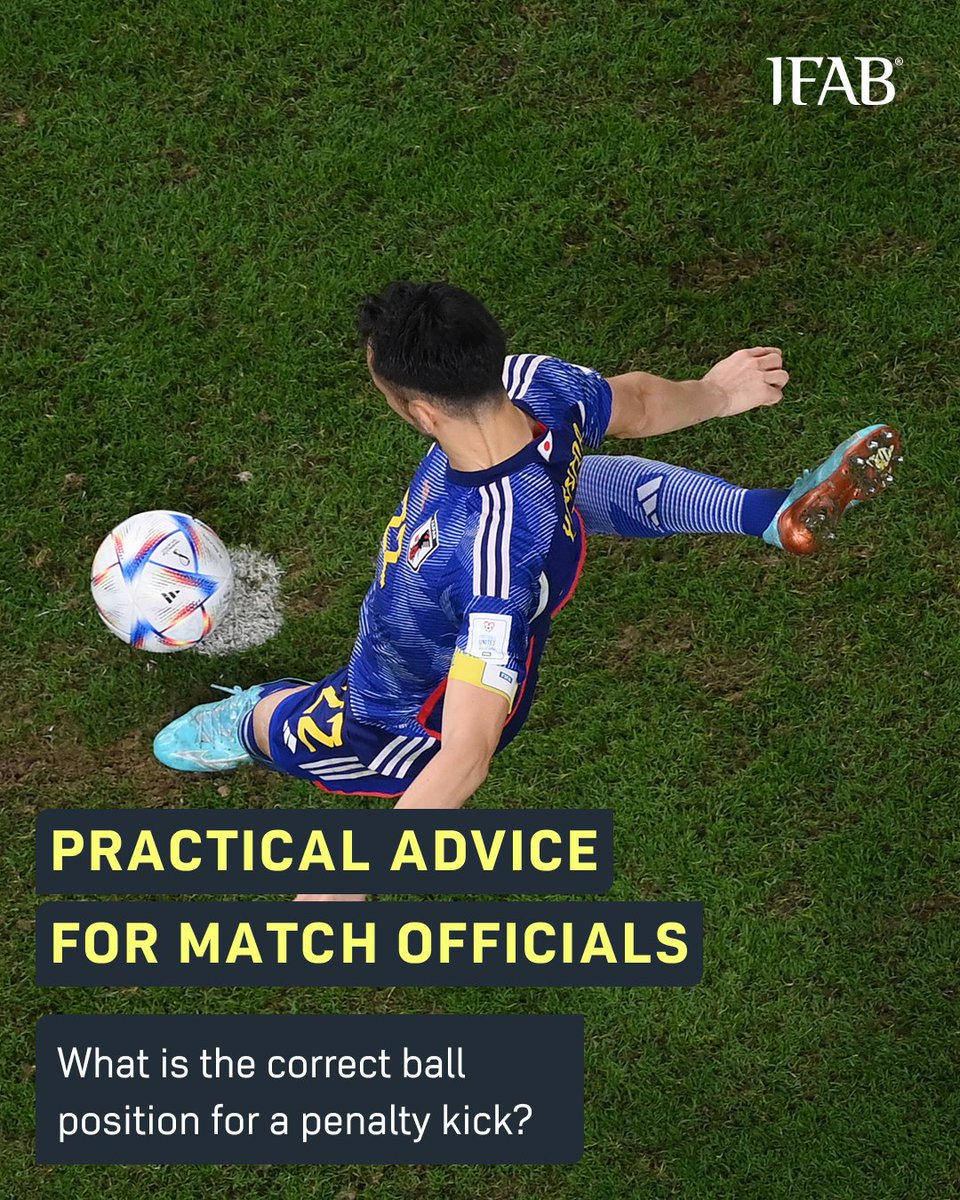
As long as any part of the ball is over the centre of the penalty mark, it is correctly positioned, and the referee allows the kick to be taken.
If this condition is not met (e.g. the ball overhangs the penalty mark, but not the centre of the mark), the #referee instructs the player taking the kick to adjust the ball position before it is kicked.
Practical advice: The kicker may slightly change the ball position if this is justified by the ground conditions and permitted by the referee.
The position of the ball for a penalty kick is correct if part of the ball:
➡️ touches the centre of the penalty mark, and/or
➡️ overhangs the centre of the penalty mark (in the air)
Law 14 does NOT require the ball to be:
➡️ wholly on the penalty mark
➡️ touching the penalty mark
A defender (Team A) attempts to kick the ball out of the penalty area. The ball deflects off another defender (Team A) and goes to an attacker (Team B), who has been in an offside position since the first defender kicked the ball. The attacker controls the ball and is unfairly challenged (careless tackle) by an opponent inside Team A’s penalty area.
What is the correct decision?
Find out more:
➡️ https://t.co/Cqoshf6ZJy
➡️ https://t.co/UzoJVOQPgb
➡️ https://t.co/6CzKym6YlD
➡️ https://t.co/sIr77TcuGP
Download the official app:
➡️ https://t.co/BwKFiVQuwn
➡️ https://t.co/jkJetKEFxU
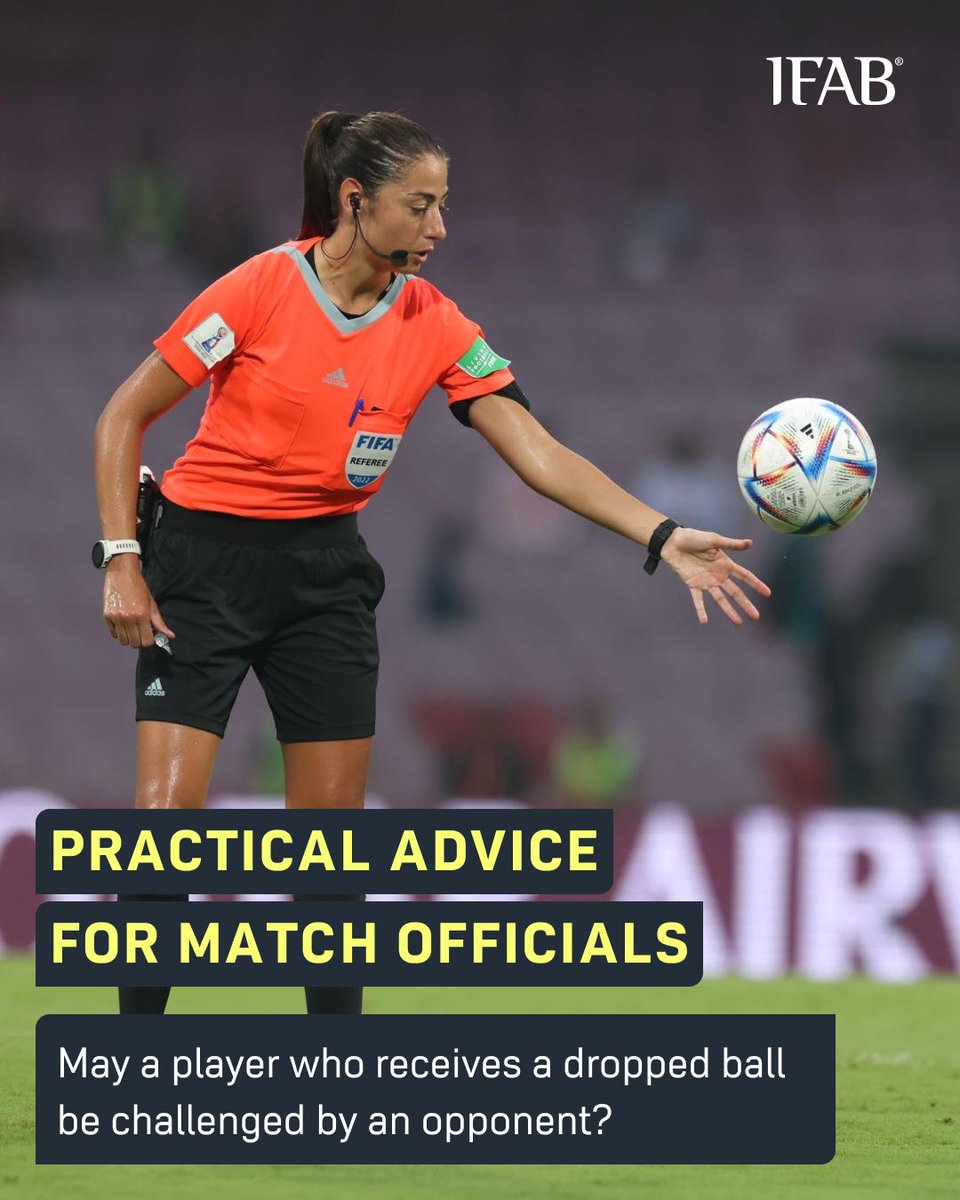
After the ball touches the ground:
➡️ it is in play
➡️ any player may approach the ball and touch it
➡️ it is not an offence if a team-mate or an opponent touches the ball before the player for whom the ball was dropped
➡️ an opponent may fairly challenge that player for the ball
Until 2019, any number of players were allowed to contest a dropped ball and the #referee could not decide who may contest it or its outcome.
In 2019, the procedure was changed so that:
➡️ the ball is dropped for only one player
➡️ all other players of both teams must be 4 m (4.5 yds) from the ball until it is in play (i.e. it touches the ground)
Until the ball touches the ground:
➡️ it cannot touch the player for whom the ball is dropped (otherwise, the referee drops the ball again)
➡️ all other players must respect the required distance (otherwise, the referee may caution* the offending player(s) and then drops the ball again)
*Failing to respect the required distance at a dropped ball is a cautionable offence. In the first instance, the #referee usually asks the player to retreat 4 metres. If the player does not comply, the referee shows a yellow card. This applies to players of both teams.
While the player taking the penalty kick is running to the ball, their team-mate touches the penalty area line with the foot before the ball is kicked. The goalkeeper saves the kick and the ball rebounds into the field to the attacking team player who encroached, who then plays the ball and scores.
What is the correct decision?
➡️ https://t.co/xP32uLkBzM
➡️ https://t.co/ho5TvIPozZ
➡️ https://t.co/Ee8OoUDFmz
Download the official app:
➡️ https://t.co/BwKFiVQuwn
➡️ https://t.co/jkJetKEFxU
@PVGaia20 Thank you for taking the time to share your ideas with The IFAB.
To officially submit a proposal to amend the Laws of the Game you need the approval/support in writing from the national football association of your residence country.
Best regards, The IFAB
Law 12 – Fouls and Misconduct allows a player to be cautioned (yellow card) for verbally distracting an opponent if this is considered by the #referee to be unsporting behaviour.
Minor offences can be dealt with a warning, unless they are blatant and/or repeated.
For a player to be punished, the referee should be convinced that the verbal distraction unfairly impacted the opponent and interfered with play (which is more likely in youth/grassroots football).
➡️ https://t.co/sIr77TcuGP
@Coventry_RA Yes, the player could be sent off and Law 12 allows for a sending-off for any offence which denies the opposing team an obvious goal-scoring opportunity.
Best regards, The IFAB
@footballxshirts Thank you for your question.
The goal is awarded and if the referee has a 'suspicion' that this was deliberate then this should be reported after the match to the appropriate authorities.
Best regards, The IFAB
An attacker is in an offside position when their team-mate makes a long pass towards them. However, the ball does not reach the attacker, as it is intercepted by a defender. The defender controls the ball with their feet, moves a few metres and touches the ball several times.
After that, the attacker, who was in an offside position, runs to the ball, tackles the defender and gains possession without committing a foul.
What is the referee’s decision?
Find out more: https://t.co/Cqoshf6ZJy
Download the official app:
➡️ https://t.co/BwKFiVQuwn
➡️ https://t.co/jkJetKEFxU
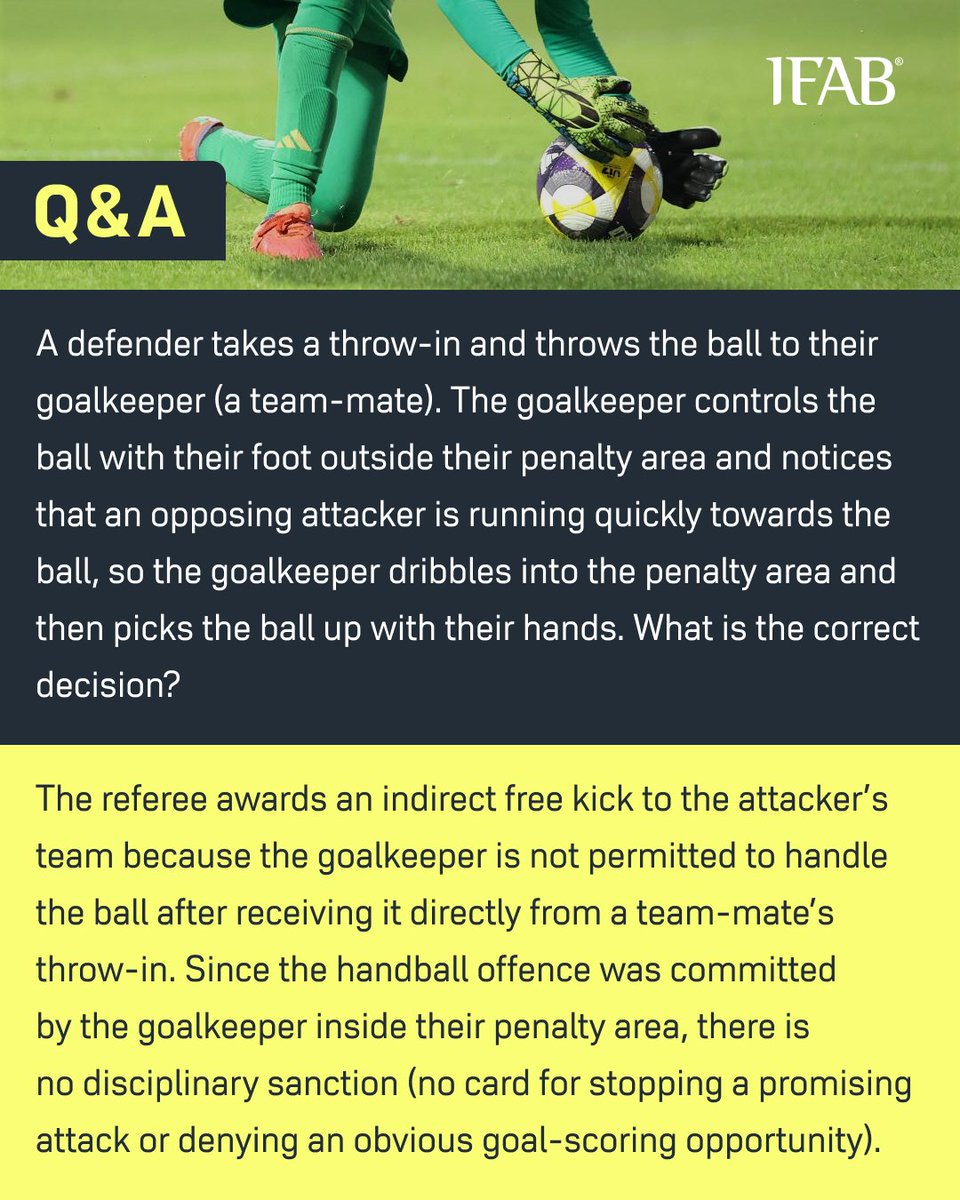
A defender takes a throw-in and throws the ball to their goalkeeper (a team-mate). The goalkeeper controls the ball with their foot outside their penalty area and notices that an attacker is running quickly towards the ball, so the goalkeeper dribbles into the penalty area and then picks the ball up with their hands.
What is the correct decision?
Find out more:
➡️ https://t.co/WmQHz1WhtL
➡️ https://t.co/UzoJVOQPgb
Download the official app:
➡️ https://t.co/BwKFiVQuwn
➡️ https://t.co/jkJetKEFxU
@WolexOlaoye Thank you for your question.
A reckless tackle is punished with a yellow card (wherever the offence occurs) and a direct free kick (except where the tackle was committed inside the OFFENDER'S penalty area, in which case a penalty kick is awarded).
Best regards, The IFAB
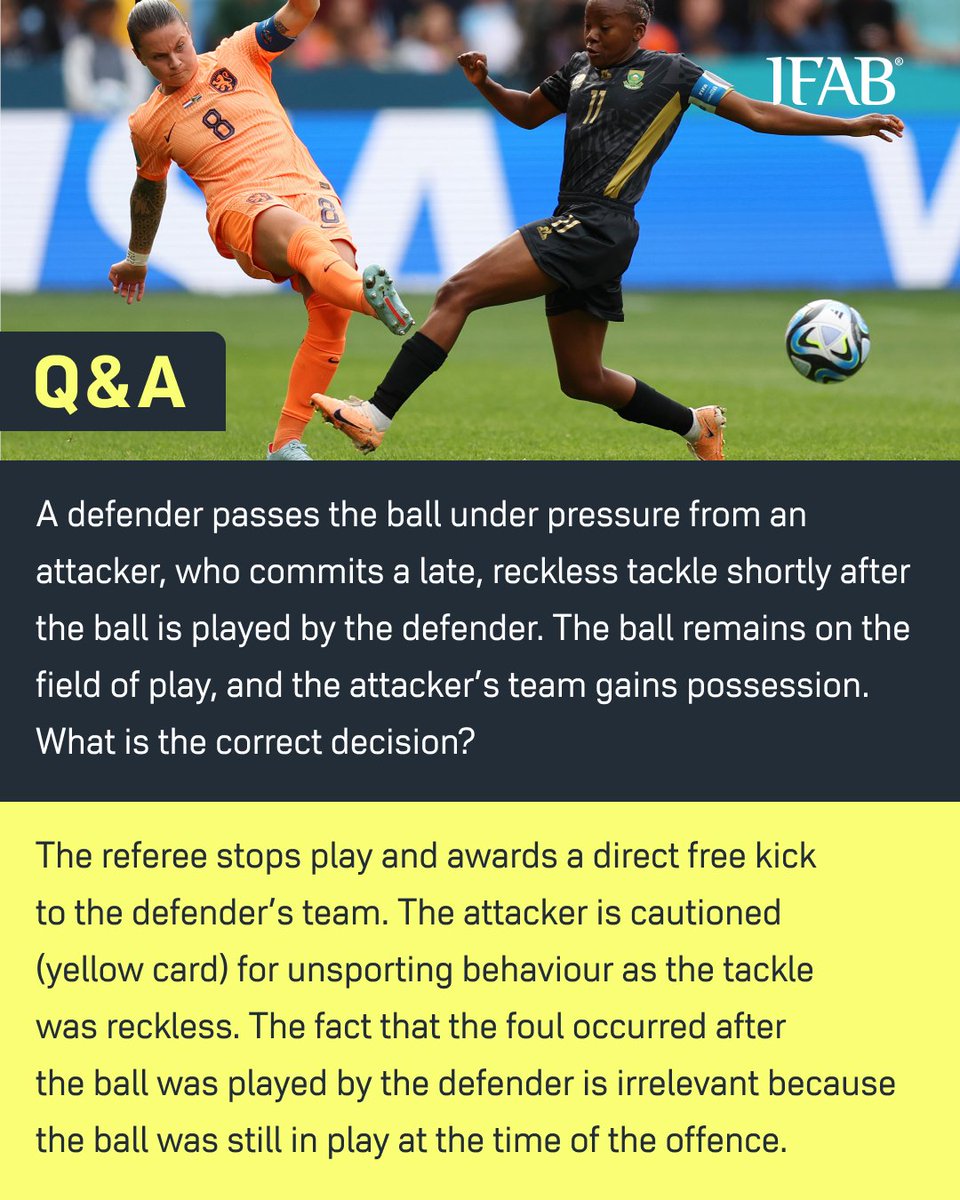
A defender passes the ball under pressure from an attacker, who commits a late, reckless tackle shortly after the ball is played by the defender. The ball remains on the field of play, and the attacker’s team gains possession.
What is the correct decision?
➡️ https://t.co/Ff3xbvi9hG
➡️ https://t.co/UzoJVORn5J
➡️ https://t.co/sIr77Td2wn
Download the official app:
➡️ https://t.co/BwKFiVR2lV
➡️ https://t.co/jkJetKFdns
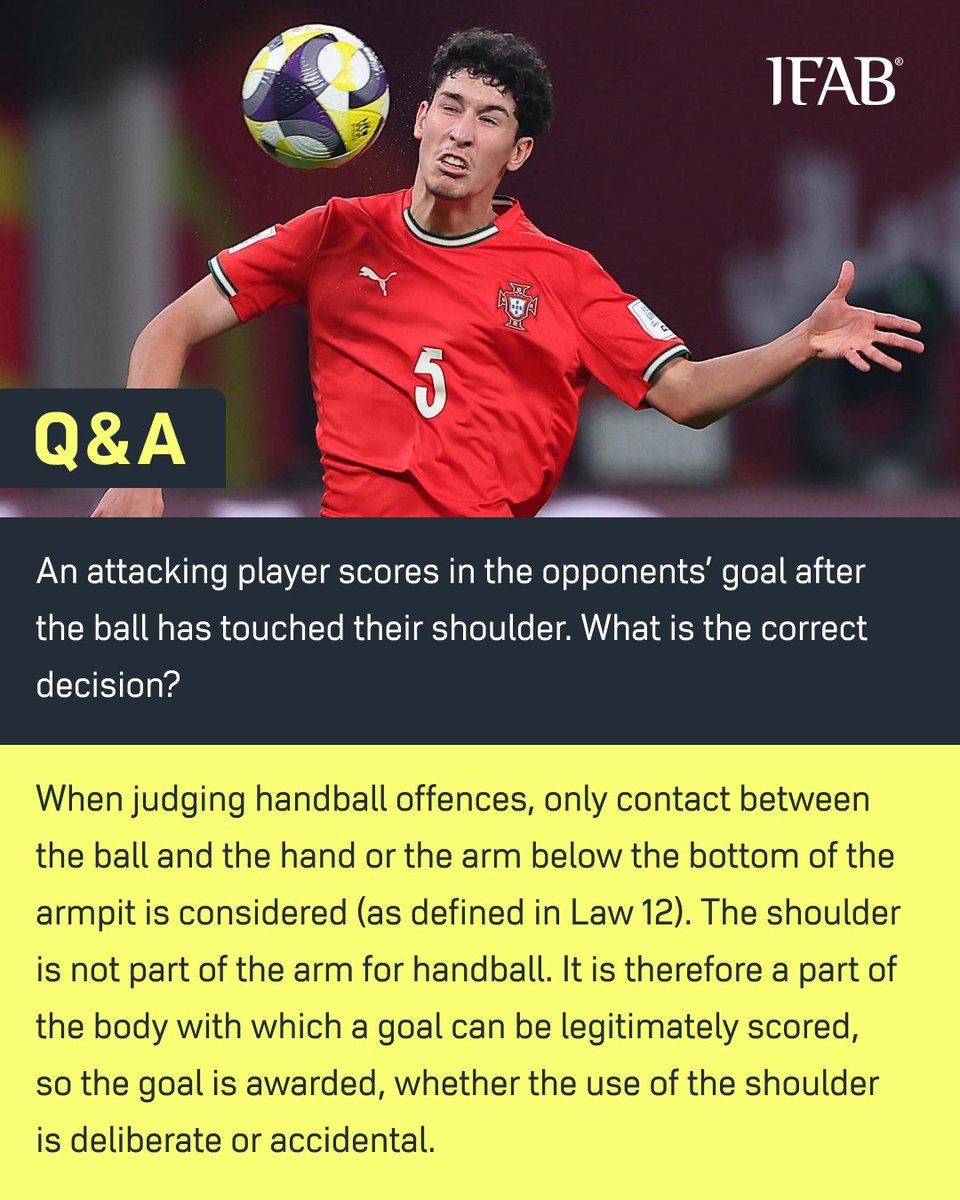
An attacking player scores in the opponents’ goal after the ball has touched their shoulder. What is the correct decision?
Find out more: https://t.co/HWpcjeJyuk
Download the official app:
➡️ https://t.co/XDWsUhp64H
➡️ https://t.co/4IV0uRgD41
Examples:
1. At a penalty kick, a defending player shouts when an attacking player is about to kick the ball. This unfair interference distracts the kicker (the kick is missed) ➡️ retake and caution
2. At a throw-in, an opponent shouts at the thrower to distract them ➡️ retake (or indirect free kick if the throw-in has been taken) and caution
3. During play, an attacker who is behind a defender shouts ‘my ball’ to mislead the opponent, who fails to control the ball ➡️ indirect free kick and caution
If a player verbally distracts an opponent:
➡️ at a restart – the restart can be retaken unless advantage is played
➡️ during play – the referee may stop play and award an indirect free kick or allow play to continue (depending on the circumstances/impact)
The free kick is taken from the place where the offending player was at the time of the offence.