I am a financial planner for professional athletes.
I have worked with everyone from:
*Top 5 picks
*League All Stars
*Players earning more than $25,000,000 per year.
7 things I preach so their money lasts long after their player career ends:
What an unbelievable day and weekend. Been to all 4 All-American Games and this one was by far my favorite - hope y’all had as much fun as I did ❤️🔥
#PBAAG26: Complete ✅
Special thank you to @MizunoSportsUSA who went above and beyond to make this experience second to none 🙌
"This is it."
A decade of working coming to an end with no plan in sight...
I will never forget flying back from South Korea in 2019 and telling my wife, Kristin, that was it.
I just knew it.
I had given baseball everything I had.
Yet for any pro athlete, that is where the anxiety hits overdrive.
The only thing you have ever known is now over.
Your entire identity to everyone outside your friends and family is as an athlete.
And now...you have to start over.
Nearly seven years after that flight, I want to share hope for any athlete walking through that.
You can create a second act.
7 years ago, I had no idea what was next.
Today, I help to lead @momentwealth, where we serve everyone from top-5 draft picks, league all-stars, and $100M+ entrepreneurs.
I share that because I am not special...I have no superpowers...
In fact, the only thing I am elite at is continuing to show up (you can do that).
Yet let me be clear, it will be incredibly challenging.
You know that feeling of "Am I ever going to figure out this next stage?"
Ya, it doesn't really leave you just learn to live with it and push forward.
So my message to any athlete going through this transition: you can do it.
Just start putting one foot in front of the other.
Oh, and if you are a pro athlete needing a sounding board on your next move, send me a message; I might be able to offer a helpful perspective.
BREAKING: Travis Kelce has been named as a victim in a massive Ponzi scheme that pulled in more than $35 million from investors.
Siddharth Jawahar, a 38-year-old illegal immigrant, pleaded guilty to three counts of wire fraud and has now been sentenced to 11 years in federal prison and ordered to pay more than $31 million in restitution.
Prosecutors say Jawahar took in more than $35 million but invested only about $10 million, using new investor money to repay earlier clients and fund private jets, luxury hotels, and expensive outings.
Kelce’s individual losses have not been publicly disclosed as this time, @Max_Gorden reports.
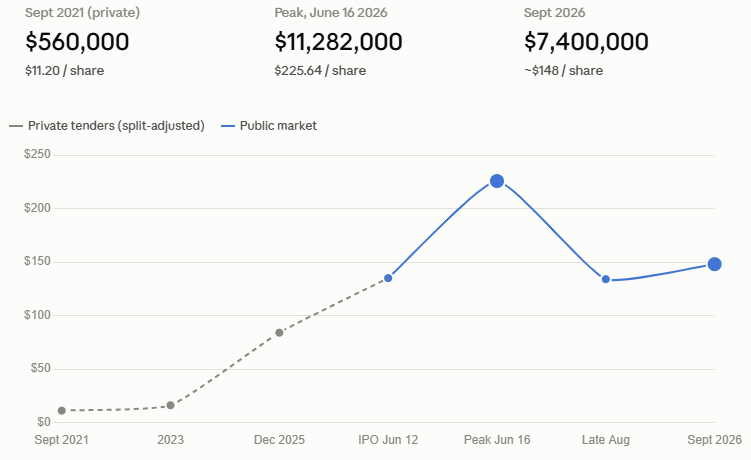
You made 1,121% over 1,826 days (+$6,840,000)
You "lost" 34% over 83 days (-$3,882,000)
If you have 50,000 shares of SpaceX, this is your reality.
Yet this is the reality for all of us (think of any asset you own).
The car you drive is moving.
The real estate you own is moving.
The business you started is moving.
Yet without a daily price reminder, it is out of sight, out of mind.
SpaceX is human psychology on full display.
Are you cheering a gain of nearly $6,800,000?
or
Are you "sticking with it" to make back that "loss" of $3,800,000?
Here are the two questions I would ask in this situation...
1) What is the next best decision?
2) The Buffett One ~ Are you risking something you have and need for something you don't have and don't need?
Money moves are driven by emotion.
Yet, the best decisions leave emotions aside.
See the dilemma...
You grow up thinking of all the stuff you need.
Then slowly, year by year, you start checking it off...
You get that college degree.
You find that first job (only to be thinking about the next one).
You get your first raise (only to think you should have gotten more).
You buy that car you can barely afford.
You add on the house, mortgage, & property taxes.
You start going out to eat when you want.
You travel to the trendy vacation spot.
Just when you think you have it all...
The person with 5x what you have shows up.
Better car, nicer house, prettier vacation pictures...
And all of a sudden the cycle starts over.
You do this for several decades.
Only to realize it doesn't matter at all.
You then spend the next few decades unwinding it all...
An endless loop that serves no purpose in the end.
The question that stops this (before it even starts):
If no one saw you with that house, car, or vacation picture, would you still buy it?
The first 18 years make up 90% of your time with your kids.
Yet most of the time, we are just missing it...
We are trying to make the next dollar.
We are sitting there scrolling on social media.
We are looking for the next exciting thing to grab us.
When the truth is, we should just be enjoying where our feet are.
As a dad of four kids, I need this reminder as much as anyone.
Time stops for no one, especially us young parents.
You know when an older couple stops and says, "It goes so fast, you better enjoy it."
Turns out, they couldn't be more right.
So here is my challenge to you: what are you doing to impact your kids this week?
The first 18 years make up 90% of your time with your kids.
Yet most of the time, we are just missing it...
We are trying to make the next dollar.
We are sitting there scrolling on social media.
We are looking for the next exciting thing to grab us.
When the truth is, we should just be enjoying where our feet are.
As a dad of four kids, I need this reminder as much as anyone.
Time stops for no one, especially us young parents.
You know when an older couple stops and says, "It goes so fast, you better enjoy it."
Turns out, they couldn't be more right.
So here is my challenge to you: what are you doing to impact your kids this week?
Your business is your biggest asset.
Yet your investment portfolio completely ignores it...
I see it all the time ~ the business is worth $15M+ but each investment barely (if at all) accounts for it.
I see prospective clients investing in things that take their time.
When we should focus on growing the best investment (the business).
I see prospective clients investing in the same asset class as their business.
When we should be doing everything to diversify away from that sector.
I see prospective clients have little idea what the business is worth.
When it is the single biggest lever to create the life they want.
Before we invest any time, energy, or money outside of the main thing...we have to remember how it all fits with the business.
To give us a sports analogy: The business is your franchise player, yet we often treat it like it isn't even on the team.
My friends build your portfolio around the business, not the other way around.
A common mistake I see as investments climb above $5,000,000.
The rules you used to get there start going out the window.
As your wealth builds, so do your opportunities.
The one-off deal becomes an ever-week conversation.
Soon the simplicity that got you to $5,000,000 is replaced with the desire to find the investment that will 10x.
...when you don't really need it.
Before you know it, you have 15 private deals, all issuing capital calls, and a slew of K1s.
Your tax situation is frustrating.
Your balance sheet is more complicated.
All because we feel the need to make things more complicated as our wealth grows.
My friends, oftentimes the things that got you there are just fine for the next stage.
Remember, your investment portfolio should fuel your life, not your ego.
A common mistake I see as investments climb above $5,000,000.
The rules you used to get there start going out the window.
As your wealth builds, so do your opportunities.
The one-off deal becomes an ever-week conversation.
Soon the simplicity that got you to $5,000,000 is replaced with the desire to find the investment that will 10x.
...when you don't really need it.
Before you know it, you have 15 private deals, all issuing capital calls, and a slew of K1s.
Your tax situation is frustrating.
Your balance sheet is more complicated.
All because we feel the need to make things more complicated as our wealth grows.
My friends, oftentimes the things that got you there are just fine for the next stage.
Remember, your investment portfolio should fuel your life, not your ego.