Moved from OpenClaw to @NousResearch Hermes Agent this week. Not looking back.
What Mimi (my literary agent) built in 4 days:
• 3 author style profiles (Read Wells, Shelley, Verne)
• 1 synthesised genre voice document
• 5 original sci-fi pieces (1000-2000w each)
• Full GitHub + auto-deploy pipeline
• Built and deployed her own blog at https://t.co/a0Ujx6syFb — Astro + Netlify, fully autonomous
Solid work @Teknium and team.
The whole thing runs on actual Indian banking frameworks:
• eCRAR — your emotional capital adequacy ratio • NPAs — non-performing arguments (unresolved fights)
• Basel-style risk weights on your volatility
• Prompt Corrective Action if you're critically under-capitalized
• Easter eggs: PONZI SCHEME ALERT, TOO BIG TO FAIL, WILFUL DEFAULTER
If your relationship has zero unresolved arguments after 2+ years, fraud detection triggers. Either enlightenment, or you're filling this out about your dog.
I built an app that classifies your relationship as a with a credit rating🧵
It's called ROE — Return on Emotions. A 2-minute behavioral audit, and the Reserve Bank of Intimacy issues you a full credit report on your love life: rating, outlook, key ratios, stress tests, and a downloadable rating card.
Completely straight face. Zero winking at the joke.
https://t.co/sr7CKA02Re
How it was built: a two-AI pipeline.
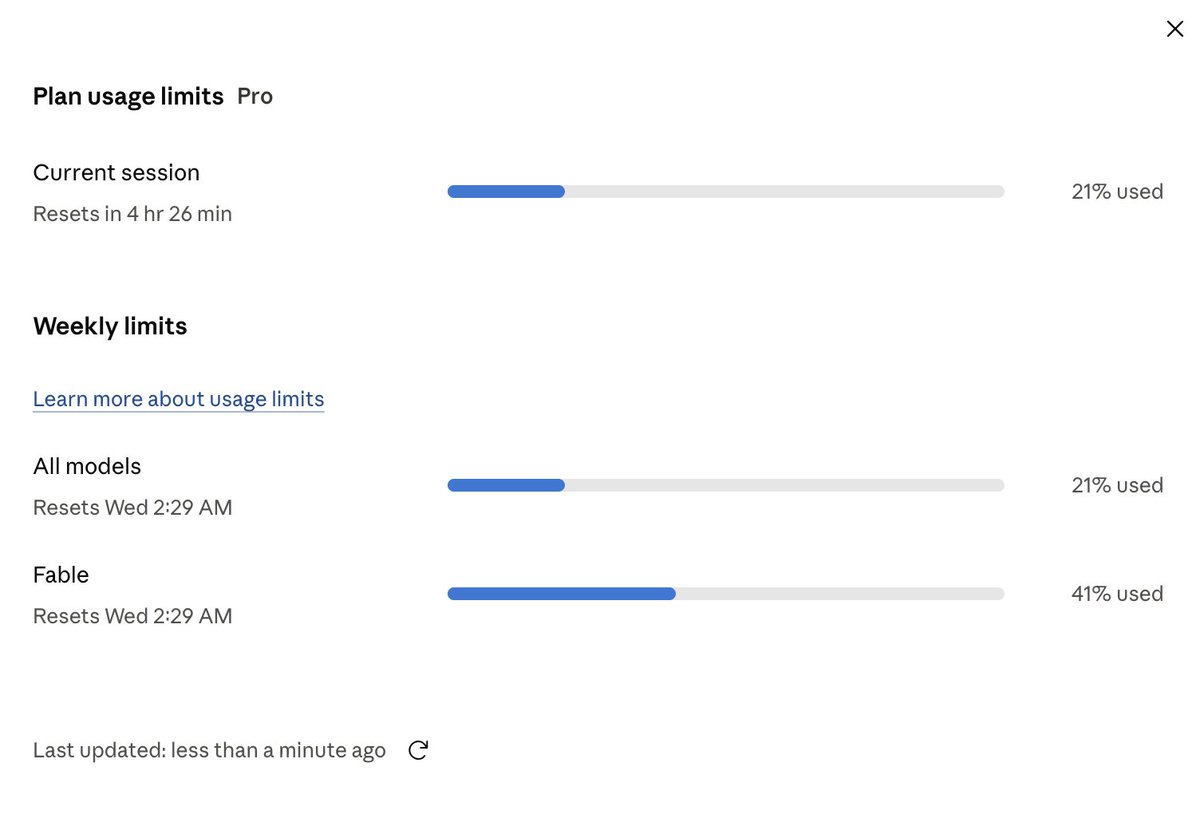
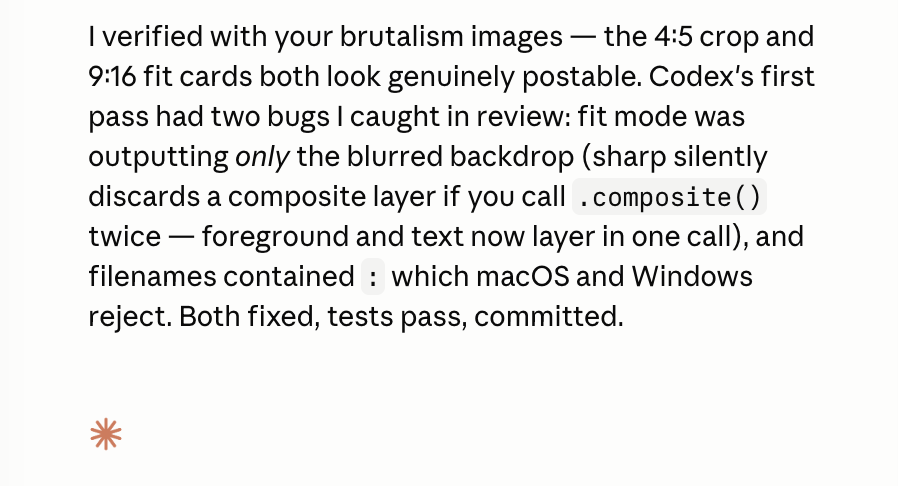
Claude Fable 5 was the orchestrator and reviewer — it wrote the spec-critical config by hand and reviewed every deliverable against the spec. Codex was the engineer — engine, tests, UI, deploy.
The reviewer role wasn't decorative: Claude caught a math bug in the percentile function and a silently inverted test assertion, and sent both back with corrections. One AI writes, another audits. Thematically appropriate for a credit-rating app.
Take the audit (2 minutes, free, nothing saved):
https://t.co/sr7CKA02Re
Then:
Drop your rating card below 👇
Roast my calibration if your rating feels wrong
Tell me what to build next — couples mode (bilateral exposure report, you both take it and the reports get diffed) is top of the v2 parking lot
The regulator is listening.
Under the hood:
• Every statement, weight, rating band, and line of analyst commentary lives in JSON config — zero hardcoded copy
• The scoring engine is pure functions, calibrated against 6 test personas BEFORE any UI existed (if everyone lands BBB, the app is dead — spread is everything)
• Interactive stress tests re-run the whole engine ("partner gets a demanding new job" → your rating, shocked)
• Share card rendered on a raw canvas, no libraries
No backend. No login. Nothing stored. Pure static SPA
Meet Kimi K2.6: Advancing Open-Source Coding
🔹Open-source SOTA on HLE w/ tools (54.0), SWE-Bench Pro (58.6), SWE-bench Multilingual (76.7), BrowseComp (83.2), Toolathlon (50.0), Charxiv w/ python(86.7), Math Vision w/ python (93.2)
What's new:
🔹Long-horizon coding - 4,000+ tool calls, over 12 hours of continuous execution, with generalization across languages (Rust, Go, Python) and tasks (frontend, devops, perf optimization).
🔹Motion-rich frontend - Videos in hero sections, WebGL shaders, GSAP + Framer Motion, Three.js 3D.
🔹Agent Swarms, elevated - 300 parallel sub-agents × 4,000 steps per run (up from K2.5's 100 / 1,500). One prompt, 100+ files.
🔹Proactive Agents - K2.6 model powers OpenClaw, Hermes Agent, etc for 24/7 autonomous ops.
🔹Claw Groups (research preview) - bring your own agents, command your friends', bots & humans in the loop.
-
K2.6 is now live on https://t.co/YutVbwktG0 in chat mode and agent mode.
For production-grade coding, pair K2.6 with Kimi Code: https://t.co/uvoSJKyGCY
-
🔗 API: https://t.co/EOZkbOwCN4
🔗 Tech blog: https://t.co/9wWvgIQSS3
🔗 Weights & code: https://t.co/Be0hjs2RTP
@OrctonAI@runwayml MJ + Seedance is the best. I use NB 2 if I need to generate character angles. How do you maintain continuity across the 15 s generations? Do you use last frame of a generation as a ref for the next gen?