Today I'm planning to present my new short paper "Real-Time Path-Guiding Based on Parametric Mixture Model" at the Eurographics 2022 at 9 am in Reims.
My technique helps to drastically decrease the variance of MC estimators for 1st bounce of light without sacrificing performance
Thanks everyone for all the reaction and feedback, it means a lot! I’m a bit of a noob at this and hadn’t quite understood that preprint ≠ final version :) So here’s a preprint of the paper: https://t.co/Us2pzIGAzC
Does anyone know about the Baader-Meinhof phenomenon? Not so long ago I learned about using Control Variates method in computer graphics. Now I'm finding mentions of this method in every second CG paper.
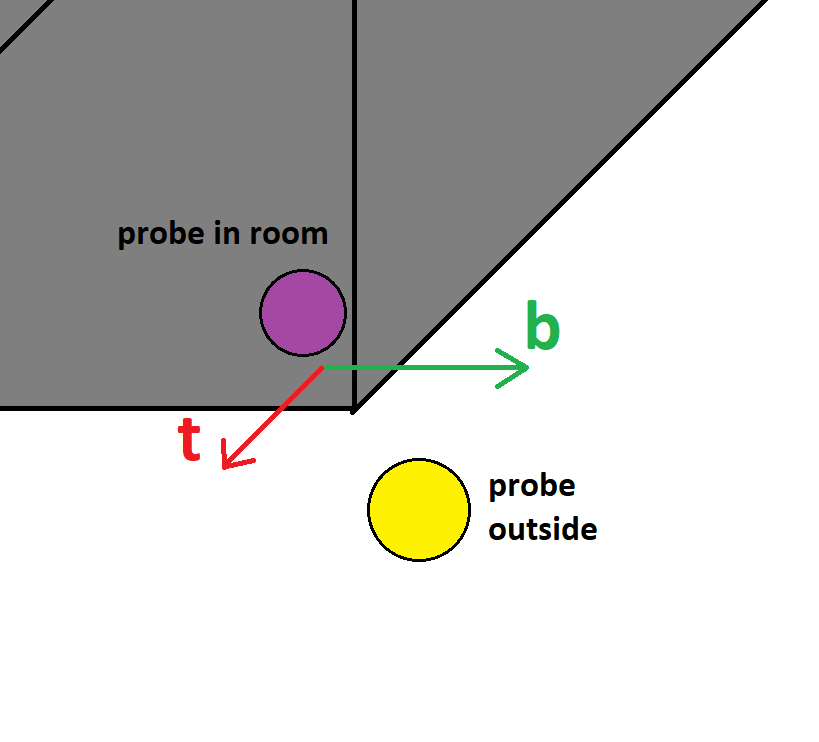
@TooMuchVoltage@nholzschuch@pointinpolygon Yeah, I thought about spatial filtering of neighbor probes. But again, the visibility stops me: for example, if one probe is in a dark room and another is outside (or even one of probes is not computed). But now I'm thinking about screen-space averaging before injecting to grid.
@TooMuchVoltage@nholzschuch@pointinpolygon BTW, here you can see DDGI-like results I reached so far. It traces rays from probes and temporally accumulates into hierarchical SH9 grid around the camera. The number of rays is comparable to 1920*1080, but variance is still really noticeable.
@TooMuchVoltage@nholzschuch@pointinpolygon Wow, so you inject screen-space trace results into a world-space structure. Sounds promising to avoid leaks. Thanks, I have to try that!
@TooMuchVoltage@nholzschuch@pointinpolygon I spent a lot of time on a similar probe-based approach, but always ran into problems: Light/shadow leaks OR lack of temporal responsibility OR bad performance OR bad convergence... Your work looks like magic to me.
@TooMuchVoltage@nholzschuch@pointinpolygon Looks awesome! So, as far as I understand, your approach is similar to DDGI, but you use a kind of ambient cube to store directional info? How many rays do you trace per frame and do you handle visibility/leaks?
Biplanar mapping - an alternative to Triplanar/RoundCube that only considers the two most relevant of the three projections at any given point. It has some singularities but in practice it works great and saves a lot of bandwidth:
https://t.co/PBbzki3E63
https://t.co/9yP9YYEA5P
@KostasAAA@SebLagarde A cute perf trick on PS3 for post-processing passes used to be to force an artificially high register count via a pragma in the shader.
This would decrease occupancy and, for simple post-fx like blur, could noticeably improve performance by reducing tex cache thrashing.