In most countries, half the buttons you press in a day might be placebos. The walk button at the crossing, the close-door button in the elevator, the thermostat on the office wall. They click, they light up, and many of them are not actually wired to anything.
Take New York, in the United States. Of the roughly 3,250 buttons at its pedestrian crossings, fewer than 120 actually do anything. The rest click when you press them, they look like working buttons, but they have not been connected to the traffic lights for more than thirty years. The city quietly deactivated them in the late 1980s when the signals moved to a computer system. Nobody told the public, because the public kept pressing them anyway.
The close-door button in most American elevators is in the same condition. It has been doing nothing since 1990. That was the year the Americans with Disabilities Act passed, which required elevator doors to stay open long enough for someone in a wheelchair or on crutches to get in. The button stayed on the panel, but the wiring was cut. Karen Penafiel, who ran the National Elevator Industry trade group, confirmed this plainly to the New York Times a few years ago.
In Hong Kong, the walk button at many pedestrian crossings is real during quiet hours and a placebo during rush hour. A central traffic computer decides which one it is, depending on how busy the road is. The same button, pressed by the same person at the same crossing, might or might not be doing anything, depending on the time of day. Parts of the UK and Australia use the same system.
Office thermostats have their own version of this. A 2003 piece in the Wall Street Journal revealed that landlords in the US had been installing dummy thermostats in commercial buildings for years. A tenant would complain about the temperature, an engineer would walk over, turn a dial that controlled nothing, and the complaints would stop. One HVAC specialist estimated that as many as ninety percent of office thermostats in the country were fake. Other engineers said it was closer to two percent. Either way, it was widespread enough to be a known trick of the trade.
These are only the places where someone has bothered to investigate and report it. Nobody has done a proper audit of the buttons in Lagos, or Nairobi, or Jakarta, or Mexico City, or Karachi. The crossings, elevators, and thermostats in those cities were installed by the same manufacturers, run by the same kinds of building managers, governed by the same kinds of traffic computers. There is no particular reason to assume the buttons there are any more honest than the ones in New York.
A Harvard psychologist named Ellen Langer has a name for what is going on. She calls it the illusion of control. When you press the button, even if nothing happens, your brain registers that you took an action, and the waiting becomes easier. The door closes eventually, the light changes, the office cools down. And every time, your brain credits the button.
THE ANDROMEDA STRAIN (1971) didn't have a traditional screenplay. It had the first example of a CINESCRIPT: an amplified screenplay that combined text and printed visuals to communicate the intended visual language before production began.
Amazon is building an $11 billion AI data campus in Indiana.
It’ll use as much electricity as roughly 1 MILLION homes.
And about 300 million gallons of water every year.
That’s just ONE facility.
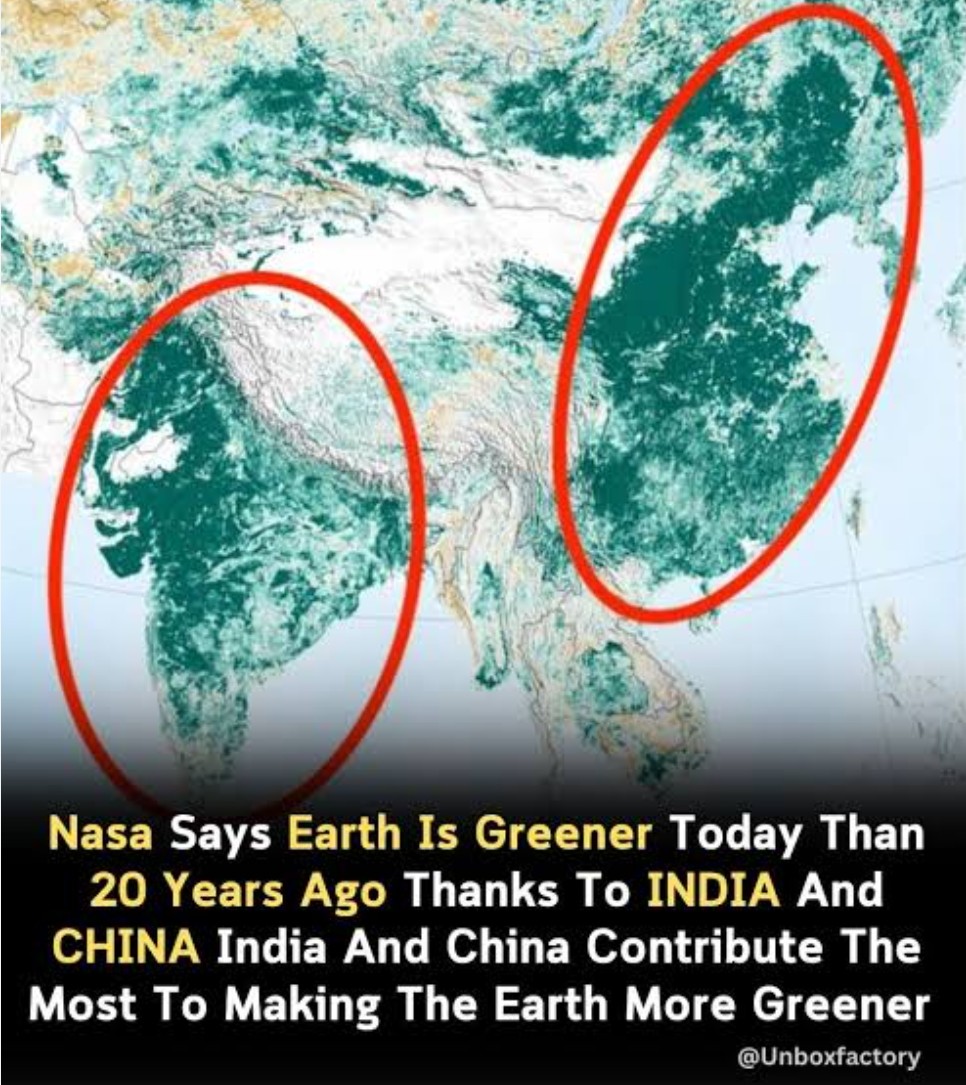
The Earth is greening at a rate never seen before in all recorded history, according to NASA satellite records from 1982–2023.
Global crop yields have risen 15–20% since 1960, almost entirely attributable to CO₂ fertilisation (Idso, 2013; IPCC AR6 WG1 Ch5). Famine deaths have plummeted over a time when the world's population doubled and CO₂ deserves much of the credit. We have increased CO₂ over the past century to thank for this explosion in plant life and available plant food from booming agriculture.
There's been a more than 18% increase in the global leaf area in 40 years, with the largest gains in India and China from CO₂ fertilisation. Warmer and more balmy temperatures are lengthening the growing seasons. These are features of rising levels of water vapour and cloud cover around the world. Every 100 ppm increase in CO₂ typically boosts plant growth by 25–50% in all non-water-limited conditions.
This analysis draws on 776 studies from 1993–2019, showing an ideal average CO₂ level of 550 ppm delivers a 38% increase in global biomass.
It's an astonishing windfall for life on earth from CO₂, a trace gas at 420 ppm (or 0.04%). It also has a secondary benefit for life by contributing to baseline levels of warmth around the planet, along with water vapour and other trace gases with similar properties, like methane (approx. 1.9 ppm or 0.00019%).
However, water vapour and cloud cover are the mainstays of rainfall and the entire hydrologic cycle, returning water as precipitation to rivers, lakes, and oceans (where 78% of rain ends up).
These are the reasons why commercial greenhouses pump CO₂ to 1,000–1,500 ppm deliberately. It ensures that crop yields jump by 20–70% depending on the crop. If 1000 ppm is good for tomatoes, why is 420 ppm an 'emergency' for the planet?
The science says 600–1,000 ppm of CO₂ plus 1–2°C extra warming hits the sweet spot for all terrestrial and marine life, including human civilisation. We should not be waging war on a trace gas that makes the planet greener.
Higher CO₂ is a net benefit to life on Earth.