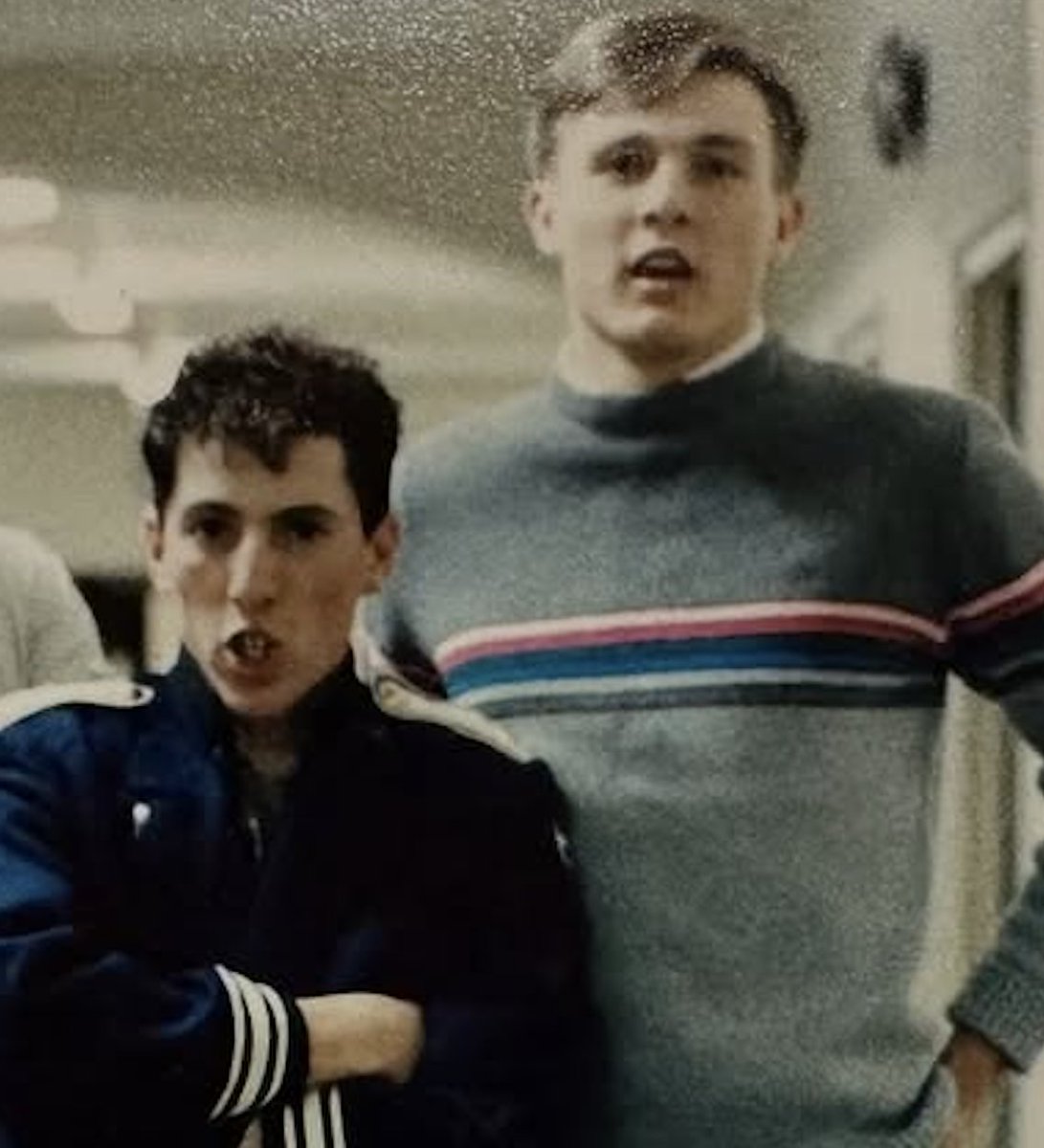
Maynard James Keenan has shared a message of support for his longtime friend and former classmate, General Randy George, who was recently ousted by Pete Hegseth.
"As long as I can remember, I wanted to be an artist in some way. Visual, musical, performing. I wasn’t certain what, just that the arts were where I was supposed to be. However, after H.S. graduation, the reality of tuition set in. My family was living on a teacher's salary. There wasn't much left over after bills, and grants and student loans weren't going to cover it.
"So I joined the Army to take advantage of the Army College Fund. As it turns out, I excelled in the military, which was not what I was expecting. I was awarded Distinguished Graduate from both basic and advanced training. Then, after many, many rounds of testing, I was chosen to attend U.S.M.A.P.S. and to apply to the U.S. Military Academy, West Point.
"As you can imagine, most of my classmates at West Point Prep were there with a singular mission: to be a West Point graduate and serve in our military. Focus, drive, a plan, and zero compromise. I, on the other hand, was one of the few with doubts and inner conflict.
"So when my heart spoke louder than the outside influencers and I declined my appointment to West Point, most of those around me saw it as a huge mistake. But a handful were very supportive. They knew me well enough to respect that decision. One of those supportive classmates was my cross-country teammate, Randy George.
"If you've been wading through the flood of news lately, you may recognize that name. Randy went on to become a four-star general and Chief of Staff of the U.S. Army. He was approaching his 40th year of service.
"I can't even imagine how disappointed and upset he must feel for having been “asked” to retire early. So I'm just here to return that favor of support. We're here for you, Randy. Might be time for a beer or three. See you soon."
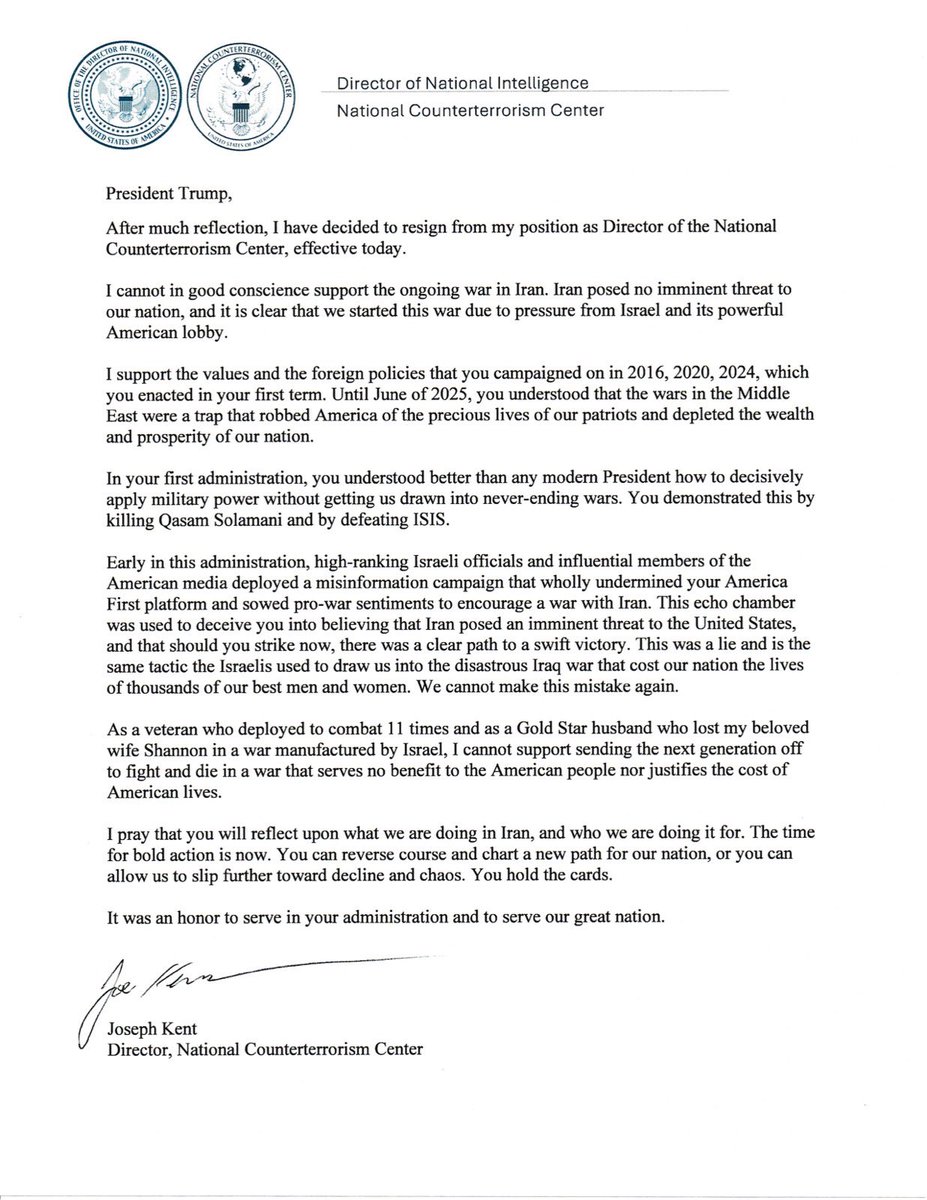
After much reflection, I have decided to resign from my position as Director of the National Counterterrorism Center, effective today.
I cannot in good conscience support the ongoing war in Iran. Iran posed no imminent threat to our nation, and it is clear that we started this war due to pressure from Israel and its powerful American lobby.
It has been an honor serving under @POTUS and @DNIGabbard and leading the professionals at NCTC.
May God bless America.
Which of these reasons was why you voted for Trump?
🔸Gas prices! - are higher than when Trump took office
🔸Drill, Drill, Drill! - There were zero bids for drill leasing in the Arctic National Wildlife Refuge and Cook Inlet. Fewer rigs are operating than before Trump took office.
🔸Crypto President! - Bitcoin has lost 34% of its value since Trump took office.
🔸Tariffs will create jobs! - Manufacturing has lost 115,000 jobs since Trump took office. There have been over 1.3 million layoffs, and the overall unemployment rate has increased.
🔸Tariffs will make us rich! - Tariffs cost the average US household $1,000 last year. We pay them, not other countries.
🔸DOGE will make us rich! - DOGE hardly cut anything and cost us more than it saved.
🔸No More Wars! - Trump started a war with Iran after invading and deposing Venezuela’s leader.
🔸A Better Economy! - Job creation dropped from over 120,000 each month to 15,000 per month. GDP growth slowed from 2.8% to 2.2%. PCE, the Fed's preferred inflation metric, increased in 2025.
🔸Fix the National Debt! - It increased by $2.2 trillion last year
Everything is getting worse.
Hating the guys who just bled for their country to earn a gold medal because they laughed at an awkward joke the president of the country they just bled for made, after chugging 6 beers in 13 mins with dopamine flowing like water, is certainly a choice
Absolutely no one is saying “that’s out of line Mr. President” and ruining one of the coolest moments of their lives for everyone. I’m not a Trump guy but getting congratulatory call from the president, no matter who it is, after winning a gold medal at the Olympics, is a moment as American as apple pie.
These are 20-something year old kids high on life (and USA-crested Mich Ultras). No one’s making a political statement in that moment.
They laughed at an awkward joke, and if I had to guess, most of them were prob like “the fuck was that joke about?” afterwards.
Jack Hughes is an LGTBQ+ advocate. He said his first thought after scoring was Megan Keller’s OT goal. Half the boys watched the women beat Canada in the gold medal game.
But there’s a 0% chance any of them are ruining that insanely cool moment. Idc what your politics are.
And if you truly think they should’ve ruined that moment and made some sort of moral stand, imo youre just completely out to lunch and are missing the bigger picture of how big of a moment this was. Touch some grass, get off social media. Half these kids prob don’t even know the 3 branches of government.
Out of line joke the president made. Shitty joke but that’s on brand for him
But don’t turn this unbelievable moment into some social justice crusade. Just let the moment live.
@JClipperton_CP Strong words for a guy who missed a wide open net and then got absolutely bodied in the defensive zone to lead to the game-winning goal.
This video should unsettle anyone who takes the United States seriously as a nation.
Because it exposes something dangerous: the trivialization of the world's most consequential office. It shows how carelessly the power, credibility, and accumulated moral authority of a superpower can be squandered for a few seconds of viral attention.
In any other major democracy, this behavior from a head of state would trigger a constitutional crisis. Paris would burn. Berlin would convene emergency sessions. In the Nordic countries, resignation would follow within hours. Across functioning democracies, the public, institutions, and political class would recognize this for what it is: an assault on the dignity of the state itself. Leaders are not free to perform as entertainers without consequence. National honor is not personal property, it's held in trust.
But the United States is not just another country with a provocateur in charge. It is the linchpin of global order. It maintains formal alliances and security guarantees with forty to fifty nations. It underwrites the financial architecture, trade systems, and diplomatic frameworks that billions of people depend on daily. When the American president speaks—or posts—it doesn't land as satire, meme, or personal whim. It reads as a signal about what the country is becoming.
American power has never relied solely on carrier strike groups or economic output. It has rested on something more fragile and more valuable: trust. The belief that beneath domestic turbulence lies institutional seriousness, predictability, and a baseline commitment to dignity. That belief is now disintegrating in real time.
Millions of American companies operate globally. They negotiate multibillion-dollar contracts in environments where reputation is currency. Boardrooms in Frankfurt, Singapore, and Dubai aren't debating whether a post was clever—they're asking whether the United States remains a reliable partner. Whether agreements signed today will be honored tomorrow. Whether American leadership has devolved from institutional to purely theatrical.
Consider tourism, which sustains millions of American jobs—airlines, hotels, restaurants, museums, entire regional economies. Soft power isn't an abstraction. It materializes in flight bookings, conference locations, study-abroad programs, and decades of accumulated goodwill. A quiet, decentralized boycott doesn't require government action—only a collective sense that a nation no longer respects itself.
Now picture this image being studied by foreign ministers, central bank governors, defense strategists, and sovereign wealth fund managers. Picture them asking a coldly rational question: How do we write binding thirty-year agreements with a country whose public face will be this, relentlessly, for years to come? How do we plan for the long term when the tone is impulsive, mocking, and unbound by the gravity of office?
This is where the real calculus begins. Trillions in foreign capital depend on confidence that America is stable, credible, and rule-governed. That confidence is now being traded for what, exactly? Applause from an online mob? A dopamine rush from manufactured outrage? Content designed to dominate the news cycle rather than serve the national interest?
Every serious nation eventually confronts this choice: burn long-term credibility for short-term spectacle, or safeguard the reputation previous generations bled to build. The United States spent eighty years constructing an image of reliability, restraint, and leadership under pressure. That image wasn't born from perfection—it came from a visible commitment to standards that transcended impulse.
This isn't a partisan issue. Europeans who value democratic norms recognize something ominously familiar here. Americans—Democrat and Republican alike—who believe in responsibility and restraint should see it too. Power attracts scrutiny. Leadership demands discipline. A superpower cannot behave like a reality TV contestant without paying a price.
The presidency is not a personal broadcast channel. It's a symbol carried on behalf of 330 million people and countless international partners who never voted but whose lives are shaped by American decisions anyway. Every post either reinforces or erodes the idea that America can be counted on when it matters most.
So the question is no longer whether this is offensive. The question is whether this is who America chooses to be: a nation that trades a century of hard-won reputation for viral moments. A country that replaces statecraft with content creation. A republic governed like a season of reality television.
History offers a harsh lesson here. Great powers don't fall because enemies mock them. They collapse when they begin mocking themselves—publicly, proudly, and without grasping the cost until it's far too late.
Stay connected,
Follow Gandalv @Microinteracti1