Six layers, one token.
XRP's "exploded view" — from value to use cases, read bottom-up. The honest version: the lower layers are real, the upper ones are roadmap.
My new essay ↓
https://t.co/SyHusRg2me
#XRP#XRPLedger#TheLongBecoming
Healthy adults carry 1–4% Akkermansia. It falls with obesity, diabetes, and age — yet persists in centenarians.
Not a supplement trend. A structural variable in the biology of aging.
Full essay: https://t.co/Fhhw6ji2tj
Six layers, one token.
XRP's "exploded view" — from value to use cases, read bottom-up. The honest version: the lower layers are real, the upper ones are roadmap.
My new essay ↓
https://t.co/SyHusRg2me
#XRP#XRPLedger#TheLongBecoming
The men who made the Parthenon built upwards. We build downwards.
Rubio's Athens speech in full — plus the three ideas worth keeping: thumos, the outward gaze, the relay.
Read it ↓
https://t.co/szNw0HIFGm
#MarcoRubio#Acropolis#TheLongBecoming
Akkermansia muciniphila keeps showing up in the guts of people who live past 100.
It eats mucus — and builds the wall. Its extracts trigger GLP-1 release from intestinal L-cells, the same hormone Ozempic was built on.
From within. No prescription. 🧵
Four hours on the course with adults. Oxytocin, not the peer bubble.
Golf has no algorithm. The scorecard is the truth.
The algorithm gives children content. Golf gives them a practice.
Full essay: https://t.co/4FlUeVQotC
The algorithm hands out the marshmallow first. Golf makes a child wait four hours for it.
Feeds tune young brains toward immediacy. Golf tunes them back — fail, process, continue.
The neural architecture of resilience, built one round at a time. 🧵
Healthy adults carry 1–4% Akkermansia. It falls with obesity, diabetes, and age — yet persists in centenarians.
Not a supplement trend. A structural variable in the biology of aging.
Full essay: https://t.co/Fhhw6ji2tj
Akkermansia muciniphila keeps showing up in the guts of people who live past 100.
It eats mucus — and builds the wall. Its extracts trigger GLP-1 release from intestinal L-cells, the same hormone Ozempic was built on.
From within. No prescription. 🧵
Vault Inheritance is LIVE 🔐
Uphold CEO @SMcLoughlin00 breaks down how Vault's newest feature lets XRP, HBAR, and BTC holders automatically and securely pass on their crypto.
Full breakdown ↓
This content is informational and not financial advice. Crypto-assets are highly volatile and involve risk. You may lose all the money you invest. Consumer protections may be limited.
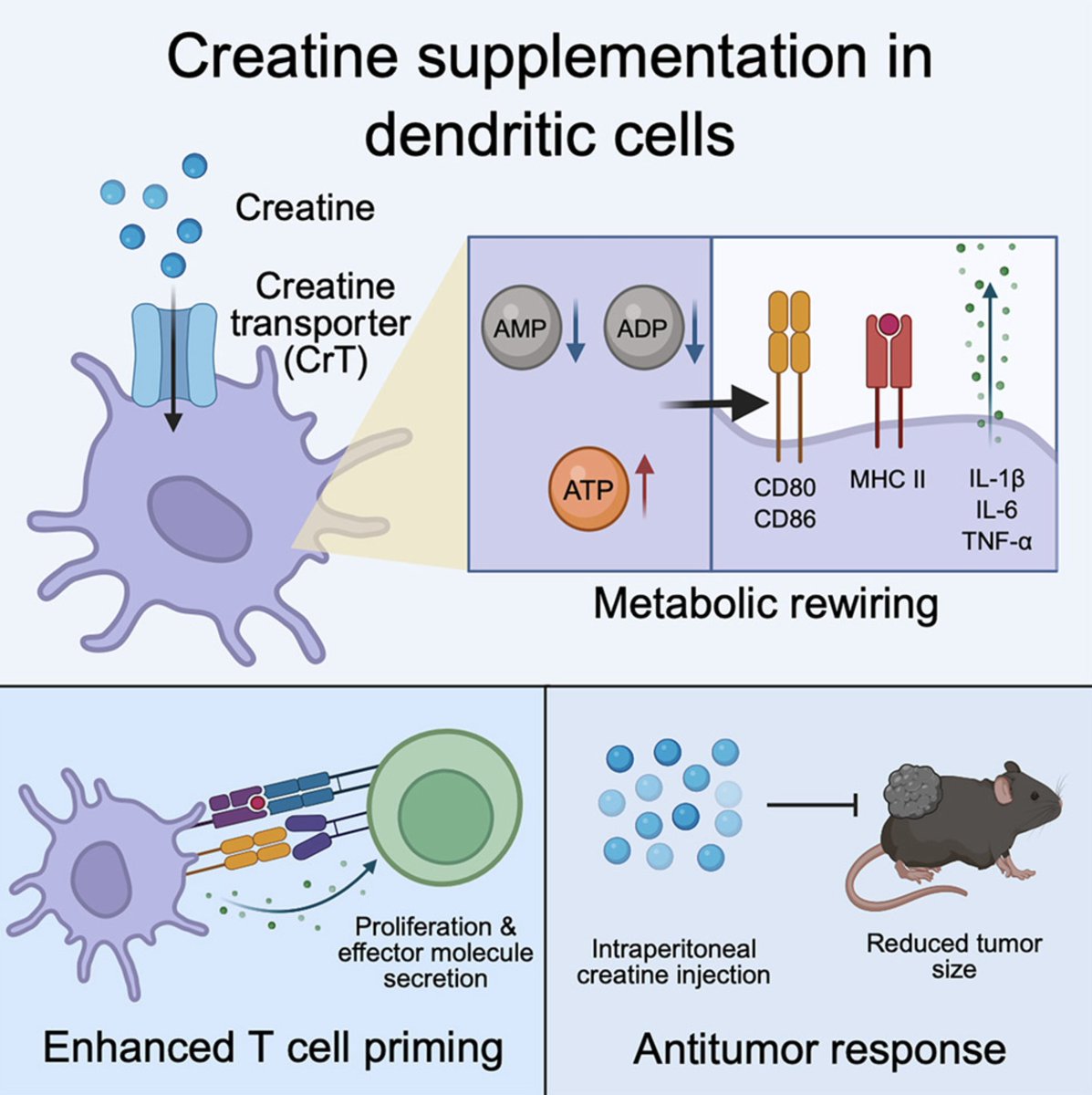
Creatine is known for building muscle and improving athletic performance. A new UCLA study just found it does something completely different: it powers the immune cells that direct your body's cancer-fighting response.
Researchers at UCLA published findings in iScience showing creatine supplementation enhances dendritic cell function and suppresses tumor growth in preclinical models. The work identifies a metabolic bottleneck in cancer immunity and suggests creatine might help address it.
What dendritic cells do
Dendritic cells serve as coordinators of your immune system's response to cancer. They patrol tissues, capture pieces of tumor cells, and present those fragments to T cells in lymph nodes. This presentation activates T cells to recognize and attack cancer.
Without functional dendritic cells, T cells never get properly instructed. The immune system fails to mount an organized response against tumors. Patients with more dendritic cells in their tumors tend to have better outcomes and more active immune responses.
There is an energy problem in dysfunctional dendritic cells.
Dendritic cells require significant energy to function. When they encounter danger signals from tumors, they activate, migrating to lymph nodes, ramping up production of surface molecules that interact with T cells, and secreting inflammatory signals.
All of this requires ATP, the cellular energy currency. Inside tumors, dendritic cells face a hostile metabolic environment. Cancer cells consume available glucose and other nutrients aggressively. Immune cells competing for those same resources often lose out, leaving them energy-depleted and dysfunctional.
Where does creatine fit in?
Creatine functions as an energy buffer. Inside cells, an enzyme called creatine kinase adds a phosphate group to creatine, creating phosphocreatine. When ATP gets consumed during cellular work, phosphocreatine rapidly donates its phosphate back to regenerate ATP.
This system is particularly important in tissues with high, fluctuating energy demands like muscle and brain. Athletes supplement with creatine to maintain ATP availability during intense exercise.
The researchers found dendritic cells also rely on this system.
When activated, dendritic cells dramatically upregulate expression of the creatine transporter, the protein that imports creatine into cells. Intratumoral dendritic cells showed especially high transporter levels compared to dendritic cells from spleens.
So how did the team test their hypothesis?
The team used two complementary approaches.
First, they generated mice lacking the creatine transporter specifically in immune cells. Dendritic cells from these knockout mice showed impaired survival and activation when stimulated. They expressed lower levels of costimulatory molecules needed to activate T cells and produced fewer inflammatory cytokines.
When these creatine-deficient dendritic cells were co-cultured with T cells, the T cells proliferated less, produced fewer effector molecules, and showed reduced activation markers. The dendritic cells couldn't effectively prime an immune response.
Second, the researchers tested whether creatine supplementation could enhance normal dendritic cell function.
Adding creatine to cell cultures improved dendritic cell survival and ramped up their activation. The cells displayed more surface proteins that signal readiness to interact with T cells and pumped out higher levels of inflammatory signaling molecules that coordinate immune responses.
There were some interesting mechanistic findings as well.
RNA sequencing revealed creatine supplementation activated energy-dependent inflammatory signaling pathways in dendritic cells. Metabolic profiling showed creatine-treated cells maintained higher ATP levels and increased phosphocreatine stores.
The researchers directly measured ATP in dendritic cells. Cells lacking the creatine transporter showed significantly lower ATP levels after activation compared to normal cells. Creatine supplementation restored and even enhanced ATP availability.
This ATP preservation appears critical for dendritic cell function.
Many of the processes required for activation, including protein synthesis, trafficking of molecules to the cell surface, and cytokine secretion, are energy-intensive. When ATP drops, these functions fail.
The tumor experiments were particularly fascinating.
The team tested whether creatine supplementation could enhance anti-tumor immunity in mice bearing B16 melanoma tumors, an aggressive cancer model. Mice received either regular drinking water or water supplemented with creatine.
Creatine-supplemented mice showed significantly slower tumor growth. Analysis of the tumor tissue revealed more activated dendritic cells with higher expression of maturation markers. These tumors also contained more activated T cells producing IFN-γ, a key anti-tumor cytokine.
Importantly, the anti-tumor effect of creatine required functional dendritic cells. When the researchers depleted dendritic cells, creatine supplementation no longer suppressed tumor growth. This confirmed dendritic cells were the critical cell type mediating creatine's effects.
Human relevance
The researchers tested whether their findings applied to human cells. They generated dendritic cells from human blood monocytes and treated them with creatine. Human dendritic cells responded similarly to mouse cells: enhanced activation, increased costimulatory molecule expression, and improved capacity to stimulate T cell responses.
This cross-species validation strengthens the translational potential. The creatine transporter and creatine kinase system are evolutionarily conserved between mice and humans.
Key takeaways:
• Dendritic cells upregulate creatine transporter expression when activated, especially in tumor environments
• Creatine functions as an ATP buffer, maintaining energy availability during dendritic cell activation
• Knockout of creatine transporter impairs dendritic cell survival, activation, and ability to prime T cell responses
• Creatine supplementation enhances dendritic cell function in both mouse and human cells
• Oral creatine supplementation suppressed melanoma tumor growth in mice through dendritic cell-dependent mechanisms
• The effect was mediated by improved dendritic cell ATP levels and enhanced inflammatory signaling
It's a super fascinating study for what it tells us about the role of creatine outside of musculoskeletal function. There are some limitations, however.
The tumor experiments used a single cancer type in young, healthy mice. Whether creatine supplementation works across different tumor types, in aged mice, or in the context of existing immunotherapies remains untested.
The creatine doses used in mouse drinking water translate to relatively high human equivalent doses, though still within the range commonly used by athletes (typically 3-5 grams per day).
The study measured associations between creatine treatment and immune activation but didn't fully map all downstream mechanisms. Additional signaling pathways likely contribute.
All experiments used syngeneic tumor models where mice develop cancer from transplanted tumor cells. Spontaneous tumor models or patient samples would provide additional validation.
This work adds to emerging evidence that creatine plays immunomodulatory roles beyond its established effects on muscle and brain. Previous studies from other groups showed creatine enhances CD8 T cell function and polarizes tumor-associated macrophages toward anti-tumor phenotypes.
The convergence across multiple immune cell types suggests creatine metabolism represents a general mechanism supporting anti-tumor immunity in metabolically challenging tumor environments.
Dendritic cells represent a logical target for metabolic interventions. They're relatively rare in tumors but have outsized influence on whether productive immune responses develop. Enhancing their function could amplify downstream T cell responses.
Current cancer immunotherapies focus heavily on T cells, particularly checkpoint inhibitors that release brakes on T cell activity. But those therapies depend on T cells already being properly activated. If dendritic cells fail at the initial priming step, checkpoint inhibitors have less to work with.
Metabolic support for dendritic cells could complement T cell-directed therapies. The combination might prove especially valuable in immunologically cold tumors that lack robust immune infiltration.
The practical advantage of creatine is accessibility. It's inexpensive, widely available, well-tolerated at typical doses, and has decades of safety data from use in athletes. The safety profile makes it a reasonable candidate for clinical testing.
The next step is human trials examining whether creatine supplementation enhances immune responses in cancer patients, particularly those receiving immunotherapy. Endpoints would include dendritic cell activation markers in blood and tumors, T cell responses to tumor antigens, and clinical outcomes.
The study provides proof of concept that targeting dendritic cell metabolism can enhance anti-tumor immunity and identifies creatine as a specific intervention worthy of further investigation.