S&P Global just flagged that hyperscalers likely carry more AI-linked debt than disclosed, thanks to off-balance-sheet "interconnected financing structures."
Nearly $500B in AI debt has hit credit markets in 2026 alone. Insurance and real money investors are already showing indigestion. When the biggest buyers start stepping back from 30-year paper, the cost of the AI buildout gets repriced fast.
$AMZN
https://t.co/TxzP1PQJ8s
SpaceX reportedly seeking thousands of cell sites to launch a 4th wireless carrier.
AT&T and T-Mobile each dropped ~8% in a single session. Meanwhile $AMT and Crown Castle surged 4-9%.
The market isn't just pricing in competition risk. It's repricing the entire infrastructure layer of telecom. The towers win either way. The carriers don't.
https://t.co/LRpOk6Al5k
Meta just posted negative free cash flow for the first time since its 2012 IPO. $35B in capex in a single quarter. $824B in future AI commitments on the books.
The market's reaction wasn't "wow, bold vision." It was "who's paying for this?"
That question is now rippling through every AI hyperscaler. When the biggest spender blinks on guidance, the whole trade reprices. $META
https://t.co/K43qusJ3Dp
$DRTS opened a new geographic front in its pancreatic cancer program this week. Three months ago, Alpha Tau completed enrollment in the IMPACT study with 48 patients. This week it signed an MOU with Samsung Medical Center in Seoul, the number-one cancer center in Korea and fifth in the world in oncology.
The two developments tell different parts of the same story. IMPACT is the controlled clinical engine: a one-time Alpha DaRT intratumoral treatment combined with first-line chemotherapy, enrolling at 10 centers across the US, Canada and Israel under a US Investigational Device Exemption. Samsung Medical Center, with more than 4,000 pancreatic resections on record, is the kind of institutional partner that could anchor a defined study in Korea, extending the program to a sixth country.
https://t.co/Vglk8mb34O
Pancreatic cancer in Korea is a recognized public health problem. The five-year relative survival rate is 17%, the lowest of any cancer in the country. Only about one in five patients undergoes surgery. The disease's death rate rose more than 6% in 2025 alone, the steepest increase among all major cancers.
The next update that matters: whether the Samsung MOU advances into a formally authorized study design after Korean regulatory and ethics committee review.
_
Disclosure: This content is not financial or investment advice. Alpha Tau Medical Ltd. is a paid subscriber to Wall Street Wire's coverage and distribution platform. Full disclosure: https://t.co/c2JcMjJfRE
$DRTS: Korea's pancreatic cancer five-year survival rate is 17.0%, the lowest of any cancer in the country. The death rate climbed more than 6% in 2025, the steepest rise among all major cancers. Only one in five patients qualifies for surgery.
What you don't usually see in this field: a Nasdaq-listed clinical-stage oncology company signing its first Korean clinical trial partnership at the world's fifth-ranked oncology hospital.
https://t.co/4FM1PZIEZ8
Alpha Tau and Samsung Medical Center signed an MOU on October 22 to explore a clinical trial of Alpha DaRT for pancreatic cancer in Korea. Samsung Medical Center's Pancreatobiliary Cancer Center has logged more than 4,000 pancreatectomies since 2008, meaning the institution knows this disease at clinical depth.
Alpha DaRT delivers radium-224 impregnated sources directly into the tumor. As radium decays, alpha-emitting daughters disperse within the tumor while aiming to spare surrounding healthy tissue. For a cancer where fewer than one in five Korean patients can access surgery, an intratumoral approach that bypasses surgical resection addresses the core clinical gap.
Watch for South Korean regulatory and ethics committee approvals, the formal gate before any trial enrollment can begin.
_
Disclosure: This content is not financial or investment advice. Alpha Tau Medical Ltd. is a paid subscriber to Wall Street Wire's coverage and distribution platform. Full disclosure: https://t.co/c2JcMjJfRE
$SCAI.V has a specific answer to what most AI companies are still treating as an unsolved problem: how do you coordinate multiple specialized AI agents inside a single live sales call, without the buyer noticing the coordination?
The 11th U.S. patent application, submitted to the USPTO on October 16, covers exactly this. Under the architecture described in the filing, a specialist agent can enter a live conversation mid-call when its expertise is needed. Agents take turns contributing. The system manages sequencing to prevent overlap. The human on the other end of the call experiences none of the coordination overhead. They experience a single, coherent conversation.
https://t.co/hvm6emsrzf
What matters about this filing is not that it happened, but what it claims. SalesCloser's patent strategy focuses on concrete execution infrastructure: the mechanics of how these systems actually run, not broad claims about "AI in sales." Earlier grants and applications covered cross-channel conversation continuity and session handoff. This one covers the real-time coordination layer across multiple autonomous agents. That's the IP layer enterprise buyers and competitors would have to navigate.
The stakes: this is the architecture that will determine who controls the coordination layer in multi-agent AI sales as enterprise adoption scales toward the 40% app penetration threshold Gartner flagged for 2026.
_
Disclosure: This content is not financial or investment advice and is distributed on behalf of SalesCloser Technologies Ltd., a paid subscriber to Wall Street Wire's coverage and distribution platform. Full disclosure: https://t.co/c2JcMjJfRE
SpaceX buying Tesla isn't really a car deal.
Altimeter's Gerstner put it plainly: whoever has the most capital, compute, and data wins the superintelligence race. SpaceX is deploying 200K GB300 chips/month and needs hundreds of billions more. Tesla's balance sheet ($45B cash) is the fuel.
The merger math is secondary. The AI arms race is the point. $TSLA
https://t.co/v4OHvRp6pt
$PYPD goes to Washington on October 22: an oral presentation at IDWeek 2026 brings new microbiology data from 2,185 patients across three trials to the infectious disease community, at a moment when the FDA is weeks away from a PDUFA decision.
https://t.co/YI43M3wL9s
The pooled analysis spans SHIELD I, SHIELD II, and a Phase 2 trial. The central question: does D-PLEX100's 30-day sustained local doxycycline release at the surgical site generate antibiotic resistance when SSIs break through anyway? The answer from this dataset is no, not at a statistically significant level. Multidrug-resistant organism proportions were similar between treatment groups, and the difference in doxycycline resistance was not statistically significant.
What the data did show: in breakthrough SSIs, heavy bacterial growth was present in only 16% of D-PLEX100 cases versus 27% in standard of care (p=0.034). Breakthrough infections in the treatment arm also arrived later, with a median onset of 10.0 days vs. 6.5 days (p<0.001). Lighter infections, arriving later, are easier to treat. In the context of colorectal surgery, where SSI management can be prolonged and resource-intensive, that difference is clinically meaningful.
The next update that frames the entire clinical evidence package: the FDA's NDA decision, with a PDUFA goal date of November 28, 2026, will determine whether D-PLEX100 becomes the first approved local extended-release antibiotic prophylaxis at the surgical site.
_
Disclosure: This content is not financial or investment advice. PolyPid Ltd. is a paid subscriber to Wall Street Wire's coverage and distribution platform. Full disclosure: https://t.co/c2JcMjJfRE
$BOIL.TO: Romania's professional foodservice market is EUR 7.3 billion. Beyond Oil just opened the door with a US$75,600 initial order from GRUP GENERAL ID.
That number looks modest next to the market size. That is the point. This is how the company has built every market: one demonstrable container, one motivated distributor, and a phased pilot program that lets the technology speak for itself before scaling.
GRUP GENERAL ID is a Baia Mare-based operator with nearly two decades in Romania's HoReCa sector. They supply professional kitchens end-to-end: design, equipment, installation, servicing. When the GRUP GENERAL ID CEO says operators are "under growing pressure to control frying-oil costs without compromising food quality," he is speaking as someone who has watched that pressure build firsthand across Romanian restaurant and hotel kitchens.
https://t.co/sjZcxrTqbP
The read that matters: whether Romania's initial pilot accounts place follow-on orders and how many new GRUP GENERAL ID customers sign up following the live demonstration phase.
_
Disclosure: This content is not financial or investment advice and is distributed on behalf of Beyond Oil Ltd., a paid subscriber to Wall Street Wire's coverage and distribution platform. Full disclosure: https://t.co/c2JcMjJfRE
The US housing market just hit a 12-year low in pending sales, with 63% more sellers than buyers — the biggest gap since the post-2008 crash.
But here's the twist: it's a buyer's market born out of caution, not strength. Rates above 7% have priced out so many buyers that the "opportunity" barely exists for most people.
14.5% of deals are falling through. Supply at a 6-year high. Prices still near record highs.
https://t.co/vAaZ1334km
$SCAI.V is promoting its CFO from within. How unusual is that for a company that's been public for just seven months?
Jacky He has been embedded inside this organization since 2020, when he joined Wishpond Technologies Ltd., the majority shareholder that spun SalesCloser out as a standalone public company in March 2026. He rose through the accounting function over six years, from Senior Accountant to Senior Manager, Accounting, with responsibility spanning both Wishpond and SalesCloser. He was part of the finance team that navigated the IPO process and has co-led the day-to-day financial reporting and audit work since listing.
Adrian Lim, who held the CFO title through the IPO and the Company's first seven months, is stepping down October 31 but expected to remain as an outside advisor. This is not a clean break. It is a structured handoff designed to preserve reporting continuity.
https://t.co/69NJerVYWV
For context on what He is stepping into: SalesCloser has been running hard since listing. Three U.S. patents granted. Sky platform cut median onboarding time from roughly five hours to about four minutes. A Tendril collaboration for AI-and-human outbound launched. Management has signaled a path from 70% gross margins toward 80% over the long term.
The finance function needs to keep pace with that cadence, and He knows the numbers from the inside.
The read that matters: how clearly He communicates the path to that 80% gross margin target in the next earnings cycle is the credibility signal investors will be watching.
_
Disclosure: This content is not financial or investment advice and is distributed on behalf of SalesCloser Technologies Ltd., a paid subscriber to Wall Street Wire's coverage and distribution platform. Full disclosure: https://t.co/c2JcMjJfRE
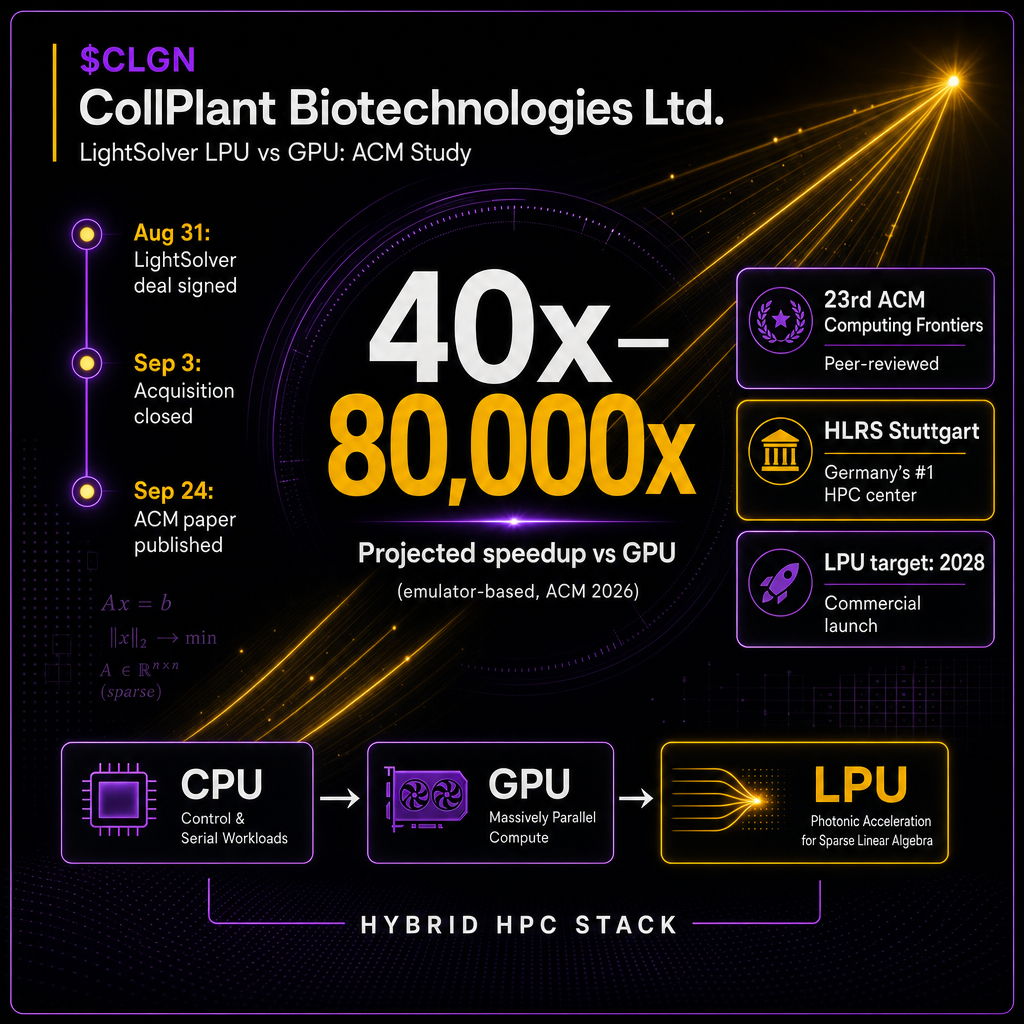
$CLGN: 40x to 80,000x. That is the projected performance gap between LightSolver's Laser Processing Unit and a GPU, for the workload class that dominates computational fluid dynamics, structural mechanics, and materials science simulations.
https://t.co/YaGDOwcY5T
Those numbers come from a peer-reviewed ACM study published September 24, 2026, conducted jointly by LightSolver, a CollPlant subsidiary, and HLRS, the High-Performance Computing Center Stuttgart, which was established in 1996 as Germany's first federal supercomputing center. Researchers benchmarked an emulator of LightSolver's LPU architecture against established iterative GPU algorithms across large-scale sparse linear equation problems.
The workload is not niche. Linear systems underlie some of the world's most computationally intensive science: molecular dynamics, electromagnetics, finite element analysis. These problems dominate HPC runtime and energy cost. LightSolver's vision is a hybrid stack where CPUs handle orchestration, GPUs handle parallel tensor compute, and LPUs handle the linear algebra bottlenecks optically.
The next update will reveal whether a physical LPU system can replicate these emulator-projected speedups at the scale HLRS operates, the test that determines whether this architecture moves from scientific validation to procurement.
_
Disclosure: This content is not financial or investment advice. CollPlant Biotechnologies Ltd. is a paid subscriber to Wall Street Wire's coverage and distribution platform. Full disclosure: https://t.co/c2JcMjJfRE
The AI buildout is quietly becoming a bond market story.
Amazon, Alphabet, Meta, Microsoft and Oracle have issued ~$250bn in bonds this year — 41% beyond 15 years. They're competing directly with the 30-year Treasury for the same pool of pension and insurance capital.
Every hyperscaler deal absorbs duration that would've gone to governments. The 30-year yield is now at its highest since 2007.
https://t.co/9OrvKKiL1E
$EMAT's portfolio of eight sintered NdFeB magnet grades covers an estimated 75% of global sintered NdFeB revenue. That figure, from an announcement five days earlier, defined the commercial footprint. Thursday's news delivered the capacity to fill it.
https://t.co/J7Nu4GMwIE
Thirteen of fifty-seven containers of ULVAC sintered magnet production equipment arrived at Evolution Metals' Pohang facility in South Korea on October 15. All remaining containers are expected before October ends. The machines were ordered from ULVAC, the Japanese benchmark supplier for sintered magnet production systems, in May on a compressed schedule. ULVAC's standard lead time runs well beyond 24 months.
Once the full set is installed and commissioned, annual magnet capacity scales from 1,000 metric tons to approximately 10,000, positioning the company as the largest rare earth magnet producer outside China. The timing is tied to a specific compliance moment: DFARS 252.225-7052 takes effect January 1, 2027, barring Chinese-origin content across the entire rare earth magnet supply chain for U.S. defense deliveries. Because China produces most of the world's neodymium-praseodymium metal, most currently available global supply is expected to become non-compliant under that rule.
The December 17 operational showcase at Pohang will show live magnet production on the expanded line to investors and government officials. That is the next milestone that will reveal whether the commissioning ramp is on pace to support the FY2026 guidance of $10 million to $11 million.
_
Disclosure: This content is not financial or investment advice. Evolution Metals & Technologies Corp. is a paid subscriber to Wall Street Wire's coverage and distribution platform. Full disclosure: https://t.co/c2JcMjJfRE
$DRTS: when 100% of your first three recurrent glioblastoma patients show local disease control, what does the FDA let you do next? Apparently: double the trial.
Alpha Tau just received an FDA-approved IDE supplement expanding REGAIN from 10 to 20 patients. Beyond the headline number, the protocol changes are substantive. Progression-free survival is now a secondary endpoint. Regular quality-of-life assessments are added. IDH-mutant grade 4 patients, a population the WHO formally split out from glioblastoma in 2021, are now eligible. An additional interim analysis is triggered six months after the fifth patient's treatment.
https://t.co/PY9yqdKvmX
The fifth patient was treated in July 2026. That means the interim analysis clock is already running. This trial is not sitting idle. It is actively accruing patients and being monitored in real time.
Alongside the trial expansion, Alpha Tau announced that an abstract from REGAIN's principal investigator, Dr. Joshua Palmer of The Ohio State University, has been accepted for the 31st Annual Meeting of the Society for Neuro-Oncology in Philadelphia. The presentation on November 13 will include new data beyond the three-patient safety interim from May 2026. This is the first time REGAIN results will appear at any scientific conference, reaching an audience of more than 3,000 researchers from over 40 countries.
The next inflection to watch: the interim analysis six months after patient five's treatment in July 2026 will be the first formal readout from this expanded, more comprehensive cohort.
_
Disclosure: This content is not financial or investment advice. Alpha Tau Medical Ltd. is a paid subscriber to Wall Street Wire's coverage and distribution platform. Full disclosure: https://t.co/c2JcMjJfRE
$BOIL.TO This week, a 70-year Connecticut quick-service institution changed its frying standard. That level of operational commitment from an established regional chain does not happen without proof. Duchess Restaurants ran a 2025 kitchen pilot and made the call.
https://t.co/PgfRNwdTus
Duchess operates 11 locations across Fairfield and New Haven counties in southwestern Connecticut, each with an eat-in dining room, take-out service, and a drive-thru. The partnership covers all locations. The chain is implementing Beyond Oil across its standard operating procedures targeting more consistent food quality, reduced oil consumption and waste, and lower operating costs.
Zoom out to the October timeline: Oct. 1, global vendor approval from a multinational with tens of thousands of locations in more than 100 countries. Oct. 6, commercial rollout across 60 franchise locations of a leading global fast-food brand in Eastern Europe. Oct. 15, a 200-plus location buffet chain goes sole source. Oct. 19, Duchess. Four commercial milestones in 18 days, across four distinct foodservice segments.
The next update to watch: Beyond Oil's CEO indicated continued pipeline activity across restaurant chains, supermarket groups, and foodservice operators. The inflection point comes when an operator from that active pipeline confirms its name publicly and announces a system-wide commitment.
_
Disclosure: This content is not financial or investment advice and is distributed on behalf of Beyond Oil Ltd., a paid subscriber to Wall Street Wire's coverage and distribution platform. Full disclosure: https://t.co/c2JcMjJfRE
China just posted 4.5% Q3 GDP growth, beating forecasts. But look under the hood: exports surged 33%+ while retail sales grew just 1.1%. The world's second-largest economy is running on one engine.
When a country's trade surplus is on track to top $1.2 trillion, the rest of the world eventually pushes back. The EU is already planning new curbs. This export-led model has a ceiling.
https://t.co/73ixjWcVI9
The AI boom is creating its own headwinds.
Central bankers at the IMF meetings in Bangkok are openly saying AI investment is hitting demand before supply, meaning inflation and higher rates now, productivity gains later (maybe).
The ECB's Kazaks put it bluntly: "There is a global fight for money." R-star is rising and nobody knows by how much.
The irony: the thing driving markets could be the thing that breaks them.
https://t.co/2yxvuY2CrY
China's Q3 GDP just printed at 4.6% YoY, beating the 4.4% consensus.
But look under the hood: retail sales barely grew 0.4% in September, fixed asset investment is still contracting, and the property sector keeps bleeding. The headline number is being carried almost entirely by AI-driven exports and factory output.
Beijing is essentially running a two-speed economy right now, and the domestic half is still struggling. With the EU now moving to expand import curbs on Chinese goods, even the export engine faces headwinds going into 2027.
https://t.co/6LopwKM4tk
PPI just printed +6.3% YoY, biggest jump since Dec 2022. But here's the real tension: Philly Fed new orders cratered from 29.2 to 4.3 in one month. Diesel is up 115% YoY, squeezing supply chains. Core retail sales ex-autos/gas? Up just 0.1%.
Inflation heating up while the real economy quietly cools. The Fed's October meeting just got a lot more complicated.
https://t.co/bwAdU3IER2