India just got its first unified air defence playbook covering all three services 🇮🇳
CDS General Anil Chauhan has released the Joint Air Defence Doctrine.
And this has been a long time coming. 👇
• First ever joint air defence framework across Army, Navy and IAF
• Designed to counter drones, stand off weapons and hypersonic threats
• Connects sensor to shooter linkages across all three services
• Builds on Joint Special Forces and Joint Airborne doctrines from August 2025
• Lessons from Operation Sindoor directly shaped this framework
• Part of General Chauhan's broader Theaterisation vision
For decades India's three services defended the skies independently of each other.
That created gaps.
This doctrine is how India starts closing them. 🇮🇳
Turkey says its friendship with Pakistan should not be India's problem.
Turkish Foreign Minister Hakan Fidan says Turkey has no bilateral issues with India and that New Delhi should not see Turkey's relationship with Pakistan as a problem.
That argument would carry more weight if Turkey had remained neutral during Operation Sindoor.
Instead, Ankara openly backed Pakistan diplomatically while India was responding to a major terrorist attack.
Pakistan also employed Turkish-origin drones during the conflict.
Multiple reports citing intelligence sources further claimed that Turkish personnel provided training, technical assistance and operational support to Pakistan's drone campaign.
Now Turkey says its ties with Pakistan should not affect relations with India.
Funny how Turkey suddenly remembers it has "no bilateral issues" with India after India started engaging Cyprus and strengthening defence ties with Armenia.
If Turkey can arm and support Pakistan, India is equally free to explore deeper defence partnerships with countries that matter to Turkey.
Perhaps the BrahMos conversation should begin. 🇮🇳
DRDO just made a key part of India's future tanks 40% lighter. 🇮🇳
That may not sound exciting until you realise what it means on the battlefield.
And for vehicles operating in places like Ladakh, it could be a serious advantage. 👇
• DRDO's new In-Arm Hydrogas Suspension System is around 40% lighter than conventional designs
• The entire suspension mechanism sits inside the suspension arm itself
• The enclosed design protects critical components from dust, mud and battlefield debris
• Better shock absorption helps vehicles stay stable while moving across rough terrain
• The weight saved can be used for extra armour, ammunition or mission equipment
• The technology is directly relevant for Zorawar and future indigenous tracked vehicles
Every kilogram matters in high-altitude warfare.
A lighter vehicle can move faster, carry more and put less strain on logistics.
Most people look at the gun or the armour.
But sometimes the real advantage comes from the engineering hidden underneath.
Can mobility become the deciding factor in the next generation of armoured warfare?
DRDO just made a key part of India's future tanks 40% lighter. 🇮🇳
That may not sound exciting until you realise what it means on the battlefield.
And for vehicles operating in places like Ladakh, it could be a serious advantage. 👇
• DRDO's new In-Arm Hydrogas Suspension System is around 40% lighter than conventional designs
• The entire suspension mechanism sits inside the suspension arm itself
• The enclosed design protects critical components from dust, mud and battlefield debris
• Better shock absorption helps vehicles stay stable while moving across rough terrain
• The weight saved can be used for extra armour, ammunition or mission equipment
• The technology is directly relevant for Zorawar and future indigenous tracked vehicles
Every kilogram matters in high-altitude warfare.
A lighter vehicle can move faster, carry more and put less strain on logistics.
Most people look at the gun or the armour.
But sometimes the real advantage comes from the engineering hidden underneath.
Can mobility become the deciding factor in the next generation of armoured warfare?
Reducing vehicle weight without sacrificing protection or mobility has been a core challenge in armoured vehicle design for decades, which is why a 40% lighter suspension system is significant
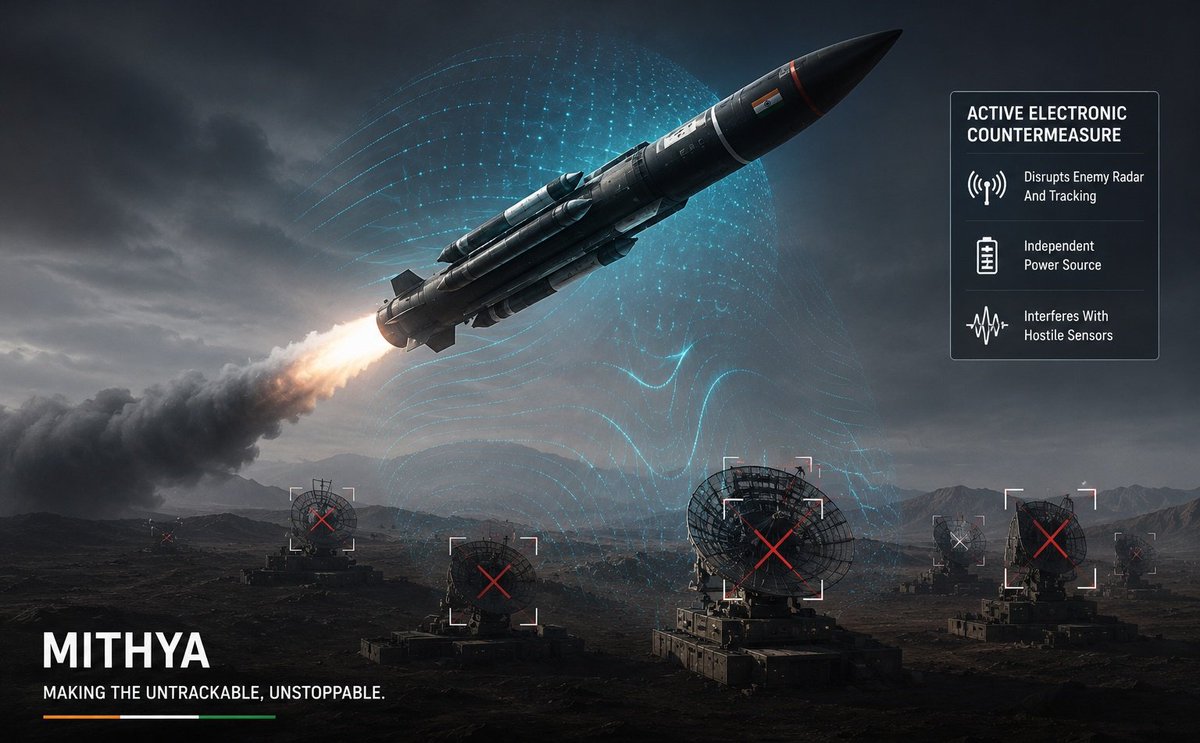
India is quietly developing a new electronic warfare system for its strategic missile force. 🇮🇳
MITHYA, the system is designed to make Indian missiles harder to track and intercept.
And that could become a major challenge for future missile defence shields 👇
• MITHYA is being developed as an active electronic countermeasure system
• It is designed to disrupt enemy radar and missile defence tracking
• The system carries its own independent power source
• Unlike simple decoys, MITHYA appears to actively interfere with hostile sensors
• Deployment and qualification hardware are already under evaluation
• The programme is reportedly linked to India's advanced strategic missile ecosystem
Range is only half the equation.
A missile must also survive modern radar networks, tracking systems and interceptors.
That is why countries are investing heavily in penetration aids and electronic warfare.
The future of missile warfare may not be about flying farther.
It may be about staying invisible for longer.
Modern ballistic missile defence systems rely heavily on radar tracking and target discrimination, which is why electronic countermeasures are becoming increasingly important for strategic missile survivability
India is quietly developing a new electronic warfare system for its strategic missile force. 🇮🇳
MITHYA, the system is designed to make Indian missiles harder to track and intercept.
And that could become a major challenge for future missile defence shields 👇
• MITHYA is being developed as an active electronic countermeasure system
• It is designed to disrupt enemy radar and missile defence tracking
• The system carries its own independent power source
• Unlike simple decoys, MITHYA appears to actively interfere with hostile sensors
• Deployment and qualification hardware are already under evaluation
• The programme is reportedly linked to India's advanced strategic missile ecosystem
Range is only half the equation.
A missile must also survive modern radar networks, tracking systems and interceptors.
That is why countries are investing heavily in penetration aids and electronic warfare.
The future of missile warfare may not be about flying farther.
It may be about staying invisible for longer.
The Indian Navy has revealed the full scale of its Operation Sindoor deployment 🇮🇳
36 frontline warships, multiple submarines and the INS Vikrant carrier battle group were positioned in the Arabian Sea within days of the Pahalgam attack.
And the impact was immediate and decisive 👇
• Entire Pakistani naval fleet confined to its harbours throughout the operation
• Deployment surpassed even India's naval mobilisation during the 1971 war
• INS Vikrant battle group supported by BrahMos armed destroyers and stealth assets
• Full operational readiness achieved within 96 hours of the Pahalgam attack
• Shipping insurance premiums around Karachi spiked, international vessels rerouted
• Navy clocked nearly 11,000 ship days and 50,000 flying hours in 2025 alone
Pakistan faced pressure on land, in the air and at sea simultaneously.
The Navy never fired a shot and still changed the entire strategic calculation.
That is what maritime dominance actually looks like. 🇮🇳
The Indian Navy's Operation Sindoor deployment of 36 warships and submarines surpassed even the 1971 war mobilisation where India's naval blockade of East Pakistan was considered one of the most decisive maritime operations in post-independence history
The Indian Navy has revealed the full scale of its Operation Sindoor deployment 🇮🇳
36 frontline warships, multiple submarines and the INS Vikrant carrier battle group were positioned in the Arabian Sea within days of the Pahalgam attack.
And the impact was immediate and decisive 👇
• Entire Pakistani naval fleet confined to its harbours throughout the operation
• Deployment surpassed even India's naval mobilisation during the 1971 war
• INS Vikrant battle group supported by BrahMos armed destroyers and stealth assets
• Full operational readiness achieved within 96 hours of the Pahalgam attack
• Shipping insurance premiums around Karachi spiked, international vessels rerouted
• Navy clocked nearly 11,000 ship days and 50,000 flying hours in 2025 alone
Pakistan faced pressure on land, in the air and at sea simultaneously.
The Navy never fired a shot and still changed the entire strategic calculation.
That is what maritime dominance actually looks like. 🇮🇳
India is going deeper into the engine that powers its largest fighter fleet 🇮🇳
HAL has begun converting Russian 2D technical drawings of the AL-31FP engine into full 3D digital models with complete interface and tolerance definitions.
And this is more significant than it sounds. 👇
• Over 260 Su-30MKIs depend on the AL-31FP thrust vectoring engine
• HAL recently signed a contract for 250 engines at 30 per year over 8 to 9 years
• 3D reconstruction will reveal manufacturing intelligence Russia never fully transferred
• Indigenous content targeted to reach 54 to 60% eventually
• DRDO developed components already waiting to enter production once tolerances are confirmed
• Lessons from this programme will directly feed into future indigenous engine projects
Russia provided drawings for assembly but not full manufacturing knowledge.
India is now reverse engineering that knowledge digitally.
That is the difference between assembling someone else's engine and truly understanding it. 🇮🇳
HAL has manufactured nearly 1,000 AL-31FP engines at Koraput since the early 2000s and is now digitally reconstructing the engine architecture to finally unlock the manufacturing knowledge Russia kept back when the licence was first signed. 🇮🇳
India is going deeper into the engine that powers its largest fighter fleet 🇮🇳
HAL has begun converting Russian 2D technical drawings of the AL-31FP engine into full 3D digital models with complete interface and tolerance definitions.
And this is more significant than it sounds. 👇
• Over 260 Su-30MKIs depend on the AL-31FP thrust vectoring engine
• HAL recently signed a contract for 250 engines at 30 per year over 8 to 9 years
• 3D reconstruction will reveal manufacturing intelligence Russia never fully transferred
• Indigenous content targeted to reach 54 to 60% eventually
• DRDO developed components already waiting to enter production once tolerances are confirmed
• Lessons from this programme will directly feed into future indigenous engine projects
Russia provided drawings for assembly but not full manufacturing knowledge.
India is now reverse engineering that knowledge digitally.
That is the difference between assembling someone else's engine and truly understanding it. 🇮🇳
Adani Defence just cleared a major hurdle for its ARYAN 52 mounted gun system. 🇮🇳
The 155mm artillery platform has successfully completed mobility and firing trials and is now in contention for Indian Army induction.
And the specs are genuinely impressive. 👇
• 155mm/52 calibre mounted on a high mobility 8x8 wheeled platform
• Firing range up to 45 km, rocket assisted rounds reach 55 km
• Transitions from travel to firing mode in under 60 seconds
• Supports Multiple Rounds Simultaneous Impact, five shells hitting one target at once
• Integrated with Army's Shakti Artillery Combat Command and Control System
• Nearly 70% indigenous content using Elbit ATMOS turret on BEML chassis
• Competing for an 800 unit order worth over Rs 15,000 crore
60 seconds from moving to firing is what shoot and scoot actually requires.
ARYAN 52 just proved it can do that.
India's artillery modernisation programme just got a lot more competitive. 🇮🇳
Adani Defence just cleared a major hurdle for its ARYAN 52 mounted gun system. 🇮🇳
The 155mm artillery platform has successfully completed mobility and firing trials and is now in contention for Indian Army induction.
And the specs are genuinely impressive. 👇
• 155mm/52 calibre mounted on a high mobility 8x8 wheeled platform
• Firing range up to 45 km, rocket assisted rounds reach 55 km
• Transitions from travel to firing mode in under 60 seconds
• Supports Multiple Rounds Simultaneous Impact, five shells hitting one target at once
• Integrated with Army's Shakti Artillery Combat Command and Control System
• Nearly 70% indigenous content using Elbit ATMOS turret on BEML chassis
• Competing for an 800 unit order worth over Rs 15,000 crore
60 seconds from moving to firing is what shoot and scoot actually requires.
ARYAN 52 just proved it can do that.
India's artillery modernisation programme just got a lot more competitive. 🇮🇳
The most important number here is 60 seconds because survivability in modern artillery often depends on how quickly a gun can fire and relocate before counter-battery fire arrives
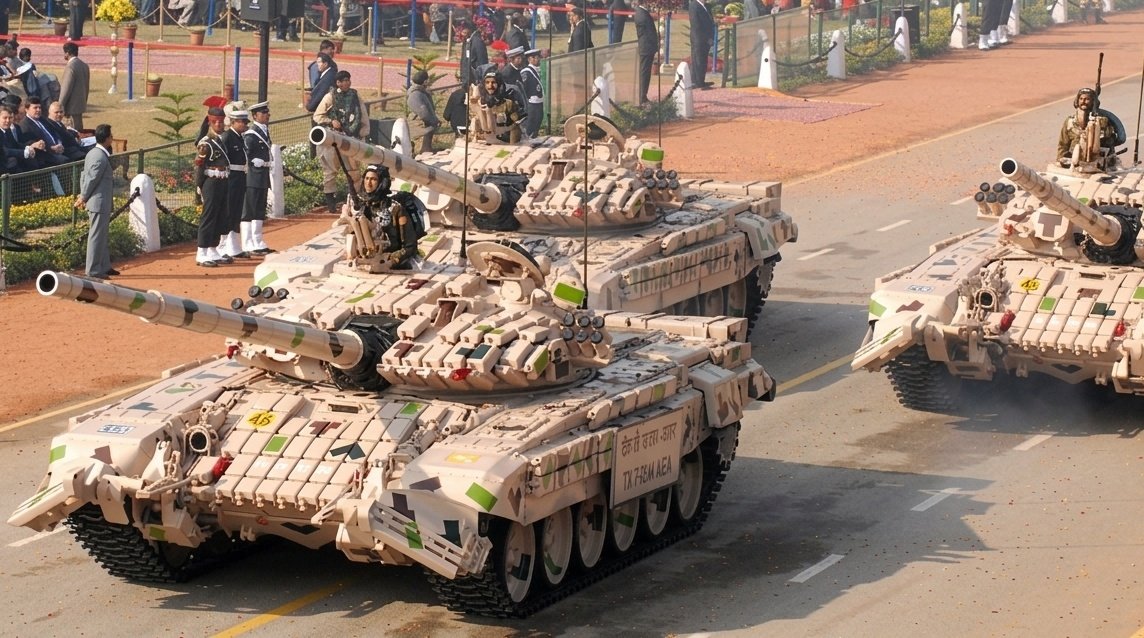
India is turning 2,400 ageing T-72 tanks into remotely operated battlefield platforms 🇮🇳
Instead of scrapping them, the Indian Army is converting them into unmanned systems for high risk missions.
And the thinking behind this is smart. 👇
• Nearly 2,400 T-72s to be converted under iDEX ADITI 4.0 challenge
• Extends operational life by 15 to 20 years at a fraction of replacement cost
• Will breach minefields, conduct reconnaissance and act as decoys
• Operate ahead of manned T-90s absorbing enemy fire and identifying positions
• Real time data links feed directly into command networks
• Bridges capability gap until Future Ready Combat Vehicle arrives from 2030
• T-72 has been in Indian Army service since 1979
Why risk a crew in a minefield when a remotely operated tank can do it instead.
That is exactly the logic here.
India is not scrapping its old tanks. It is giving them a second life on the modern battlefield. 🇮🇳