Most people explain behavior by listening to what people say.
I prefer to watch what they protect, what they repeat, what they pay for, and what they’re afraid to lose.
Money reveals incentives.
Power reveals character.
Pressure reveals priorities.
This account is about the motives underneath all four.
A guy checked the price of a hard drive on Walmart’s app.
$369.
His wife checked the exact same product on her phone.
$259.
Same product. Same household. $110 difference.
The Wall Street Journal reported the story today. Walmart says it was a pricing error, not personalized pricing.
Maybe it was. Glitches happen.
But think about how easily he could’ve paid that extra $110 without ever knowing.
We’ve reached a point where checking the price apparently isn’t enough. You might need to check your spouse’s phone too.
That’s a pretty strange way to shop.
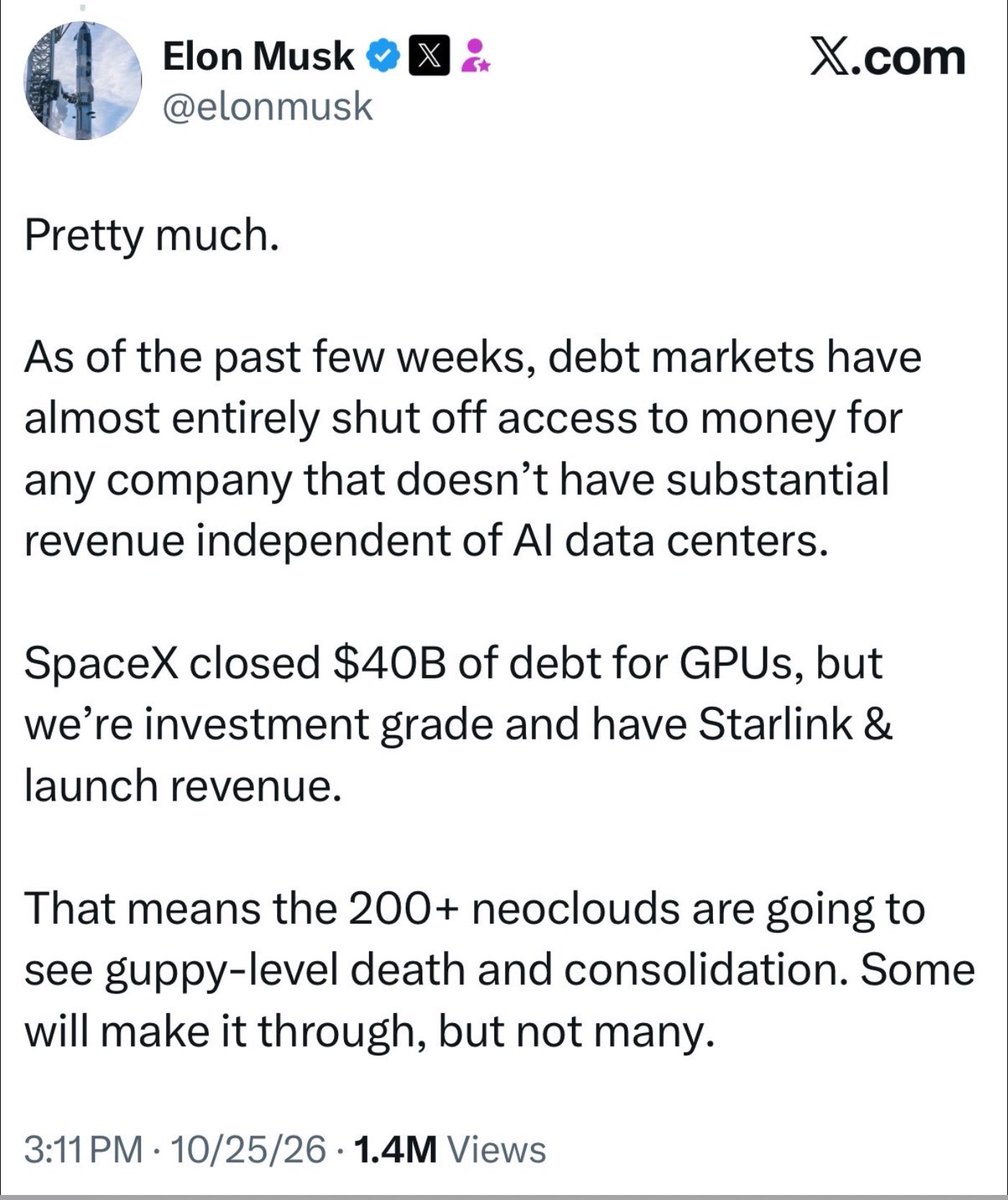
Elon Musk’s warning about AI debt markets got me thinking about something that has nothing to do with AI.
Looking wealthy and being financially secure are two very different things.
A company can own billions of dollars in GPUs and still be in trouble when lenders stop lending.
And someone can have a big house, a nice car, and a $200K salary while being just a few missed paychecks away from serious trouble.
That’s why cash flow matters more than appearances.
Easy money doesn’t last forever. A booming industry doesn’t mean every company in it will survive. And having cash sitting in the bank isn’t necessarily a missed investment opportunity.
Sometimes, that cash is what gives you choices.
You can walk away from a bad job. You don’t have to sell your investments during a market crash. You don’t have to take on expensive debt just to get through the month.
And when everyone else is desperate for money, you might actually be in a position to take advantage of opportunities.
I’ve come to think of financial freedom a little differently.
It’s not about how rich you look when everything is going well.
It’s about how many choices you still have when things go wrong.
I don’t expect a professional to charge only $22 for a $22 part. You’re paying for their time, experience, and overhead too.
But refusing to tell a customer what’s broken after charging them for a service call? That’s what bothers me.
If your $850 quote is reasonable, you should have no problem explaining it.
That text message says everything.
He didn’t see a man struggling with addiction who needed help. He saw someone with money and a weakness he could profit from.
And the worst part? He was the doctor.
The person who was supposed to protect him was trying to figure out how much he could make off him.
A woman in Texas spent over a year trying to sell her house.
She listed it for $750,000.
Finally sold it for $650,000. And had to contribute another $9,000 toward repairs.
She wasn’t flipping houses or trying to make a quick profit.
She’d lived there for 21 years. Her kids had grown up and moved out. She just wanted a smaller place.
Meanwhile, buyers are looking at mortgage rates that make even discounted homes hard to afford.
That’s what makes this housing market so frustrating.
Some homeowners can’t afford to move.
Some buyers can’t afford to move in.
Owning a house is supposed to give you financial security. Pretty strange when your biggest asset is also what’s keeping you stuck.
Imagine your doctor’s office gets bought by a hospital chain.
Same doctor. Same waiting room. Same appointment.
But suddenly, your bill can get a lot bigger.
A Health Care Cost Institute study found that an average primary care visit cost $116 at a doctor’s office, compared with $217 in a hospital outpatient setting.
Hospitals say the extra fees help cover their operating costs.
Okay, but imagine explaining to a patient why they’re paying so much more when nothing about their appointment has changed.
We’ve reached a point where who owns your doctor’s office can matter almost as much as the care you actually receive.
I’d leave enough to give my kid freedom, but not so much that they never have to make hard choices.
The tricky part is that every wealthy parent probably thinks their own kids will handle the money better than the last generation did.
And that’s probably what the last generation thought too.
Your 2% credit card cash back might be partly funded by someone paying cash for groceries.
Sounds ridiculous, right?
A 2026 NBER study estimates that credit card swipe fees shift roughly $30 billion a year from cash and debit users to credit card users.
Here’s how it works.
Stores pay fees when customers use credit cards. Some of those costs get built into prices everyone pays.
The person with the rewards card gets points or cash back.
The person paying cash pays the same price and gets nothing.
I love a good credit card reward as much as anyone.
But it’s interesting how quickly “free money” stops looking free when you start asking who’s paying for it.
The pilots made the right call. No question.
But having passengers hunt for hotel rooms, rebook their own flights, and chase down missing luggage after midnight? That’s ridiculous.
A mechanical failure is something an airline can’t always prevent. A complete breakdown in communication is something it should be prepared for.
@Bkclaims 2 stars is apparently the stage where the restaurant gets a little too obsessed with proving how sophisticated it is.
If I need a 10-minute explanation before eating a carrot, we’ve probably gone too far 😂
@japan_nobunaga He didn’t know a camera would preserve what he did. He didn’t know he’d receive a medal 16 years later.
He just knew other men were in danger, and he kept fighting.
That kind of courage deserves to be remembered long after the war itself is forgotten.
@racerhome Imagine making millions as a kid and still not having a bed of your own.
That’s what gets me. He was the one earning the money, but the adults were the ones holding all the power.
Being rich and having control over your own life are two very different things.
The 4 a.m. workouts get all the attention, but the five-year thinking is what impresses me.
Most people want to see results next month. Kobe was willing to do the same boring work thousands of times because he knew those hours would eventually add up.
That’s a level of patience people don’t talk about enough.
@DiscussingFilm I actually respect him for admitting it.
Most people with powerful connections spend years pretending those connections had nothing to do with their success.
Just don’t expect the kids without famous parents to believe they’re all playing on a level field.
@realEstateTrent A bigger house sounds great until you realize how much of your day gets spent driving everyone around.
Being able to walk out the door and have everything nearby is a luxury too.
Of course, Manhattan makes you pay a fortune for that convenience.
Halloween candy is getting ridiculously expensive.
Candy and gum prices are up 44% in five years. And Halloween candy sales fell 6.7% in the month ending October 17.
I don’t think Americans suddenly stopped liking Halloween.
I think a lot of parents are standing in grocery aisles doing math they never used to do over a bag of candy.
Gas, groceries, rent, insurance. Everything wants another piece of the paycheck.
And now even handing out chocolate to kids is something people have to think twice about.
That’s a pretty depressing sign of where we are.
Amazon agreed to a $2.5 billion FTC settlement over allegations that people were signed up for Prime without consent and had trouble cancelling.
Now more customers are getting automatic refunds.
What gets me is how familiar this whole thing feels.
Companies spend millions figuring out how to make buying something as easy as possible.
One click. Done.
But when you want to stop paying? Suddenly there are extra screens, more questions, and another offer to stay.
They clearly know how to make things easy when they want to.
Funny how that works.
I can see the case for a massive short squeeze.
But calling the exact bottom while betting on earnings, Fed decisions, oil prices AND two geopolitical conflicts going your way?
That’s a lot of moving parts for one Friday.
The market might surprise everyone. Just maybe not in the way anyone expects.评论
@ChrisWillx Putting your phone in another room might be the hardest one here.
Not because it costs anything, but because some of the richest companies in the world make money every time you pick it back up.
The problem with a 2008-style crash is that the people you’re trying to help might be the first ones to lose their jobs or mortgage approvals.
Meanwhile, investors sitting on cash could end up buying even more properties.
Cheaper houses don’t necessarily mean more affordable housing if ordinary people still can’t buy them.