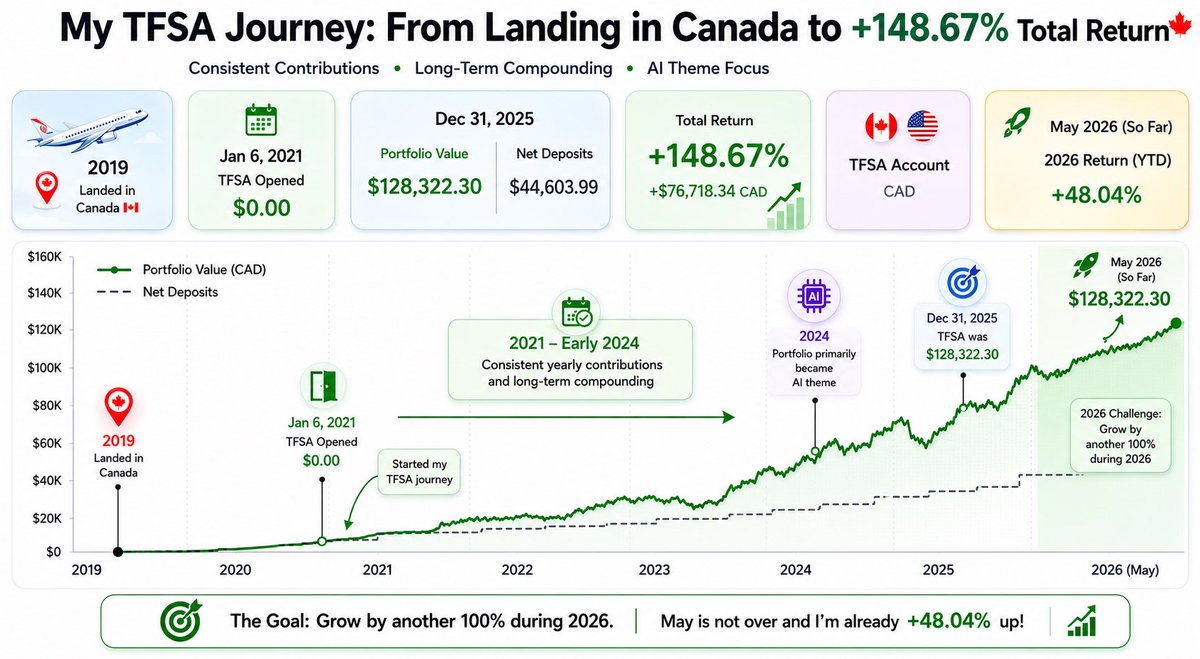
I landed in Canada in 2019 and opened my TFSA in January 2021.
There was no secret formula. Just consistent contributions every year, patience, and letting compounding do its job.
Over time, I gradually shifted my portfolio, and during the last two years it became heavily focused on the AI theme. By December 31, 2025, my TFSA had grown to $93,532 from total contributions of $44,604, delivering a +148.67% lifetime return.
At the start of 2026, I set myself a personal challenge: grow the portfolio by another 100% from the December 2025 level.
May isn’t even over yet, and the portfolio is already up 48% year-to-date, reaching $128,322.
The journey has reinforced a few lessons for me:
• Start early, even if the amount is small.
• Stay consistent with contributions.
• Let compounding work over years, not months.
• Concentrated themes can create outsized returns but they also require conviction and risk tolerance.
• Long-term investing is a marathon, not a sprint.
The challenge continues. Let’s see where the rest of 2026 takes me.
@JRupena The biggest mistake people can make is assuming an IPO is automatically a buying opportunity since an IPO is usually just a liquidity event.
Some of the best buying opportunities come from waiting a year after an IPO when the hype fades
So far, I’m down $50K since yesterday, and the market still doesn’t seem interested in finding a bottom. Every pop gets sold, and the downhill move just keeps accelerating.
Days like these are a reminder that markets are unpredictable. Just two day back Warren Buffet bought into $GOOG !
Now comes the hard part: staying calm, sticking to the plan, and not letting emotions drive decisions.
I never ever thought I will ever have more than 100K USD in just one stock! But then $AMD happened! It rocketed past my $NVDA position this year and still not slowing down.
@elonmusk is soon going to be the world’s first trillionaire.
The human mind is terrible at understanding very large numbers, so let’s put a trillion dollars into perspective.
A high earner in the U.S. might make $300,000 per year and live a wonderful life. Nice home, good neighborhood, comfortable lifestyle.
Raise that to $500,000 per year, and you’re talking about larger homes, multiple cars, and significant financial freedom.
At $1 million per year, you’re in executive-compensation territory: luxury vehicles, multiple properties, international vacations, and membership in the top 1% of earners.
Now let’s raise the bar dramatically.
Imagine earning $1 million every single day.
No taxes. No expenses. Every dollar goes straight into your bank account.
That’s $365 million per year.
Sounds unimaginably rich, right?
Now imagine you’ve been earning $1 million per day continuously since the year 0, around the time of Jesus’s birth.
More than 2,000 years later, you would have accumulated roughly $740 billion.
You still wouldn’t be a trillionaire.
To reach $1 trillion, you’d need to keep earning another $1 million every day for about 712 more years.
That’s how absurdly large a trillion dollars is.
Numbers at that scale stop feeling real. Yet we’re about to witness someone reach it.
@Tesla@xai@SpaceX
I have seen this happen in my own family, from very close quarters.
Five years ago, no one could have imagined where it would end. Arguments slowly became fights. The wife made allegations, left with the child, and the husband kept trying to bring the family back together. He continued paying heavy maintenance, carried the emotional burden silently, slipped into drinking, damaged his health, lost his job, and recently passed away. Everything happened in just 5 years, from a happy family to a child without a caring father.
It is heartbreaking.
Your partner can have an enormous impact on your life : emotionally, financially, physically, and mentally. Choose carefully. And when conflict starts destroying lives, families must intervene before it is too late.
I work at one of the Big 4 consulting firms, and I’m seeing this shift happen right in front of my eyes.
In previous technology waves, a large share of the value was captured by consultants and system integrators. With AI, much more of the value seems to be flowing directly to OpenAI, Anthropic, AWS, Azure, and other platform providers.
What is also becoming apparent is that the recurring nature of consulting revenue is weakening. Enterprises are adopting AI faster and more independently than many expected. Their small centre of excellence teams are far more capable and consulting firms are not able to match up.
Consulting will still have a role, but this may be the first major technology wave where platforms capture more of the economics than the services ecosystem.
Every new idea, every new thought was ridiculed, questioned, and doubted upon. Yet the men with unwavering determination marched on.
Skepticism is healthy. It forces ideas to prove themselves. Quantum computing should be held to the same standard. Today, it appears to solve mostly niche or contrived problems, and it’s fair to question whether it will ever deliver meaningful real-world value.
But history reminds us that breakthrough technologies often spend years, sometimes decades, looking like solutions in search of a problem. The internet, personal computers, and AI all went through that phase.
Will quantum computing change the world? Nobody knows yet. But if it does, it won’t be because people stopped doubting it. It will be because a small group of researchers kept pushing forward despite the doubts.
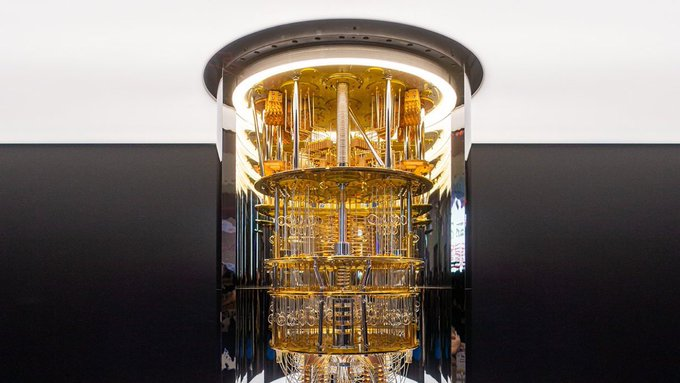
$MSFT unveiled its next-generation quantum chip called Majorana 2 and says it is targeting useful quantum machines by 2029.
Microsoft says AI-designed materials helped unlock a major performance jump.
Every new idea, every new thought was ridiculed, questioned, and doubted upon. Yet the men with unwavering determination marched on.
Skepticism is healthy. It forces ideas to prove themselves. Quantum computing should be held to the same standard. Today, it appears to solve mostly niche or contrived problems, and it’s fair to question whether it will ever deliver meaningful real-world value.
But history reminds us that breakthrough technologies often spend years, sometimes decades, looking like solutions in search of a problem. The internet, personal computers, and AI all went through that phase.
Will quantum computing change the world? Nobody knows yet. But if it does, it won’t be because people stopped doubting it. It will be because a small group of researchers kept pushing forward despite the doubts.
Data centers need enormous amounts of reliable water and power. Coastal locations can certainly use seawater cooling or desalinated water, and some facilities already do. However:
• Desalination itself is energy-intensive and adds cost.
• Many data centers need to be close to major population centers, internet exchange points, and power infrastructure, which are often inland.
• Coastal land can be more expensive and faces risks from storms, flooding, hurricanes, and sea-level rise.
• The biggest issue is not that seawater cooling is impossible. it’s that water availability was rarely considered a limiting factor when many data centers were originally sited.
That said, as AI drives data center growth, I expect we’ll see more coastal campuses, direct seawater cooling, recycled wastewater usage, and even colocating data centers with desalination and power generation facilities.