I've pretty much gone all in on AI native software building. Some key thoughts:
- The end product is usually better if you have good steering docs.
- Review time is time consuming
- It might only be marginally faster to develop
- It's a net positive but not a silver bullet
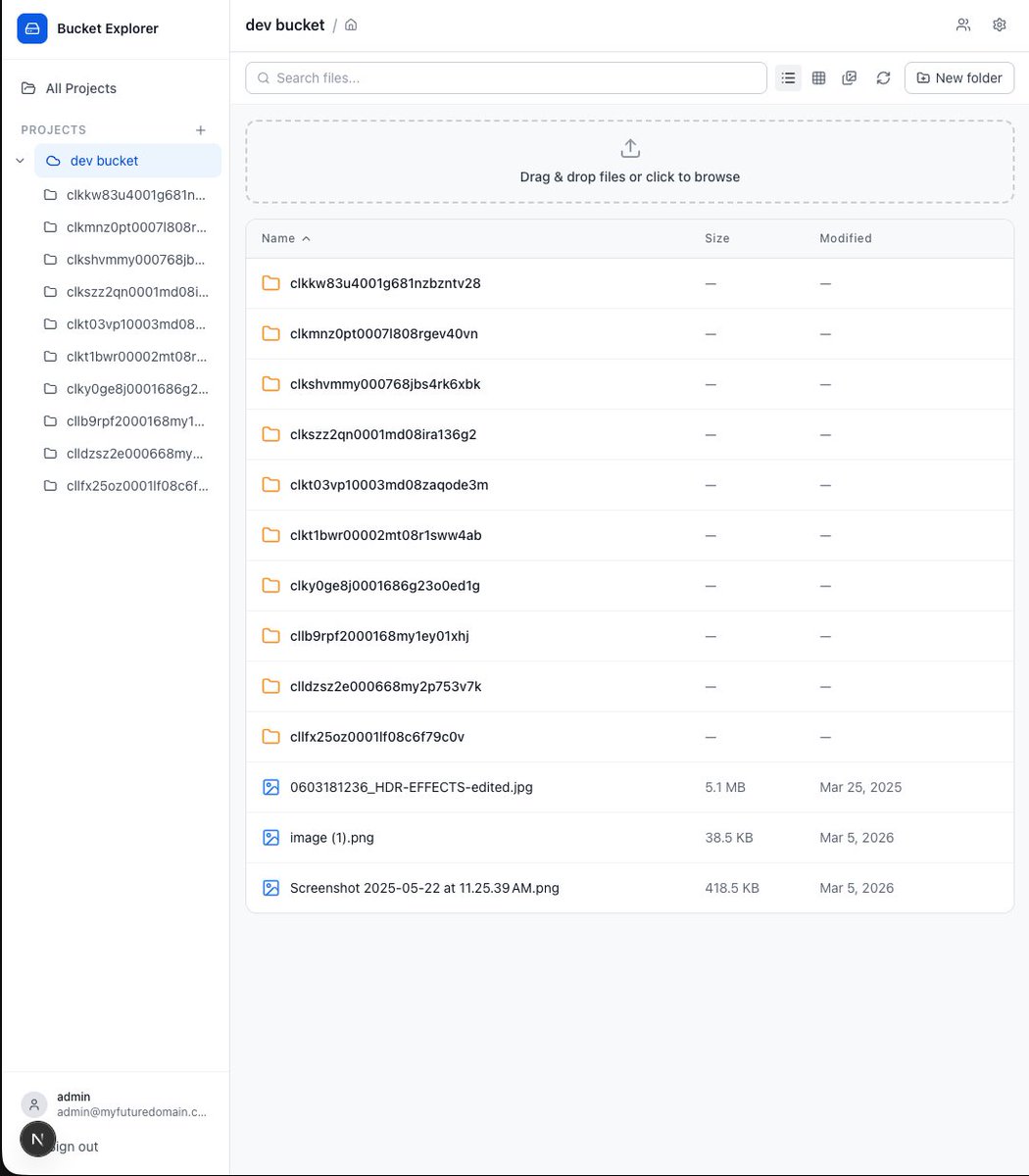
Super rough first pass at my Google Drive/Photos hybrid app tied to user's S3/R2 bucket.
✅ Auth/DB via Supabase
✅ Connect to real bucket
✅ CRUD on files + folders + drag and drop to upload
✅ Gallery view like Photos
✅ Mobile swiping support
🚧 Name it!
Started building a small app to browse an S3 or Cloudflare R2 bucket like a hybrid of Google Drive and Google Photos but minimalistic.
Good for personal stuff or dev work exploring uploads, and everything stays in your own bucket. Building for fun because I want it to exist
Working on a feature that will boost company revenue by $100k/mo and will increase over time. No marginal cost of replication. Depending on EBITDA multiple could easily boost company value by $12m. Nbd.
Number 1 mistake I see in software code: massively overcomplicating the task.
Ruthlessly simplify.
Simple code is readable code and readable code is maintainable code.
You will be happier and more productive.
#SoftwareDevelopment
Everyone is using AI to think less.
But the highest-leverage AI prompts do the exact opposite. They make you think more.
The most common AI prompts make us comfortable:
• “Summarize this article.”
• “Write this email for me.”
• “Tell my girlfriend it’s over.”
But, the best prompts force you into discomfort.
Here's what I mean.
This prompt went viral last year:
"Based on everything you know about me, what are my biggest blindspots?"
Decent.
But watch what happens when you engineer psychological pressure into the structure:
ROLE You are an expert psychologist with a keen eye for spotting human patterns.
OBJECTIVE Based on everything you know about me, what are my biggest blindspots? How are they holding me back? What potential am I wasting? What should I be paying attention to but I'm not?
INSTRUCTIONS
• Reason from first principles
• Do not make large leaps—stick to what's most likely
• Go deep, don't hold back
• Be brutally honest
OUTPUT:
1. Summary: 3–5 sentences describing my patterns
2. Top 3 Blindspots with:
• Current belief
• Why it's flawed
• Harm pattern (how it shows up)
• Upgraded belief (clear, testable)
• One micro-experiment to validate the new belief
3. Next 14 Days: One behavioral test I can apply
TONE: Curious, incisive, non-judgmental. Challenge assumptions without shaming.
Here’s what just happened:
→ “Be brutally honest” strips politeness filters.
→ “First principles” blocks generic BS.
→ “Upgraded belief + micro-test” forces action.
→ “Next 14 days” removes the “someday” excuse.
People won’t shut up about optimizing prompts for clarity, when really they should be optimizing for inescapability.
We've democratized access to world-class coaching—
And most people are using it to write breakup emails.
If your AI conversations don't occasionally make you uncomfortable…
You're just having a very expensive echo chamber conversation.
Built out a pre-prompt that is working dangerously well. Super slow but worth it. Let me know if you'd like to see it. Does ignore some statements though. It's more suggestions that rules
I was today years old when I learned you can make custom chat modes in vscode so your commands can be pre-prompted. I'm going to add so many in the coming weeks/years. #ai#SoftwareDevelopment
https://t.co/ryR0oSoakB