If you're a business owner doing $1M–$5M a year, there’s a very good chance you're leaving hundreds of thousands of dollars on the table.
And the reason is simple:
You’re not systematically running A/B tests across your funnel.
Not small tweaks.
Not redesigning the site once a year.
Actual controlled testing.
Let me show you what this costs you.
Imagine your funnel looks like this.
10,000 people visit your landing page every month.
Your numbers might look something like:
• Landing page conversion rate → 3%
• Leads generated → 300
From those leads:
• 30% book a call
• 20% close rate
• Average deal size → $5,000
Now let's walk through the math.
300 leads
→ 90 booked calls
→ 18 customers
That equals:
$90,000 in revenue from that traffic.
Seems solid.
But here's where most businesses unknowingly leave money on the table.
Most funnels have major inefficiencies that nobody ever tests.
Not because the owners don’t care.
But because testing requires:
• hypotheses
• controlled experiments
• structured iteration
Without that process, conversion rates stay frozen for years.
Let’s say we improve just one metric.
Lead → booked call rate.
A very common improvement with proper CRO.
From:
30% → 39%
That’s only a 30% improvement.
Now the funnel looks like this:
300 leads
→ 117 booked calls
→ 23 customers
Revenue becomes:
$115,000
Same traffic.
Same ad spend.
Same offer.
Just one improvement produced $25,000 more revenue.
Now here's where it gets interesting.
Conversion improvements compound.
If we improve multiple stages of the funnel:
Landing page conversion
3% → 3.9%
Lead → booked call
30% → 39%
Close rate
20% → 26%
None of these numbers are unrealistic.
They're common outcomes when funnels are properly tested.
Let’s run the math again.
10,000 visitors.
Landing page:
3% → 3.9%
Leads generated:
300 → 390
Lead → booked call:
30% → 39%
Booked calls:
90 → 152
Close rate:
20% → 26%
Customers:
18 → 39
Revenue:
$195,000
Same traffic.
Same ads.
Same business.
But the system converts better.
This is why serious operators treat conversion optimization as leverage.
Because improvements stack across the entire funnel.
Where most businesses lose money:
• Landing pages designed for aesthetics instead of conversion
• Headlines never tested
• Offers never tested
• CTAs never tested
• Booking pages ignored
• Follow-up sequences untouched
Meanwhile thousands of potential customers move through the funnel every month.
And the obvious question never gets asked:
"What happens if this step improves by 20–30%?"
Here’s something we’ve consistently seen.
Improving the Lead → Appointment Booked rate by ~30%.
I've achieved that improvement 10 times consecutively across different funnels.
And because funnel improvements compound, those gains stack across the system.
Which means more qualified prospects reach the sales call.
Which means more revenue from the same traffic you're already paying for.
If you're running a business in the $1M–$5M range and already have traffic coming in,
there’s a good chance your funnel has hidden conversion opportunities.
That’s exactly what we focus on.
If you want help identifying where your funnel is leaking revenue,
send me a DM.
Every time I open AI to write a post, I close it and write it myself.
Every time I'm about to generate a graphic, I design it myself.
Not because AI can't do it.
Because I refuse to let a tool erode what took me years to build.
Short-form content already has people's attention spans on life support.
AI is the most recent brain-eating bastard.
Your creativity doesn't disappear overnight.
It quietly erodes away one "generate" click at a time until the day you sit down to think and nothing comes out.
Go outside. Write something bad. Design something ugly. Think through a hard problem with no help.
Skills are the only asset that survives every technological shift.
The people who kept sharpening their skills while everyone else outsourced their brain to ChatGPT or Claude won't be replaceable.
Use AI as a calculator, not a crutch.
You're a human. Act like one.
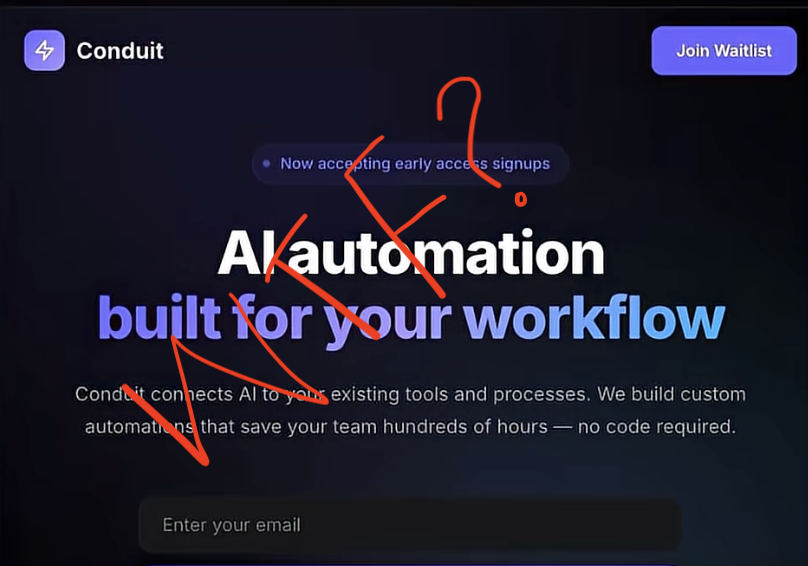
Hot take: I would never work with a company whose landing page looks like it was stitched together from 5 random AI prompts and a “startup gradient pack.”
Very unprofessional.
AI is making humans lazy and less intelligent.
Everyone’s celebrating speed.
Faster writing. Faster answers. Faster thinking.
But is it worth it to trade your intelligence for convenience?
The science is already catching up,
• A 2025 study (666 participants) found a significant negative correlation between frequent AI use and critical thinking.
Young users (17–25)? Worst scores. Highest dependence.
• MIT research showed a 47% drop in brain activity when people used ChatGPT for writing.
Less reasoning. Less memory. More “metacognitive laziness.”
• Students using AI summaries had a 45.5% memory decline after a week.
Those who wrote their own notes? Just 18.3%.
• High AI users recalled 22% fewer key concepts in delayed tests.
• 53.6% of students admit AI reduces their ability to think independently.
50% say they’re already overly reliant.
This isn’t humanity improving.
It’s literally going dumber and dumber.
And like any unused muscle, your brain adapts.
Less strain → less growth
Less thinking → less capability
The real danger isn’t that AI is “slop.”
It’s that you stop thinking at all.
Use AI as a tool, not a crutch.
Or don’t be surprised when you can’t solve problems without it.
Human over bot. Always.
None of these.
Marketplaces like Fiverr and Upwork are mostly people trying to find the cheapest person possible.
The best clients come from referrals, reputation, and your own marketing.
Every market, no matter what you sell, breaks down the same way:
3% are ready to buy right now
17% are researching
20% know they have a problem
60% don’t even know they have a problem yet
Most businesses do the dumbest thing possible:
They only talk to the 3%.
The people already hunting for a solution.
They shout:
“Buy now!”
“Limited time!”
“Let’s hop on a call!”
And then they wonder why their cost per lead keeps going up
and their conversion rate keeps going down.
Here’s the truth:
The real money is in the 97% who AREN’T ready yet.
And the brands winning right now are the ones who understand this.
The Larger Market Formula (explained simply)
If you want to triple your leads without spending more, do this:
1. Stop pitching strangers. Start helping them.
Lead with something useful - checklists, guides, tools, cheat sheets.
Something they can use without booking a call.
2. Nurture them with real education.
Webinars, short video courses, case studies, walkthroughs.
Give them clarity before you ever ask for anything.
3. THEN make the offer.
Once they trust you, the call feels natural.
There’s no pressure. No skepticism. No fighting for attention.
This is how you turn:
• 3% conversion → 30 to 40% conversions (top of funnel)
• And eventually → 12%+ buyers (bottom of funnel)
Not because you pushed harder…
but because you stopped ignoring the 97% who weren’t ready yet.
Why This Works
People don’t buy when you are ready.
They buy when they’re ready.
Your job isn’t to “close” everyone.
Your job is to move people from cold → aware → educated → ready
before you ever talk about price.
Brands that do this dominate their space quietly.
Brands that don’t… fight over the same tiny slice of the market forever.
The Lesson
If you sell to only the 3%, you’ll always struggle.
If you educate the 97%, you’ll never run out of customers.
Simple.
Predictable.
Unfair advantage.
If you're doing $1M to $5M a year in revenue and running ads, dm me to make more money from the same ad spend.
people think you need a big office to build something real
meanwhile i just moved into a new apartment in Dubai (amid iranian drones lol 😂)
a laptop
wifi
and ballsy decisions is the new economy.
fight me if you disagree.
HIRING:
I’m looking for one killer cold caller to join my team.
Your job is to generate pipeline.
• No previous sales experience needed
• Fluent English required
• EU timezones (CEST)
• 6h a day - 5 days a week
• Base + Performance
Send a DM if interested!