PART 1 - THE LANGUAGE OF GROWTH
“I’ve done the work.”
“I’ve healed.”
“I’m not the person I used to be.”
These words may be true. But words alone cannot tell the whole story.
Today, many people know how to speak the language of growth. They can identify attachment styles, name their wounds, explain their triggers and describe the patterns they learned in childhood. That awareness can be a meaningful beginning.
But understanding a pattern is different from changing it.
You can explain why you withdraw and still leave someone alone every time a conversation becomes uncomfortable. You can recognise your fear of rejection and still punish others for needing space. You can talk about accountability and still find a way to make every conflict someone else’s fault.
Insight gives us a map. It does not walk the road for us.
👉🏻 Growth becomes visible when what we understand begins to influence what we choose. It shows in the pause before an old reaction, in the willingness to listen, and in the ability to acknowledge the impact of our behaviour without immediately defending our intentions.
None of this means we must be perfectly healed to be worthy of connection. It means that growth asks more of us than a convincing story about how much we have changed.
The question is not only, “Can I explain my patterns?” It is also, “What am I doing differently because I recognise them?”
#PersonalGrowth #SelfAwareness #ConsciousnessPatterns #EmotionalMaturity
Notice how when women play simulator games they build beautiful, cozy homes, plant trees & flowers, have hobbies like gardening, pet animals, get married, have babies, cook + host… Men, on the other hand, sleep with prostitutes, go to strip clubs, sell dr*gs, and kill others.
The nature of women is more people-oriented (social, relational), & we love aesthetics because we truly appreciate beauty. Men are more system-oriented (status, physical looks, competition..). The problem is that men have been heavily psyoped to fantasize about exaggerated versions of “status”, “dominance” & sexual access through p*rn, the media, & a culture that distorts their existing (natural, healthy) drives into extreme, unhealthy, consequence-free scenarios. P*rn started it, especially if their exposure to it was at a young age
Secure attachment becomes visible through hundreds of ordinary choices to communicate clearly, regulate yourself, keep your word, repair quickly, and remain emotionally available.
💫DATING VS. RELATIONSHIPS💫
From Attraction to Emotional Responsibility
PART 10 | FROM CHOOSING A PARTNER TO BUILDING A PARTNERSHIP
The Foundations of Conscious, Reciprocal, and Sustainable Love
✨WHEN ATTRACTION BECOMES A SHARED RESPONSIBILITY
Throughout this series, we have explored one fundamental distinction: wanting a relationship is not the same as possessing the willingness and capacity to sustain one. Attraction may initiate a connection, chemistry may intensify it, and emotional attachment may deepen our investment. Yet none of these experiences guarantees that two people can create a healthy, reciprocal partnership.
👉🏻Dating invites us to discover another person. Commitment challenges us to participate in a shared reality.
And this is where romantic possibility encounters the demands of emotional maturity.
A sustainable relationship requires more than finding someone who meets our expectations. It requires recognising that we, too, become part of another person’s emotional experience, bringing our histories, protective strategies, vulnerabilities, and behavioural patterns into the connection.
✨FROM UNCONSCIOUS REACTIONS TO CONSCIOUS PARTICIPATION
Relationships reveal aspects of ourselves that may remain invisible during the excitement of dating. Disappointment exposes expectations. Conflict reveals defensive strategies. Vulnerability challenges our need for control, while intimacy confronts our capacity to remain emotionally present without abandoning our autonomy.
These experiences do not necessarily indicate incompatibility. They can become opportunities for growth when both individuals are willing to examine their responses and accept responsibility for their impact.
Conscious relating does not require the absence of emotional wounds, insecurity, or disagreement. It requires the willingness to recognise these experiences without repeatedly making another person responsible for managing them.
✨RECIPROCITY IS THE FOUNDATION OF PARTNERSHIP
A mature relationship cannot depend indefinitely on one person’s initiative, patience, emotional labour, or determination to preserve the connection.
Both partners must be willing to communicate, demonstrate affection, acknowledge mistakes, repair disconnection, and contribute to the relationship’s development.
This does not mean their contributions will always be identical. Life circumstances, individual strengths, and periods of vulnerability naturally create temporary imbalances.
What matters is the shared recognition that the relationship belongs to both people.
✨LOVE DOES NOT ELIMINATE ACCOUNTABILITY
Understanding someone’s psychological patterns can encourage compassion, but compassion must never become a permanent substitute for accountability.
Similarly, recognising someone’s potential does not obligate us to build a future around behaviour that has yet to change.
Love can offer patience. It cannot manufacture willingness.
Trust develops when intentions and actions become increasingly consistent, particularly when circumstances are uncomfortable.
✨THE CONSCIOUSNESS PATTERNS PERSPECTIVE
The ultimate purpose of recognising relational patterns is not to become suspicious, emotionally detached, or excessively analytical. It is to develop the discernment necessary to distinguish genuine connection from projection, temporary difficulty from persistent inequality, and romantic desire from relational capacity.
Equally important, awareness must extend beyond evaluating others. We must examine how our own expectations, fears, boundaries, and choices influence the relationships we create.
Consciousness without personal responsibility becomes observation without transformation.
A healthy partnership is not built by two perfect individuals. It develops when two imperfect people are sufficiently willing to recognise their patterns, respect each other’s individuality, and participate in the ongoing work of maintaining their connection.
💫DATING VS. RELATIONSHIPS💫
From Attraction to Emotional Responsibility
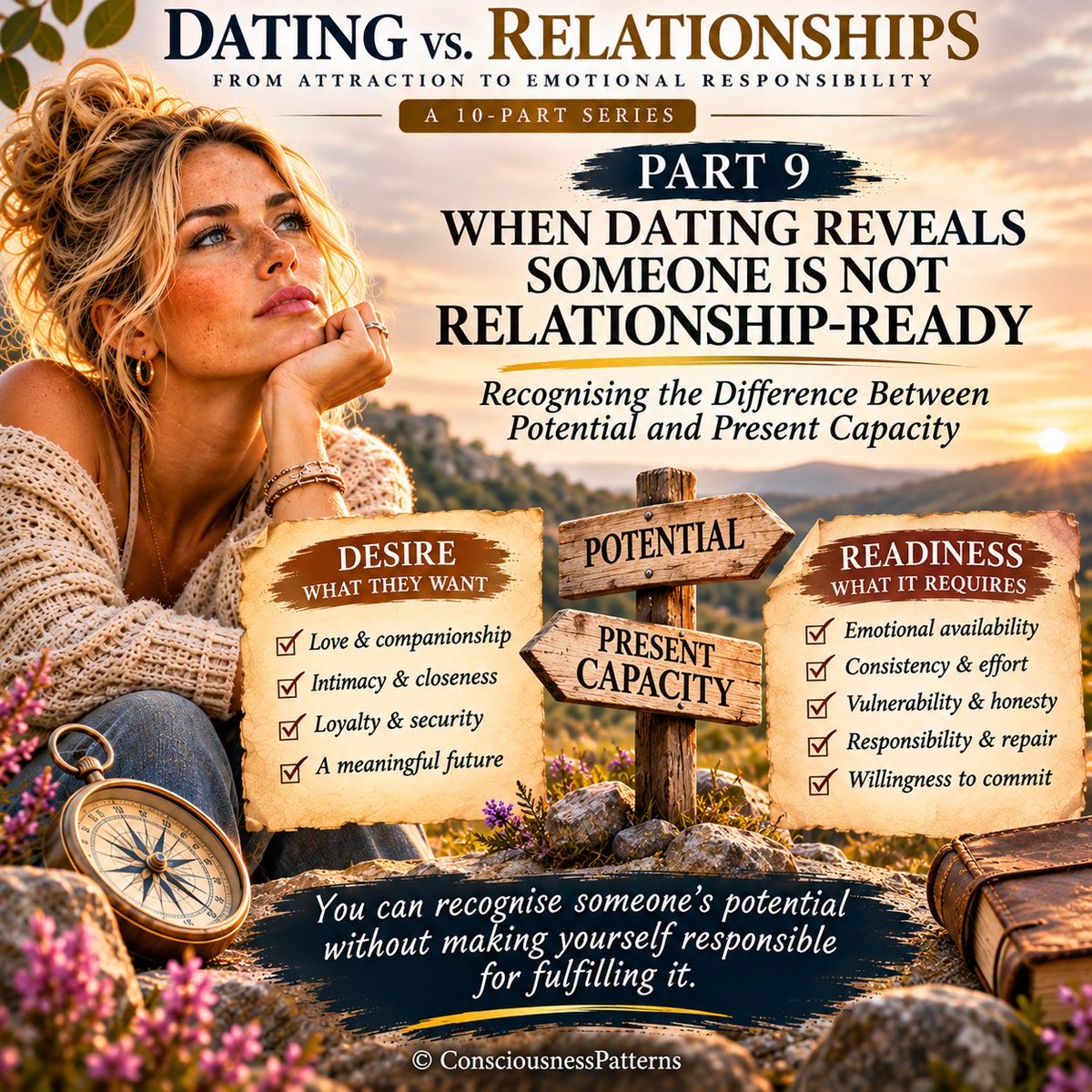
PART 9 | WHEN DATING REVEALS SOMEONE IS NOT RELATIONSHIP-READY
Recognising the Difference Between Potential and Present Capacity
✨WANTING LOVE IS NOT THE SAME AS BEING READY FOR IT
One of the most difficult realities in romantic relationships is that someone can genuinely desire love without being prepared to sustain the responsibilities that accompany it. They may long for companionship, intimacy, loyalty, and emotional security while struggling with the vulnerability, consistency, compromise, and accountability required to build a healthy partnership.
👉🏻Desire expresses what someone hopes to experience. Readiness becomes visible in how they participate.
This distinction matters because romantic attraction can encourage us to interpret someone’s intentions as evidence of their capacity. We become invested in what they say they want, sometimes overlooking what their behaviour repeatedly demonstrates.
✨THE PSYCHOLOGY OF RELATIONSHIP READINESS
Relationship readiness is not a fixed personality trait or a permanent psychological condition. It involves a combination of emotional awareness, practical circumstances, relational skills, willingness, and compatibility.
Someone may possess considerable emotional maturity yet lack the time or personal circumstances necessary for commitment. Another may have sufficient availability but struggle with communication, vulnerability, or conflict resolution.
Readiness also depends on the relationship itself. Being unwilling to commit to one person does not necessarily mean being incapable of commitment altogether.
The important question is not whether someone could theoretically become a suitable partner, but whether both individuals are presently willing and able to build the relationship they envision.
✨WHEN POTENTIAL BECOMES A TRAP
One of the most persistent relational patterns involves becoming attached to someone’s possibilities rather than their present behaviour.
We recognise their intelligence, sensitivity, affection, or capacity for growth and begin constructing a future around qualities that have not yet translated into consistent action.
Their occasional moments of emotional availability become evidence of what the relationship could become. Their repeated disengagement is interpreted as a temporary obstacle to overcome.
👉🏻Gradually, hope begins doing the work that reciprocity should be doing.
Understanding someone’s struggles can encourage compassion, but compassion does not require indefinite investment in unrealised potential.
✨DISCERNMENT WITHOUT DISMISSING GROWTH
Recognising limited readiness does not mean declaring someone incapable of change. People can develop emotional skills, confront protective patterns, reconsider priorities, and become more capable of sustaining intimacy.
However, growth requires personal participation. It cannot be manufactured through another person’s patience, reassurance, or willingness to carry the relationship.
A temporary difficulty deserves different consideration from a persistent refusal to acknowledge problems or participate in solutions.
The distinction becomes clearer through patterns over time.
✨THE CONSCIOUSNESS PATTERNS PERSPECTIVE
Conscious dating requires evaluating the relationship that actually exists rather than becoming exclusively committed to the relationship we imagine might eventually emerge.
Can expectations be discussed honestly? Are both individuals making meaningful efforts? Does behaviour reflect expressed intentions? Is there observable progress when difficulties are acknowledged?
These questions encourage discernment without demanding perfection.
You can recognise someone’s potential without making yourself responsible for fulfilling it.
And the most important lesson is this:
A person’s capacity to become a wonderful partner someday does not automatically make them the right partner for you today.
Mature love protects individuality.
Loving someone doesn’t mean they have to think like us, enjoy what we enjoy, or want everything we want. We can be close without agreeing on everything, spend time apart without feeling rejected, and support dreams that aren’t our own. When we try to control or change the people we love, we often end up pushing them away. Mature love makes room for differences. It gives people the freedom to be themselves without having to worry that being themselves will cost them the relationship.
✨FROM CARRYING TO SHARING
Conscious relating requires the courage to stop confusing excessive effort with relational strength.
You can communicate your needs, establish boundaries, and invite greater participation. But you cannot manufacture another person’s willingness to contribute.
A relationship should not survive solely because one person has become exceptionally skilled at compensating for the absence of the other.
Love may inspire extraordinary effort, but sustainable partnership requires mutual participation.
Because when one person carries the entire relationship, the question is no longer how much love exists, but whether a partnership genuinely exists at all.
⸻
READER’S NOTE: This series is intended for psychological education and personal reflection, not diagnosis or the labelling of individuals. Relational patterns should be considered within their broader personal and contextual circumstances.
#ConsciousnessPatterns #DatingVsRelationships #Reciprocity #EmotionalLabour #UnequalInvestment #RelationshipPsychology #Overfunctioning #EmotionalResponsibility #HealthyBoundaries #RelationshipAccountability #EmotionalMaturity #SelfAwareness #ConsciousRelationships #HealthyRelationships #MutualEffort
@stoicalphaman Why would clarity take courage?
Creating clarity is a responsible approach - I assume everyone wants to know where a situation that rapidly evolves emotionally, is going?