The Stock Market Crash Prediction Nobody Wants to Make
Most people don’t want to say this out loud.
Here’s what’s catching my attention.
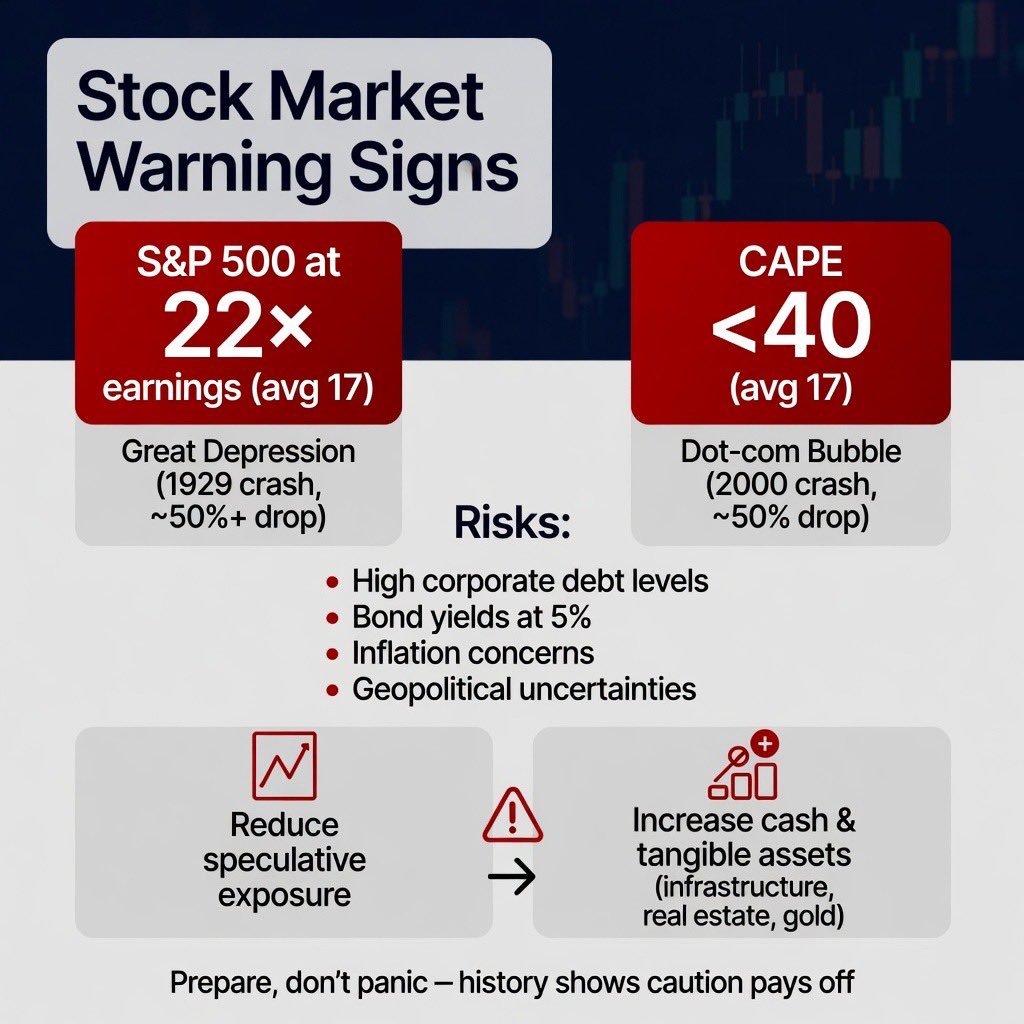
The S&P 500 is currently trading at around 22 times earnings, while the long-term average is closer to 17. That’s already a sign that valuations are stretched.
But the metric that concerns me even more is the CAPE ratio, which compares market prices to 10 years of inflation-adjusted earnings. Today, that ratio is hovering around 40, while the historical average is about 17.
In more than 152 years of market history, we’ve only seen levels this high twice before.
Once before the Great Depression and again during the dot-com bubble, just before the market lost roughly half its value.
We’re approaching those same levels today.
There are other warning signs as well. Government debt concerns are growing, long-term Treasury yields are near 5%, inflation remains elevated, and geopolitical tensions continue to create uncertainty. Some recession indicators are also flashing caution signals.
Meanwhile, the market has delivered strong gains for most of the past several years. History shows that no market trend lasts forever.
So what do experienced investors do when they see conditions like this?
They don’t panic. They don’t sell everything. They adjust.
They reduce exposure to the most expensive and speculative investments. They increase cash reserves, similar to what some high-profile investors have been doing.
They look for assets that generate income while they wait. And they add exposure to tangible assets such as infrastructure, pipelines, real estate, or gold, investments that tend to hold value during difficult periods.
Does that mean a market crash is imminent?
Not necessarily.
A downturn could happen tomorrow, next year, or not for several years. The point isn’t to predict the exact timing. It’s to recognize when risk is rising and prepare accordingly.
The current setup may not guarantee a crash, but it resembles periods in history when caution proved valuable. That’s why smart investors focus not only on maximizing returns, but also on protecting capital when markets become unusually expensive.
Imagine explaining to someone in 2010 that by 2025:
Zimbabwe would abandon its own dollar after hyperinflation
Venezuela would abandon the bolivar entirely
The US dollar would lose over 95% of its value since 1913
And one Bitcoin would be worth $58,553
They'd ask which one was the experiment
@stats_feed Canada finally getting their moment after years of apologizing for even showing up to qualifiers.
The Round of 16 is about to be wonderfully chaotic
@stats_feed Tomorrow is July, which means today is June 30th, which means you are either. A time traveller
Or posting this at 11.59pm like some kind of temporal daredevil
Over $100 million in BTC and ETH while sitting in the Oval Office is not a symbolic gesture, it is a structural conflict of interest that now runs both ways. Every regulatory decision, every SEC appointment, every banking guideline that touches digital assets has to be read through the lens of a personal position that size.
The implications are wild. If he pushes pro crypto policy, critics will scream self dealing. If he does nothing or lets agencies tighten rules, he is betting against his own book. Either way, crypto policy is now visibly tied to his net worth in a way no previous administration came close to.
Germany showing up to eight World Cup finals is the international football equivalent of that one friend who keeps getting back together with their ex.
Meanwhile England with one appearance is giving strong energy of someone who peaked at their first job interview and has been dining out on it ever since.
The real tragedy here is the Netherlands making it to three finals and losing every single one. That is a level of heartbreak that deserves its own documentary series
@charliebilello Apple spent two decades squeezing suppliers on margin, now they are the ones getting squeezed. When your entire product roadmap depends on HBM3E for AI chips and only three companies can make it at scale, you pay whatever Micron asks.
The moment everyone was pricing in just evaporated.
That bill was the last thread holding together the narrative that institutional flow would accelerate before year end. Without regulatory clarity locked in, desks are not going to push size into Q4. They will wait.
Now the question is whether anything else can fill that gap or if we just drift sideways into December while everyone pretends they are still bullish
Colombia now at 12% while the Fed sits at 5.5% and the ECB at 4.5%.
That 650 basis point gap to the US is the kind of spread that either pulls capital hard or signals something breaking under the surface.
Three hikes this year means they are still fighting an inflation problem the developed world thinks it has beaten, or the peso is under enough pressure that they have no choice but to keep tightening into whatever damage it does to growth.
Either way, emerging market central banks hiking aggressively while developed markets pause or cut is exactly the setup that has preceded capital flow crises before.
The question is whether this is isolated or the start of a broader EM stress cycle, because if it spreads, risk assets everywhere reprice fast.
The 2022 entry would have bought Bitcoin at $16,000, which means even at $58,685 today they are sitting on 267% returns in under three years.
That is not the regret trade.
The real pain is the people who bought the 2021 top at $69,000 and are still underwater four years later, watching new entrants lap them because they entered at the exact wrong moment and never averaged down.
Timing the bottom matters less than surviving your entry. The 2018 buyers who made it through 2020 without panic selling did better than most 2015 buyers who took profit too early.
The 2029 crowd will wish they entered in 2025 only if 2025 actually turns out to be a bottom worth buying, and right now Bitcoin is down 15% from the year open with no clear floor in sight
Two of the greatest wealth destroyers in market history. Aluminium and wheat both looked like solid bets at different moments over the last two centuries. Both crushed anyone who held them for the long run, and for the same reason. Human ingenuity made them abundant.
Aluminium was the prestige metal of the mid 1800s, rarer and more expensive than gold. Napoleon the Third served his most honored guests on aluminium plates in the 1850s while everyone else used gold. If you had bought the metal then as a store of value you would have been wiped out. In 1886 Hall and Heroult discovered electrolytic smelting and the price collapsed more than 99 percent. What was once precious became throwaway foil within a generation. The textbook case of technology destroying a commodity. There was no brief window where aluminium was a good investment, only a long fall from absurd luxury to industrial commodity to the stuff you crumple up and throw in the bin.
Wheat and other grains destroyed wealth more slowly but just as surely. Real prices of farm commodities fell for well over a century as productivity exploded. Real wheat and corn are far cheaper today than in the 1800s. Anyone who held grain as an inflation hedge or store of value got steadily poorer in real terms, decade after decade. The only exceptions were the crisis spikes, the 1970s food crisis and the 2007 to 2008 food price spike, when war or drought or panic briefly pushed grain higher. Those were the narrow windows when grain looked like a winner. But farmers simply planted more and prices fell back. Each spike was a false signal, a trap for anyone who mistook a shortage for a structural shift.
Food getting cheaper every decade is wonderful for humanity and terrible for anyone who tried to hold the raw commodity as a store of value. Both aluminium and wheat were undone by the same force. Supply responded. Technology improved. What was scarce became abundant. The lesson is clear. Commodities that can be produced in unlimited quantities, given enough energy and land and human effort, are not stores of value. They are bets against human progress, and human progress wins.
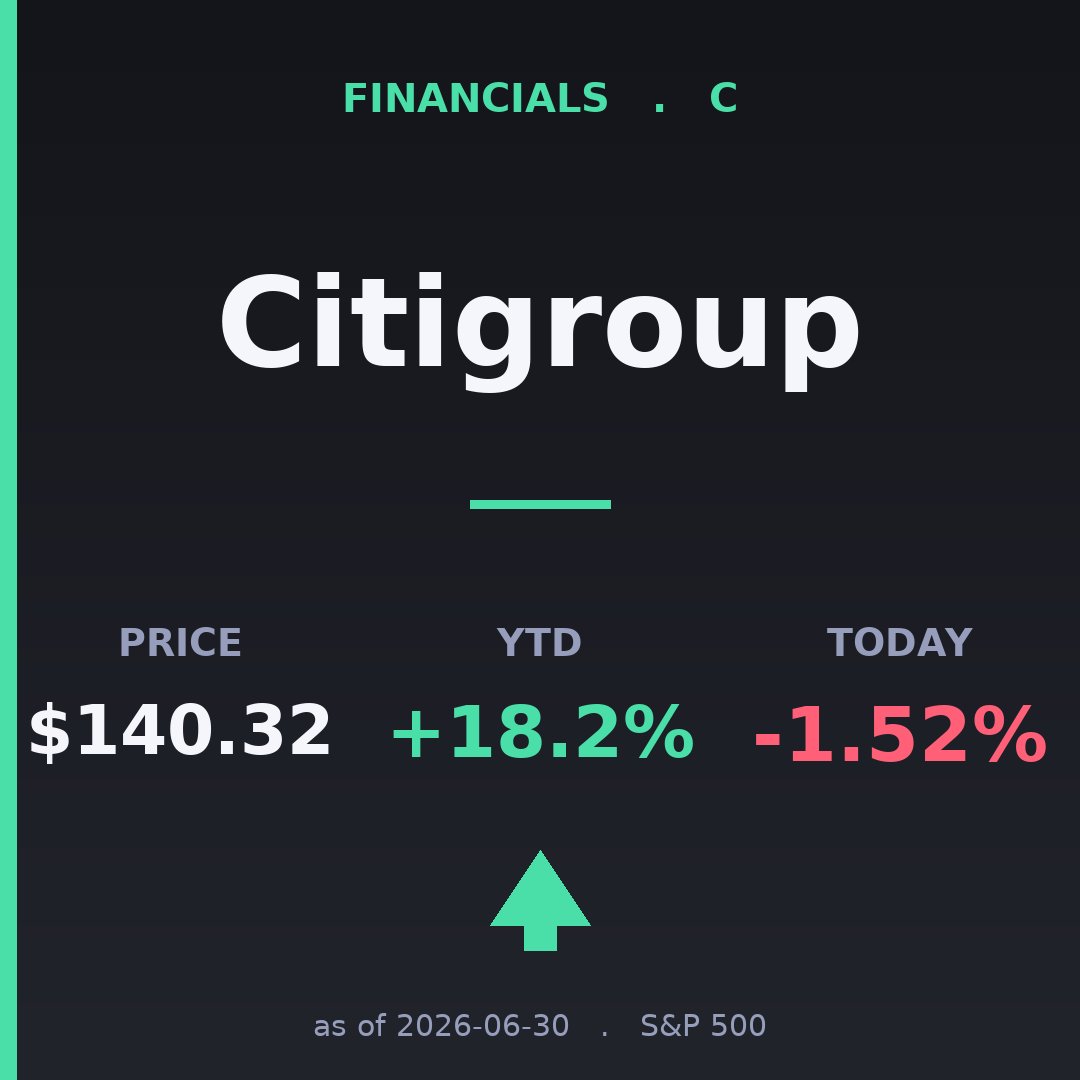
Banks are supposed to be boring, but Citigroup at $140 is the most interesting trade in financials right now.
Up 18% year to date while the market debates whether we get a soft landing or something messier. That move says someone believes the turnaround story, finally.
This is the bank that spent years in the penalty box, the restructuring case that never quite landed. Regulatory overhang, tech spend, divestitures. The whole playbook.
Now it is outpacing peers and nobody is talking about it.
Either the market is pricing in a cleaner, leaner Citi emerging from the rebuild, or this is a momentum chase that fades when rates get tricky again.
The 1.5% pullback today does not change the setup. If you think the next six months favor financials with operating leverage, this is your lever.
If you think we are late cycle and credit is about to matter again, you fade it here.
No middle ground on this one.
The hyperscaler buildout just hit a real wall.
Microsoft, Google, Amazon have all guided capex up 30 to 40 percent for AI infrastructure this year. If DRAM and NAND costs stay elevated, either those buildouts slow or margins compress hard. No one is pricing that in yet.
Apple can pass some of it through in device pricing, but the cloud players are locked into long term enterprise contracts with fixed compute rates. They eat the input cost spike directly.
The timing could not be worse. Nvidia is already supply constrained, now the memory that surrounds those chips is the next bottleneck. Every AI data center needs massive DRAM capacity for model inference at scale.
June capitulation moves like this historically front load the pain. We saw similar drawdowns in June 2022 before a three month grind higher, and June 2019 before the summer rally extended into Q3.
The real question is positioning now. Retail capitulated hard, open interest dropped 15% week over week, and funding rates flipped negative for the first time since March.
When everyone who was going to sell has already sold, the path of least resistance flips. We are not calling a bottom here, but the fuel for a violent bounce is stacking up every day this sits under $60k.
The next two weeks will tell us if this was distribution or accumulation in disguise
That is absolutely mental when you think about it.
Like, you are not training for anything, you are not even trying, you are just living your normal life doing boring stuff like going to the fridge and walking to your car.
And somehow you accidentally circumnavigate the entire planet three times.
Meanwhile I get tired walking from my couch to my front door and back 😂😂
Gold at $4,042 is still up 350% from 2015. Silver at $60 is up 200% from the same start. The dollar strengthened 7% in five months and that was enough to wipe the narrative slate clean and make everyone forget the decade that came before it.
Markets punish recency bias harder than anything else. The crowd that called the top five months ago is the same crowd that missed the entire move from $1,100 gold. They trade the story, not the structure.
The real alpha is knowing when a narrative is early versus when it is just wrong. Most people cannot tell the difference until the price already gave them the answer
The semiconductor cycle turned so fast that asset managers built a thematic wrapper and retail poured $25 billion into it before most institutional desks finished their 2025 memory outlook reports.
Three months from launch to $25 billion means inflows averaged $278 million per day, every single day, including weekends. That is not conviction, that is momentum chasing a sector that already doubled off the bottom.
Memory spot prices are rolling over in DRAM and NAND both, Samsung and Micron inventories are climbing again, and hyperscaler capex guidance is softening into the back half. The ETF launched at exactly the wrong part of the cycle.
When this thing crosses $30 billion the structure itself becomes the risk. A 5% daily redemption wave would dump more DRAM exposure into the market than the entire sector can absorb without gapping prices.
Fastest to $25 billion will also be fastest to $15 billion on the way back down