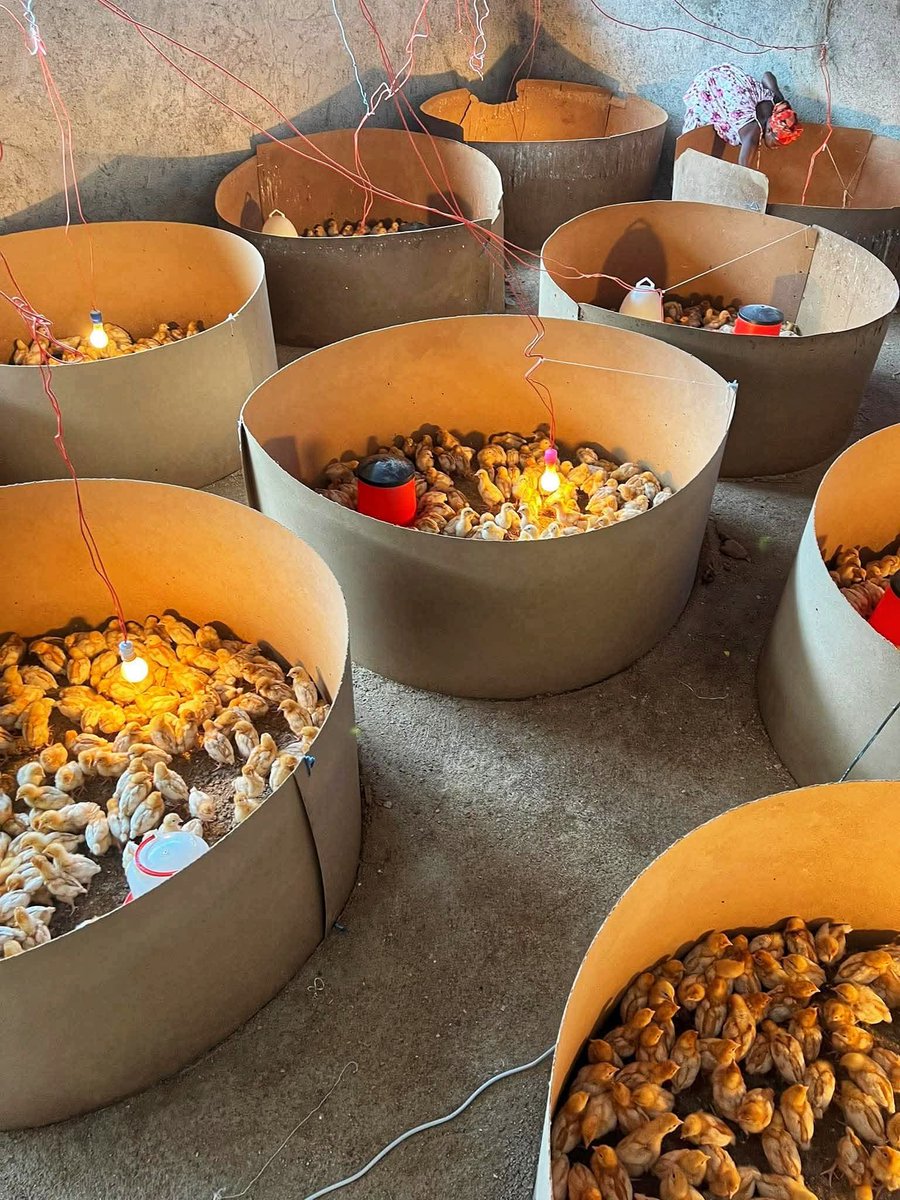
MISTAKES POULTRY FARMERS MAKE ON ARRIVAL OF DAY-OLD CHICKS
1️⃣ Prepare the Brooder in Advance
Many farmers forget to heat the brooder before the chicks arrive. Day-old chicks need warmth immediately, so switch on your heater a few hours early to bring the brooder to the right temperature. This ensures they stay comfortable and stress-free.
2️⃣ Water Before Food
Chicks must drink water before eating. Providing water with glucose and vitamins for at least two hours before offering food helps kick-start their digestive system and improves survival rates. Feeding them too soon can lead to weak chicks.
3️⃣ Use Proper Feeders and Feed Size
Big feeders are unsuitable for tiny chicks. Use shallow trays during the first week and switch to baby feeders as they grow. Also, starter feed should have small, easy-to-digest particles, because chicks’ stomachs are very small.
4️⃣ Avoid Tarpaulin; Use Brooder Paper
Some farmers use tarpaulin under the brooder, but it can harbor harmful bacteria like coccidiosis. Always use brooder paper instead. Make sure husks or bedding are also covered so chicks don’t eat them by mistake, which can make them sick.
5️⃣ Regulate Brooder Temperature
Too much heat in the brooder can dehydrate chicks and cause constipation. Maintain an ideal temperature warm enough to comfort the chicks but not so hot that it stresses them. Monitor daily to keep conditions optimal.
6️⃣ Provide Enough Space
Crowded brooders lead to stress, slow growth, and higher mortality. Ensure each chick has enough room to move, eat, and grow. Adequate space reduces competition and promotes healthy development.
7️⃣ Bonus Tip: Glucose & Vitamins
Adding glucose and vitamins to the water reduces early chick mortality and strengthens their immunity. Follow these brooding tips carefully, and your day-old chicks will have the best start toward healthy, productive growth.
Have you ever done a research on Broilers?
If you haven't, don't worry.
We've done an extensive facts research on Broilers for you.
1) it reaches its full market weight in approximately 42 days (six weeks), compared to several months for heritage breeds.
2) The primary commercial broiler used globally is a hybrid cross developed from specific strains of White Cornish (for meat yield) and White Plymouth Rock chickens (for robustness).
3) In the 1920s, it took roughly 112 days to raise a chicken to 1.36kg; modern genetics allow a chicken to reach over six pounds in less than half the time.
4) It is estimated that over 95% of the chickens raised for meat in the United States and Europe are these genetically engineered, high-efficiency birds.
5) Due to their rapid growth rate, the legs and skeletal structure of broiler chickens often struggle to keep up with the weight of their breast muscle, leading to lameness issues.
6) The industry focuses intensely on feed conversion ratio (FCR), with modern broilers requiring less than 0.86kg of feed to gain 0.45kg of body weight, making them incredibly efficient.
7) Broilers are bred specifically for a large, robust breast muscle, as this is the most profitable and desired cut of meat.
8) The term “broiler” refers to the cooking method (broiling), as these young birds are tender enough to be cooked quickly over high heat.
9) While they have the genetic potential for rapid growth, the modern broiler’s success is dependent on a very specific, high-protein diet designed to meet their intensive nutritional needs.
10) A major study found that the modern broiler chicken, due to its rapid growth, has bones that are less dense than those of traditional breeds.
11) The global meat consumption of chicken has surpassed pork as the most consumed animal protein on Earth, largely due to the efficiency of the broiler industry.
12) The genetic lines for commercial broilers are closely guarded secrets, owned by only a few global breeding companies, creating a highly consolidated industry.
13) The “broiler house” is a specialized, climate-controlled environment designed to provide the perfect temperature, light, and feed conditions to maximize growth rates.
14) Chickens raised for meat are typically all white-feathered because colored feathers leave pigmentation in the skin and carcass that is seen as undesirable by consumers.
13) In 2023, the U.S. alone produced approximately 9.37 billion broiler chickens for meat consumption.
I went back to Luke this morning just to revisit the story of Christmas… and Luke 2:7 hit me like an arrow to the chest:
“She gave birth to her firstborn son. She wrapped him in cloths and laid him in a manger because there was no room for them in the inn.”
We romanticize that line so much that we forget how brutal it actually is. If the gospel narrative is true, then that’s not a cute nativity detail. That is the most explosive statement in human history.
The God who created galaxies entered His own creation… and there was no room for Him.
No royal welcome, no palace, no safety, no honor, not even a bed. He comes into the world He made, and the doors are closed in His face.
This is the single greatest scandal of Christianity: God doesn’t supervise salvation from a throne. He steps into it. He doesn’t arrive in glory. He arrives vulnerable. He doesn’t come intimidating humanity into submission. He comes as a child who can’t even hold His own head up. If you were inventing a religion, this is not the story you’d write.
Luke is quietly showing something staggering about God’s character:
He wins, not by force, but by love.
He saves, not by domination, but by self-giving. He comes close, not as a King demanding space, but as a Savior entering even when there is “no room.”
And that manger isn’t sentimental. It’s confrontational.
It confronts our pride, cos humanity has always had space for power, wealth, celebrity, and status… just never space for God unless He serves our plans.
It confronts our illusions of strength cos God is showing that real power isn’t the ability to crush. Real power is the courage to empty yourself for the sake of others.
It confronts religion, cos God bypassed temples and elites and arrived where animals feed… then announced His coming not to emperors, but to shepherds.
Luke 2:7 tells us who God is.
He is not distant, He is not indifferent, He is not cold sovereignty. He is the God who chooses weakness so He can stand with the weak. He is the God who walks into human pain instead of observing it from afar. He is the God who would rather be rejected with us than reign without us.
If this verse is true, Christianity isn’t just another belief system. It’s a radical claim that the deepest power in the universe is love; not might, not fear, not spectacle.
So yes… this verse broke me today.
Because if this is who God is… then hope isn’t sentimental. Grace isn’t theoretical. And Christmas isn’t “cute.”
It’s God stepping into history quietly…
exposing us gently… and saving us completely. Luke 2:7 isn’t a children’s story. It’s a revolution.
Merry Christmas 🎄❤️
#RDC🇨🇩 : JOSEPH KABILA-AFC/M23-DOHA
Ce syllogisme qui taraude auquel le gouvernement a, pour la première fois répondu.
Si JKabila est l'AFC/M23 alors que le gouvernement négocie avec l'AFC/M23 à Doha, ce que Kinshasa négocie avec JKabila. ?
Réponse du VPM @shabani_lukoo 👇
Octobre 2001, à seulement 29 ans et 9 mois après son accession à la magistrature suprême, l'homme affichait déjà une sérénité et une intelligence remarquables.
Dans cette vidéo tournée à la Kennedy School of Government de l’Université Harvard (États-Unis), Joseph Kabila fait preuve d'une sagesse et d'une maîtrise impressionnantes dans ses réponses... Bref, un homme profondément réfléchi dans ses propos.
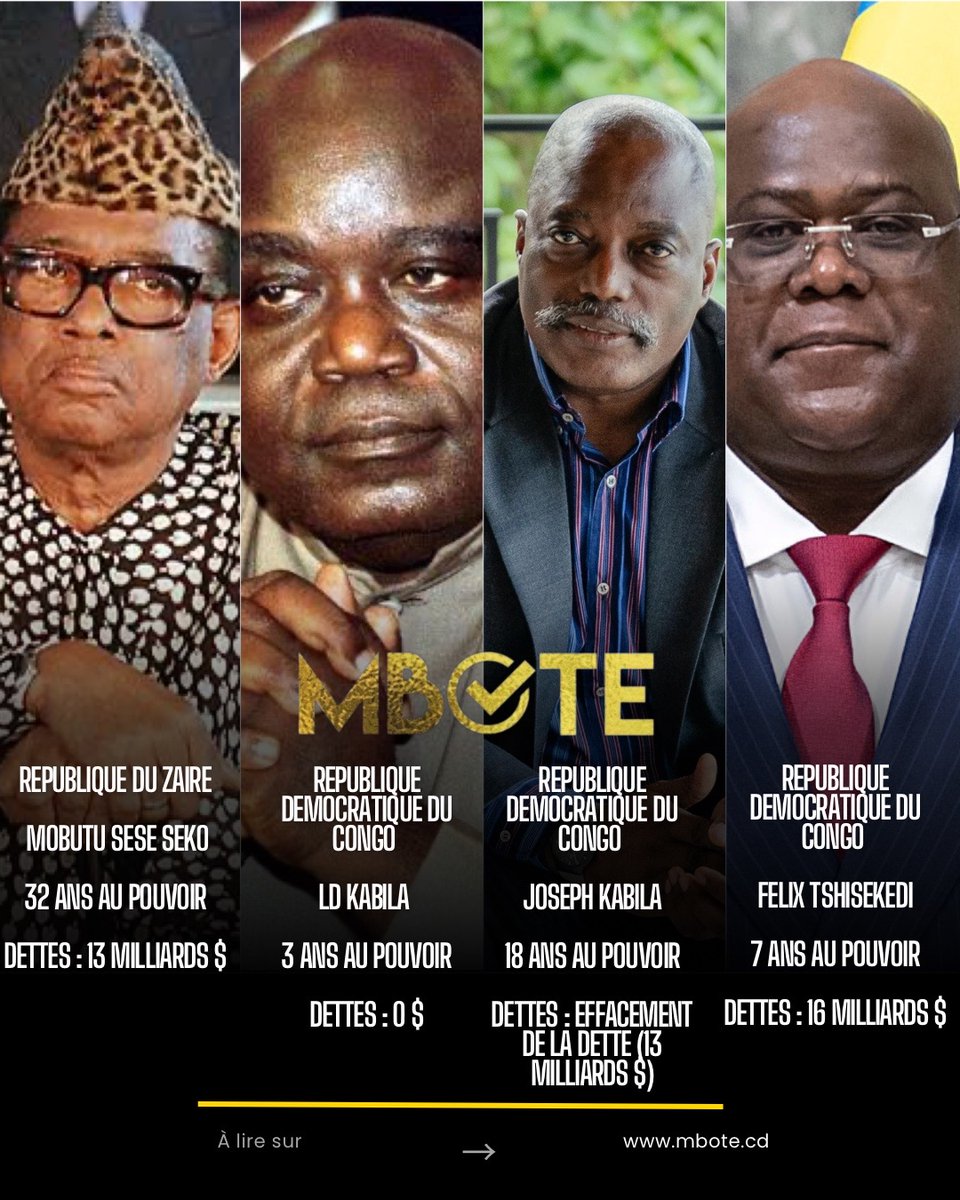
À QUI LA FAUTE ?
- 32 ans de pouvoir : Mobutu, dictateur, avait accumulé une dette extérieure de 13 milliards USD.
- Mzee Laurent-Désiré Kabila n'avait contracté aucune dette extérieure en 3 ans.
- Joseph Kabila a permis l'effacement de la dette du Maréchal, estimée à 13 milliards USD (sous Muzito), en 18 ans au pouvoir.
- Félix Tshisekedi, en 7 ans, a accumulé un crédit extérieur de 16 milliards USD, tel qu'affirmé par le VPM du Budget, Adolphe Muzito.
Entre-temps, pour un investissement de 2,5 milliards, l'Éthiopie vient d'ériger le plus grand barrage du continent, et pire, sur des eaux (le Nil) qui, majoritairement, ne leur appartiennent pas. Au Congo, Inga ne représente plus grand-chose, et le Président n'a pu atterrir aisément faute d'électricité.
#RDC #Kinshasa #Congo #LutteContreLaCorruption #CultureCongolaise #ÉconomieRDC #JusticeSociale #EnvironnementRDC
@aminata_kasa Citation de Samora Machel : « Si un jour vous entendez les Européens me louer, sachez que je vous ai trahi. »
Samora Machel's quote, "If one day you hear the Europeans praise me, know that I have betrayed you."
#RDC : A 29 an avec la fougue d’envie sexuelle aucun jeune de l’udps n’aurai réussi à faire mieux que #Kabila , la preuve : nous faisons aujourd’hui face à une bande des jouisseurs qui veulent rattraper leur jeunesse en étant au sommet de l’Etat ( des copines partout, des détournements chaque jours ).
Joseph Kabila hérite d’un pays au bord de l’implosion économique, morcelé politiquement et institutionnellement vide. Il réussit, malgré des limites et critiques sur la gouvernance, à réunifier le territoire, stabiliser les finances par l’effacement de la dette, et lancer un programme d’infrastructures qui a partiellement modernisé le pays.
1. État économique à son arrivée et gestion de la dette
Quand Joseph Kabila arrive au pouvoir en janvier 2001, la RDC sort de plusieurs années de guerres meurtrières (1996-2001) et d’effondrement économique.
•Croissance économique négative, monnaie instable, inflation à trois chiffres.
•Dette colossale héritée en grande partie du régime Mobutu, estimée à plus de 13 milliards USD selon les chiffres officiels de l’époque (certains analystes parlent de plus de 52 milliards en valeur cumulée avec les arriérés).
•Les infrastructures productives étaient à l’arrêt, les recettes de l’État quasi inexistantes.
Sous son mandat, la RDC entre dans l’Initiative PPTE (Pays Pauvres Très Endettés) et parvient, en 2010, à obtenir un effacement massif de la dette extérieure, libérant des ressources pour les investissements publics.
2. Situation politique et institutionnelle héritée et pacification
En 2001, le pays est divisé en plusieurs zones d’occupation (RCD, MLC, armée gouvernementale), avec présence de forces étrangères (Ouganda, Rwanda, Zimbabwe).
•Les institutions étaient pratiquement inexistantes, la Constitution de transition n’était pas encore adoptée.
•Kabila engage un dialogue intercongolais (Sun City 2002), aboutissant au gouvernement d’union nationale.
•Réunification administrative et territoriale effective en 2003, puis organisation des élections pluralistes de 2006, mettant fin à la transition.
3. Réalisations infrastructurelles
Avec les recettes minières en hausse et l’accord dit “contrat chinois” (2008), il lance plusieurs chantiers :
•Routes : réhabilitation de la RN1 Kinshasa-Matadi, tronçons de la RN2, RN4, etc.
•Bâtiments publics : réfection du Palais du Peuple, Hôpital du Cinquantenaire, nouvelles universités régionales.
•Énergie : relance des travaux d’Inga, construction de barrages secondaires.
•Transports : rénovation de l’aéroport de Ndjili, relance partielle de la SNCC , Congo Airways etc..
La seule chose que ne pardonnerai jamais à #Kabila c’est d’avoir laisser la gestion du pays dans les mains de l’udps et la bande des frappeurs de la diaspora.
#SANS_GANTS 🥊🥊