Conservative voice sharing bold editorials and views on freedom, security, and values. Pro-2A, Pro-Police, Pro-Israel, Anti-Crime. Join the fight for truth!
There is a particular kind of luxury belief that flourishes only in a country defended by other people’s sons.
Silicon Valley has lately perfected it.
The latest fashion among certain AI companies—those temples of algorithmic self-regard—is to issue grave declarations that their products must never, under any circumstances, be used by the military. Statements are drafted. Principles are proclaimed. Ethics boards nod solemnly. Executives tweet their moral courage to the world.
And somewhere, a young American infantryman pulls another night watch on a freezing base so that the authors of those statements can sleep soundly in their Palo Alto mansions.
It is a remarkable arrangement.
On one side: twenty-something engineers earning stock grants the size of small national budgets, announcing that they will not sully their code by assisting the armed forces.
On the other: the armed forces themselves—mostly young enlisted Americans, many from modest towns and families—who spend their early adulthood doing the rather unfashionable work of guarding sea lanes, deterring hostile states, and occasionally fighting wars.
The first group becomes multimillionaires lecturing about ethics.
The second group ensures that the lecture hall remains standing.
Yet the tech mandarins speak as though the military were some embarrassing relic—an unfortunate institution whose existence they tolerate only because it remains conveniently out of sight.
One can almost imagine the boardroom dialogue:
“War is terrible,” says the executive, sipping oat-milk espresso in a glass conference room.
“Yes,” replies another, gravely. “Therefore, we must ensure our software never helps soldiers.”
“Excellent. That should solve the problem.”
Meanwhile, the soldiers continue existing. They continue deploying. They continue deterring the sorts of regimes that would not hesitate for five seconds to weaponize the same technologies Silicon Valley refuses to touch.
Reality has a way of intruding like that.
The truth—unfashionable but stubborn—is that the prosperity of the American technology sector did not emerge in a vacuum. It grew inside the most secure geopolitical environment in human history. The internet itself began as a defense project. GPS, satellite communications, microelectronics—all of it matured inside a system underwritten by American military
power.
Freedom isn’t free. It never has been. It is purchased—quietly, repeatedly—by people whose job descriptions rarely include panel discussions at Davos.
And yet here we are: an era in which the beneficiaries of that security feel comfortable denouncing the very institution that provides it. The aristocracy of code declaring moral independence from the men and women guarding the gates.
It is not bravery. It is not wisdom.
It is what happens when people become so insulated by the security of a civilization that they forget the civilization has defenders at all.
A City in Rebellion: Chicago’s ICE-Free Decree and the Spirit of Insurrection
Mayor Brandon Johnson has found a new frontier for “compassion”—and it begins with padlocks. His latest decree designates city-owned properties and buildings as ICE-free zones, barring federal immigration officers from using municipal facilities to carry out lawful duties. On paper, it sounds noble. In practice, it’s an act of quiet insurrection—a bureaucratic barricade dressed up as moral leadership.
This isn’t protest; it’s policy-level obstruction. When a city blocks federal agents from using its property to execute immigration law, it’s not taking a “humanitarian stand.” It’s declaring a form of administrative secession. Chicago’s government is no longer cooperating with Washington—it’s actively impeding it. The polite rebellion of the paperwork class has begun.
The language is soothing, the intent revolutionary. “ICE-free” sounds like a diversity initiative, another moral checkbox for the city that fancies itself a capital of conscience. But in constitutional terms, it’s the municipal version of standing in the schoolhouse door—a soft replay of the South’s “massive resistance” to federal law during the civil-rights era. Then it was governors barring desegregation officers from public schools. Now it’s a mayor barring immigration agents from public buildings. The wardrobe changes, the defiance does not.
Johnson’s defenders call it “local control.” That phrase should make every constitutionalist’s skin crawl. The 10th Amendment does not grant cities a veto over federal law enforcement. Immigration falls under the exclusive domain of Congress and the executive branch, not a mayor’s moral mood board. Chicago can manage its potholes, not the nation’s borders.
The mayor insists this move reflects Chicago’s “values.” Perhaps—but the Constitution is not a mood ring. Federal supremacy is not a suggestion, it’s the glue that keeps the Union from disintegrating into fifty—or five hundred—little republics of righteousness. When one city decides that its compassion supersedes federal law, it doesn’t just resist ICE; it resists the very premise of a united nation.
The irony is cinematic. Progressives who hyperventilate about “insurrection” on January 6 now applaud it in policy form. The difference is tone, not substance. When citizens barricade Congress, it’s sedition. When bureaucrats barricade federal officers, it’s “values-based governance.” But whether it comes wrapped in flags or press statements, rebellion is rebellion.
By banning ICE from city buildings, Mayor Johnson hasn’t merely drawn a moral line—he’s redrawn a constitutional one. He’s asserting a city’s right to obstruct federal duty, to decide which laws are enforceable within its jurisdiction. If that principle stands, it won’t end with immigration. Tomorrow it could be tax law, gun law, or civil rights law. Every mayor becomes a micro-sovereign, every council chamber a little Confederacy.
Compassion is not a license to nullify. Sanctuary is not sovereignty. And the Constitution is not a “choose-your-own-adventure” pamphlet for progressive mayors.
Mayor Johnson’s ICE-free edict is not a gesture of mercy; it’s a declaration of defiance. A city that bars the federal government from its own property isn’t showing kindness—it’s rehearsing rebellion. And if Washington shrugs, the next “sanctuary” won’t just be for migrants. It’ll be for lawlessness itself.
The New Pirates Off Venezuela’s Coast
Let’s drop the pretense: these aren’t “fishermen,” “smugglers,” or “unlicensed merchants” skimming the Caribbean. They are narco-pirates—floating laboratories of death whose cargo flows directly into the veins of America’s cities. And if a U.S. Navy drone or Coast Guard cutter decides to turn their vessel into coral reef, the only proper response should be applause.
The handwringers cry “Constitutional overreach.” Please. The Constitution was not written as a suicide note; it was written to allow a young Republic to defend itself against precisely this kind of foreign predation. Article II vests the Commander-in-Chief with the authority to repel sudden attacks; Article I gives Congress the power to define and punish offenses against the law of nations. Smuggling narcotics into the U.S. isn’t some boutique crime—it’s an act of war by other means.
The Founders faced the Barbary corsairs, who hijacked American ships and enslaved their crews. Jefferson didn’t convene a symposium; he sent the Marines “to the shores of Tripoli.” No judge in powdered wig whined about “extraterritoriality” then, and none should now. Pirates were deemed hostis humani generis—enemies of all mankind—subject to summary justice wherever found. Replace “cutlass” with “cocaine,” and the principle is unchanged.
And let’s be honest: every kilo that sails north from Venezuela translates into overdoses in Ohio, gang murders in Chicago, fentanyl-laced funerals in New England. The pipeline runs straight from a jungle lab to your neighbor’s morgue. Are we seriously meant to believe that defending against such an assault requires polite diplomacy with Caracas? That a Coast Guard skipper must wait for a Venezuelan magistrate’s permission slip while smugglers unload their poison?
Critics say it looks like “blowing up boats.” Good. That’s exactly what it is. The U.S. Navy once cleared the Caribbean of slavers the same way—by fire. No one now weeps for the lost profits of human traffickers. So why the sudden delicacy about narco-terrorists?
The truth is, America’s constitutional tradition gives broad latitude when foreign threats strike at home. To stop the flow of drugs is not adventurism; it is self-defense—precisely the kind of robust action that has always distinguished a confident republic from a decadent one.
The choice is stark: either we treat these smuggling vessels as the pirates of our age—swiftly sunk, decisively dealt with—or we continue the polite decline into overdosed neighborhoods and border chaos. Civilization or barbarism. Jefferson or appeasement. Masthead or morgue.
Which side do you think the Constitution is on?
#drugs #narcoterrorists #venezuela
The H-1B visa program is forever described in tones befitting a Manhattan Project: America, starved of talent, must scour the globe for the rare Einsteins who will code our future, invent our cures, and keep Silicon Valley on its gilded perch. That’s the pitch. The reality? Grey cubicles stuffed with entry-level coders flown in by staffing firms whose business model amounts to wage arbitrage with a side of corporate gaslighting.
The gap is not subtle. Politicians and tech CEOs hail the “best and brightest,” while anyone who has watched an outsourcing firm empty out an IT department knows the drill: longtime American employees are given severance and a grotesque little exit ritual—train your cheaper replacement before you collect your cardboard box. World-class innovation, apparently, now looks like writing Java for a billing app at half the prevailing wage.
It is, in fact, one of the great scams of the age. Silicon Valley polishes its halo—lecturing us on immigration compassion, diversity, the future of work—while quietly outsourcing not only its payroll but its integrity. The “talent shortage” is less about skill scarcity than about cost control. And the tragedy is that we are meant to clap along while billion-dollar firms plead poverty and tell Congress they simply must have foreign innovators, as if the survival of Western civilization depends on one more outsourced QA tester.
The rhetoric is aerospace; the reality is spreadsheet. The myth is Steve Jobs; the practice is staffing firms gaming the lottery to flood the system with interchangeable résumés. America thought it was importing visionaries. Instead, it imported a business model: cut costs, displace locals, and hide it all under the banner of global progress.
So the next time a CEO intones that without H-1Bs the U.S. will lose its edge, remember: what they really mean is without H-1Bs, they might have to pay market wages. That is the “innovation” the program protects. Which is why Trump’s recent move to slap fees on H-1Bs is not xenophobia but sanity: make the corporations pay for their pipeline of cheap labor, and suddenly the “talent shortage” may evaporate like morning fog. For the first time in decades, policy is aligning with reality. And the real question is not whether America can afford to lose this scam, but how much longer it can afford to keep it.
#h1b #trump #tech #india
So Jimmy Kimmel didn’t just crack a limp joke—he tried to rewrite reality. On his show, he declared that Charlie Kirk’s would-be assassin was a MAGA maniac, a right-wing zealot. Except he wasn’t. The shooter was a leftist. That wasn’t in dispute. The facts were plain. But in Kimmel’s universe, inconvenient truths are simply swapped out for more politically appetizing fictions. And the same left that preens about “disinformation” lapped it up like champagne at a donor gala.
This is the selective moral compass in action. Conservatives canceled? That’s righteous “accountability.” A late-night host smearing political opponents with outright falsehoods? That’s “satire,” and God forbid you criticize it or you’re attacking democracy itself. Speech is violence—until it’s their violence, dressed up as jokes and applause lines.
Let’s run the counterfactual. Imagine Tucker Carlson falsely claiming a leftist victim was shot by Antifa when in fact it was a deranged right-winger. The media would combust. Think pieces would fill the op-ed pages. Congressional hearings would sprout overnight. But when Kimmel slanders millions of Americans by inventing a MAGA shooter? Silence. A shrug. Maybe even a chuckle. The standard isn’t double—it’s rigged.
This is why the Kimmel episode matters. It’s not just about comedy’s decline into partisan agitprop. It’s about the deeper rot: the left’s total comfort with censorship, cancellation, and fabrication, so long as they’re the ones holding the censor’s pen. The moral compass doesn’t point north. It points wherever their narrative needs it to.
And the central question, the one they can’t answer without exposing themselves, still hangs in the air: whose speech do they actually believe deserves protection? Because it clearly isn’t yours. It clearly isn’t mine. Free expression, in their world, is a club, not a principle.
Kimmel thought he was delivering a punchline. What he really delivered was a confession—proof that when the left screams about “misinformation,” they’re not worried about lies. They’re worried about losing their monopoly on them.
#KimmelSuspended #HollywoodHypocrisy #CharlieKirk
Kathy Hochul has decided to make New York’s slow-motion decline official policy. Her endorsement of Zohran Mamdani is not just a nod to the party’s left wing—it is a political suicide note for the state she governs.
Mamdani is not some outlier. He is the distilled essence of the “progressive” project: punitive taxes, anti-policing dogma, sanctuary sloganeering, and a studied contempt for the basic mechanics of civic life. If it sounds familiar, that’s because it’s the same sermon preached in Detroit, Chicago, and San Francisco—each now a civic cautionary tale.
Detroit was once the arsenal of democracy. Then came decades of progressive governance that fetishized grievance over growth and client politics over competence. Result? Bankruptcy, boarded factories, and residents fleeing faster than the tax base could shrink. Chicago’s script was different but the ending the same: machine patronage, violent crime brushed off as “systemic,” and an exodus that left whole neighborhoods as war zones. San Francisco, jewel of the Pacific, has in two decades managed to turn into a half-billion-dollar social experiment in public decay: syringes on the sidewalk, addicts slumped in designer doorways, a downtown hollowed by crime and “compassion.”
This is the canon Mamdani wants to import, and Hochul has signed the shipping invoice. What makes it lethal in New York is the combination. A governor desperate for progressive absolution, and an assemblyman eager to play policy arsonist. Together, they will accelerate the very forces already gnawing at the city: flight of the middle class, disinvestment, and a law-and-order void papered over with activist euphemisms.
Ask yourself: What happens when a state already bleeding residents adopts the very model that drove millions out of Detroit? What happens when the MTA is treated like Chicago’s public schools—perpetually broke, perpetually forgiven? What happens when Midtown Manhattan becomes San Francisco East, with its sidewalks converted into open-air rehab clinics?
New Yorkers do not need to imagine the answer. They can book a one-way ticket to O’Hare, or take a stroll through the Tenderloin, or wander past the ghost neighborhoods of Detroit. That’s the Mamdani future. And thanks to Hochul’s endorsement, it may soon be ours.
The lesson from these cities is not abstract. Progressive governance does not just fail; it corrodes. It breeds excuses where there should be accountability, symbolism where there should be competence, and finally, the civic death rattle of residents who simply leave.
Hochul and Mamdani promise us “equity,” “compassion,” “justice.” History promises us something else: collapse. And unless New Yorkers are willing to tie themselves to the mast and resist this siren call, they will watch their city follow Detroit, Chicago, and San Francisco into managed ruin.
The bullet that felled Charlie Kirk was not just aimed at a man; it was fired at the very idea that conservatives have a right to speak in public without fear. Let us not dress it up as anything else. This was political violence with a purpose: to intimidate, to silence, to enforce through bloodshed what the censors and de-platformers try to enforce through bureaucracy. The message was blunt: stay quiet, or pay the price.
But here is the counter-message that must thunder back from every corner of the right: no. No, we will not cede the microphone. No, we will not retreat from campuses, city halls, and town squares. No, we will not live as guests in our own republic, tiptoeing lest we offend the commissars of speech. To do so would be to hand victory to the assassin, to make his bullet echo louder than any word Charlie Kirk ever spoke.
History teaches that tyrants, whether armed with laws or pistols, thrive only when decent men decide it is safer to shut up. The Left has built an empire on this psychology—call it “cancel culture” in its bureaucratic form, “antifa” when it wears a mask, “lone gunman” when it carries a Glock. Different masks, same mission. They do not fear your silence. They depend on it. What they fear, what they cannot kill, is a movement that refuses to be cowed.
So let the call go out: if Charlie Kirk’s voice has been silenced, let a thousand more rise in its place. Let every conservative who once wondered whether it was worth the hassle of speaking boldly now take up the mantle as duty. To speak in public today is not just an act of politics—it is an act of defiance, even of patriotism. The public square belongs to the citizen, not the censor, and certainly not the gunman. If violence is the Left’s chosen argument, then our answer must be unflinching speech—louder, clearer, everywhere.
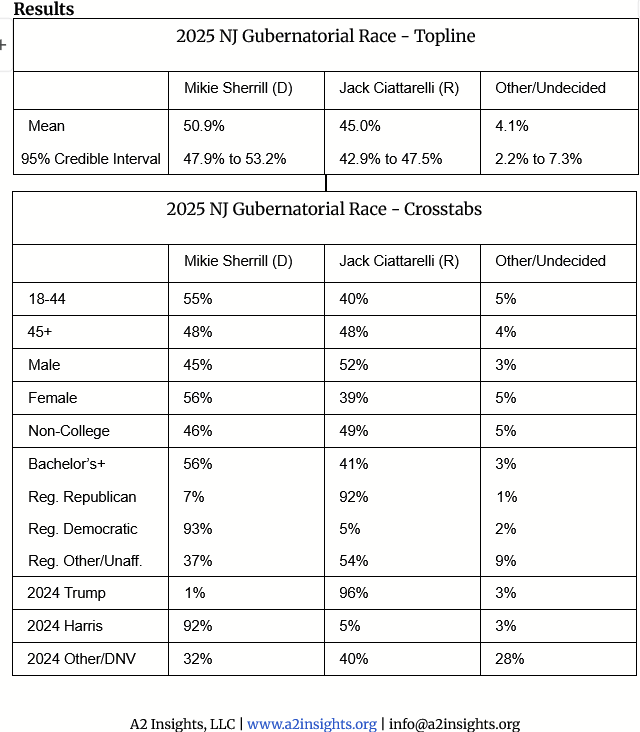
@JeremiahW2044 This poll still has Jack losing, even with a 17 point favor with the unaffiliated. Without major inroads with the young, women and the 'not likely voting' block, he will lose. We can't take our foot off the gas pedal.
We can't fall into a false sense of security. The bigger picture on that poll still has Jack behind. If he doesn't make inroads with the young, women and the 'not likely voting', he won't win. He needs to take the gloves off and start his scorched earth media campaign. Were there any Jack commercials during the Giants game? I don't recall....and that's a problem.
The President’s War Power Isn’t a Debate. It’s a Design.
For the umpteenth time, America’s commentariat is in full fainting-fit mode because the president ordered force without first convening a toga party in Congress. Apparently, to hear them tell it, the Commander-in-Chief is required to ask Nancy Pelosi or Mitch McConnell for a signed permission slip before launching so much as a patrol boat. This is constitutional illiteracy masquerading as moral concern.
Article II of the Constitution is not subtle. “The executive Power shall be vested in a President.” Not some of it, not the decorative kind—the executive power. That includes command of the armed forces. And the Commander-in-Chief clause has never meant “the commander-in-chief of nothing until the Senate finishes arguing.” Jefferson didn’t think so when he sent the Navy against Barbary pirates. Lincoln didn’t think so when he blockaded Southern ports before Congress could stir itself. Clinton, Bush, Obama—all used force without a formal declaration of war. Not one impeachment followed, though the op-eds flowed like cheap wine.
Enter Venezuela’s narcoterrorists. These are not a few unlucky fishermen with AK-47s. They are cartel-backed, state-abetted operators smuggling poison into the United States and laundering money through hostile regimes. They are, by every rational measure, a national security threat. And when a president orders the Navy to interdict them, he isn’t playing cowboy—he is fulfilling the very core of his constitutional role: protecting the Republic from foreign predators.
Critics, of course, mumble about “overreach” and “escalation.” Spare us. The Constitution does not require the president to wait for a 535-member committee to decide whether foreign gangs should be allowed to ship fentanyl into Miami. Congress has the power to declare war, yes—but war declarations have been obsolete since the phonograph. What it cannot do is micromanage the president’s duty to repel threats in real time.
So let’s be clear: the strike off Venezuela was not a violation of the Constitution. It was its vindication. The president acted as presidents are meant to act—decisively, unilaterally, in defense of American lives. If Congress wants to squeal, let them pass a funding cutoff. But unless and until they do, the Commander-in-Chief is not merely permitted to act against narcoterrorists. He is obligated to.
Sometimes the Constitution is not a straitjacket. Sometimes it’s a sword.
When a Judge Outlaws Common Sense
A federal judge recently ruled that Donald Trump’s decision to send the National Guard into Los Angeles—after mobs attacked ICE officers and torched federal property—was “illegal.” Illegal. As though the President is some rogue warlord for daring to defend his own government’s agents.
Let’s be clear: the Constitution does not treat the protection of federal officers as a presidential hobby. Article II obliges the executive to “take Care that the Laws be faithfully executed.” Federal statutes—from DHS’s authority to secure property to the Insurrection Act—back him up. In other words, the legal framework isn’t ambiguous. It is explicit. If local law enforcement collapses or refuses to act, the President must step in. That is the job.
And yet in Los Angeles, while officers were spat on, buildings smashed, and cars burned, local authorities preened and postured. The governor made sympathetic noises about “peaceful protest.” The mayor managed to be out of town. Police melted away. Trump sent in the Guard. For this, he is told by a judge that he acted outside the law.
But what law, exactly? Not the Constitution, which requires him to defend federal functions. Not the statutes, which authorise him to act when states won’t. The “law” here is the judicial imagination—a realm where mobs are rebranded as “provoked demonstrators” and presidential duty is redefined as presidential tyranny.
The logic is as perverse as it is predictable. In this telling, those who spit on federal officers are the victims, while those tasked with protecting them are the aggressors. Federal authority evaporates the moment a city council refuses to cooperate. The Republic itself becomes hostage to the veto of the most unserious officials in the land.
This is not jurisprudence. It is abdication masquerading as restraint. The judiciary pretends to safeguard liberty while in fact licensing lawlessness. What the ruling really declares is that federal agents may be beaten, federal property may be destroyed, and the executive must stand aside and watch.
The Constitution never envisioned such cowardice. It armed the President precisely to prevent it. Which is why the only real lawlessness here is not the Guard patrolling Los Angeles. It is a judge declaring the defense of the Republic itself to be a crime.
Accepting the Guard Is Refusing the Baseline
Every weekend, the headlines from Chicago, Baltimore, St. Louis look less like news and more like a weather report: forecast calls for scattered gunfire, high probability of funerals. We are meant to accept this cadence as normal, the “baseline” against which city leaders measure their competence. They never say it out loud, of course. Instead, they insist that refusing federal assistance—specifically the National Guard—is a principled defense of local autonomy. What it really is: political vanity purchased with working-class blood.
Let’s be clear. The National Guard is not a magic wand. Guardsmen are not detectives, nor are they social workers. They do not dismantle gangs, repair witness protection, or prosecute gun traffickers. But they do one thing that hollowed-out municipal forces cannot: they project presence. They stand on corners, patrol perimeters, and saturate neighborhoods with the visual, visceral fact of order. Call it deterrence, call it “eyes and ears,” call it a show of force—whatever the vocabulary, it is the one language that lawless men still understand.
Opponents dismiss this as militarization. A melodramatic word, designed to conjure tanks outside row houses and martial law on Main Street. In practice, the Guard’s deployment looks far more mundane: uniformed patrols, traffic checks, manpower that allows city police to focus on the investigative grind. That “mundane” presence matters. Even the most ruthless crew thinks twice when Humvees idle at intersections, when every alley has a pair of boots at the far end. Violence thrives on impunity, on the assumption that nobody is watching. Flood the streets with watchers, and the calculus shifts.
There is precedent. After Katrina, Guardsmen kept New Orleans from dissolving entirely. In Ferguson, in Minneapolis, in Washington, D.C.—whether loved or loathed—the Guard tamped down chaos that civilian forces simply could not contain. Was it perfect? Of course not. But perfection is a luxury Chicago families burying teenagers cannot afford. Deterrence that reduces shootings by ten percent is not an abstraction. It is fifty names never etched into headstones.
And let us puncture the grand lie: that saying yes to the Guard means conceding failure. Nonsense. It means conceding reality—that the present “baseline” is intolerable, and that every tool must be on the table. No mayor loses credibility by deploying help; they lose credibility by pretending they don’t need it while the morgues fill up.
Would the Guard solve root causes? No. Poverty, segregation, fatherlessness—these are decades-deep wounds. But rejecting immediate deterrence until utopia arrives is malpractice. It is governance by daydream. The first duty of a city is not to balance equity indices; it is to keep citizens alive long enough to argue about them.
So yes, bring in the Guard. Let them stand watch while the city rebuilds its competence. Let their presence buy breathing space—for cops, for courts, for kids who deserve to make it past 18. A baseline of blood is not destiny. It is a choice. And refusing the Guard is choosing to keep it.
Judges are not priests of their own little cults, though some are trying very hard to audition for the role. In his latest opinion within the recent NIH funding ruling, Justice Gorsuch fires off a reminder that should never have been necessary: district courts are bound by Supreme Court precedent. That is not a suggestion. It is the skeleton of the republic. Yet here we are, with federal judges citing dissenting opinions—yes, the losing side—and dusting off appellate rulings that this Court has already buried, as if constitutional law were some choose-your-own-adventure paperback.
Gorsuch names the disease plainly: anarchy. Not Molotov-cocktails-in-the-streets anarchy, but something quieter and more corrosive—the erosion of vertical stare decisis, the refusal of judges to accept that there is, in fact, a hierarchy in the federal judiciary. When a district judge decides he prefers the dissent over the holding, he is not “interpreting.” He is nullifying. He is, in effect, seceding from constitutional order.
And make no mistake: judicial activism dressed up as civil disobedience is still lawlessness. Imagine if every trial judge took it upon themselves to rewrite precedent based on their “better judgment.” What you would have is not a legal system but a Balkanized patchwork where the law in Boston is whatever one rogue judge feels in his bones that week, and the law in Dallas is whatever some other robe happens to think sounds just. That is not jurisprudence. That is chaos with footnotes.
The irony is almost too rich. Judges—those perennial scolds of “lawless” executives and “overreaching” legislatures—are now openly committing the very sin they claim to police. They read the majority, shrug, and quote the dissent like a talisman. As if judicial opinions were a buffet line, and precedent a matter of taste.
But the Constitution did not design a judiciary of philosopher-kings. It designed a hierarchy, one in which lower courts apply the law as declared, not as reimagined. Without that discipline, the system collapses. An “independent” judiciary becomes an insubordinate one. And the rule of law—already battered—takes another step toward being little more than a polite fiction.
Call it what you like: activism, freelancing, resistance from the bench. Gorsuch has the right word for it. Anarchy. And unless the Court reins it in, the republic’s vaunted “judicial order” will look less like a system of justice than a law school seminar run amok.