SAUDI ARABIA HAS REOPENED ITS ESCAPE ROUTE FROM HORMUZ.
The East-West Pipeline is moving crude again after a drone strike shut it down for over a week.
But the attack exposed the deeper risk:
A backup route is not resilience once the war can reach it too.
TRUMP JUST ACKNOWLEDGED THAT UKRAINE’S REFINERY CAMPAIGN IS WORKING.
He says Russia has “lost control” of its diesel industry after numerous refineries were blown up or forced offline.
Six days ago, he announced an energy truce.
It never reached the battlefield.
RUSSIA MAY TEST NATO WITHIN MONTHS—NOT YEARS.
European intelligence officials warn Moscow could use drones, missiles, a limited incursion or a false flag to test whether Article 5 is real.
The target would not be territory.
It would be NATO’s willingness to fight.
Six days after Trump announced an energy truce, Moscow’s main refinery is burning.
Ukraine reportedly launched 1,600+ drones, hitting a facility that supplies over a third of the region’s fuel.
Oil markets open in 10 hours. The truce never reached the battlefield.
@Polymarket Denmark keeps sovereignty on paper. Washington gains permanent control over the security of the Arctic’s most strategic territory.
The flag stays Danish. The balance of power does not.
The Houthi war is no longer contained to Yemen or the Red Sea.
The State Department is urging Americans in the Middle East to remain vigilant—and those outside it to reconsider travel—after attacks on Saudi cities and civilian airports.
The risk is now regional.
Global trade looks stronger than it is.
AI is hiding the damage.
Trade in AI-related goods surged 42% in the first quarter of 2026.
Everything else grew just 7%.
That gap explains why the global economy still appears resilient despite tariffs, disrupted shipping routes and an energy war pushing oil above $100.
Two economies now coexist.
One is ordering semiconductors, servers, networking equipment and the machinery required to build data centers.
The other is absorbing higher fuel costs, protectionism and increasingly fragmented supply chains.
The AI economy is expanding quickly enough to conceal the weakness of the second.
That is why the WTO’s warning matters.
If technology investment slows, global trade will not simply lose one fast-growing sector.
It will lose the shock absorber currently offsetting disruption elsewhere.
The contradiction is strategic.
Governments increasingly describe AI as a national-security industry that must be localized and protected.
But the boom depends on one of the most international supply chains ever constructed: Asian fabrication, American design, European equipment, global minerals and enormous quantities of energy.
The policies designed to secure AI could eventually fragment the same trading system that makes its expansion possible.
For emerging economies, the opportunity is real but uneven.
Countries can supply copper, electricity, data-center sites and industrial inputs. But unless they capture engineering, software and capital, they may remain the raw-material layer of someone else’s technological boom.
AI is not proving that globalization remains healthy.
It may be temporarily concealing how much of it is already weakening.
The question is what global trade looks like when the servers stop carrying the rest of the economy.
Rogue Signals
Tracking second-order effects.
Mecca may have just entered the battlefield.
Saudi Arabia says it intercepted a Houthi drone south of Islam’s holiest city before it entered restricted airspace. The Houthis deny targeting Mecca.
The drone never reached the city.
But the red line has already been tested.
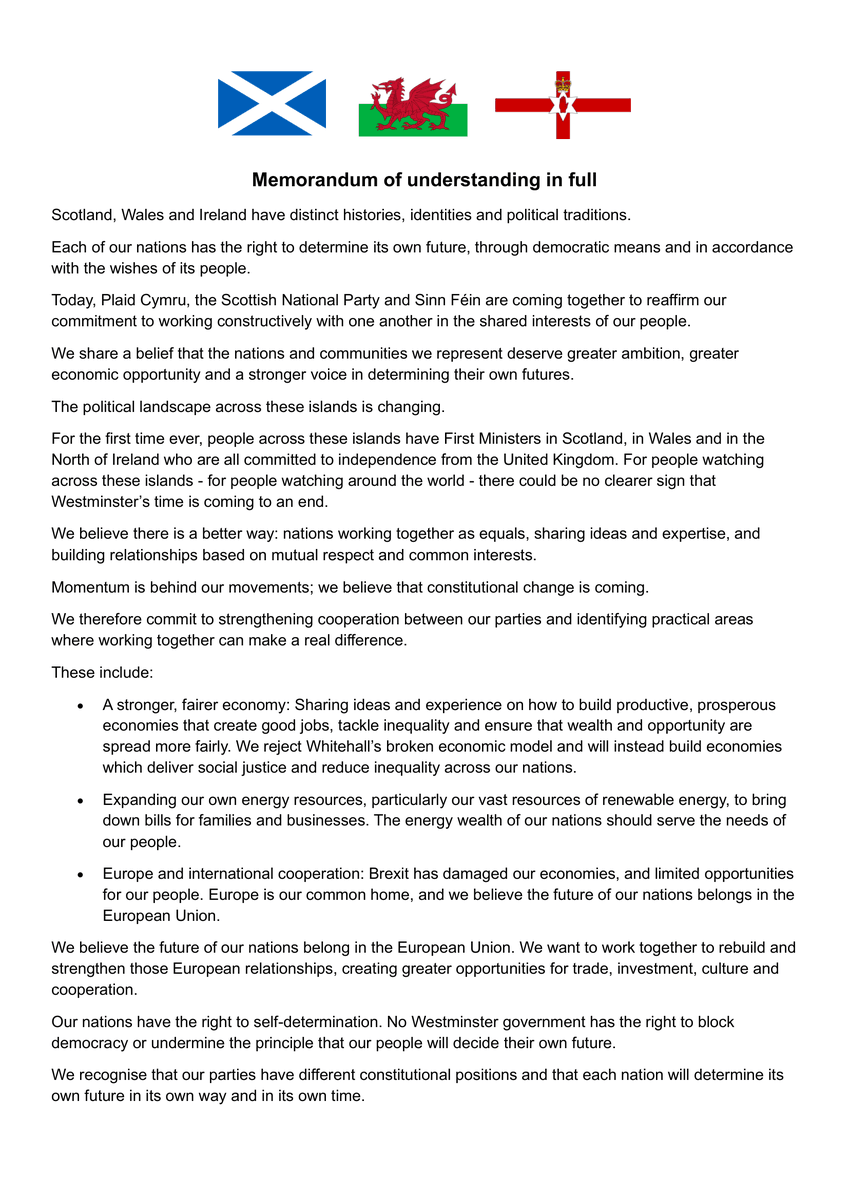
@PolitlcsUK Three nations, three different paths, one message to London: the United Kingdom can no longer take its unity for granted.
Scotland wants another referendum, Wales is building its movement, and Northern Ireland is looking toward reunification with Ireland.
Three nations, three different paths, one message to London: the United Kingdom can no longer take its unity for granted.
Scotland wants another referendum, Wales is building its movement, and Northern Ireland is looking toward reunification with Ireland.
🚨 NEW: The leaders of Scotland, Wales and Northern Ireland say the future of their nations "belongs in the European Union" as they call for independence from the UK
The UK is being challenged from three directions at once.
Parties that want to leave the union now lead Scotland, Wales and Northern Ireland. They are joining forces to demand a legal path for constitutional change.
Britain is not breaking up yet.
But this is no longer a local revolt.
Boris Johnson may have escaped a Russian drone strike by minutes.
The drone hit a train near Poland shortly after his delegation passed. Former CIA chief David Petraeus was aboard another train nearby.
Ukraine suspects the diplomats were the target.
That remains unconfirmed.
The next weapons lab may be a laptop.
Anthropic says a cell in Houthi-held northern Yemen used Claude Code to develop guidance software for rockets and missiles—and built an offline simulation toolkit.
The rocket test failed.
The knowledge transfer did not.
@Reuters Saudi Arabia built a route to bypass Hormuz. Now that alternative is also under pressure. A backup route is not resilience if the same war can reach it.
Saudi Arabia built an oil pipeline to bypass the Strait of Hormuz.
A drone attack has now shut it down.
At the same time, the Houthis have reached Mayun Island inside Bab el-Mandeb, the maritime corridor linking the Red Sea to the Indian Ocean.
The original logic was straightforward:
If one chokepoint fails, another route keeps exports moving.
But redundancy only works when the alternative remains outside the conflict.
The East-West pipeline can carry roughly 4–5 million barrels a day toward the Red Sea. It was designed as Saudi Arabia’s insurance policy against a Hormuz disruption.
That insurance policy is now exposed.
Washington says Iran was probably behind the strike. Baghdad is investigating. The attribution remains contested.
For markets, uncertainty can be nearly as disruptive as certainty.
Tanker rates rise before a blockade is declared.
Crews hesitate before a route is formally closed.
Insurance reprices the entire corridor, not just the damaged facility.
The second-order effect is larger than the temporary loss of one pipeline.
Hormuz, Bab el-Mandeb, pipelines, terminals and shipping insurance are beginning to function as one risk system.
Energy security will require more than a second route.
It will require dispersed storage, protected infrastructure and enough shipping capacity to absorb a prolonged diversion.
A bypass is not resilience if the war can reach it too.
Rogue Signals
Tracking second-order effects.
An explosive-laden drone was found near a Ukrainian aircraft at Leipzig Airport.
Germany blamed Russia.
Berlin closed Russian diplomatic sites. Moscow retaliated by closing Germany’s consulate in St. Petersburg and its Goethe Institutes.
This is not open war.
It is hybrid conflict: sabotage, deniability and retaliation kept below NATO’s threshold.
Meanwhile, AfD—calling for less support to Ukraine and warmer ties with Moscow—just won 44% in Saxony-Anhalt.
Russia is pressuring Germany from the outside.
The political backlash may weaken its resistance from within.
Rogue Signals
Tracking second-order effects.
Fighting armed groups is a duty of the state.
Displaying their bodies is a political choice.
Twice in four days, Colombian President Abelardo De La Espriella appeared before the bodies of people killed in security operations.
First came 23 alleged FARC dissidents in Guaviare.
Then four more bodies in La Guajira, accompanied by a warning: those who refuse to surrender will “end this way.”
An operation can be lawful while its presentation remains dangerous.
Two models of security are competing.
One measures territory recovered, commanders captured, financial networks dismantled and civilians protected.
The other measures bodies—and turns their display into evidence of presidential strength.
There is no public evidence that these deaths were extrajudicial.
But the second-order risk begins when body counts become a political performance. Security institutions then acquire an incentive to produce more deaths, more images and more fear.
Colombia already knows the danger of measuring success in war by the number of people killed.
A democracy can confront violent groups without turning the dead into scenery.
Force demonstrates capacity.
Restraint reveals what kind of state controls it.
Rogue Signals
Tracking second-order effects.
@Kalshi 162,000 jobs is good news for workers—and potentially bad news for borrowers.
With unemployment at 4.1%, the Fed has more room to keep rates high.
The same report that signals resilience could delay relief on mortgages and credit.
@unusual_whales To afford that three-bedroom without spending more than 30% of income on rent, a household would need to earn nearly $490,000 a year.
That is the real headline.
$NVDA just bought the closest thing open AI has to a public square.
The chipmaker will pay $12.93 billion for Hugging Face, the platform where more than 18 million developers share models, datasets and applications.
Nvidia says it will remain open.
It will support multiple clouds and will not require developers to use Nvidia chips.
That promise matters.
So does the new ownership.
Nvidia already supplies much of the computing infrastructure on which modern AI runs. Hugging Face gives it influence over where developers discover models, how they deploy them and which hardware integrations appear easiest.
Two forces are colliding.
Open models reduce dependence on proprietary laboratories such as OpenAI and Anthropic.
But their most important distribution platform will now belong to the industry’s dominant hardware supplier.
Nvidia does not need to exclude competing chips to benefit. Defaults, optimization tools and preferred integrations can direct computing demand without closing the platform.
The second-order effect is vertical control over the AI stack.
Nvidia can supply the processor, connect the data center and own the marketplace where developers choose what to run.
Hugging Face may remain open.
The strategic question is whether an open ecosystem can remain neutral after its central platform becomes part of the company that profits from nearly every additional computation.
Rogue Signals
Tracking second-order effects.