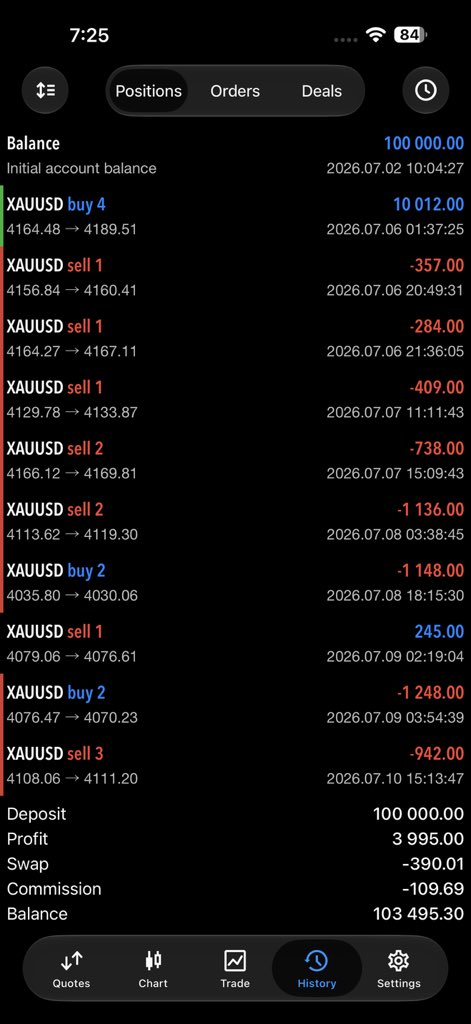
I took my first trade on a $100K FTMO account on Friday, risking 2% ($2,000) with a 10% ($10,000) target. The market closed 4 hours earlier than usual, so I had to hold the position over the weekend.
On Monday, my TP was hit within 20–30 minutes of the open, but because of roughly $300 in swap charges, the account finished just short of the 10% target.
Instead of waiting for another clean setup, I tried to recover that missing $300. I took a loss, and over the week I slowly gave back around $7,000, bringing the account down to about $103K.
A small gap to the target can become a bigger psychological challenge than the target itself. That’s why I prefer passing challenges in one or two trades whenever possible.
No excuses lesson learned, and I’ll hit that 10% target soon.
Have you ever gone through a similar situation? Let me know in the comments.
I wrote a Muslim children's story book about honesty and Taqwa.
Perfect for the child who takes things and lies about it, and the parent who has tried everything to stop it.
Shop at https://t.co/fYJrrsxjk5
Guys, I'm tired. Are you not tired of this upskilling thing? Can I pleasee get a job with the ones I have first. Learn this one, it's become saturated, learn another one, same thing, and it goes on and on.
Please nauuuu.
Many corps members are active every day but inactive about their future.
And that is the dangerous part.
You wake up early.
Wear khaki.
Go to PPA.
Gist with other corps members.
Attend CDS.
Collect allawee.
Sleep.
Then repeat the cycle for 12 months.
You are moving every day, but your life is not necessarily moving forward.
That is why many people become shocked after POP.
Because NYSC can easily create the illusion of progress.
You feel busy.
You feel occupied.
You feel like life is happening.
But deep down, nothing strategic is being built.
No skill.
No network.
No visibility.
No leverage.
No experience outside the PPA routine.
No intentional direction.
And unfortunately, the job market is ruthless and brutal
Nobody is going to hire you because you “suffered during service.”
Companies care about value.
Business cares about value.
The market rewards value.
That is why I keep telling corps members this:
Your service year is one of the cheapest years of your life to experiment.
You still have a small safety net.
People still give you grace.
Mistakes are still somewhat forgiven.
Use that period well.
Learn a skill.
Volunteer somewhere strategic.
Build relationships.
Start posting online.
Learn communication.
Take online courses.
Teach.
Sell.
Network.
Shadow people.
Ask questions.
Try things.
Because once POP happens, life becomes extremely practical very fast.
I have seen corps members waste one full year waiting for NYSC to end before they “start life.”
Then suddenly everybody is applying for the same jobs with the same CV and the same confusion.
Your NYSC year should not just be a transition phase.
It should be a positioning phase.
If you are currently serving or preparing for NYSC, I’m putting together a free webinar for corps members and fresh graduates on:
* choosing the right PPA,
* using NYSC strategically,
* career growth,
* visibility,
* skills,
* and how to avoid wasting your service year.
Comment NYSC and I will send you link to join the waitlist.
I have never left any sales role with the expectation that my customers would automatically follow me to my new employer.
Whenever I move, I move with the mindset of starting from ground zero. That mindset has never failed me.
Customers may promise to move their business to your new organisation, but when the time comes, many of them will drag their feet. It is not always because they do not value your relationship or because you were not good at your job.
Sometimes it comes down to market dynamics, brand perception, product offerings, pricing, or internal business considerations. These factors can influence their decision regardless of how strong your relationship is.
Even the employers you tell during interviews that you will bring customers along know that there is no guarantee. What they really want to see is confidence, experience, and your ability to win business.
So when you attend interviews, be bold. Speak confidently about your achievements. Share your numbers. Leave a strong impression. The first objective is to get the job.
Once you get the job, show willingness to work. Show enthusiasm. Put in the effort. Those are the things that prove hiring you was the right decision.
As you keep showing up every day and doing the work, the results will come.
I am saying all these with confidence because I have been through it myself. It worked for me, and I want you to succeed.