My Path
This is the first hot market I have missed in 6 years I think.
I was gone on vacation for 1 month and really thought about the way I want to approach trading and my life path going forward.
__
The result:
I do not want to be actively trading anymore. I do not want the stress, the time involvement, the volatility, the toxic competition.
I want to compound and work/live around people I respect and love. I want those around me to prosper and the cake to get bigger for all, not for the piece to get bigger because I thought my friend for it (day trade vs investing/ finite vs infinite mindset)
It is hard to cut the ties because it is who I was for the past 10 years, however what is my goal and my position?
When everyone you traded with your entire career is still trading and they do so within a group, it is extremely easy to conform to the social pressure (be it hidden or not).
__
Why did I trade
At my core, I wanted freedom which is what money gave me. I had nothing to lose, no lifestyle, no expenses... I was young, hungry to prove people wrong and gain my freedom through it.
I reflected on it all and I found a few answers.
I have freedom✅
I have the lifestyle I want ✅
I do not need to make it twice ✅
I live a stress free life(as much as possible)✅
I want more time to think and learn🚫?
Continuing to trade does not provide me a better life, heightens my stress, reduces my freedom through the time involvement and increases the risk of a black swan.
I am in a different situation than others and thus had to truly reflect on why I am doing what I am. Even the biggest traders I know continued to trade past success, however none of them knew how to invest or even had the remote interest to do so.
I saw 9fig trades blow up and also nearly blow up. Does it need to be me?
__
Resolution
My passion is not trading, it is the markets, it is the game, the quest for new mastery of a craft. I do not need to be actively trading to continue this path.
Instead I want to manage my portfolio for legacy. I want to compound and be in the game in 50y.
I am 23y old at this time and I have the biggest asset any super investor would want. Time to compound.
I will be continuing to learn from the masters out there like Buffett, Smith, Ackman and alike and aiming to match the ~15% per year returns. Additionally I will be investing/trading with a layer of pyramiding risk management as taught by Druckenmiller and Soros to maximize returns.
Trades, should I take any, will all be based around this philosophy:
"I will refrain from engaging in trades where an unfavorable shift against my position presents a more favorable opportunity, recognizing that it is within these realms that the elusive black swan resides."
__
All my biggest losses and most stressful positions started as small positions, followed by adds while losing and I kept on being proven wrong.
The truth is you can not truly eliminate these situations from happening if strategies are build around reversion. You can stop out, however you will stop out in the spot that has better odds than the one you entered at.
Thus the more you are wrong, the more enticing the opportunity. You are constantly fighting between bad risk management and Win rate and it creates a heightened black swan potential and a shift in win vs losses distribution.
__
🚫Reversion trades: Dip buys, parabolic shorts and capitulation trades.
✅Trend trades: Breakouts, EP, Investing
The overall shift in trading approach will get rid of high win rate strategies, but will focus on strategies based on RR. Risk-reward is where pyramiding reigns king and thus my expertise.
If I am right, I get the right to maximize positions to huge gains, if I am wrong I will take my small losses. A peaceful life.
__
Bottom line
This new approach will allow me to focus on what truly matters and will be united with my values.
I will:
- not be exposed to career ending losses
- have time to learn (even outside of the stock market)
- use compounding as my closest ally
- allow for alpha to be captured
The hardest part about this all is to let go of preconceived notions, to walk my own path despite all my friends and trader friends walking another path and despite the countless conversations, messages and alike I get multiple times per day.
My success comes from the ability to do what other will not do.
First in small caps reading SEC filings and using data when none did. Second by learnings about macro and investing and 3x my account during the 2022/23 recovery.
Now it is time to adjust once more to the liquidity profile and overall goals and just like these prior paths, I will have to start walking alone.
The strategy will revolve around quality investing traded with a Druckenmiller/Soros risk management(pyramid) and accompanied by the alpha the select breakout opportunities will provide throughout time.
This will lead to a long term compounding effect with alpha being used to start new compounding positions.
Writing this out allows me to be more structured in my thoughts and this approach and I hope this now explains how I will proceed.
I do not want to close the door on trading, however this is for now, the journey I will embrace.
No reason to avoid facing reality.
We are breaking down.
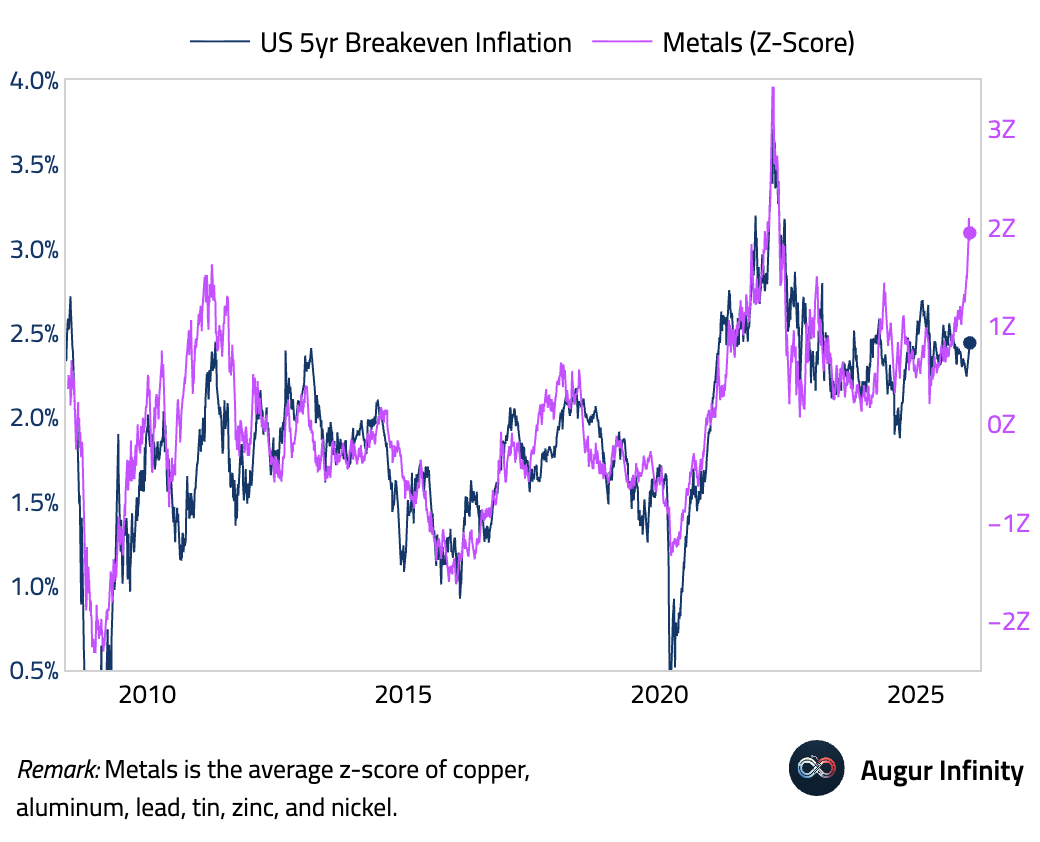
That said I wouldn’t write off anything until we see metals top.
We are talking about trillions of dollars that will likely rotate.
It is not random that we see metal go parabolic with a monthly 95 RSI while crypto breaks down.
If I had to guess metals top, crypto cracks lows and flows make crypto reverse higher as metals take a few months to years breather.
Don’t believe moves until metals top.
During massive liquidation events in specific asset classes the entire market flows to accommodate this asset class.
It is only when the panic subsides that the rest has a chance at organic action.
I’m not even suggesting metals have to top forever, I’m more so making the point that extreme moves trigger portfolio rebalancing, require higher margin requirements, create irrational behavior…
Under such conditions trying to console other asset classes simply won’t bear fruit.
I’m especially thinking of Crypto here that could be touching some of the inflationary bid but instead has been beaten down.
As panic sets in metals those deeply red or tired of slow movement are selling and succumbing to the sweet taste of FOMO.
Little do they know the taste will likely be bitter in the end.
In the majority of cases moves happen like the smart money is positioned for, it is the extremes that are very hard to foresee where leverage gets wiped and resets for the next fresh positioning happen.
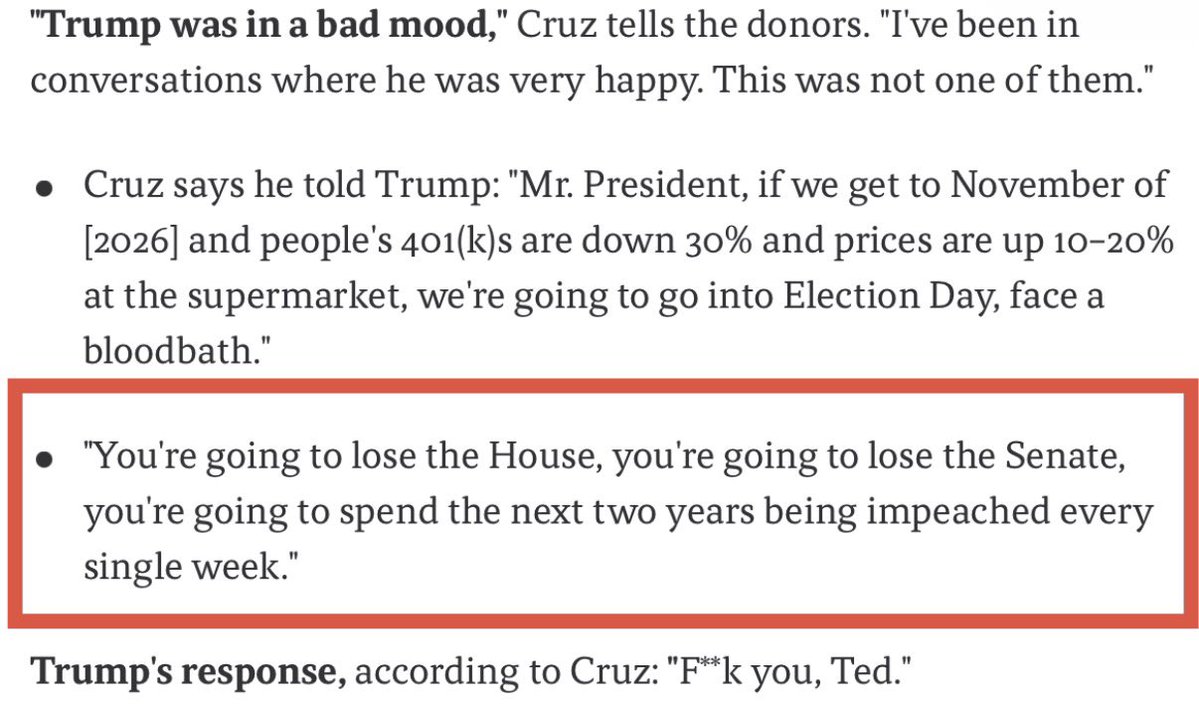
BREAKING: In secret recordings, Senator Ted Cruz reportedly “trashed” President Trump on tariffs, per Axios.
"You're going to lose the House, you're going to lose the Senate, you're going to spend the next 2 years being impeached,” Cruz said.
Trump’s response: “F you, Ted.”
Crypto as the Next Safe Haven?
By the end of this decade, crypto could emerge as the ultimate safe-haven asset.
Historically, 80–90% of crypto ownership has been retail-driven, with institutional participation remaining marginal.
Even today, despite ETFs and regulatory progress, long-term institutional ownership of Bitcoin is estimated at only ~15–25%, with Ethereum even lower at ~10–15%.
Pension funds, sovereign wealth funds, insurers, and endowments remain structurally under-allocated.
As ownership shifts, behavior follows.
We are already seeing early signals of this transition. The recent surge in bond yields, expanding fiscal stimulus, and mounting sovereign debt pressures have triggered a powerful rally in precious metals. This is not merely inflation hedging. It is a crisis of trust in sovereign debt, real yields, and long-term monetary credibility.
Crypto, and Ethereum in particular, stands alone as the only asset class that combines a true structural trifecta:
•Sovereign-less neutrality
•Real yield via protocol-level burn and fee mechanics
•Inflation-adjusted growth driven by network adoption
Even gold and silver, while historically reliable stores of value, remain physically constrained, costly to transport, and vulnerable to regulatory intervention, export controls, and capital restrictions.
Political leaders may pledge fiscal discipline and monetary stability, yet recent history suggests the opposite. In a world defined by geopolitical competition, demographic pressure, reindustrialization, and security-driven spending, structural deficits and monetary expansion appear unavoidable.
Ethereum, specifically, offers something fundamentally different.
It enables global capital to move outside political pressure, transparently reflects real monetary debasement, and provides native yield through the most secure, liquid, and programmable financial network ever created.
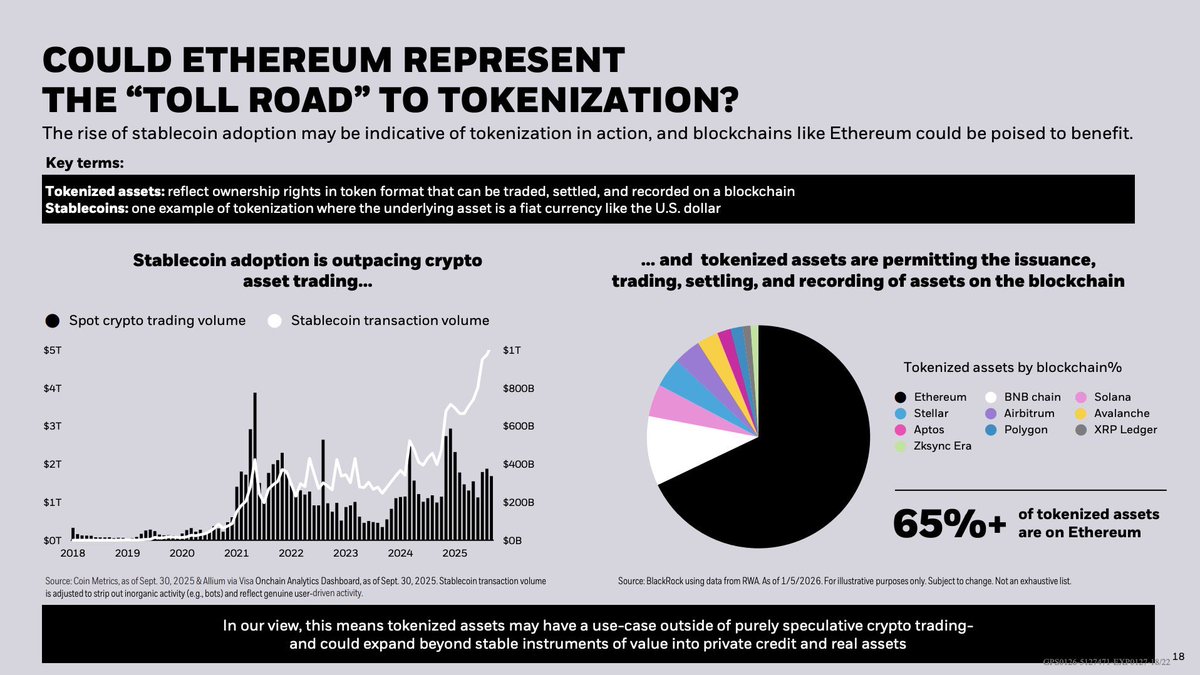
As tokenization, stablecoins, and decentralized financial infrastructure expand, Ethereum’s role as the settlement layer of the global economy becomes increasingly embedded. This creates a powerful structural demand tailwind.
In a world of rising geopolitical risk, deteriorating sovereign balance sheets, and eroding trust in fiat stability, crypto, and especially Ethereum, is positioned to be repriced entirely: from a speculative high-beta asset into a sovereign-less, yield-bearing, global safe-haven instrument.
This dynamic is not theoretical.
We have already observed its early form in emerging markets, where crypto adoption has long served as a hedge against capital controls, currency debasement, confiscation risk, and political instability. In these regions, crypto is not speculation. It is financial survival.
Now imagine this flow expanding from emerging markets to the entire global system, as tensions between the U.S. and the rest of the world intensify and monetary debasement accelerates into a full-fledged sovereign debt crisis.
I see no credible alternative.
Gold and silver have already repriced violently, moving hundreds of percent over the past cycle. They are signaling a profound structural shift in capital allocation and trust.
While crypto investors have been forecasting versions of this paradigm for years, this is the first time that the West itself is being forced to confront it, and at exponential speed. Unlike emerging markets, where monetary instability is cyclical, the West has operated under the assumption of permanent financial credibility. That assumption is now being challenged.
If the scale of the U.S. monetary system and the vast network of dollar-denominated trade, reserves, and financial infrastructure, begins to fundamentally question the integrity of the system, the resulting capital flows could be historic.
It is a regime change.
There may still be time to stabilize and rebalance, but doing so will be extraordinarily complex, politically constrained, and structurally difficult.
Feedback?
Tariffs and the U.S. Position thoughts.
The problem with “100% tariffs or else” is that, eventually, a country will become so frustrated by constant pressure, coercion, and perceived disrespect that it will choose pain over submission.
When that moment comes, the entire world will be watching.
If that transition proves anything short of an outright disaster, it could trigger a broader domino effect. Others will realize that economic independence, even at short-term cost, is survivable. And once that realization sets in, leverage shifts.
The deeper issue is the United States’ reserve-currency privilege. This status has long kept borrowing costs artificially low and positioned the dollar at the center of global trade, finance, and power. But that privilege rests on trust, cooperation, and systemic stability.
Recent studies show that roughly 96% of tariffs are ultimately paid by U.S. consumers, not foreign exporters.
The consequences are compounding:
•Deteriorating business conditions via reduced imports and exports
•Strained relationships with key allies
•Strengthening economic ties among non-U.S. blocs, particularly with China
•Increasing geopolitical aggression as pressure builds
•A structurally weaker dollar, higher debt burden, and rising bond yields
This is precisely the type of macro backdrop that invites further U.S. credit downgrades.
Europe and especially Canada have effectively reached a breaking point. While their business ties with the U.S. remain far stronger than with the East, geopolitical decisions are not always driven by pure economic rationality. Political pressure, public sentiment, and national pride matter.
At the same time, India, China, Brazil, and Poland are reducing U.S. Treasury holdings and increasing gold reserves.
That is what the metals market has been signaling all along.
Many still believe the U.S. does not need the world. In reality, U.S. prosperity has been built on global capital flows, foreign demand, and the willingness of others to finance American debt.
The United States remains the epicenter of global capital markets. But its greatest asset, stability, is eroding rapidly.
America provided the world with the deepest capital markets and security guarantees through NATO. That system created decades of growth and prosperity.
Tariffs changed from incentivizing discussion and fairer terms for all to an ultimatum for all.
It works until someone would rather endure pain than humiliation. A lot would be repaired if dignity and appearances alone would be part of equation. Just like the US does not want to look weak, so do other countries.
This is the most dangerous I have ever seen the world. We had decades of stability, I hope we can get a few more.
Global instability is something we should avoid at all cost. Any US debt linked issues would trigger a worldwide recession and likely some sort of war.
This influences all of us in the US and abroad.
We need each other.
We need to fix relations now.
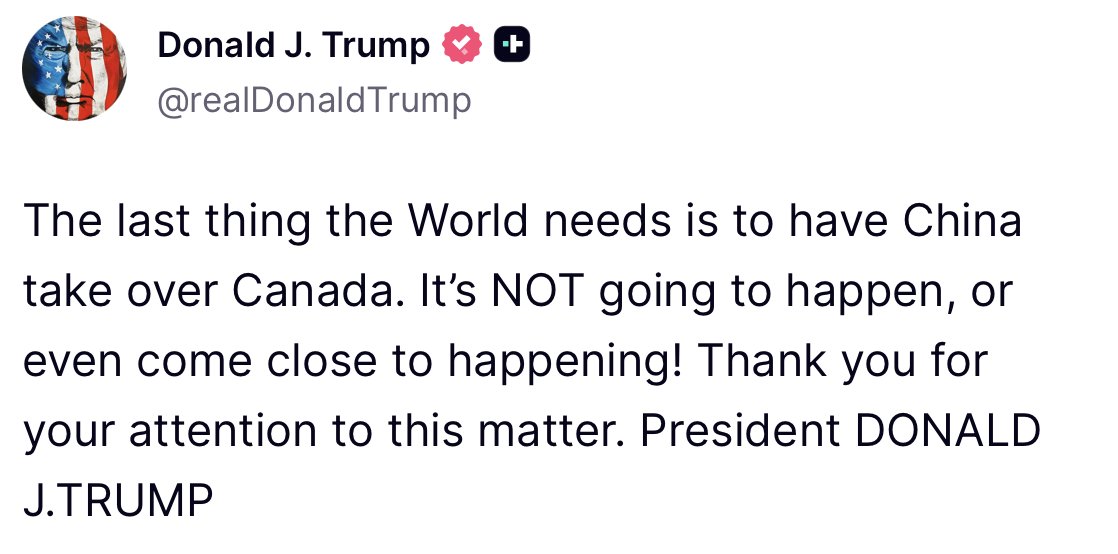
"The last thing the World needs is to have China take over Canada. It’s NOT going to happen, or even come close to happening! Thank you for your attention to this matter." - President DONALD J. TRUMP
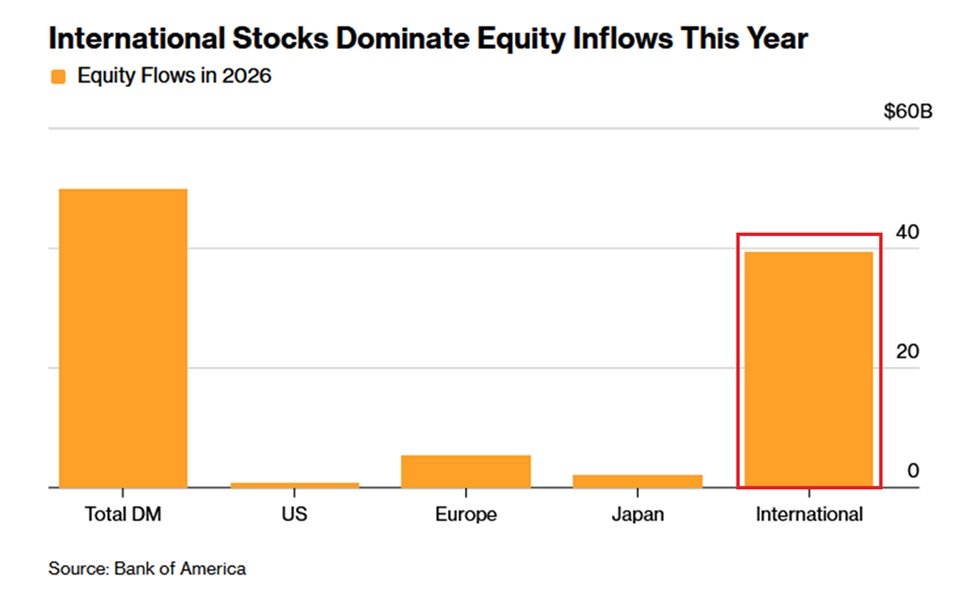
International stocks are seeing massive inflows:
Total developed market equity funds have attracted +$50 billion in net inflows year-to-date.
International stocks captured +78% of the total, at +$39 billion.
Investors also invested +$5 billion and +$2 billion into European and Japanese equities, respectively.
By comparison, the US has posted just +$771 million in inflows.
In other words, international stocks attracted 50 times more inflows than US stocks so far in 2026.
Demand for international stocks is surging
Never ever seen so much hate in the comments.
Everyone an expert today and everyone is long.
Makes me want to step right back in monday.
99% long inexperienced traders thinking they know best with their 3 shares of metals.
People need to understand I don’t give a shit about one trade. Yes I’ll be mad, yes I’ll let an out a loud “fuck”… then I do my review, I see if I made mistakes, I get my lessons, I rectify and I move on.
Monday I’ll be back at the desk, I’ll still outperform and I’ll still be in market wizards.
Everything is hindsight on here nowadays. Sad.
I took 6k+ trades in my career, I don’t care about one.
All out.
-13% on Silver, that's it, took it off.
Short from mid 93s, out 102s equivalent.
Still think overall the trade is valid and data backed, simply did not work and big size did the rest.
Prior $GLD and $SLV gains along the way account for 55-60% of this loss, so effectively lost 6.5% across the trades. (or gave back around $SNDK trade equivalent alternatively depending if you want to go by year or by asset class)
Historical times, as extended as in 1980, 50y ago, backed by ema extension data, time spent over ema, volume and more.
Still no dice.
If I had to take it again I'd be a bit smaller to begin and scale better but overall would not do much different.
Basically decided to take the hit to make it a big slap rather than something that could change my path and long-term plan.
The focus remains latin america and Ethereum and I cant let stubbornness or a martingale stop me from letting these evolve.
This is likely lower in a short period but I will say I could also see something different happen. inventories are running low quickly, at 4-5%+ pace each day.
China price premium is leading to a massive outflow and I am hearing of big banks like UBS stuck short with major size. As these shorts are covered, retail chases and major nations stockpile, there is a chance we could completely detach and see a quick move into 130+.
That is the flip side of this bet and what I want to avoid.
We are going into the weekend, over 100$, with a massive volume big green bar, the risk you take on over the weekend is massive if you aren't structured with upside protection.
The worst case I see is a sort of 108-112 gap up and spray into 120s+. Likely? Not the likeliest path, but possible and even a 10-20% chance is not worth giving up on the major longer term compounding journey.
Again make no mistake, longing here is playing with fire. Data indicating prior instances lead to 30%+ losses over the next mid term period with strong 15%+ losses within weeks.
NEXT!
Retail investors are piling into gold and silver funds at an accelerating pace:
Individual investors posted a +$95 million net inflow in the largest gold ETF, $GLD, on Tuesday, the largest since October 2025.
By comparison, the largest daily inflows in 2025 were in October and April, at ~$150 million.
Retail investors have net bought $GLD for almost every single day in 2026.
As a result, retail net inflows are up to ~$370 million YTD.
Meanwhile, silver-linked ETFs saw a record $922 million of retail inflows over the last 30 days.
The retail rush into precious metals is accelerating.
NEXT WEEK: We are partnering with the @CFTC to hold a joint event on harmonization and U.S. financial leadership in the crypto era.
The event, held at CFTC headquarters, will be open to the public and livestreamed on our website.
With silver approaching $100 ($96 now) it's worth noting that one of the rumors (that I've been hearing incessantly) helping to drive silver higher simply isn't true. Long-time followers know that I've been a precious metals bull for a very long time and I know the frenzied silver bulls won't like to read this, but this is important to know when sizing ones' positions.
"China has had a licensing regime in place for silver since 2019. However, a document issued in October by the Ministry of Commerce to extend that policy into this year and 2027 rattled investors, with some seeing it as a sign of new or increased restrictions.
Versions of that interpretation, during a period of market tightness, have helped fuel a rally that has lifted the white metal alongside gold — pushing it to a record above $95 an ounce.
Major exporters in China say there has not been a significant change in shipments since the document was issued."
https://t.co/CfHBdd8mCl
We are witnessing a historic structural dislocation between the COMEX (Paper) and Shanghai (Physical) markets. The arbitrage gap has blown out to ~$10/oz, incentivizing a relentless vault drain from West to East.
COMEX 'Registered' inventories have plummeted >70% since 2020 to critical levels (~82 Moz), leaving an estimated runway of just ~10 weeks before operational depletion at current bleed rates.
Expect coordinated interventions to intensify.
The CME and SGE have already hiked margins, mirroring the 'kill switch' tactics of 2011.
If the physical drain continues, we could see more drastic measures like 'Liquidation Only' orders or forced Cash Settlements. These are some options.
All in all expect measures to drop to try and maintain order in the silver market.
If the gap continues and depletion continues its hard to know where we will end.
This is a historical extension by any standards, but even a positive catalyst such as the Greenland deal could not hold it down.