NEW: Iran has not submitted a response to the latest US proposal as multiple mediators continue efforts to narrow gaps between the United States and Iran. Both US and Iranian officials said on May 21 that nuclear weapons and the Strait of Hormuz remain the two “sticking points” on negotiations. Iranian officials appear divided over potential nuclear concessions, especially whether Iran should send its highly enriched uranium (HEU) stockpile abroad. The reporting does not clarify the seniority of the Iranian leakers or clarify their motives, but the contents of the leaks about the alleged directive from Mojtaba and subsequent denials suggest disagreement within the Iranian regime over nuclear concessions.
Other Key Takeaways:
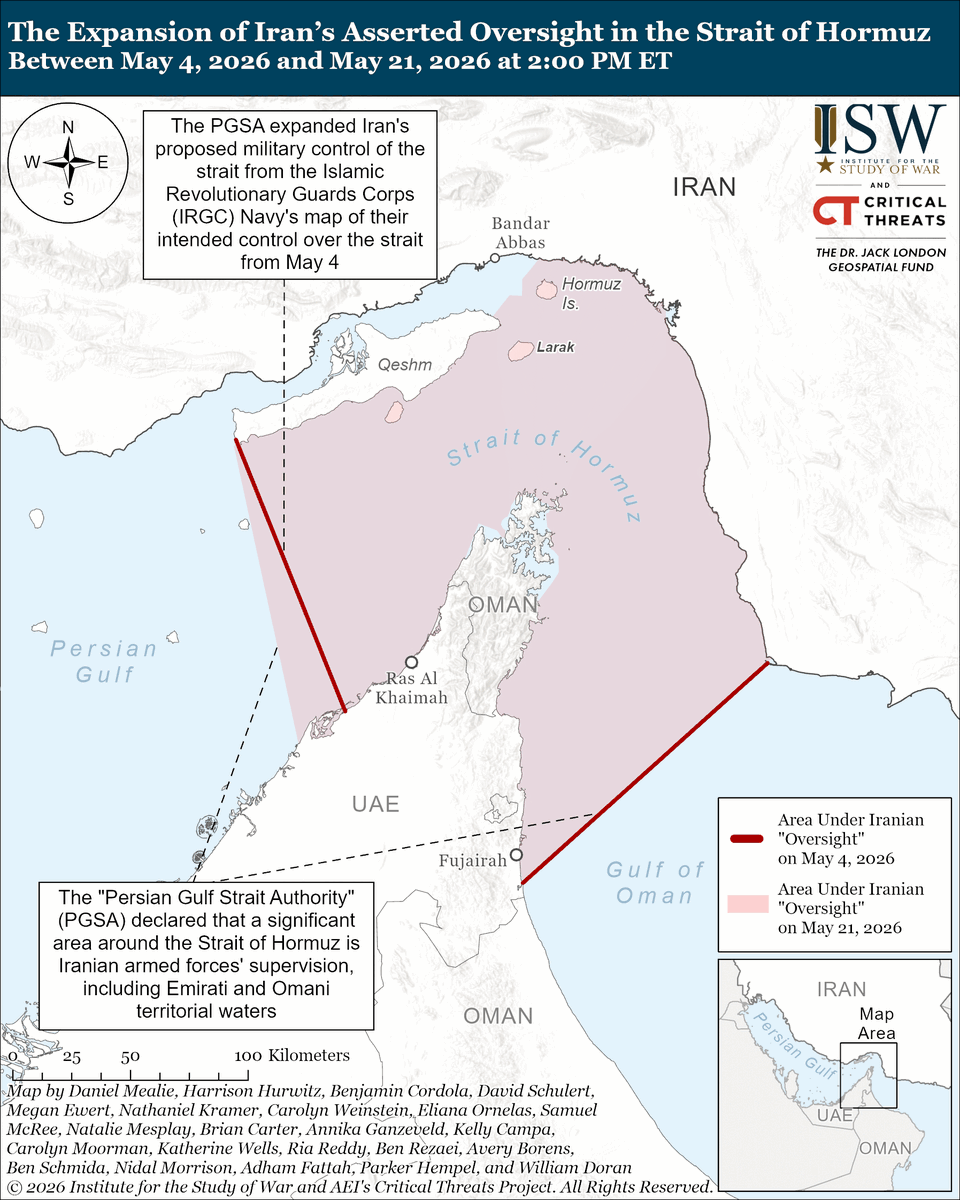
Iranian officials have coalesced around demands to formalize Iranian control over Strait of Hormuz transit, in contrast to their apparent division over the nuclear file. Iran’s demands over the Strait of Hormuz demonstrate that Iranian officials believe they won the war because formalizing Iranian control over the Strait of Hormuz is a territorial claim on the sovereign territory of another country.
Iran continues to attempt to build support for its protection racket in the Persian Gulf, in which vessels must pay, coordinate with, or receive permission from Iran’s preferred mechanism to transit the Strait of Hormuz in order to avoid attacks from Iranian forces.
Iran is continuing to use the ceasefire period to reconstitute its drone and missile program. Iran’s drone program is far more difficult to degrade for long periods of time compared to the ballistic missile program. The drone program relies on less complex and more easily-produced systems compared to the ballistic missile program, which requires huge facilities with extremely specialized equipment (like planetary mixers for solid fuel, for example).
The People’s Republic of China (PRC) and Russia are helping Iran reconstitute its drone and missile program. The PRC has sent missile components, according to US officials familiar with intelligence assessments, speaking to CNN. There is no evidence that these missile components reached Iran.
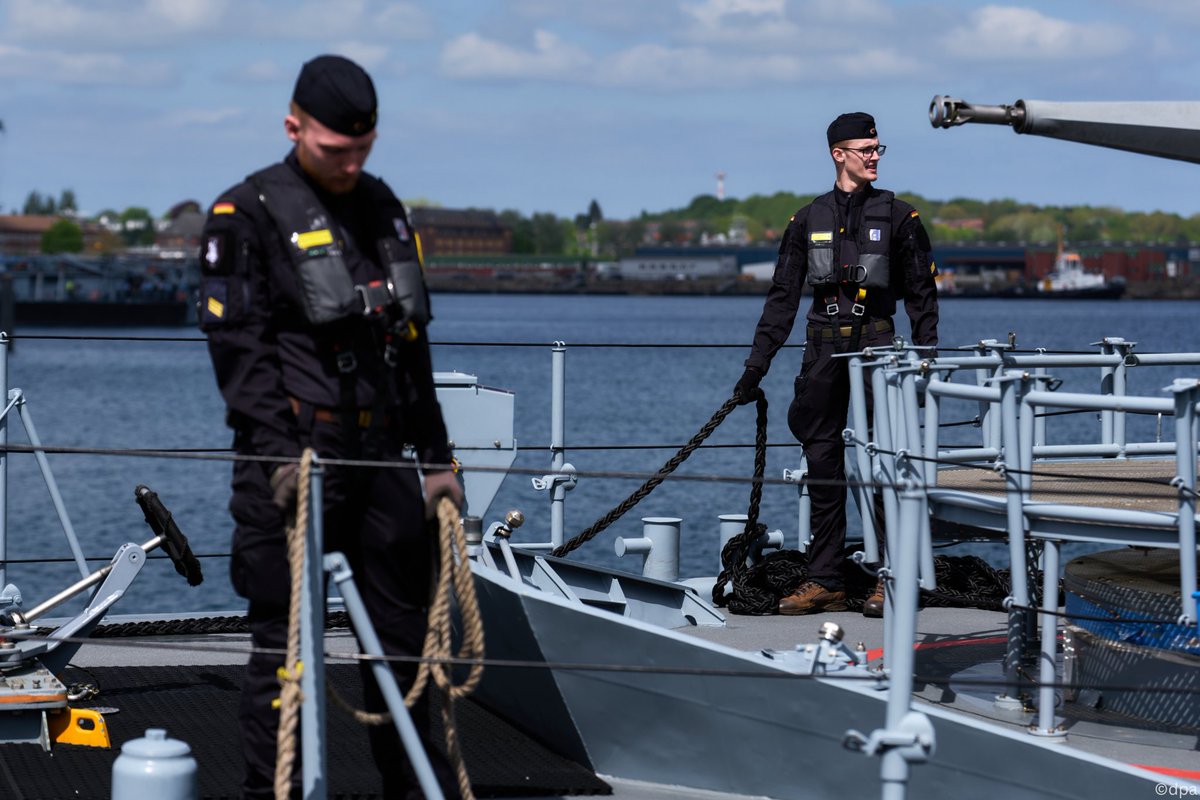
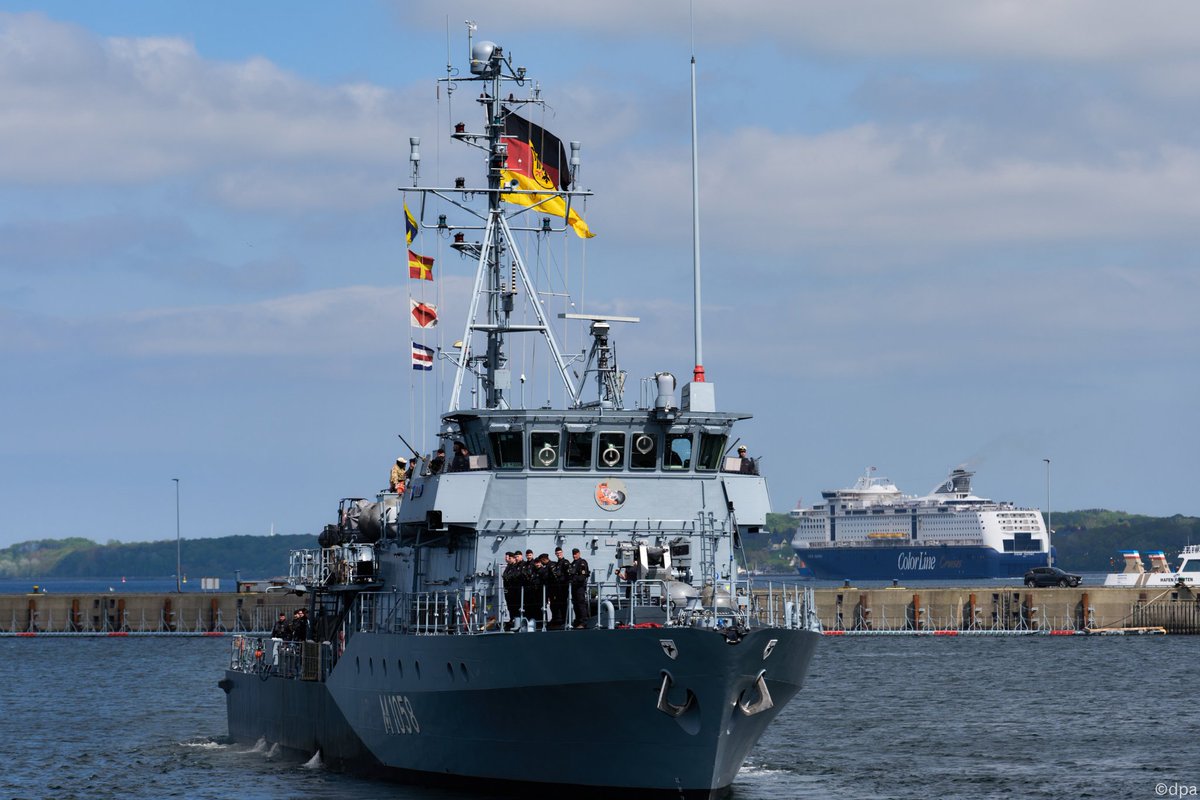
Germany is moving assets into position. Mine-hunter FGS FULDA is deploying to the Mediterranean to be forward-positioned to join a multinational mission to secure the Strait of Hormuz when the conditions are met. (1/6)
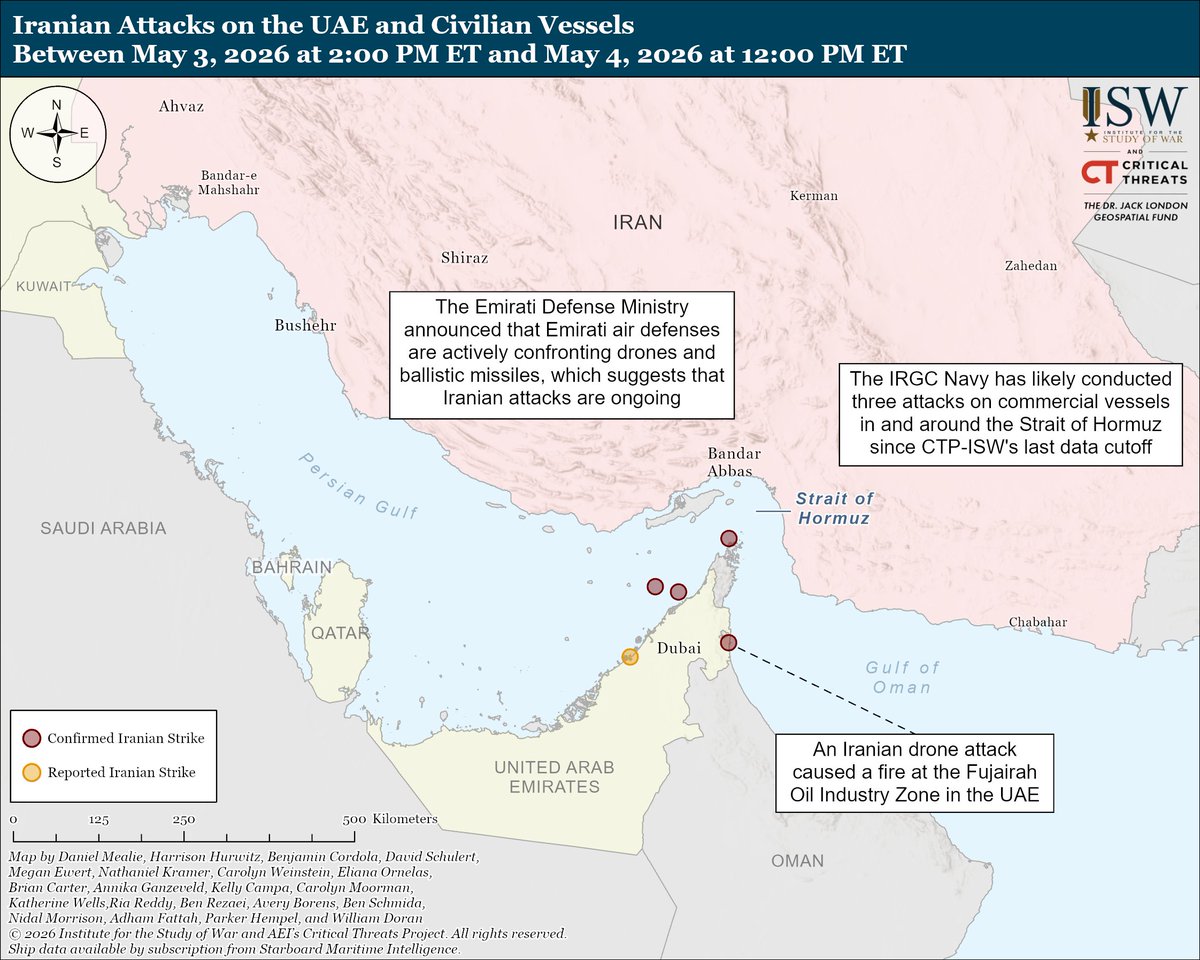
BREAKING | An Iranian drone attack caused a fire at the Fujairah Oil Industry Zone in the United Arab Emirates (UAE), marking the first Iranian attack on a Gulf state since the US-Iran ceasefire went into effect on April 8.
The Emirati Defense Ministry announced that it detected four cruise missiles launched from Iran toward the UAE. Emirati air defenses intercepted three of the missiles, while the fourth fell in the sea. The Emirati Defense Ministry also announced that Emirati air defenses are actively confronting drones and ballistic missiles, which suggests that Iranian attacks are ongoing.
This attack comes after US President Donald Trump announced on May 3 that the United States would “guide” vessels out of the Strait of Hormuz. Trump warned that the United States would respond “forcefully” to any Iranian interference in this operation.
Senior Iranian military and political officials threatened to attack any vessels that attempted to transit through the strait without Iranian permission and warned that Iran would consider any US “interference” in the strait to be a ceasefire violation in response to Trump’s announcement.
US Central Command (CENTCOM) successfully guided two US-flagged commercial vessels through the strait on May 4.
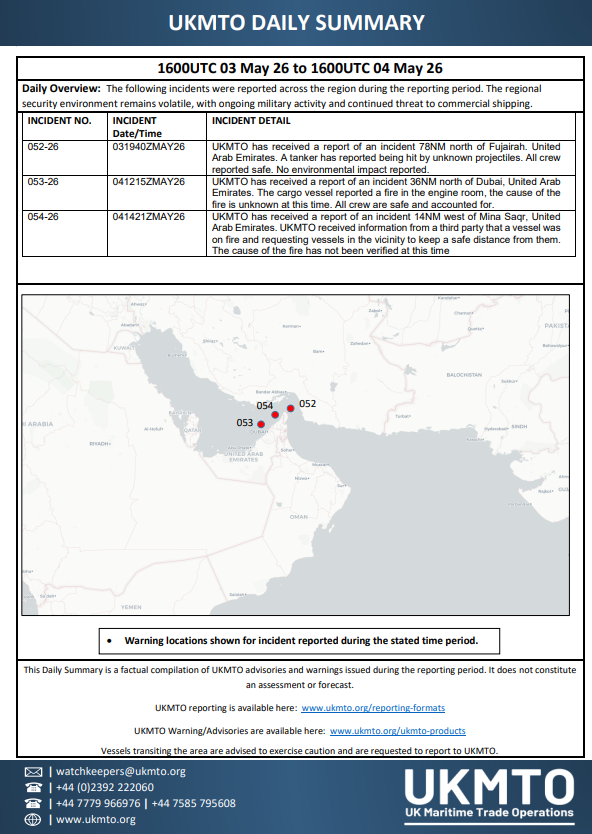
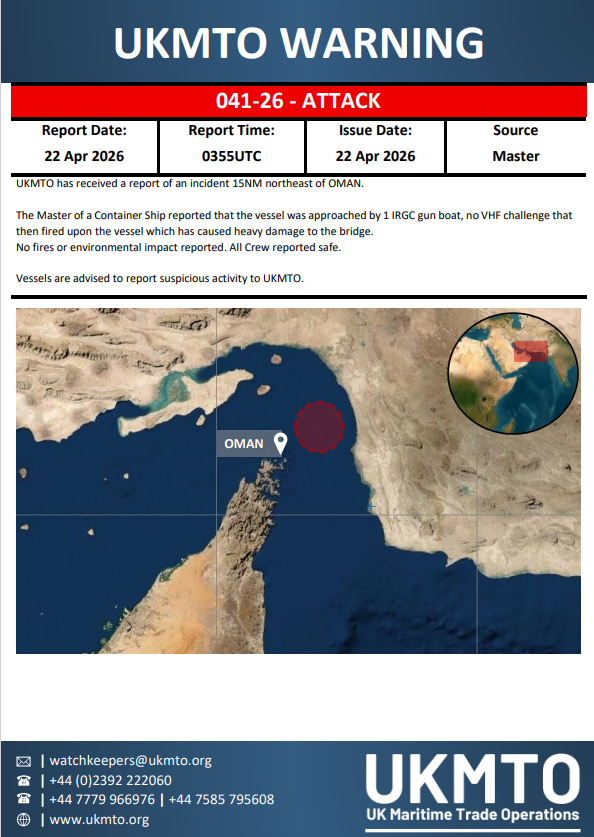
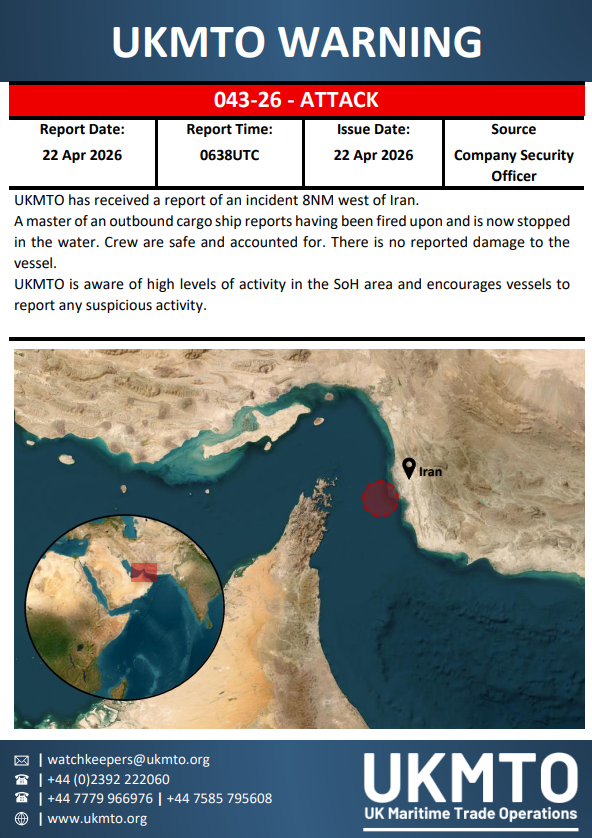
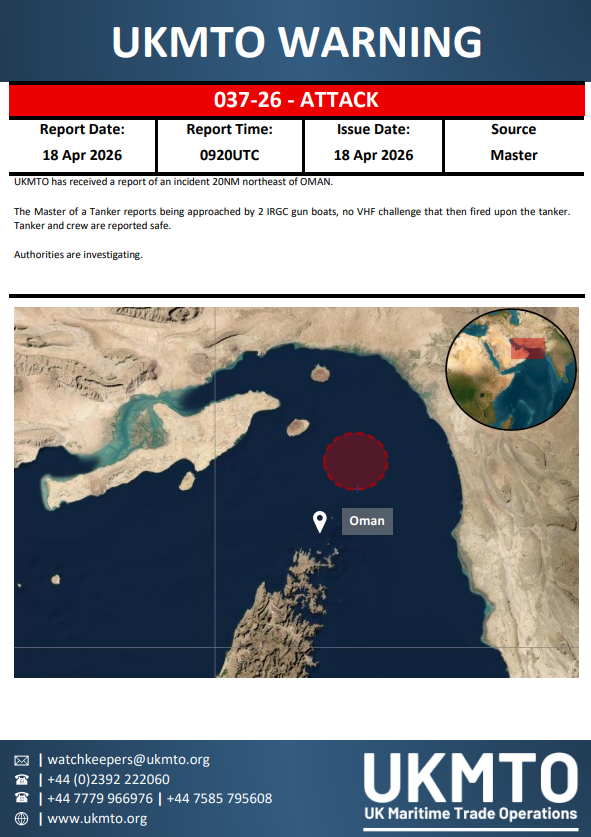
The IRGC Navy has likely conducted three attacks on commercial vessels in and around the Strait of Hormuz since ISW-CTP's last data cutoff. United Kingdom Maritime Trade Operations (UKMTO) reported that unspecified projectiles struck a vessel north of Fujairah, the UAE. UKMTO also reported fires on two vessels north of Dubai and west of Mina Saqr, the UAE.
One of the attacked vessels is owned by the Abu Dhabi National Oil Company. The Emirati Foreign Ministry condemned the attack and described Iranian attacks on commercial vessels as “acts of piracy.”
ISW-CTP is actively monitoring this developing situation and will provide analysis about these unfolding events in its May 4 Iran Update.
In a call with reporters just now, Adm. Brad Cooper of @CENTCOM says Iran has opened fire on U.S. warships and commercial vessels today, but declines to say whether the ceasefire between the U.S. and Iran is over.
U.S. forces returned fire and destroyed some Iranian small boats.
🚫 CLAIM: Iranian state media claims that Iran's Islamic Revolutionary Guard Corps hit a U.S. warship with two missiles.
✅ TRUTH: No U.S. Navy ships have been struck. U.S. forces are supporting Project Freedom and enforcing the naval blockade on Iranian ports.
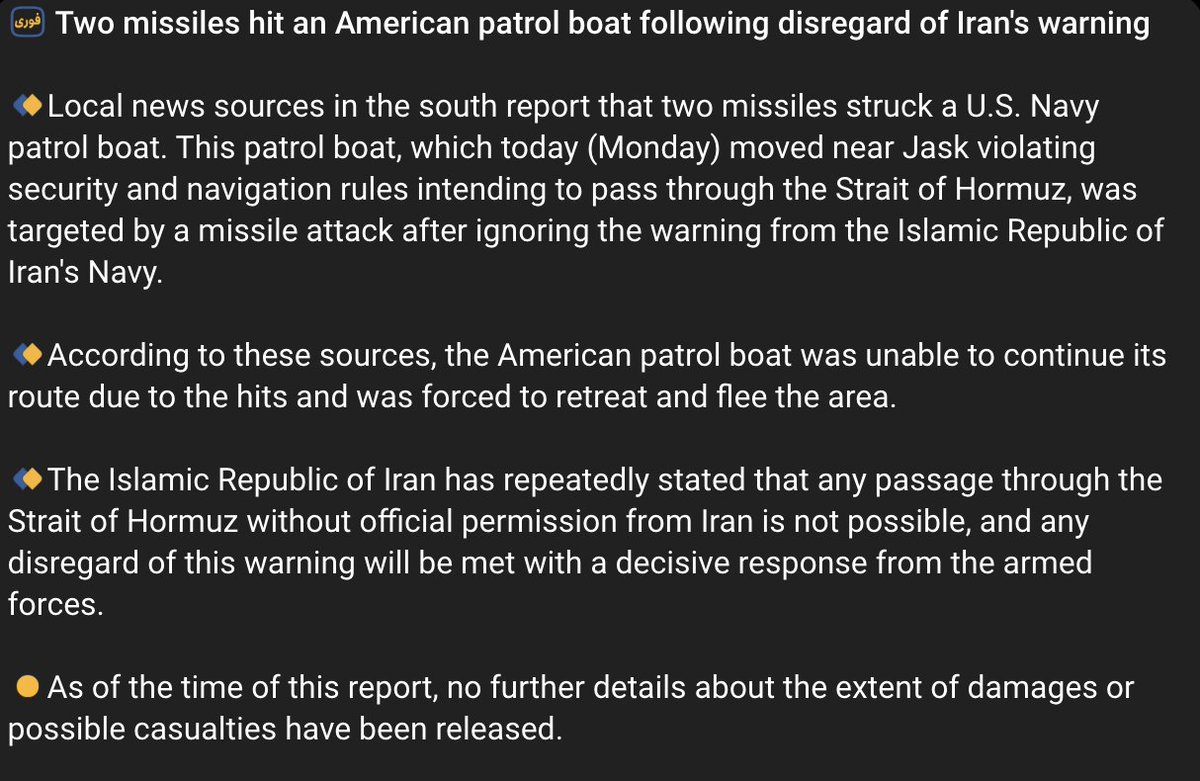
BREAKING: A U.S. Navy patrol boat has been struck by two missiles after ignoring Iranian warnings to not pass the Strait of Hormuz, according to IRGC-affiliated Fars News Agency
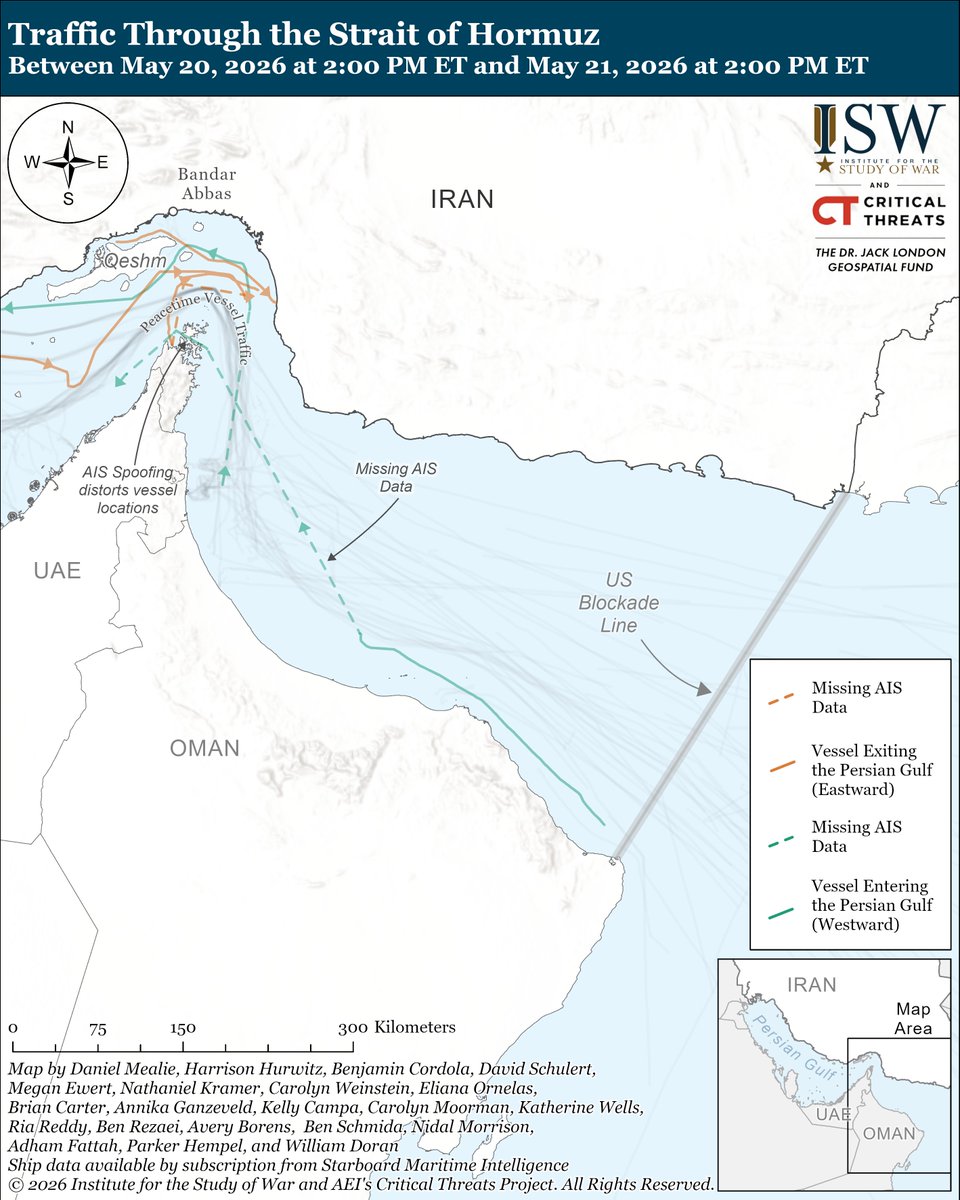
U.S. forces have directed 29 vessels to turn around or return to port as part of the U.S. blockade against Iran.
Over past 24 hours, media reports have alleged that several commercial ships evaded the blockade, citing M/V Hero II, M/V Hedy, and M/V Dorena as examples. These reports are inaccurate.
Hero II and Hedy did not sail past the blockade as part of a flotilla that “ferried” millions of barrels of oil to the market. In fact, the Iranian-flagged tankers are anchored in Chah Bahar, Iran, after being intercepted by U.S. forces earlier this week. Dorena has been under the escort of a U.S. Navy destroyer in the Indian Ocean after previously attempting to violate the blockade.
The U.S. military has global reach. American forces are operating and enforcing the blockade across the Middle East and beyond.
The Administration needs to get a handle on this reporting - either it is true or isn't, or highly misleading- because this gives aid and comfort to the enemy, making the US look weak or confused.
BREAKING NEWS: Top U.S. Nuclear Chief Caught LEAKING Sensitive National Security Information to Stranger, Reveals Army Chemist Was Exposed to U.S. Chemical Nerve Agent, Confirms U.S. Strike Killed Children in Iran, Discloses U.S. Plans to ‘Kill Iran’s New Supreme Leader’
“If he [Mojtaba Khamenei] doesn't change his ways, yeah, they're [United States] going to kill him.”
“The easiest way to get intelligence…send a pretty girl, talk to the guy…I have to resist your eyes.”
“Your eyes have mesmerized me so much…Almost like you're an intelligence.”
Andrew Hugg, a U.S. Chief of Chemical Nuclear Surety, was caught on hidden camera casually revealing sensitive information to a stranger in a public restaurant. Andrew Hugg, Chief of Chemical Nuclear Surety, in charge of nuclear and chemical safety was caught on hidden camera releasing information regarding the U.S. Nuclear Information. He claims the U.S. still possesses nerve agents and says a U.S. Army chemist recently died from exposure.
He also acknowledges U.S. airstrikes have killed children in Iran, calling it “collateral damage,” and revealed to the journalist how nuclear launch decisions are made in real time.
Hugg described how the United States could assassinate Iran’s next leader if he “doesn’t change,” while admitting the U.S. has no plans to use nuclear weapons: “We’re not going to nuke anybody.”
All of this was casually revealed to an undercover journalist in a restaurant. This raises serious questions about this official's judgment, security, and what’s really happening behind closed doors.
We have reached out to the Pentagon and U.S. Army for comment and they are working on a response.
@USArmy@DeptofWar
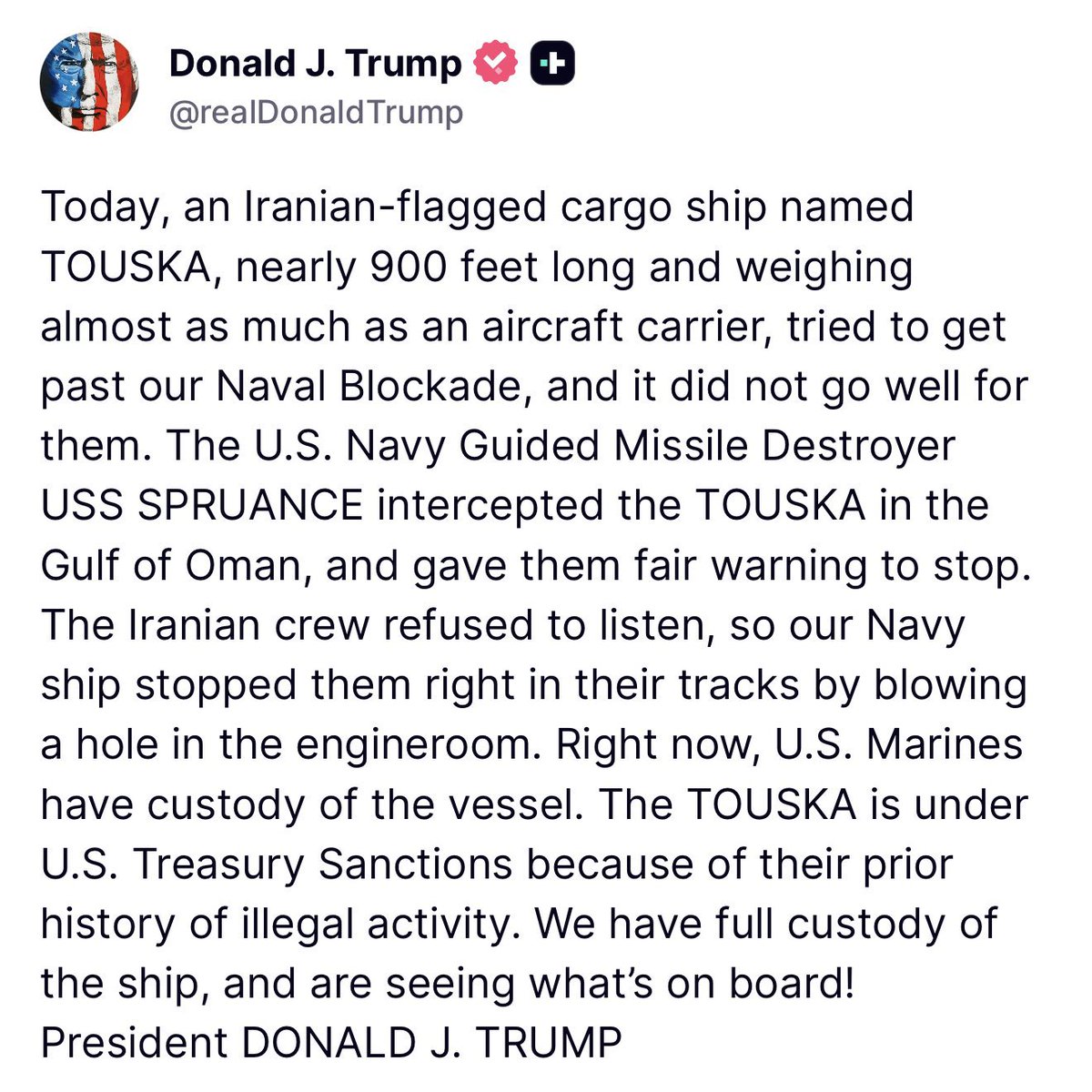
TRUMP: "Today, an Iranian-flagged cargo ship named TOUSKA, nearly 900 feet long and weighing almost as much as an aircraft carrier, tried to get past our Naval Blockade, and it did not go well for them. The U.S. Navy Guided Missile Destroyer USS SPRUANCE intercepted the TOUSKA in the Gulf of Oman, and gave them fair warning to stop. The Iranian crew refused to listen, so our Navy ship stopped them right in their tracks by blowing a hole in the engineroom. Right now, U.S. Marines have custody of the vessel. The TOUSKA is under U.S. Treasury Sanctions because of their prior history of illegal activity. We have full custody of the ship, and are seeing what’s on board!"