Reminder - I'll be going live with @liquid2ulu at 3PM CST today, topic is Kant v. Rand on epistemology.
Hoping to cover a lot of interesting ground here, so should be a good one.
Thanks for the reply,
I want to make it clear from the top that I don’t think you have to agree with Kant’s conclusion to see that there is something unique and interesting about his argument. So, my chief concern here is to make sure that his argument is understood.
To that end, we need to get some language clear. “Unauthorized” representation does not simply reduce to “misrepresentation” here. The lawyer analogy is supposed to make exactly this point. The unauthorized person can be transparent about what they’re doing, and it’s still wrong (allegedly), because the wrong in question isn’t about deception. Rather, it’s about acting in a capacity for someone that they were never given the authority to exercise. You might think that there is no real difference to misrepresentation here, but that would need to be argued because the distinction seems to have at least some utility.
“but none of this has anything to do with copyright--nor even trademark. IP Proponents Do Not Even Know The Difference Between Patent, Copyright, Trademark”
Right. That’s basically my entire point. Kant isn’t making an IP argument, and it’s silly to try to construe it as one, because none of his reasoning is based on any claims to books themselves or their contained patterns. So, if his argument fails, it fails for reasons other than the ones that make IP arguments fail, which is what makes it worth taking seriously over the four millionth labor argument.
“Okay maybe I am defrauding customers, but how does it violate Kant’s rights?”
He’s making the claim that it isn’t fraud to republish (at least not necessarily), but it is nonetheless an unauthorized expression of his own capacities because of the relationship between books as a medium and the public (again, why art doesn’t apply). To your later point, I mentioned at the end of my reply that, yeah, I don’t think the argument works on its own, but for reasons that are secondary to the moral thrust of it all. That is to say. I don’t take it to be a facially stupid argument, and we can see this clearly by noticing the *structural* parallels to the lawyer case. So even if we draw out some disanalogy, I expect it would be framed as a misapplication of a good principle by Kant, rather than it just being nonsense all the way down (like someone saying a creator has highest claim to a pattern).
Whether or not it’s correct, there is something unique to Kant’s argument. If I have convinced you of that much, then I’ve accomplished my mission here.
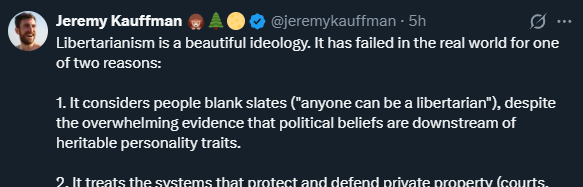
Blank-slate'ism is not core to libertarianism; it is agnostic as to how one acquires one's views, only that they do arrive at consent and property as sacrosanct. I personally believe genetics play a sizable though far from deterministic role—there is no conflict.
Reason is the ground of intelligibility. To the extent that we can prefer, we prefer for reasons - good ones, bad ones, subjective ones, but reasons all the same. Insofar as we act at all, we don’t have any choice in the matter, it’s simply a self-imposed mandate by virtue of the kinds of things we are.
The problem with the brute desire-satisfaction model of action (which includes intentional belief formation) is that it both entails and refuses to explain the ordinary means-end (otherwise known as rational) structure of action. Once we realize that the structure is what gives any weight to its products, then “ought I abide by that structure” is answered, not implicitly, but *explicitly* through its use.
So, to respond directly to your claim - we can’t choose to do anything but “prefer” reason. The only real question is whether we act in accordance with it.
@LudwigNverMises@TheLostOddity If it is *necessary* to behave contrary to morality, and morality is the domain of things we have overriding reason to do, then aren’t you just saying that it isn’t moral?
Ought implies can, after all.
There is an interesting idea here worth working through.
To start from a point of agreement, libertarians take stealing to be wrong. We ought not steal. So lets say that there is a state and that it decides to enact a "no stealing" policy. This could mean a few things, but the first is that the state will go out an enforce the no stealing rule, arresting people, throwing some in jail, etc. Doing so would involve the use of stolen resources, and would result in bad outcomes for some number of innocent people. So maybe we should be hesitant. The state perhaps ought *not* enact such a rule, even though we ultimately agree that stealing is wrong.
But now suppose that the state had a prior "stealing is fine" rule that they enforced which entailed jailing people who exercised their right to defend their property. If the state simply struck that rule from the books, there is a sense in which they are enacting a "no stealing" policy by no longer subverting the rights of property owners, but they are not enacting a new enforcement structure alongside it. In other words, the policy abolishes the rule defending (and incidentally promoting) bald theft.
Now, finally, say that after abolishing this rule many people (a billion, if necessary) start to go hungry, starve even, because they became dependent on theft for survival, and the state, being the state, decides to issue a public food security program that did not exist before. Libertarians are against this program for the same reasons they would be against the state enforcing the "no stealing" rule - stolen resources, damages, etc. But the question is, from a libertarian perspective, ought the state have refrained from striking the "stealing is fine" rule because of this consequence?
I think it would be absurd to say that the state ought to continue to defend stealing because "otherwise there would be breadlines." That some other wrong may pop up later doesn't seem to change the fact that arresting people who rightly defend their property from thieves is evil, and under no circumstances ought be done. So then, the "stealing is fine" rule ought to be abolished, and we just have to deal with the consequences of that as we can, hopefully quickly.
Is there anything wrong with this picture?
It's been tried multiple times before, but I really think actively mocking someone for getting murdered in the street on video by masked feds for filming them at a protest might finally be enough to make a motion for @LPNational to disaffiliate LPNH successful.
"But the alternative is no LP presence in New Hampshire at all!"
Okay, that is *obviously* massively, massively better than the LP presence being LPNH.
I remember when Dave said that some bad things were going to have to happen to innocent people, and we would all just have to accept that.
Own your fucking choices Dave.
They’re all we are.
I’m an immigration restrictionist. I believe that we have the right to remove any and all people who entered our country illegally.
Also, ICE is out of fucking control. A bunch of pussies, drunk on power going around intentionally escalating violent interactions and intimidating US citizens.
They create these tragic situations and after this gigantic show of force, they won’t deport a fraction of the illegals who entered under Biden. This is simply not worth it.