Expulsion from the Garden of Eden by Thomas Cole 1828 Thomas Cole painted this just three years after arriving in America from England, yet he became the founder of the country's first true art movement, the Hudson River School. #art
Fighting Fauns by Franz von Stuck, 1898. Von Stuck designed his Munich villa down to the furniture, treating the house as one total artwork. He painted fauns and centaurs to capture raw instinct and wild nature. Both Paul Klee and Kandinsky studied under him. #art
Flower Beds in Holland, Vincent van Gogh, 1883. One of his earliest oil landscapes, painted before he moved to France and found his blazing color. Flat bands of tulip and hyacinth beds, rows of red, white and yellow telling the whole story. #art
The Mirage by Henri Paul Motte Henri Paul Motte trained under the celebrated Jean-Léon Gérôme, absorbing a style built on precise drawing and carefully staged historical scenes. #art
The Last Supper by Jean Baptiste de Champaigne He trained under Philippe de Champaigne, the great portraitist of the French court, and carried that family workshop into the next generation. #art
Architect's Dream by Thomas Cole 1840 Cole painted this for architect Ithiel Town, piling Egyptian, Greek, Gothic, and Roman buildings into one impossible landscape. The architect rests atop a giant column, dreaming the styles into being. #art
Hol Über Get Over by Alexander Rothaug Alexander Rothaug trained in the academic style of Vienna but built his reputation on myth and dream, painting gods and ferrymen rather than portraits. #art
Victoria Mortis by Owe Zerge 1921 Owe Zerge was a Swedish painter who trained in the academic tradition but worked for decades on the west coast of Sweden. #art
Felsenriff am Meeresstrand by Caspar David Friedrich 1824 Friedrich often placed a lone figure with its back to us, gazing into the distance, so we see the view through that person's eyes rather than our own. #art
In Time Of Peril by Edmund Blair Leighton Leighton painted medieval scenes long after the Middle Ages had ended, part of a Victorian fascination with knights and chivalry. He never joined the Pre-Raphaelites, yet shared their love of history and romance. #art
Lady Godiva by John Collier 1898 Collier painted Lady Godiva riding through Coventry, the medieval noblewoman who, legend says, protested her husband's harsh taxes by riding naked through town. #art
On the Veranda by Edvard Munch, 1902. Painted in Norway, where shifting seasonal light shaped his sense of color and mood. Munch believed art should show what a person feels, not just what the eye sees. That idea helped open the door to modern art. #art
Dream of the Orient by Jean Lecomte du Nouÿ 1904 Lecomte du Nouÿ studied under Jean-Léon Gérôme, the leading French painter of Eastern scenes, and traveled to Egypt and Turkey to gather the details he later worked into his canvases. #art
Night Festival at the Universal Exposition under the Eiffel Tower by George Roux 1889 The 1889 Universal Exposition marked the debut of the Eiffel Tower, built as its grand entrance and meant to stand for only twenty years. #art
Greifswald in Moonlight by Caspar David Friedrich 1817 Friedrich painted his hometown of Greifswald from across the bay, its church spires rising in silhouette under a low moon. #art
Hail Caesar, We Who Are About to Die Salute You by Jean Léon Gérôme 1859 The Latin salute in the title was supposedly spoken by gladiators to the emperor before combat, though ancient writers record it only once, at a staged naval battle. #art
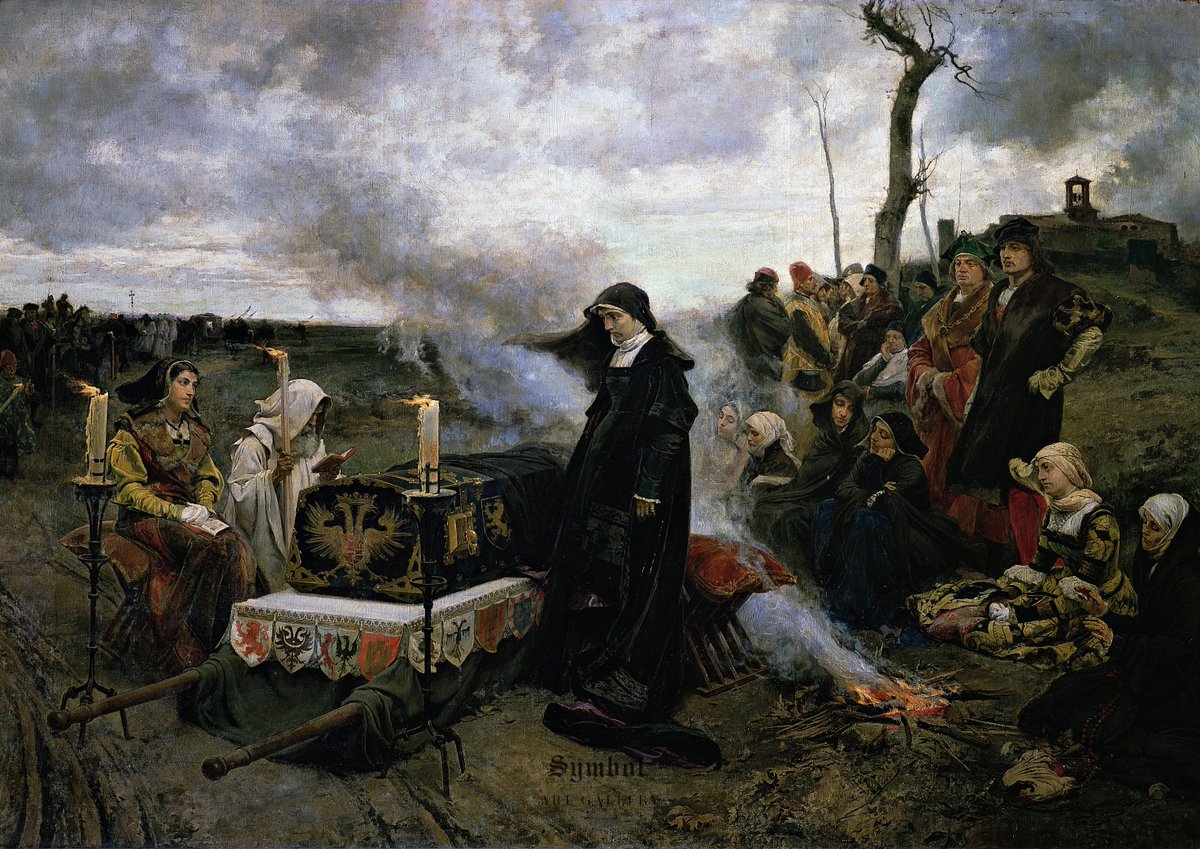
Joanna the Mad by Francisco Pradilla 1877 Joanna was a real queen of Castile who, grief-stricken, kept her dead husband's coffin near her and halted its journey so it could not be left alone. #art
La Fuite du roi Gradlon by Évariste Vital Luminais 1884 This painting tells the Breton legend of Ys, a city said to have been swallowed by the sea when its gates were opened during a storm. King Gradlon escapes on horseback, leaving his daughter to the waves. #art
L'Eminence Grise by Jean Léon Gérôme 1873 The gray-robed figure is Father Joseph, the friar who quietly ran state affairs for Cardinal Richelieu in 17th century France. Courtiers bow to him on the stairs even as he ignores them, reading his prayer book. #art
Ivan the Terrible and His Son, Ilya Repin, 1885. Repin captured the moment after Ivan struck his own son in rage, killing him. His wide eyes show horror as he cradles the dying young man. So disturbing it was banned, and decades later a viewer attacked it with a knife. #art