🚀¡Qué auténtica barbaridad!
🇰🇪El keniano Sebastian Sawe se ha convertido en primer atleta en bajar de las 2 horas en el maratón estableciendo un récord del mundo estratosférico en Londres (1 hora 59 minutos y 30 segundos)
New traders get told that they have to have specific 'setups'
So they spend all day back-testing some random price pattern and shove a couple of indicators in there for good measure, and then fire risk into the book as soon as it 'triggers'
In reality the vast majority of your returns as a crypto trader most likely won't be set up-driven but rather regime-driven
Most of the time the market does mostly nothing
And if you try to force your set ups in the wrong regime, then you'll just get bad results (e.g. momentum trading breakouts in a choppy market)
So I think the first useful port of call is at least some broad sense of what type of regime the market is in
This doesn't need to be complicated: you can just look at the chart, use some basic moving averages or even common sense to get an understanding of trending, mean-reverting, momentum, catalyst-based, volatility compression/expansion etc (complexity can be layered in later if required)
Each regime should then have specific playbooks or set ups associated with it
For example if the market is trending then you might adjust to trade shallower pullbacks, lower time frames, faster moving averages, less drastic momentum resets etc.
That same so-called set up would get you absolutely cooked in a choppy market
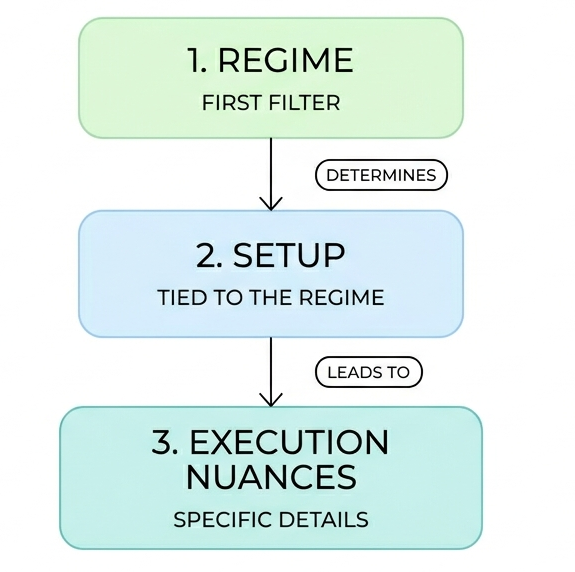
In other words the super TLDR is that the correct hierarchy is:
1. Regime is the first filter
2. Setup is tied to the regime
3. Execution nuances
As a practical example:
The current regime is technically defined as "soul-crushing dogshit" so the correct setup is to develop a nicotine and video game addiction
Hope this helps
I am not going to motivate you because if you need motivation from a stranger on a plane the answer is stay
but I will give you the game theory
your corporate M&A gig is a repeated game with diminishing marginal returns. year 1 you learn everything. year 2 you refine it. year 3 you are executing pattern recognition. year 4+ you are being paid more to do the same thing with slightly larger numbers. the learning curve flattens but the golden handcuffs tighten because every year the comp goes up and the opportunity cost of leaving gets more painful on paper
this is a classic status quo bias trap. the payoff of staying is known and comfortable. the payoff of leaving is uncertain and scary. so you stay not because staying is optimal but because the asymmetry of regret is lopsided. you can imagine regretting the leap. you cannot as easily imagine regretting the years you stayed too long because that regret builds slowly and never hits you in one moment
here is where game theory actually helps:
in your M&A seat you are playing someone else's game. the firm sets the rules, the deal flow, the comp structure, the promotion timeline. you optimize within their framework. you are a very well-compensated player in a game you did not design. your upside is capped by whatever the partnership or MD economics look like. your downside is protected by a salary. that is the trade
owning a local business flips the entire payoff matrix. you design the game. you set the rules. the downside is real and unprotected but the upside is uncapped and compounds in ways a salary never does because you own the equity. a $2M EBITDA business bought at 4x and grown to $3M EBITDA over 3 years is worth $12-15M on exit. no M&A salary trajectory produces that kind of wealth creation in that timeframe unless you are a founding partner
the Nash equilibrium of your current situation: you and every other M&A professional are competing for the same promotions, same deal credit, same bonus pool. the competition is fierce because the players are identical. same schools, same skills, same hours. you are in a crowded equilibrium where everyone works 80 hours to stay in the same relative position
local business ownership is a different game with different players. the competition is a 62-year-old owner who stopped innovating in 2014 and a 35-year-old who inherited the business and does not want to be there. you walk in with financial sophistication, deal structuring experience, and the ability to read a balance sheet faster than anyone in the room. you are overqualified for the game which is exactly where you want to be. the best strategy in game theory is to play games where your existing skill set gives you an asymmetric advantage over the other players
the timing question is about optionality. every year you stay in M&A your financial optionality goes up slightly because you save more. but your operational optionality goes down because you get further from the reality of running anything. the M&A guy who leaves at 28 adapts to operations in 6 months. the one who leaves at 38 has a decade of habits built around delegating to analysts and reviewing decks, and managing a P&L feels foreign in a way it would not have 10 years earlier
but again. if you need me to motivate you, stay. the people who actually do this do not need motivation. they need a spreadsheet that shows the math works and then they cannot NOT do it. if you have the spreadsheet and you are still asking strangers for motivation the spreadsheet is not the problem
Mi camino acaba aquí. Gracias a todos, porque también habéis formado parte de ello. En esta nueva aventura llevaré conmigo los valores que me han acompañado hasta ahora e intentaré devolver a la sociedad todo lo que me ha dado en este tiempo. Ha sido un viaje maravilloso ♥️
Here's a useful way I've used openclaw to help me manage info on X...
I had a dumb problem:
I bookmark waaaay too much stuff on X.
- Market charts
- Macro takes
- AI tools
- Threads I want to revisit
- Random ideas I know are useful
The problem is bookmarking something feels productive.
Going back through 500 saved posts later is not.
So most bookmarks just die in a folder...
But I finally fixed it.
I built a workflow with OpenClaw that does this automatically:
1. Pulls all my new X bookmarks
2. Extracts the full post + links + media
3. Classifies each one by type:
a. market signal
b. AI tool
c. trading strategy
d. OpenClaw/agent idea
e. worth remembering
f. skip
4. Surfaces the top picks
5. Extracts the main themes across the batch
6. Saves everything into a clean report in my notion database
7. Creates projects/to do's based on top actionable items
So instead of a giant pile of “saved for later,” I get a bookmark report with:
- top signals
- key themes
- clean research notes
- less noise
- better recall
- action steps
If you’re overloaded with information, this is a much better workflow:
- save aggressively
- let the agent sort it
- keep the synthesized signal
- ignore the clutter
If you want to build this yourself, the prompt is basically:
“Pull my new X bookmarks. Classify them by category. Identify the top picks. Extract the big themes. Save the output as a report. Send valuable items into a research database.”
You can customize exactly how you want your report to look...
But that alone is enough to turn bookmarks from digital hoarding into something actually useful.
Chasing what’s already gone parabolic is the easiest way to give profits back.
Right now, metals are extended…
Bitcoin is compressed…
And small cap stocks are quietly leading.
I put together a Chart Radar to outline what I’m watching now 👇
https://t.co/w4NE0jfLbd
Your coins are your coins. Don’t let them be clubbed into dank submission. Be on the watch, there are ways out. There is a light somewhere. It may not be much light but it beats the darkness. The gods will offer you chances: know them, take them. You can’t beat death but you can beat death in life, sometimes.
Happy new year.