Hope everyone is doing well. After the whole Truebit Hack i decided to focus on finishing my first building project in a small town in South Africa called Stilbay, located about 300km from Cape Town and 50 km from Mossel bay. Yes the property will be for sale soon
Join the community vs Truebit. You can join at https://t.co/YKfzrRUbAb. If you see the old Stats page and not the screenshot page you must just refresh your browser. Please share if backing the community.
@JasonTeutsch@Truebitprotocol
Looks like https://t.co/v1lx3s9ODQ has changed.
It's now a final message from the community — and gauging interest in a class action against Truebit Inc.
If you held TRU and got burned, worth a look.
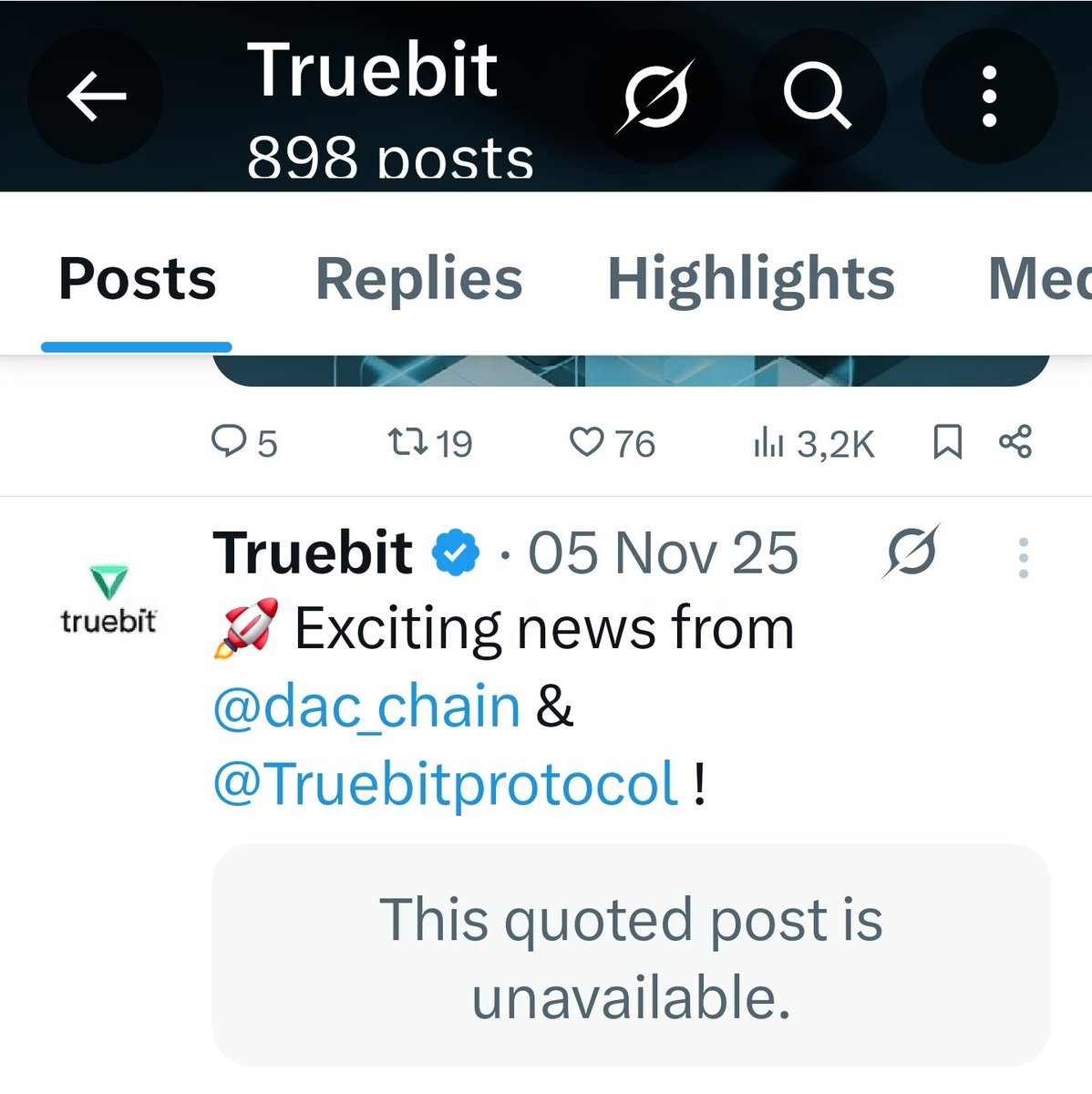
Truebit X Account
Grok reply
X account appears to have undergone significant post deletions, resulting in only 117 total posts visible despite being active since 2017. This low count indicates a major purge, likely of older content from 2017–2025, including promotional updates, development announcements, partnership news, and general blockchain insights related to verifiable computation and Ethereum scaling.
The deletions seem to have occurred around early 2026, coinciding with the $26M hack, possibly for account maintenance, security cleanup, or to streamline focus on recovery
Specific details on the exact deleted content are not publicly archived or discussed in detail, as X deletions remove posts from direct access, and no comprehensive snapshots (e.g., via Wayback Machine) captured the full timeline before the purge.
Community speculation points to routine housekeeping or post-exploit caution against misinformation, but no official statement from Truebit explains the reasons or lists the removed posts.
The remaining activity centers on hack updates and product features from late 2025 onward.
I believe you are correct yet TRUEBIT VERIFY is proving a very important factor. You still cannot trust the humans that run the verification. It all looks great on paper but can you really TRUST THE VERIFIERS AND THEIR TEAM. Once there is money involved, can you really trust them. Human Greed is the the biggest issue keeping us from true and honest verification. We learned one thing from TRUEBIT TEAM, TRUST IS EARENED, YOUR INVESTORS AND TOKEN HOLDERS ARE DISPOSABLE, why do i say this. He who controls the gold, makes the rules. The simple question remains, if you cannot trust the Verification team can you trust the verification game.
I believe you are correct yet TRUEBIT VERIFY is proving a very important factor. You still cannot trust the humans that run the verification. It all looks great on paper but can you really TRUST THE VERIFIERS AND THEIR TEAM. Once there is money involved, can you really trust them. Human Greed is the the biggest issue keeping us from true and honest verification. We learned one thing from TRUEBIT TEAM, TRUST IS EARENED, YOUR INVESTORS AND TOKEN HOLDERS ARE DISPOSABLE, why do i say this. He who controls the gold, makes the rules. The simple question remains, if you cannot trust the Verification team can you trust the verification game.
Truebit’s silence for more than seven weeks following the incident has seriously damaged trust within the community.
Many token holders contributed significant capital to support the development of the protocol and its verification infrastructure. When an incident occurs and communication stops, it raises legitimate concerns about transparency and accountability.
The issue is not speculation about motives.
The issue is responsibility to the community that funded the system.
At a minimum, the community deserves:
a clear incident report
an explanation of what failed
a defined recovery or migration plan
clarity on the current security model
Without these answers, it becomes increasingly difficult for participants, node operators, and developers to maintain confidence in the platform.
Trust in decentralized infrastructure depends on communication and transparency.
After seven weeks of silence, the community is left asking whether that trust can be restored in Truebit team members and Jason Teutsch.
IF WE CANNOT TRUST THE TRUEBIT TEAM, HOW DO WE TRUST THE PROJECT.
How can participants confidently support future projects involving the same team if communication and accountability during critical moments remain unclear?
Truebit Verify Patent.
The recent update showing a final rejection of the Truebit patent application raises serious questions for the verification ecosystem.
For years, described TRU as the economic security layer protecting verification integrity. Yet the system now appears to be operating without that mechanism functioning as originally described.
This creates an important discussion for the broader verifiable-computation community.
If the architecture originally relied on a staking-based security model, and that model is no longer active, then the community deserves clarity about:
how verification security is currently maintained
whether the original architecture has changed
what implementation path the platform now follows
The patent office’s rejection does not mean the application cannot be amended or appealed. But it does reinforce the importance of careful technical and legal scrutiny of claims in this space.
Developers working on verifiable computation, fraud proofs, and off-chain verification systems should continue documenting prior art and architectural approaches. Open discussion and transparent examination of these systems is healthy for the ecosystem.
The goal should not be conflict.
The goal should be clarity, transparency, and robust verification infrastructure that the entire Web3 ecosystem can trust.
After these events and the unresolved questions around the security model, the community is left asking: can Truebit Verify still be trusted as originally described?
To the Truebit team: @Truebitprotocol@JasonTeutsch
Why the Truebit Patent Is Now Being Questioned by the Community
Truebit has historically described TRU as a staking-based economic security component intended to protect verification integrity.
That framing matters because patents protect implemented systems, not theoretical intent.
Following the recent incident, several unresolved questions now exist:
the economic security layer ceased functioning
no migration framework has been published
no continuity or replacement model has been defined
the platform continues operating without the token layer previously described as foundational
This raises an important technical and legal discussion within the broader Web3 community:
If economic security forms part of a system’s described architecture, what happens when that mechanism is no longer active?
This is not about fault or motive.
It is about implementation continuity.
In patent law, enforceability depends not only on claims, but on whether the invention is being practiced as described particularly when core security mechanisms are involved.
When a system evolves away from a previously defined economic-security model, questions naturally arise about scope, interpretation, and future implementation paths.
This does not threaten verifiable computation.
It expands the design space.
Builders may now explore alternative architectures including transparent reserves, immutable guarantees, and formally defined failure-handling without relying on assumptions that were never codified.
This discussion is not adversarial.
It is the result of silence.
And in decentralized systems, silence invites reinterpretation.