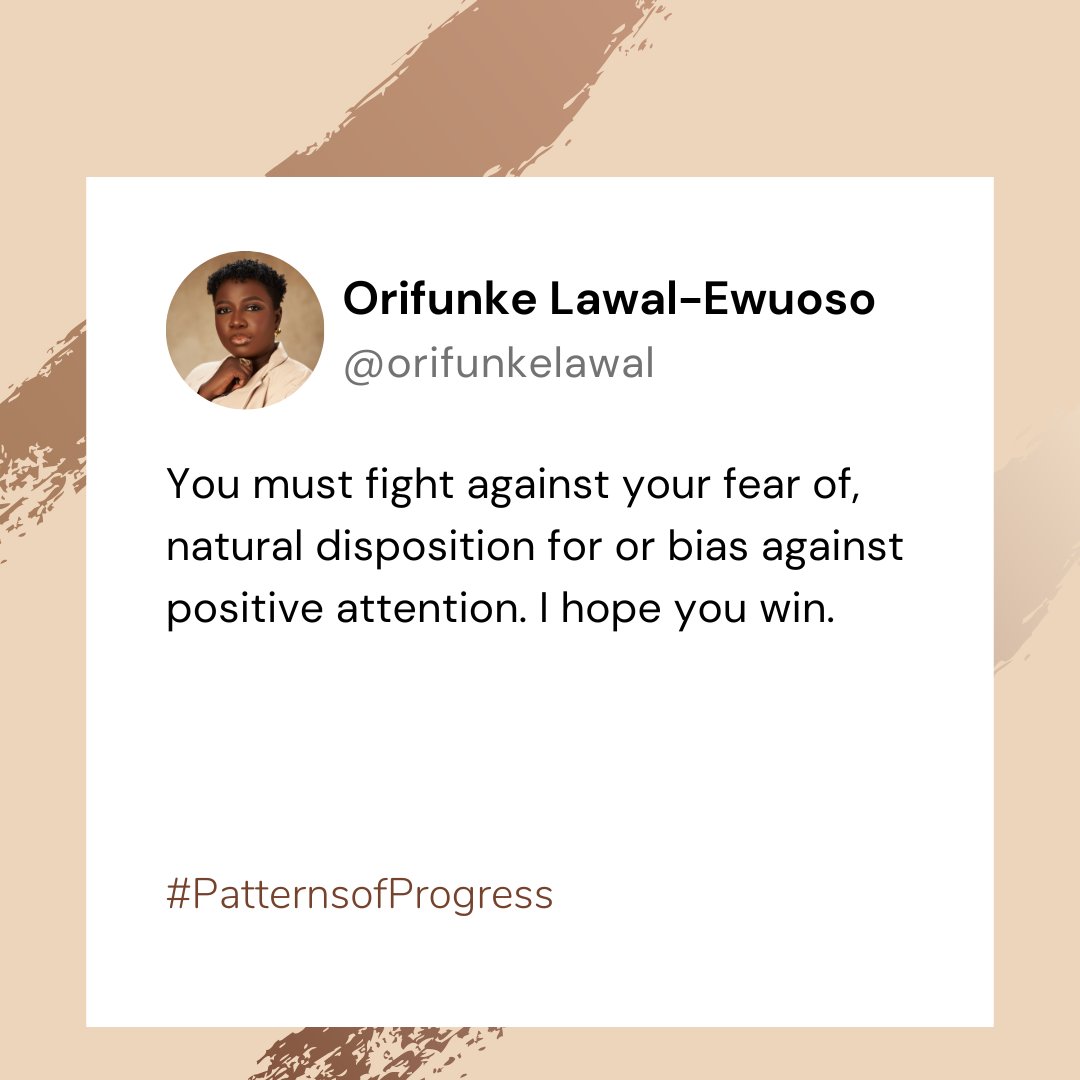
I don't like being seen ❌
I do better behind the scenes ❌
I hate attention ❌
I prefer my work speaking for me than my face ❌
What other lies have you told yourself?
Stop hiding. You've hidden enough. You've given yourself enough excuses for relegating yourself to the background.
The world needs to see you, hear you and know you. Not for your own vainglory or simply for the purpose of being seen. But because there are people who need what you have and will not be able to get it if they do not even know you or see you.
Positive attention does not necessarily mean you're always struggling to be seen. It could mean:
Writing about something you know on your WhatsApp status ✅
Asking questions and speaking up in meetings or events ✅
Turning on your video at high-level virtual meeting or events ✅
Applying to speak at an event ✅
Hosting a session yourself ✅
Writing your book ✅
Organizing a workshop ✅
Recording that podcast ✅
Sitting in front at that event ✅
Showing up at industry events that matter ✅
Looking good ✅
Hosting a virtual trade event for your new product ✅
Volunteering to lead that team project ✅
Even the Bible says nobody lights up a candle and hides it under a bushel. You place it on a table so that all who need light will see it.
You're a light. Begin to act like it! And it doesn't matter if people get uncomfortable with it. That's their business, not yours.
If you have a vision, it is your duty to ensure that those who need it see it.
You've hidden enough. It's now time for you to shine. Step out. Show up. Speak up. Shine 💫 #PatternsofProgress
Unveiling the SayingIDo 2025 Conference’s Theme!💃💃💃
A Rise of PURPOSE PARTNERS (A Commissioning)
You do not want to miss this.
Admission is free and registration is now open.
https://t.co/E2ZZ5Yosv9
Register, tell someone to register and let them tell someone to register!
Unveiling the SayingIDo 2025 Conference’s Theme!💃💃💃
A Rise of PURPOSE PARTNERS (A Commissioning)
You do not want to miss this.
Admission is free and registration is now open.
https://t.co/axsxGrS8Fi
Register, tell someone to register and let them tell someone to register!
I became a Yorùbá teacher overnight 🤣🤣🤣 Yesterday, a lot of people responded to my thread about how to convert words into sounds to be able to get the àmì.
I did an hopefully explanatory video that allows you know which sound is dò, re, mí.
Let me know if it helps.
Yorùbá is beautiful to speak but it can be knotty to write (and understand what a person has written) without the right marks on top (àmì).
Here's a long/short guide for writing better Yorùbá. I hope it helps.
Background:
Àmì is important in Yoruba writing because it gives meaning to what a person has written. It is especially important because one single word could have different meanings. Therefore, only the àmì can help differentiate.
The àmì below vowels represent the pronunciation of the letters/vowels themselves, not the sounds.
The àmì on/above Yorùbá letters/sounds represent the tone/tonal sounds. Yorùbá is a heavily tonal language - it sounds like music. Keep this in mind.
1. Àmì under vowels (pronunciation)
So in Yorùbá, you have a, e, ẹ, i, o, ọ, u. Like you have a, e, i, o, u in English.
"e" without the àmì below would be pronounced somewhat like /hay/, ẹ will be pronounced like /air/, o will be pronounced as /oh/ and ọ will be pronounced /or/.
2. Àmì above vowels/letters (sounds)
Now, here's where it gets dicey for most Yorùbá speakers and writers. It was so for me for a long time.
The regular Yorùbá language we all speak has three tones. Remember I said Yorùbá sounds like music. So, if you remember your DÒ RE MÍ, you will do fine. These are not letters, they are sounds. You can try singing it now 😁
The technique that helped me?
Raising my hands in a V-shape or funnel-shape.
Left hand - dò
Neutral hand/Equilibrium - re
Right hand - mí
What I used to get this correctly was by using my left and right hand. The àmì on dò looks like my left hand slanting.
"re" has no àmì on top and it looks like my hands in neutral position - not left or right.
"mí" looks like my right hand slanting to the right.
So, do (\), re (-), mi (/). Like you're raising your two hands in V-shape. Never forget this: dò - left hand, mì - right hand.
Now, let's look at how to use them in writing:
- Let's say you have a word: Rain.
In Yoruba, rain is "ojo" - do do - so the àmì would be òjò.
- How about Day?
This is spelt "ọjọ" - re mi - àmì would be ọjọ́. Note the àmì below because of how the word sounds (Or-jor)
- How about a fearful person or coward? This is spelled ojo - re re - àmì would be ojo because of how it sounds (oh-joh) and how it sings (re - re)
The trick again?
- When you hear a word in Yoruba, try singing it as music - like do re mi?
Imagine my name, Orifunke. Did you try saying it carefully? How did it sound to your ears? If you speak Yorùbá, it would sound like re/mi/mi/re/mi/. So the proper Yoruba spelling would be Orífúnkẹ́.
I know it may seem complex but it is not so hard if you're committed to doing it. And never forget, practice makes perfect.
Óyá, your assignment 🫵🏾
Let me see how well you understand. If you are Yorùbá, can you try replying this tweet with your Yorùbá name or the name of a friend with the àmì. I'll give you feedback on whether you are right or what should be done better. Let's go 🙌🏾
We are live!
Minister Worship Ife Adesola ministering at the moment!
You can still join in using this link:
https://t.co/RJvAdZ5vMR
#SayingIDoConference2023#SIDC2023 https://t.co/cJgXGnZ3G5