THE BINARY OUTCOME OF THE IRAN CONFLICT IS IMMINENT
President Trump just stated on national television that he is in a final deciding mode regarding the ongoing war with Iran. He explicitly warned that very big things are coming, openly weighing whether to blow the entire nation up or strike a historic diplomatic deal.
The metrics and timeline of this conflict are reaching a critical inflection point:
Operation Epic Fury has been systematically degrading Iranian infrastructure since February 2026.
The United States is maintaining a strict naval blockade, completely choking Iranian oil exports and severely restricting their capital inflows.
Trump outlined three specific strategic options currently on his table: wipe Iran out militarily, let the regime rot economically under the blockade, or execute a comprehensive peace deal.
Tehran has transmitted seven preconditions for peace through Qatari mediators, demanding an end to the naval blockade and the release of frozen assets.
A potential direct meeting between Trump and Iranian President Masoud Pezeshkian is actively being floated for the United Nations General Assembly in New York this week.
The threat to annihilate the nation is not random rhetoric. It is a calculated maximum pressure tactic deployed right before the United Nations General Assembly.
Trump has systematically isolated Tehran. By securing an explicit agreement with Houthi forces to halt attacks on American assets, he has fractured Iran's proxy network. The Iranian economy is suffocating under the blockade, and the military lacks the capacity for a prolonged war of attrition. Trump is forcing a binary decision: either the Iranian leadership accepts a restrictive diplomatic settlement, or they face the complete destruction of their remaining military architecture. The geopolitical premium currently priced into global markets hinges entirely on this single decision.
Do not get caught off guard by the impending volatility. Here is your strategic framework:
Monitor the United Nations General Assembly schedule. A direct meeting between Trump and Pezeshkian would be the most significant geopolitical pivot of the decade. If they meet, expect a massive relief rally in risk on equities.
Trade the oil premium. Crude oil has heavily priced in the risk of a regional supply collapse and the ongoing disruption in the Strait of Hormuz. If a diplomatic deal is struck, that premium will instantly evaporate. Adjust your energy sector exposure accordingly.
Stay liquid and wait for the catalyst. We are facing a binary outcome between unprecedented military escalation and total conflict resolution. Preserve your capital, avoid over-leveraging into the uncertainty, and wait for the definitive trend to emerge.
The macro environment is entirely dependent on this diplomatic window.
US DEBT CROSSES 100 PERCENT OF GDP
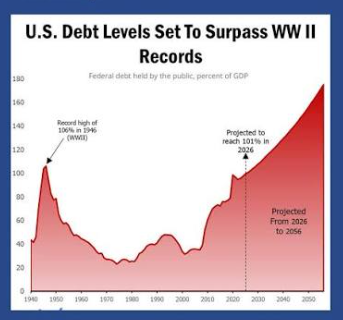
For the first time since the aftermath of World War II in 1946, the United States national debt held by the public has officially surpassed 100% of the entire economic output of the country.
Here is the deep data dive into the latest baseline projections, why this time is structurally different from 1946, and exactly how you need to position your portfolio for the macroeconomic fallout.
The sheer velocity of this debt accumulation is alarming. Based on the latest 2026 Congressional Budget Office reports:
Debt held by the public just crossed 101 percent of GDP and is projected to shatter the all time 1946 record of 106 percent by 2030.
By 2036, the debt is projected to hit a massive 120% of GDP.
The government is currently spending roughly 1.33 dollars for every single dollar it collects in revenue.
The cost to service this debt is spiraling. Net interest payments are projected to double from nearly 1 trillion dollars today to over 2.1 trillion dollars by 2036, effectively consuming a massive share of all federal revenue.
We are witnessing a complete structural failure of fiscal policy. When the United States crossed this threshold in 1946, the macroeconomic setup was entirely different. We had just won a global war, our demographics were incredibly young, and we were entering the greatest industrial expansion in human history. We grew our way out of the debt.
Today, the exact opposite is true. We have an aging population, slowing economic growth, and mandatory entitlement spending running entirely on autopilot.
There is no mathematical way out of this through traditional taxation. The government is caught in a vicious feedback loop where higher debt requires more borrowing just to pay the rising interest. The only historical way out of a sovereign debt trap of this magnitude is financial repression and systemic currency debasement. They are mathematically forced to inflate the debt away.
Do not hold your capital in assets that can be diluted by a central bank. Position into structural scarcity. When sovereign debt spirals, fiat debasement is the only release valve. You must overweight your portfolio in assets with fixed supplies, specifically Bitcoin, premium equities, and tokenized real world assets.
Monitor the interest expense ratio. Watch the percentage of tax revenue consumed solely by interest payments. As this number climbs, the Federal Reserve will eventually be forced into yield curve control to cap borrowing costs, which will trigger a massive risk-on liquidity cycle.
Ignore the political theater. Neither side of the political aisle has a credible mathematical plan to cut the trillions required to balance this budget. Trade the data, not the politics.
The era of fiscal restraint is over. Respect the macroeconomic math, protect your purchasing power, and position your capital for the inevitable liquidity injections.
SAUDI ARABIA EXITS THE ANTI DOLLAR BLOCKCHAIN
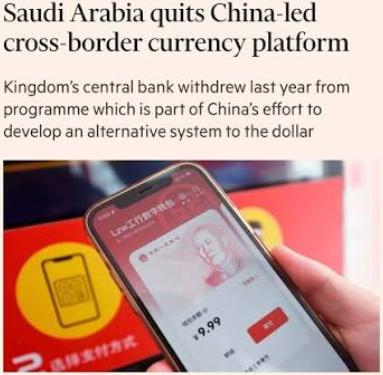
Saudi Arabia has officially withdrawn from Project mBridge, the cross border blockchain payment system in which China is a key participant. The global currency war just took a massive turn.
Here is the deep data dive on why the Saudi Central Bank just pulled the plug and exactly how this impacts the macroeconomic landscape.
The timeline and mechanics of this withdrawal are critical:
+ The Saudi Central Bank confirmed its withdrawal from mBridge, stating it completed its proof of concept phase and is no longer a participating member.
+ The mBridge platform was originally developed by the Bank for International Settlements alongside China, Hong Kong, Thailand, and the United Arab Emirates to facilitate direct foreign exchange using Central Bank Digital Currencies.
+ Saudi Arabia only joined as a full participant in June 2024. Their exit effectively removes a massive global oil exporter from the network.
This follows recent reports that the Bank for International Settlements was considering shutting down the pilot platform because BRICS nations were discussing using the technology to evade the United States financial system and SWIFT.
For the past two years, the loudest narrative in global finance was imminent de dollarization. The thesis was simple: China and Saudi Arabia would use a unified blockchain to trade oil outside of the SWIFT system, breaking the petrodollar monopoly.
This withdrawal completely fractures that narrative.
Technology cannot override geopolitics. Building a decentralized ledger to trade digital currency is mathematically easy. But officially abandoning the US Dollar settlement layer carries diplomatic consequences that Saudi Arabia is clearly not willing to accept right now. By stepping away from mBridge, Riyadh is signaling that while they want technological modernization, they are not ready to openly participate in a direct assault on the American financial system.
The macro environment is unforgiving.
OPENAI IS SPENDING $856 BILLION ON COMPUTE. THE CAPEX WAR HAS ESCALATED
OpenAI just leaked its internal financial projections, and the numbers are completely redefining the scale of the artificial intelligence arms race. They are preparing to spend nearly $900 billion on data centers and computing infrastructure by the end of the decade.
As a data driven analyst, the sheer velocity of this capital deployment is historic. Based on the latest internal presentations:
+ OpenAI projects a cumulative compute and infrastructure spend of $856 billion by the end of 2030.
+ To fund this, they are forecasting a negative free cash flow of $278 billion between 2026 and 2030. Despite projected revenue climbing to $350 billion annually by 2030, the physical infrastructure costs will entirely dwarf their income.
+ To bridge this staggering financing gap, OpenAI is already in early talks for a new funding round that could value the company at over $1.2 trillion, a massive premium over its recent $852 billion valuation.
=> The traditional venture capital model is dead at this frontier. You cannot fund an $850 billion infrastructure buildout with standard equity rounds. OpenAI is transitioning from a software research lab into a sovereign scale infrastructure developer. By committing this much capital to physical data centers and energy grids, they are attempting to build an insurmountable hardware moat.
My analytical take is that the frontier AI models of the 2030s will not be constrained by algorithmic breakthroughs, they will be constrained by physical gigawatts. The fact that OpenAI expects $278 billion in negative cash flow proves that they view short term profitability as a distraction. They are playing a winner take all game for the cognitive infrastructure of the internet, and they are willing to burn hundreds of billions to lock out the competition.
Do not get distracted by the consumer chatbots. The real alpha is in the physical layer. Stop focusing on software margins. If the leading AI company on earth is preparing for five years of massive negative cash flow, the software application layer will be heavily commoditized.
Position in the physical supply chain. That $856 billion has to flow somewhere. It is going to commercial real estate, cooling systems, fiber optics, and energy generation. Align your capital with the legacy industrials and utility providers that will physically build these data centers.
Track the energy bottleneck. OpenAI's data center projects are targeting tens of gigawatts of capacity. Companies that can provide sustainable, baseload power to these hyper-scale facilities will capture a massive premium over the next five years.
The artificial intelligence war has moved from the cloud to the concrete. Follow the capital expenditure, understand the scale of the hardware buildout, and position your portfolio for the infrastructure supercycle.
US DEBT CROSSES 100 PERCENT OF GDP
For the first time since the aftermath of World War II in 1946, the United States national debt held by the public has officially surpassed 100% of the entire economic output of the country.
Here is the deep data dive into the latest baseline projections, why this time is structurally different from 1946, and exactly how you need to position your portfolio for the macroeconomic fallout.
The sheer velocity of this debt accumulation is alarming. Based on the latest 2026 Congressional Budget Office reports:
Debt held by the public just crossed 101 percent of GDP and is projected to shatter the all time 1946 record of 106 percent by 2030.
By 2036, the debt is projected to hit a massive 120% of GDP.
The government is currently spending roughly 1.33 dollars for every single dollar it collects in revenue.
The cost to service this debt is spiraling. Net interest payments are projected to double from nearly 1 trillion dollars today to over 2.1 trillion dollars by 2036, effectively consuming a massive share of all federal revenue.
We are witnessing a complete structural failure of fiscal policy. When the United States crossed this threshold in 1946, the macroeconomic setup was entirely different. We had just won a global war, our demographics were incredibly young, and we were entering the greatest industrial expansion in human history. We grew our way out of the debt.
Today, the exact opposite is true. We have an aging population, slowing economic growth, and mandatory entitlement spending running entirely on autopilot.
There is no mathematical way out of this through traditional taxation. The government is caught in a vicious feedback loop where higher debt requires more borrowing just to pay the rising interest. The only historical way out of a sovereign debt trap of this magnitude is financial repression and systemic currency debasement. They are mathematically forced to inflate the debt away.
Do not hold your capital in assets that can be diluted by a central bank. Position into structural scarcity. When sovereign debt spirals, fiat debasement is the only release valve. You must overweight your portfolio in assets with fixed supplies, specifically Bitcoin, premium equities, and tokenized real world assets.
Monitor the interest expense ratio. Watch the percentage of tax revenue consumed solely by interest payments. As this number climbs, the Federal Reserve will eventually be forced into yield curve control to cap borrowing costs, which will trigger a massive risk-on liquidity cycle.
Ignore the political theater. Neither side of the political aisle has a credible mathematical plan to cut the trillions required to balance this budget. Trade the data, not the politics.
The era of fiscal restraint is over. Respect the macroeconomic math, protect your purchasing power, and position your capital for the inevitable liquidity injections.
SAUDI ARABIA EXITS THE ANTI DOLLAR BLOCKCHAIN
Saudi Arabia has officially withdrawn from Project mBridge, the cross border blockchain payment system in which China is a key participant. The global currency war just took a massive turn.
Here is the deep data dive on why the Saudi Central Bank just pulled the plug and exactly how this impacts the macroeconomic landscape.
The timeline and mechanics of this withdrawal are critical:
+ The Saudi Central Bank confirmed its withdrawal from mBridge, stating it completed its proof of concept phase and is no longer a participating member.
+ The mBridge platform was originally developed by the Bank for International Settlements alongside China, Hong Kong, Thailand, and the United Arab Emirates to facilitate direct foreign exchange using Central Bank Digital Currencies.
+ Saudi Arabia only joined as a full participant in June 2024. Their exit effectively removes a massive global oil exporter from the network.
This follows recent reports that the Bank for International Settlements was considering shutting down the pilot platform because BRICS nations were discussing using the technology to evade the United States financial system and SWIFT.
For the past two years, the loudest narrative in global finance was imminent de dollarization. The thesis was simple: China and Saudi Arabia would use a unified blockchain to trade oil outside of the SWIFT system, breaking the petrodollar monopoly.
This withdrawal completely fractures that narrative.
Technology cannot override geopolitics. Building a decentralized ledger to trade digital currency is mathematically easy. But officially abandoning the US Dollar settlement layer carries diplomatic consequences that Saudi Arabia is clearly not willing to accept right now. By stepping away from mBridge, Riyadh is signaling that while they want technological modernization, they are not ready to openly participate in a direct assault on the American financial system.
The macro environment is unforgiving.