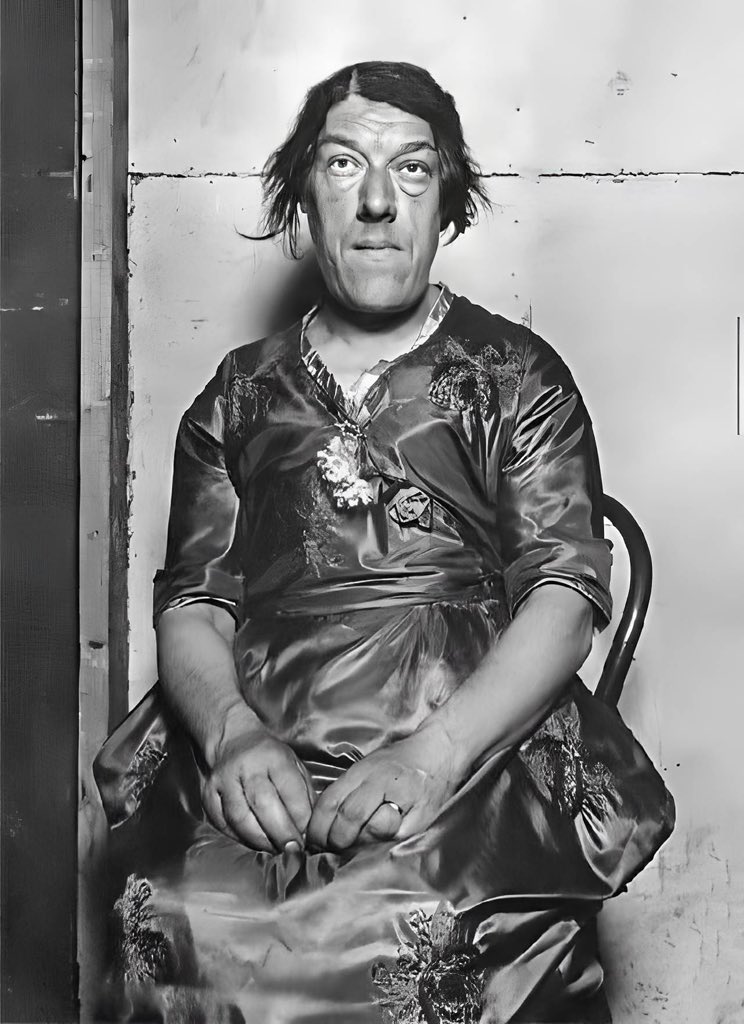
In the early 1900s, Mary Ann Bevan was a nurse, a wife, and a mother of four.
Then her life changed in a way she could never have imagined.
After marrying Thomas Bevan, Mary began suffering from severe headaches, worsening eyesight, and painful changes to her hands, feet, and face. She was eventually diagnosed with acromegaly, a rare condition caused by excessive growth hormone.
The symptoms became so severe that she could no longer return to nursing.
Then, in 1914, her husband suddenly died.
Mary was left alone to support four children—and she had very few ways to earn money.
So she made an extraordinary decision.
Instead of allowing strangers to mock her for free, she decided to make them pay.
In 1919, she entered an “ugliest woman” competition. She later claimed that the public wanted her to win, but the judges awarded the prize to someone else.
A few months later, Mary began appearing in sideshows.
She toured Britain, allowing crowds to stare at the physical effects of her illness. During one tour through Scotland, thousands of postcards featuring her image were sold.
But Mary wasn’t simply being exploited.
She learned how to negotiate.
When managers failed to pay her properly, she took them to court. She even secured a contract stating that she had to be kept clean and presentable and could not be unnecessarily exposed to public attention.
And despite everything, people who met her often remembered something completely different from the cruel label attached to her.
Mary had a warm personality, a beautiful voice, and a sense of humor. She loved talking about her children and proudly showed visitors their photographs.
Her son eventually joined the British Navy, something she spoke about with enormous pride.
When someone asked whether any of her children wanted to follow her into the sideshow business, Mary joked:
“No, no! One prize winner in the family is enough.”
In 1922, she entered another “ugliest woman” competition—and this time, she actually won.
Her prize was £20 and a blue ribbon.
The woman who had been turned into a spectacle by strangers had found a way to turn their cruelty into a livelihood for the four people she loved most.
Mary Ann Bevan died in 1933.
But the most important thing she left behind wasn’t the title of “ugliest woman.”
It was the life she built for her children—and the fact that, behind the sideshow poster, there was a mother who refused to let the world decide what her worth was.
This was one of the last known photographs of Travis Alexander.
It was taken in the shower at his Arizona home in June 2008—just hours before his life would come to a violent end.
Alexander was later found dead inside the house, and the investigation quickly focused on his former girlfriend, Jodi Arias.
What followed became one of the most closely followed mu*der trials in the United States. Arias initially denied involvement, then gave investigators multiple accounts before eventually admitting she had k*lled Alexander, claiming self-defense.
Prosecutors presented evidence that Alexander had suffered numerous injuries before his death. In 2013, Arias was convicted of first-degree mu*der and later sentenced to life in prison without the possibility of parole.
A simple photograph taken during an ordinary moment would become a haunting reminder of how little Alexander knew about what was coming next.
In 1991, Patricia Stallings was sentenced to life in prison for allegedly poisoning her infant son with antifreeze.
But while she was behind bars, she gave birth to another baby. He was immediately placed in foster care—and weeks later, he became seriously ill with symptoms almost identical to those that had killed his older brother.
There was just one problem: Patricia had never been in contact with him.
Doctors eventually discovered the real cause: methylmalonic acidemia, a rare inherited metabolic disorder that can produce chemical findings resembling ethylene glycol, the main ingredient in antifreeze.
Scientists reexamined her first son’s blood and found that the original laboratory results had been misinterpreted. The evidence that had helped convict Patricia was wrong.
She was released in 1991, and prosecutors dropped the case after concluding that her son had not been poisoned.
A mother lost her child, her freedom, and nearly two years of her life—because a rare disease looked like murder.
On September 11, 2001, United Flight 93 was hijacked while flying from Newark to San Francisco.
But the passengers soon learned what had happened to the other hijacked planes. They realized their aircraft could also be turned into a weapon.
Led by passengers including Todd Beamer, Tom Burnett, Mark Bingham and Jeremy Glick, they decided to fight back.
At 9:57 a.m., they stormed toward the cockpit. The hijackers fought to keep control, but the struggle continued until the aircraft plunged into a field near Shanksville, Pennsylvania, at 10:03 a.m.
All 44 people aboard were k!lled.
The plane never reached Washington. The hijackers had intended to strike a major U.S. target, and the passengers’ decision to fight back almost certainly prevented Flight 93 from being used as another weapon.
They knew they might not survive.
They fought anyway.
For nearly two years, a 9-year-old boy in France lived alone in an apartment while his mother lived just a few kilometers away with her partner.
She reportedly visited him only from time to time.
The boy had no proper heating or hot water, and he was largely left to take care of himself.
His food was mostly whatever he could find—including cake and canned goods.
And yet, every morning, he did something that would eventually help reveal what was happening.
He went to school.
Teachers described him as a good student, and for a long time, nobody realized that he was essentially living alone.
His apartment was only about 5 kilometers from where his mother lived, meaning she was close enough to visit—but apparently chose not to provide him with regular care.
Authorities eventually discovered the situation, and the boy was taken into protective care.
The most disturbing part isn’t simply that a child was left alone.
It’s that he managed to maintain the appearance of a normal life—going to school, studying and interacting with people—while going home every night to an empty apartment.
Sometimes, the most serious signs of neglect aren’t visible from the outside.
One of history’s most terrifying torture stories involves a cage of rats placed against a restrained victim.
According to later accounts, the cage was sometimes heated, supposedly driving the trapped animals into a desperate attempt to escape. Other versions claim starvation was used to make the rats attack.
But historians have questioned how often this method was actually used, and some famous descriptions may be exaggerated or poorly documented.
What makes the story endure is the idea behind it: torture wasn’t only about physical pain. It was about creating fear so extreme that everyone watching would understand the consequences of resistance.
Whether every detail is true or not, the legend reflects a very real part of history—how rulers and authorities have used terror as a tool of control.
Carmen Andrade married Daniel McCormack in October 2024 after the two met on Hinge in 2020.
What makes their story extraordinary is that Carmen is conjoined to her twin sister, Lupita, meaning the sisters share parts of their bodies and internal systems.
Daniel is Carmen’s husband, and Lupita has always been clear about that boundary. She attended their intimate Connecticut wedding and has described her relationship with Daniel as being like family.
A year later, Carmen and Daniel are still together.
Their story is a powerful reminder that love, marriage, and family don’t always fit into the way we expect them to.
What do you think makes a relationship truly work?
For 44 days, a 17-year-old girl was held captive while her family desperately believed she might still come home.
Her name was Junko Furuta.
And what happened to her became one of Japan’s most notorious criminal cases.
In November 1988, Junko was a 17-year-old high-school student living in Saitama Prefecture.
She studied, worked part-time, and was saving money for a graduation trip.
Then, on November 25, everything changed.
While Junko was riding home from work, a group of teenage boys targeted her.
One of them, Hiroshi Miyano, had previously shown interest in Junko. After she rejected him, he and his accomplices abducted her.
They took her to a location in Tokyo and threatened her family, making her too frightened to resist.
Then they began abusing her.
What followed lasted 44 days.
Junko was repeatedly assaulted, beaten, starved, and tortured.
She tried to escape.
But every attempt failed.
At one point, her parents even reported her missing.
But the kidnappers discovered this and forced Junko to call home.
She was made to tell her parents that she had run away willingly and didn’t want them looking for her.
Believing their daughter was safe somewhere, her family eventually withdrew the missing-person report.
Meanwhile, Junko remained trapped.
Her condition became worse with every passing day.
She was severely injured and increasingly weak.
The abuse continued even when she was barely able to move.
And despite everything she was suffering, she survived for more than a month.
Until January 4, 1989.
That night, Junko died.
The perpetrators then placed her body inside a large drum, filled it with concrete, and abandoned it at a construction site in Tokyo.
For a while, they believed they had hidden the evidence.
But they hadn’t.
On March 29, police investigating an unrelated case questioned four teenage boys.
During questioning, their stories didn’t match the case investigators were working on.
But all four boys independently described the same horrifying crime.
Police followed the information.
They searched the construction site.
And they found the concrete-filled drum.
Inside was Junko Furuta.
The investigation eventually led police to the four main perpetrators.
Their ages ranged from 16 to 18.
And because they were juveniles when the crime happened, Japan’s juvenile justice system played a major role in how the case was handled.
The sentences were far shorter than many people expected given the brutality of the crime.
That became another source of public anger surrounding the case.
But perhaps the most heartbreaking part isn’t the courtroom.
It’s what happened before it.
Junko’s parents had reported her missing.
They were looking for their daughter.
They had no idea she was being held only miles away.
For 44 days, she was trapped while the people who loved her believed she might still be alive somewhere.
Junko was only 17.
She should have been thinking about graduation, friends, and her future.
Instead, her life ended in captivity.
The case remains a dark reminder that danger doesn’t always announce itself.
Sometimes it begins with something as ordinary as a ride home.
And sometimes, the most important warning sign isn’t what someone does in public—
but what they are capable of doing when they think nobody is watching.
Junko Furuta was 17 years old.
And she should have had an entire life ahead of her.
Imagine flying across the Atlantic at 39,000 feet…
and suddenly realizing your airplane has almost no fuel left.
No airport nearby.
No engines.
Just a massive ocean thousands of feet below you.
That’s exactly what happened to Air Transat Flight 236.
On August 24, 2001, an Airbus A330 carrying 306 people was flying from Toronto to Lisbon.
Everything seemed normal.
Passengers were sleeping, watching movies, and waiting for breakfast.
But underneath the aircraft, a fuel leak was quietly getting worse.
The problem had actually started days earlier, when a replacement engine was installed.
Because of a configuration mismatch between the engine and the aircraft, a hydraulic line and a fuel line ended up rubbing against each other.
Flight after flight, vibration slowly damaged the fuel line.
Nobody noticed.
Then, over the Atlantic, it finally cracked.
Fuel began pouring out at an enormous rate.
The cockpit didn’t have a direct fuel-leak warning system, so the pilots initially didn’t realize what was happening.
They noticed the fuel imbalance and opened a crossfeed valve, believing they were correcting the problem.
But that decision sent even more fuel toward the leak.
And now the situation became critical.
The crew eventually realized they were losing fuel much faster than expected.
Their destination, Lisbon, was no longer reachable.
So Captain Robert Piché and First Officer Dirk de Jager turned toward the Azores.
There was just one problem.
They were still hundreds of miles away.
Then, at around 34,000 feet…
the right engine stopped.
The aircraft was now flying with only one engine.
Thirteen minutes later…
the second engine stopped too.
Flight 236 had become a giant glider.
There was no engine noise.
The cabin went dark.
And below them was nothing but the Atlantic Ocean.
The crew prepared the passengers for a possible ditching.
People put on life jackets.
Some passengers prayed.
Others said goodbye to the people they loved.
But Captain Piché had one advantage.
He had experience as a bush pilot and had previously dealt with challenging landings away from conventional airports.
He wasn’t going to give up.
Using the aircraft’s remaining energy, the pilots carefully guided the powerless A330 toward Lajes Air Base in the Azores.
And then…
they saw the runway.
The aircraft touched down hard.
The tires were badly damaged.
There were sparks and flames around the landing gear.
But the plane stopped.
And unbelievably…
all 306 people survived.
Flight 236 had flown for roughly 19 minutes without engine power, covering about 65 nautical miles while gliding toward the Azores.
It became one of the most remarkable emergency landings in commercial aviation history.
But there was another twist.
After the landing, it was revealed that Captain Piché had previously been imprisoned in the United States for his involvement in a drug-smuggling operation.
The man who had once been a convicted smuggler had just saved 306 lives.
And that’s what makes Flight 236 so extraordinary.
The passengers didn’t survive because of one miracle.
They survived because, when almost everything went wrong, the pilots still had enough control, enough altitude, and enough skill to make one final landing.
A 200-ton aircraft had lost both engines over the Atlantic…
and somehow…
it became a glider, found a runway, and landed safely.
Imagine building a website where someone could order drugs as easily as they order something from Amazon.
Now imagine the FBI spending years trying to find the person behind it.
And imagine that person wasn’t a criminal mastermind hiding in some underground bunker.
He was a 26-year-old programmer.
His name was Ross Ulbricht.
And the website he created was called Silk Road.
But before we get to Ross, there’s one thing you need to understand.
The internet you use every day is only a small part of the whole picture.
Google, YouTube, Amazon, Instagram—that’s the Surface Web.
Then there’s the Deep Web, which includes things like private emails, banking systems, medical records and password-protected databases.
And then there’s the Dark Web—a much smaller part of the internet designed to make users and websites harder to identify.
One of the technologies commonly used to access it is Tor, which routes internet traffic through multiple relays to make tracing more difficult.
And Ross Ulbricht saw an opportunity.
He had strong libertarian beliefs and wanted to create a marketplace where people could buy and sell things without government control.
In 2011, he launched Silk Road.
At first, it was tiny.
But then people discovered they could buy illegal drugs through it using Bitcoin.
And suddenly, Silk Road exploded.
Drugs were being shipped through ordinary mail.
Sellers had ratings.
Customers could leave reviews.
There was even an escrow system to protect buyers.
Ross had basically taken the business model of Amazon…
and applied it to the black market.
The site eventually attracted well over 100,000 buyers, while hundreds of millions of dollars in illegal transactions passed through the marketplace. (Justice Department)
Ross operated under a mysterious online identity:
Dread Pirate Roberts.
And for a while, law enforcement couldn’t figure out who he was.
But then Ross made a mistake.
A very small mistake.
An IRS investigator went back through old internet posts from the early days of Silk Road.
Eventually, investigators found a connection between an early Silk Road post and an email address linked to Ross Ulbricht.
That tiny digital footprint helped crack the mystery.
By 2013, investigators had identified him.
And then came the arrest.
October 1, 2013.
Ross was sitting inside a public library in San Francisco, working on his laptop.
He had no idea that federal agents were watching him.
Then, while he was logged into Silk Road, agents moved in.
They grabbed the laptop before he could shut it down.
And on the screen was the evidence they needed.
The man behind the mysterious Dread Pirate Roberts was finally caught.
Ross was convicted in 2015 and sentenced to life in prison. (FBI)
But here’s where the story gets even stranger.
Ross wasn’t only accused of running an illegal marketplace.
Prosecutors presented evidence that he had solicited murders-for-hire to protect Silk Road, although none of those murders were actually carried out. (FBI)
For years, Ross remained behind bars.
Then, in January 2025, something happened that almost nobody expected.
President Donald Trump granted Ross Ulbricht a full and unconditional pardon.
After more than a decade in prison…
Ross Ulbricht was free. (Justice Department)
And that’s what makes the Silk Road story so fascinating.
One young programmer created a website that changed the Dark Web forever.
The FBI eventually found him through a tiny mistake he made online.
He went from being sentenced to spend the rest of his life in prison…
to walking free more than a decade later.
The internet was supposed to give people anonymity.
But Ross Ulbricht’s story proved something very different:
**You can hide behind technology for a while.
But eventually, one small mistake can reveal who you really are.**