Twitter page for the Veterans Trader Project. The VTP aims to turns Veterans into Traders, and turn Traders into Veterans of Financial Markets. See link below.
Bet you can't watch 5 minutes of this without having a trading breakthrough. - MUST BOOKMARK
Mark Douglas gives a 2-hour masterclass on Trading Psychology.
Watch this instead of Netflix over weekend.
There are two reasons I still use X
1. It is important for traders to constantly preach "best practices" to themselves -- I mean daily, hourly, trade by trade
2. Putting thoughts into typed words helps me work through the details of a trade
There is a third -- and that is rare courteous and thoughtful engagement. These are far rarer than 10 or 15 years ago
Today, everyone's a genius
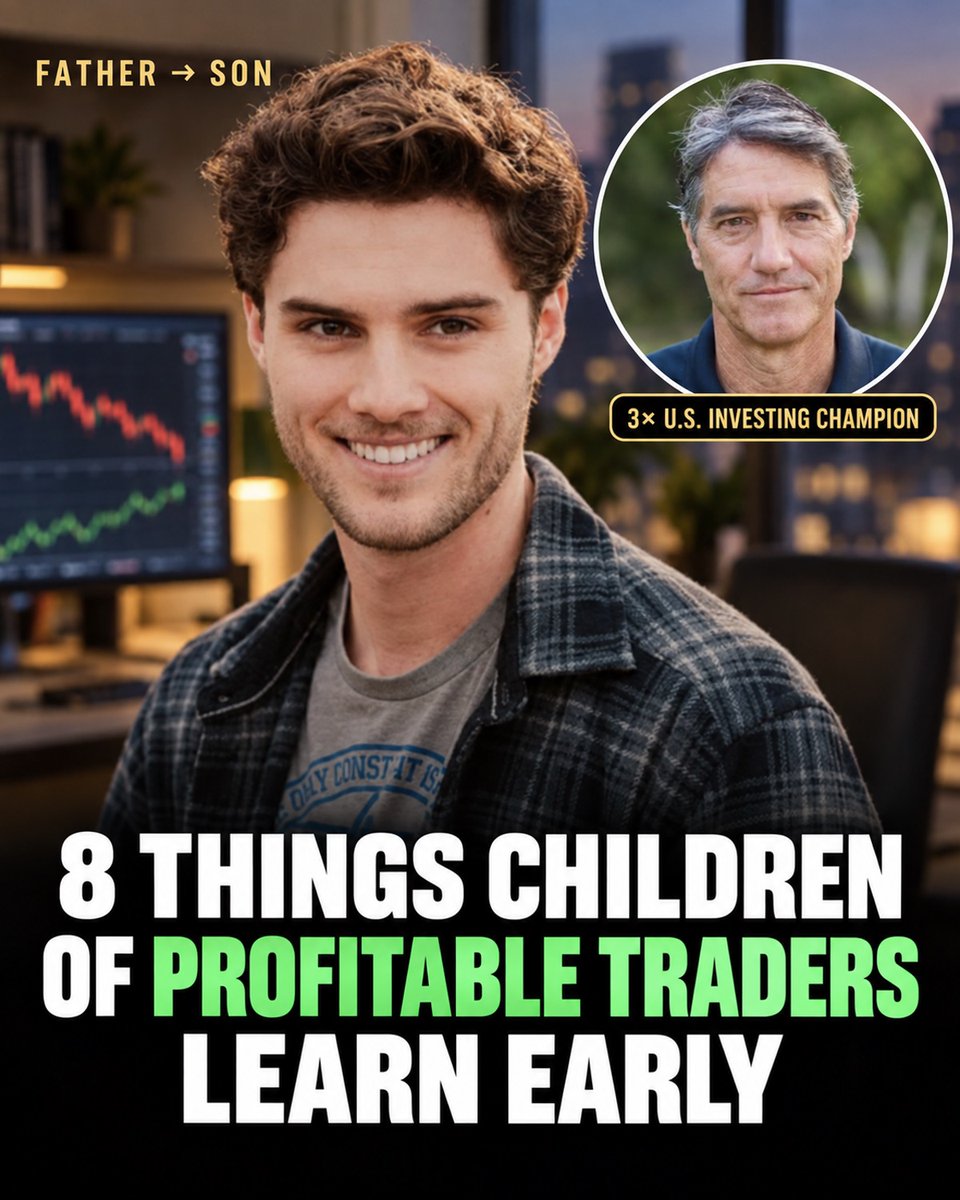
David Ryan won the US Investing Championship 3 times.
His son Sean learned to trade before most kids learn to drive, and returned 132% in a year the market crashed.
Here are 8 things every child of a profitable trader learns early 👇
My biggest winning trades often look surprisingly similar.
My mediocre trades don't.
That's one reason I study my biggest winners over and over again.
For every year, I keep a book of my own trades. I collect the screenshots and data, print them out, keep them on my desk and regularly go through them again.
For the biggest winners, I study:
* Setup and setup quality
* Prior price move
* Fundamentals
* Market environment
* Entry
* Exit and partial exits
I'm trying to answer one important question:
What actually made me money here?
Was this simply a lucky outcome—or was there something I can repeat?
Over the years, I've noticed how similar my biggest winners are.
Strong market.
Strong stock.
Clean setup.
Clear entry.
Easy to trade.
The mediocre trades can be mediocre for countless different reasons. My biggest winners tend to share the same characteristics again and again.
Of course, I study my losers too. They show me what I need to remove.
But my biggest winners show me what I want to repeat.
You need both sides of the review.
The best trading advice I could give is, ironically, to learn to reduce your activity. Let the action come to you, don't chase it.
Always seek for a reason not to take a trade, and learn to sell really slowly and gradually, than abruptly.
For roughly my first 10 years as a trader, I spent countless hours studying charts.
Looking back, I wish I had spent more of that time studying myself.
Once you have an edge and 5–10 years of experience, another 100 hours of chart study may not be where your biggest improvement comes from.
Your behavior may be the bigger opportunity.
Today, I spend 15–30 minutes almost every day on self-coaching:
* Journaling
* Reviewing trades
* Writing down mistakes
* Recording successes and accomplishments
* Preparing myself mentally
On weekends, I spend another 30–45 minutes reviewing my trades and journal entries.
One area where this changed me significantly is patience.
Writing down why I need to wait, what impatience feels like, and what happens when I act on it has helped me enormously during difficult market periods.
You can understand intellectually that you need to be patient.
But repeatedly confronting your own behavior is different.
If you already have an edge and years of market experience, don't automatically assume your next breakthrough will come from another setup, chart or indicator.
Spend more time working on the person executing the system.
I wish I had started doing that much earlier.
“Traders need 2 levels of belief.
On the level of one trade, you have to firmly believe that anything could happen.
On the level of 30 trades, you have to believe with every core of your being, that your edge will work out. And that’s difficult.
All of us understand probability at an intellectual level, but understanding probability at a stomach level is quite something.”
Studying a curated, done-for-you, model book feels like learning.
Research says that feeling is a trap. It's like reading the answer-key to a test
Do the hard work!
Position sized too large: checking charts at 2am, texting the broker, calculating breakevens
Position sized correctly: checked it in the morning, it either worked or it didn't, went back to sleep
The quality of your sleep is real-time feedback on your position sizing.
A futures trader I knew would say:
"My job is not to know why. My job is just to sell and buy."
It kept him trading the signals he read out of the noise, instead of trying to fathom the reasons behind every move, which always got him into trouble.
Jesse Livermore had a simple idea about position sizing:
1) Start small.
2) If the trade goes against you, take a small loss.
3) If price confirms your idea, add to the position.
4) Keep adding as the trend strengthens.
5) Never average down.
The key idea:
Risk less when uncertainty is high.
Commit more when the market proves you right.
The goal isn’t to catch the lowest price.
It’s to increase your position as the probability of being right improves.
Livermore on overtrading
“There is the plain fool, who does the wrong thing at all times everywhere, but there is the Wall Street fool, who thinks he must trade all the time. No man can always have adequate reasons for buying or selling stocks daily, or sufficient knowledge to make his play an intelligent play.”
The mistake is not being wrong once , it is feeling the need to always be in a trade. Markets do not offer good opportunities every day, and forcing trades leads to poor decisions.
The lesson for traders:
=You do not need to trade every day
=Good trades are rare
=Waiting is part of the job
The best traders act only when they have a clear reason.
Doing nothing is often the smartest position.
$QQQ
We're back with the Monday Market Update at 1230. Join us on the zoom link within the Meetup Invite. Plenty to discuss today.
Alternatively we also try livestreaming it through YouTube on the https://t.co/cIj7HomWEA
Paul's Monday Market Update https://t.co/mSMkvFb6Hy
Hope is an expensive thing
Just like you cant simply hope to get a great job
You can’t hope for to turn a losing position into a win.
Without proper action or game plan- you’re not gonna see a difference.