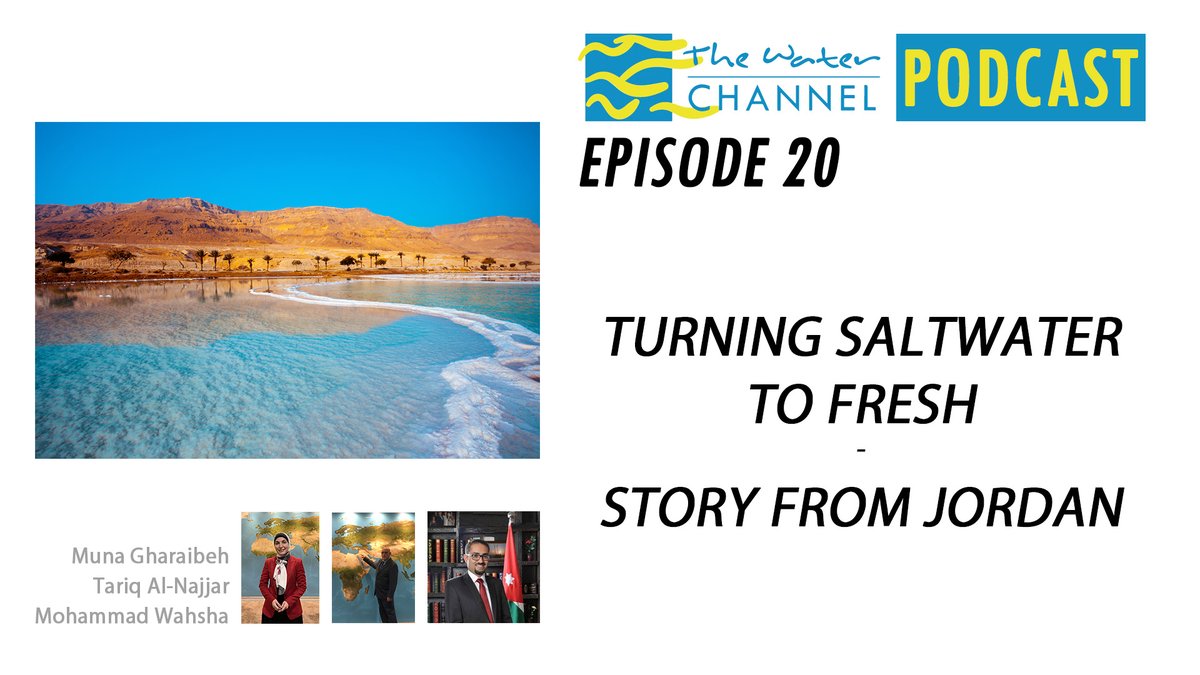
Our latest podcast is out: Story from Jordan on what it takes to turn saltwater to fresh. We learn what it takes to fight water scarcity.
Listen on:
Spotify https://t.co/oskLtlMRNO
Apple podcast https://t.co/h1n9C00oio
TheWaterChannel: https://t.co/O3bRx9JoxO
Food prices in Lebanon have increased by 396% in just one year1. As of early 2025, 30% of the Lebanese population faces food insecurity. Adding to these challenges, the MENA region – including Lebanon – is among the most water scarce areas in the world.
https://t.co/6EBcnILDgT
To make ends meet for the family, Sewnet worked as a wage laborer in construction for 13 years. It was hard perilous work. Ten years ago, she shifted from construction to becoming a washerwoman, washing clothes for families in Bahir Dar Town in Ethiopia.
https://t.co/7PpuV6TDOc
In the rangelands in Balochistan there are three grazing systems: nomadic (following a long route), transhumant (moving between high land and lowland) and sedentary (grazing around one’s village).
https://t.co/aHkpBWw5Gx
Covering nearly 90% of the Balochistan's area, rangelands are not just the source of grazing and biomass, but also home to biodiversity, natural beauty, an absorber of flash floods and buffer to droughts.
https://t.co/Jx6cEQQiil
Washing clothes is key to life and defines hygiene and health. In most of rural Amhara (Ethiopia), clothes are washed manually in rivers or streams, with women often walking long distances
https://t.co/16mYT9eE3N
The chars, temporary river islands formed by the shifting sediments of the Brahmaputra, are home to over a million people in Bangladesh.
https://t.co/3QKZIkQy1J
ORDA regrants 70% of the €1 million it receives directly to local communities. The core focus is to restore six severely degraded micro-watersheds covering 2,735 hectares and improving the livelihoods of Koti’s 5,498 residents.
https://t.co/CzXbZ3l9MQ
RtF works by local NGOs who serve as hubs in each region. These hubs regrant 70% of the €1 million they receive directly to local communities, enabling those communities to lead their own adaptation efforts.
https://t.co/Y0t5v1DfDk
Using agricultural waste as a source to develop bio stimulants is a real game-changer. Due to the farm-to-fork and EU Green Deal strategy, the use of chemical pesticides is to be reduced by 50% and nutrient losses are to cut by at least 50% by 2030.
https://t.co/jQVuXS9m4v
The Awer have developed the ability to whistle to birds, in particular the indicator indicator or the honey guide.
Learn more about this simbiosis through the link.
https://t.co/FfIvF6pLkj
Barring some communities on the western border where rain fell in brief storms, the vast hinterland of Afar this year is bone-dry and thirsty.
Learn more about how the population has overcome these dry period through the link.
https://t.co/GohH77pTiY
CO₂ impact depends on the surface it interacts with. Forests, oceans & urban areas have different effects on radiation absorption and emission, making climate sensitivity a constantly shifting target.
https://t.co/e5uSmS9lAP₂-ecosystem-restoration-as-a-climate-game-changer/
Mountainous regions generate floods, and these often cause huge economic, social and environmental damage.
Learn more about it through the link.
https://t.co/wDftrK6T98
While they provide significant ecological benefits, such as preventing soil erosion, improving biodiversity, and enhancing water retention, hedge's advantages are not always immediately visible.
Learn more about their advantages in our new blog.
https://t.co/8ugCYp1rMA
Across the world, scientists and innovators are turning to enzymatic biotechnology as a powerful tool to enhance soil regeneration and carbon sequestration.
Learn more about it through the link.
https://t.co/whOwR8pHNH
Assigning a financial value to nature is an example of the human need to quantify and operationalize abstract ideas into tangible facts; think of everything from happiness indices to social credit scores.
Learn more about it through the link.
https://t.co/wNjabL05MF
Since 2008, APIL has led an innovative project aimed at strengthening the economic autonomy of rural women in the Sanmatenga province, in Burkina Faso, through sheep fattening.
Learn more about it following the link
https://t.co/CgmJH7GUR2
Chickpeas are very suitable for rain-fed and flood-fed system in arid areas, where moisture comes occassionally and crops then need to thrive on the moisture they can access.
Learn how its cultivation became popular in Pakistan following the link.
https://t.co/EZolX6p4MJ
What if one small shift in the way we farm could solve multiple problems at once—improve nutrition, protect crops from disasters, control erosion, and increase income for struggling smallholding tribal farmers?
Learn more about it following the link.
https://t.co/vHwIuBhkr6