More rain. Less water. That's not a typo; it's what a new study shows.
Fewer, more intense storms mean greater evaporation and less percolation.
Using total rainfall as a proxy for water availability, may no longer hold up.
Learn more here: https://t.co/P5HaRULB3u
$5.1 billion. That's the annual price tag natural disasters are now putting on US agriculture.
A new report breaks down the costs using FEMA and USDA data going back to 1996.
Read more about the study in our latest blog: https://t.co/14fuDFbh5o
#Agriculture#Drought
$46 million in funding available!
California is offering grants to address the bacteria, trash, and sediment problems in the Tijuana River and New River at the US/Mexico border.
Applications close August 31. Learn more: https://t.co/5Ce7TUOYU9
#WateFunding#TheWaterReport
Regulatory costs for California farmers have increased by over 1,300% in less than two decades.
These expenses now consume 12.6% of total production costs, placing immense pressure on the state’s agricultural backbone.
📘 Read the blog
https://t.co/AI0bkoPIQZ
#TWR
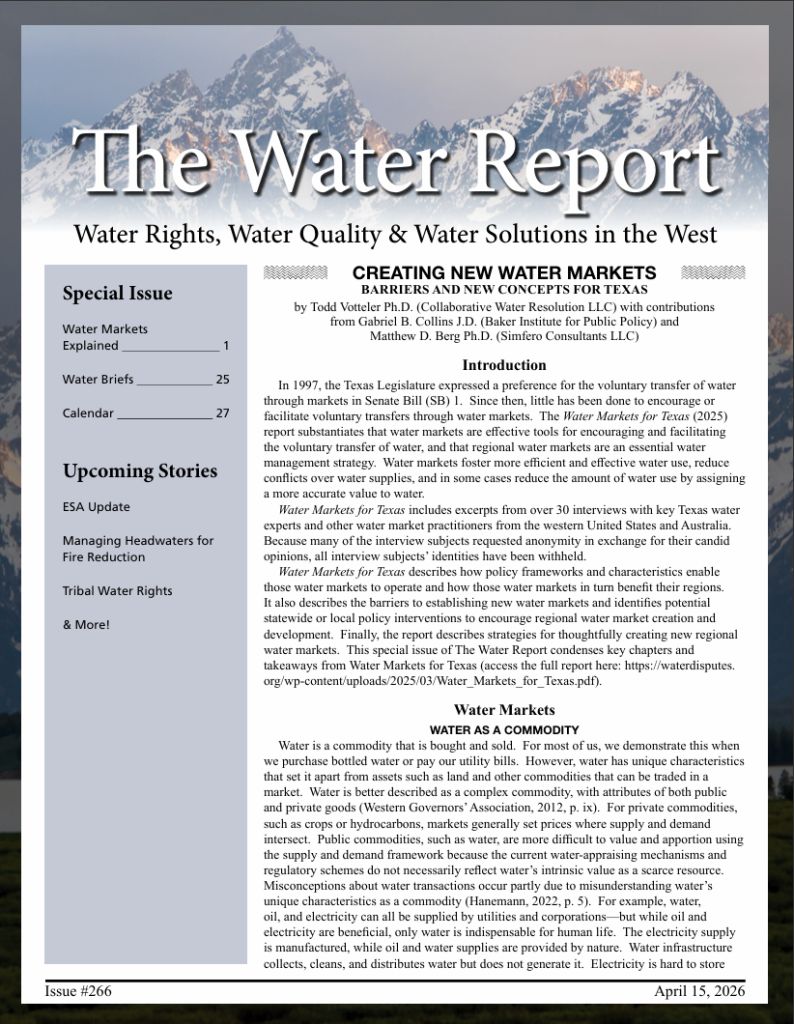
Is your region prepared for water competition? Water markets have the potential to move water to where it is most valued.
-Learn what defines a "successful" water market.
-Identify the barriers that can prevent markets.
-Understand potential statewide/local policy interventions
A new AI-driven map reveals the US sits on 306,500 cubic kilometers of groundwater. Previous models underestimated reserves by 18%. This resolution upgrade allows us to track human depletion and better manage our groundwater resources.
Learn more: https://t.co/rPDCqElubN
A recent simulation reveals that groundwater travels much deeper and further than we thought.
Hidden groundwater networks exchange water between watersheds meaning pollutants (e.g., PFAS) can persist and spread for centuries.
📘 Discover more: 👇
https://t.co/7TSA6Y3fwT
Comment on proposed increase to Oregon forest logging today! 🚨
This proposal could increase timber harvests to more than ten times their current volume.
Submit comments to the [email protected] by March 23.
Learn more: https://t.co/mdw9QwuelG
Nevada has released a new online tool that calculates the water needs of fragile Groundwater-Dependent Ecosystems (GDEs).
This enables water managers to model impacts and protect freshwater sources before ecological damage occurs.
📘Learn more 👇
https://t.co/bPYIOPphYI
A new study shows that combining specialized AI with the National Water Model corrects errors in the national model boosting flood prediction accuracy which helps communities better prepare and reduce economic impacts.
Learn more here.
https://t.co/biOAkLZB75
Breakthrough Tech Destroys Forever Chemicals
Researchers at Rice University and international partners have developed the first eco-friendly technology that can capture and destroy PFAS in water.
See how this new tech is tackling the PFAS crisis. 👇
https://t.co/EYz1MK4ewo
A new report reveals that millions across the US are served drinking water contaminated with chemicals such as chromium-6, arsenic, and nitrate.
See the contamination hot spots and potential solutions. Read our blog for details. 👇
https://t.co/LJDwJaluJn
A major legal dispute over the Rio Grande water compact may be resolved after more than a decade.
The settlement provides certainty for groundwater users and resolves federal claims.
Learn more here.
https://t.co/QmMaB8NcAR
Major Water Sale Boosts Farm Security 🤝🌾
A new deal is set to transfer water from Xcel Energy to farmers in the water-strapped Lower Arkansas River Valley.
See how this water sale protects agriculture. Read our blog for the full story. 👇
https://t.co/ZzAr8cyiZC
#AgWater
A new "Playbook" offers a practical guide for water, wastewater, and energy utilities to attract, develop, and retain a new generation of trained workers.
Read our blog for details. 👇
https://t.co/awYK6a3zk2
#TWR#TheWaterReport#WorkforceDevelopment#Utilities#WaterSector
Investing in prevention can offer huge returns, even tenfold in some cases. Learn how we can build resilience and secure our water future!
Want to know more? Visit our blog for details! 👇
https://t.co/hTg9Bwm0l9
#TheWaterReport#DroughtCrisis#ClimateAction#WaterSecurity
Drought costs could jump by over a third by 2035. 😱 The global land area affected by drought has doubled since 1900, impacting everything from agriculture to migration. Even high-income countries are feeling the heat! 🥵
But there's hope! 🌱
Wildfires Cause Lasting Water Damage 🔥💧
New research reveals wildfires pollute rivers and streams far longer than we thought. Contaminants like organic carbon, phosphorus, and turbidity stay high for years, with nitrogen and sediment loads increasing for up to eight!