https://t.co/BaHMShztMb
Well, most people were calling for 50k.
Bad news started to not affect the price.
SP ATH, and now it's time for $BTC to leave everyone behind.
I was starting to call for it 2 months ago...
Yes, we had poor confirmation, but now, now it's more confirmed IMO.
Let's see if it holds the price.
Purple line is my average entry.
If we come back, I'm gonna evaluate if I sell, but hopefully we will see a range and then an explosion.
Time will say, but the analysis is looking good and strong.
Cheers.
PD: Bought $ETH average price 2.080$ and $HYPE average price 27$.
Well, after a few weeks, my thesis was right.
I'm starting to buy a little bit of $BTC and $ETH.
I would like to buy more, but the macro must improve.
Bad news should start having less impact on the price, and good news a stronger one.
We'll see.
In the meantime, I keep farming @hibachi_xyz and @hyenatrade, and at least I feel distracted.
https://t.co/R6VHVZipY1
One of the biggest mental hurdles after making money, and something nobody really tells you, is that nothing really changes.
You imagine there will be this euphoric moment where everything feels different. In reality, it’s often the biggest anticlimax.
I’m not saying having no money is good. It isn’t. A lack of money creates its own set of problems. But having money doesn’t solve the deeper questions either.
You look around and your friends are still going to work. Your family are still going to work. Even if they’re doing well, you start to feel disconnected from the way they view time, work, and money because your reality has changed.
It’s a strange feeling.
You spend years believing freedom is the destination, then one day you have far more control over your time than most people, and you realise that everyone you care about is still busy exchanging theirs for money.
The irony is that after spending your whole life wanting more time, you suddenly have it, but very few people to spend it with.
That’s the part nobody prepares you for.
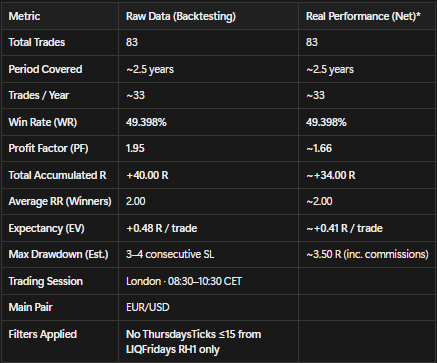
After 2 years and a half of backtesting, these are my results on the LN Strategy.
More than 150 trades analyzed.
These are the results after optimization. Now it's time for forward testing on real accounts.
Happy to see, after 6 years of constant learning and frustration, real results.
2 positive expectancy strategies, traded at different times of the day.
Low frequency, but combined, they compound.
95-100% objective strategies.
What else do you want?
Really proud of myself.
Now, time to capitalize and star rolling the ball.
Cheers!
After 2 years and a half of backtesting, these are my results on the LN Strategy.
More than 150 trades analyzed.
These are the results after optimization. Now it's time for forward testing on real accounts.
Happy to see, after 6 years of constant learning and frustration, real results.
2 positive expectancy strategies, traded at different times of the day.
Low frequency, but combined, they compound.
95-100% objective strategies.
What else do you want?
Really proud of myself.
Now, time to capitalize and star rolling the ball.
Cheers!
Win rate is one of the most overrated metrics in trading.
Risk-to-reward is what actually pays you, so let me break it down for you.
Back in 2021-2022, a lot of “furus” sold beginners on flashy stats like 90% win rate because it sounds impressive to people who don’t understand the math. New traders hear that and think consistency. I hear that and immediately ask one question:
What’s the average winner vs. average loser?
Because that’s the whole game.
I think @NickSchmidt brought up a very important topic.
Trading is not a popularity contest, and definitely not about how often you’re right. It’s simply a math problem that only YOU can solve.
And the traders who understand that early skip years of pain and frustration. I’ll give you a real example.
1) Example 1: High Win Rate, Terrible Risk/Reward
Trader A wins 9 out of 10 trades.
Sounds amazing, right?
But every winner makes +$100, and the one loser is -$1,200.
Math:
9 wins = +$900
1 loss = -$1,200
Net = -$300
So despite being right 90% of the time… he lost money.
That’s the trap.
A lot of traders build systems designed to feel good, not make money. They take tiny gains quickly, then freeze when wrong and let one loser wipe out weeks of work.
That style works… until it doesn’t. And when it breaks, it breaks violently.
--
2) Example 2: Lower Win Rate, Strong Risk/Reward
Trader B wins only 4 out of 10 trades.
Sounds mediocre to most beginners.
But each winner makes +$500, and each loser is capped at -$100.
Math:
4 wins = +$2,000
6 losses = -$600
Net = +$1,400
Wrong more often, but far more profitable.
That’s real trading.
I would rather have a 30% win rate with 5:1R setups than a 90% win rate with sloppy negative expectancy.
Why?
Because one compounds, and the other eventually implodes.
This is why risk-to-reward is my main focus every single day. Before I enter any trade, I’m asking:
- Where am I wrong?
- How much am I risking?
- Does the reward justify the attempt?
- What is the realistic upside if I’m right?
If the answer is no, I pass.
"But... how do I incorporate this into my OWN system?"
1. Tight entries at major pivots:
I’m looking for asymmetric spots where I know quickly if I’m wrong. EMA reclaim, gap support, 15/30 min pivot, weekly breakout retest, etc.
That keeps risk small.
2. Leaders in strong groups:
I want names that can actually move if I’m right. No point risking $1 to make $0.80 in dead names.
3. Immediate invalidation:
If price loses the level that made the trade attractive, I’m gone.
I think of small losses as business expenses.
4. Let winners breathe:
If I catch momentum, I trim strategically and let part of the position work.
That’s where the asymmetry comes from.
I see most beginners obsess over being right, but you'll see the best traders obsess over expectancy/probabilities.
Which means...
(Win rate x average win) - (Loss rate x average loss)
That’s what matters.
1) You can be a bad trader with a high win rate.
2) You can be an excellent trader with a low win rate.
...the scoreboard is your equity curve.
What I gravitate towards:
- Average winner
- Average loser
- Max drawdown
- R multiple per trade
- Did you follow the plan?
Trading is simple math wrapped in difficult psychology. And once you understand that…
Risk-to-reward becomes the edge.
I don't see #fintwit talking enough about this topic: