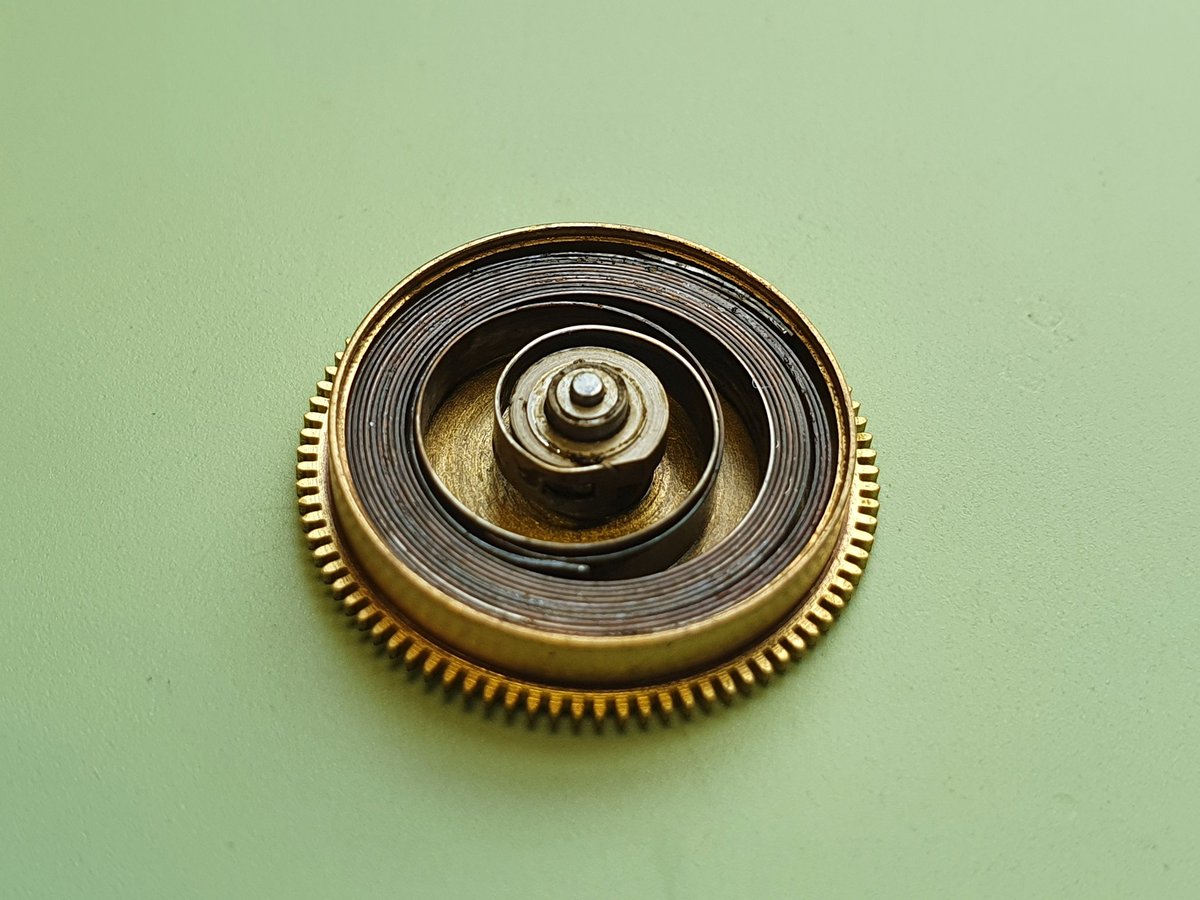
@DrStruthers I know the very one, here's one I was working on only the other week. Excuse the extremely long stem - it was a replacement which I later shortened after this photograph! 😅
Horological fact of the day: it was common place in the 19th and early 20th century for watchmakers to insert a paper disk in your pocket watch case after they completed work on it. Here's just a few examples from a single watch. #horology#watchmaking#repair
The first Omega date calendar mechanism, the cal. 355. First appearing on the market in 1952, it also incorporated an early version of automatic winding, known as a "bumper" rotor due to the way in which it bumps back and forth to wind the watch. It's an impressive little piece!
Today I came across a very primitive repair on an old military issue pocket watch. There's no telling where this repair took place however it may have been the work of a field watchmaker during times of conflict. As shown, the spring has been riveted together to function again!
Putting right a previous poor repair: The barrel arbor bearing presumably became worn on this vintage omega. As a result, the previous repairer decided to punch around the hole to close it up. The below photographs show how I put this right again. #horology#watchmaking#repair
@SnowdoniaA Most definitely, we'll be back. It's felt like a home from home. When I'm next in the area I'll let you know. Would be great to talk clocks 👍🏼
@SnowdoniaA I happened to be in your shop today as we're touring Wales. Unfortunately you were out but I met your mother, or as she referred to herself "The Welsh Dragon"! Sorry I missed you. You live in a beautiful part of the country.
@A_Mechanician The author wouldn't happen to be F. J. Garrard? If not, I recommend picking up some of this material. Most of his publications are now 100+ years old but naturally still very relevant. I mean 100 years old to a horologist is considered new, right? 😏
@KenBerry19 Ken, in this case I simply chipped two minute pieces of shellac which I positioned over the void between the pallet jewel and fork. The brass plate was then heated from the far corner to ensure the heating of the pallets was controlled and not via a direct flame.
Both pallet jewels were mis-shapen and chipped, this meant that both had to be replaced. The below photos demonstrate how I held the pallet fork and gently eased the new jewels into position using the end of a cocktail stick. Both jewels will require adjustment and shellac added.
I've been rather quiet on here given the current restrictions, so here's a fully restored gramophone motor with a superb governor (otherwise referred to as a flywheel). As it spins, the weights ensure that it maintains a constant momentum - perfect for playing 33 rpm records!
@flanneryspeedos Cousins UK offer a great range of Tungsten Carbide Drills from the Horotec brand, sizes starting at 0.5mm up. I use them myself for pivot replacements on hardened clock arbors.