Using Lactate to Find Your Training Zones
Testing Protocol:
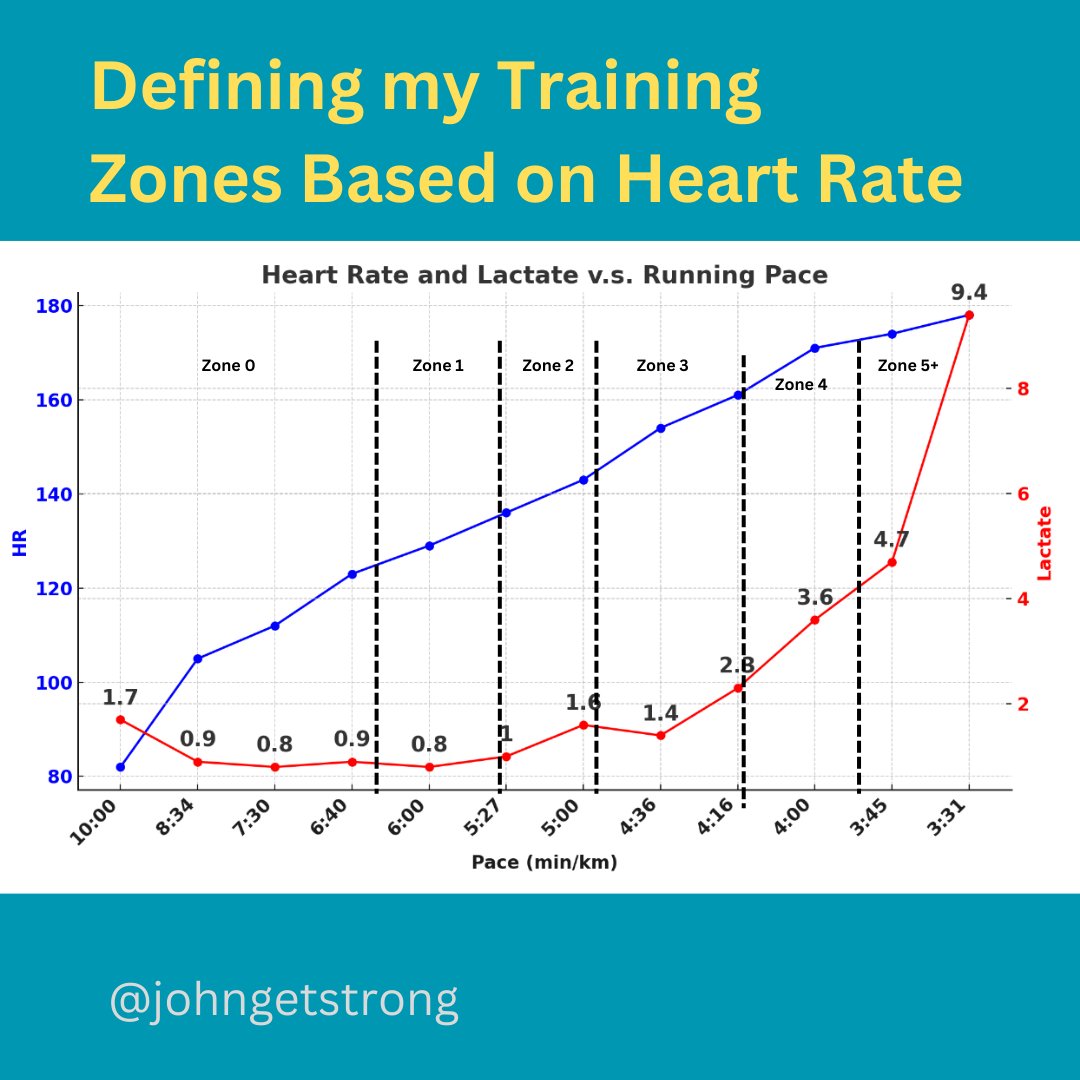
Ramp protocol. I started at walking pace (6km/hour), then increased pace by 1km/hour every three minutes until reaching an "extremely hard" level of intensity. Lactate was measured at each steps.
Definitions:
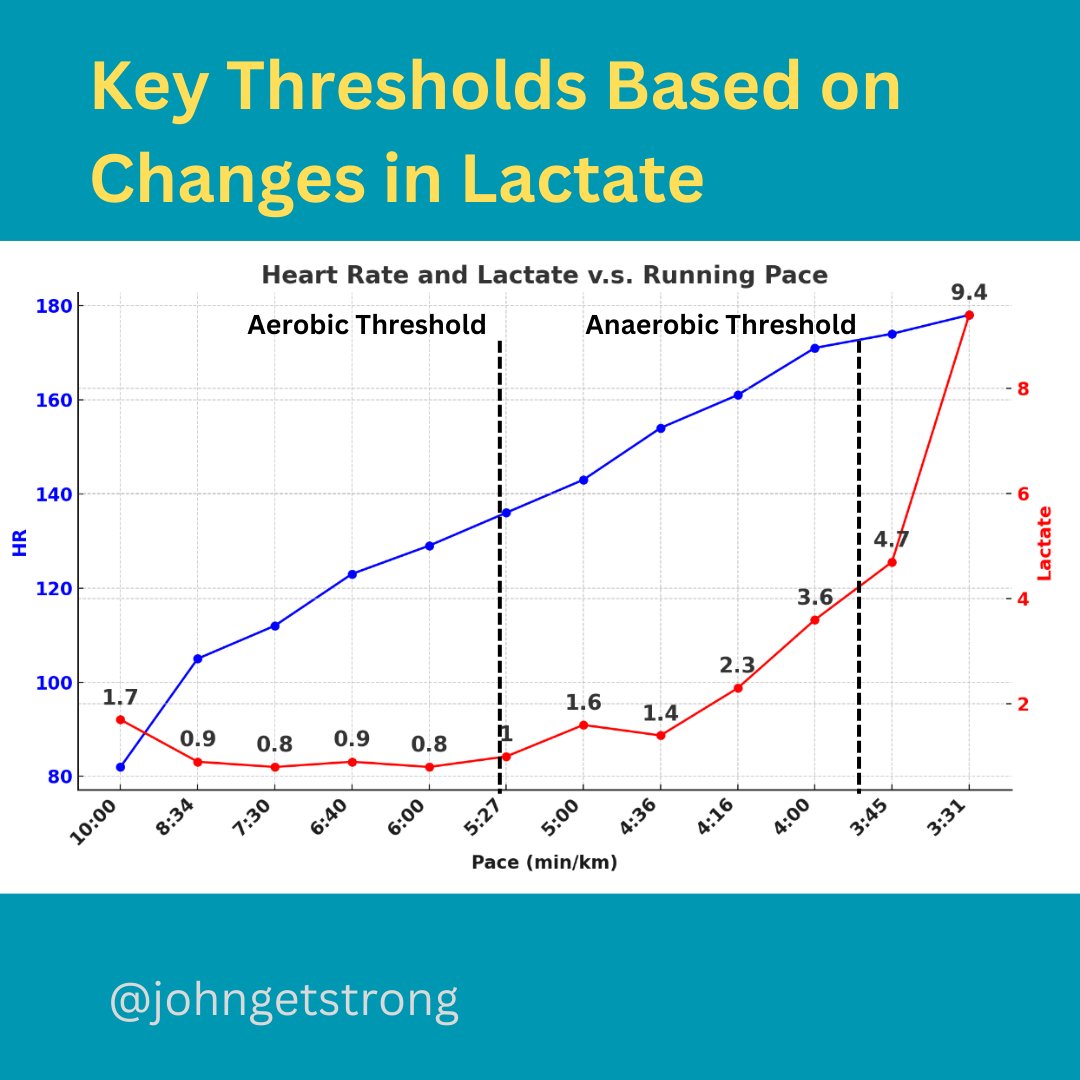
I was looking to find key heart rate thresholds using the lactate values.
Aerobic (AeT):
- The point below the first rise of lactate of > 0.3mmol/L
- Represents a the beginning of increased usage of a glycolytic (IIa) fibers over slow-twitch (I) fibers.
- My heart rate was 136bpm at this point
Anaerobic (Ant):
- Point farthest from the line connecting AeT and AnT
- Represents a shift away from Fast Oxidative Glycolytic (IIa) (Fibers), to Non-Oxidate (IIx) Fibers.
- My heart rate was 171bpm at this point
Calculating Zones:
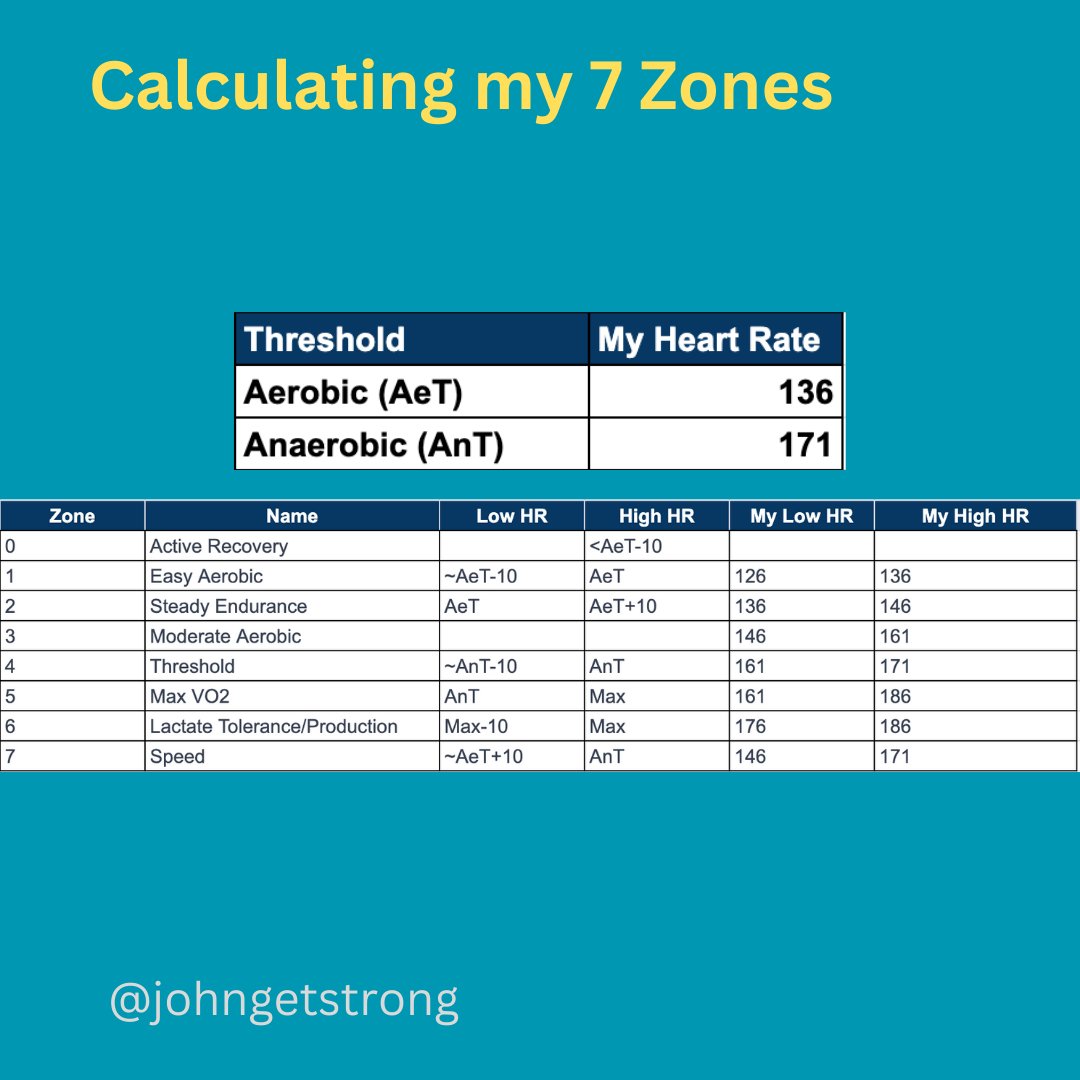
From these two thresholds we can now calculate 7 training zones. These are the 7 training zones that @Alan_Couzens recommends in chapter 6 of his book (high recommended).
Zone 0: Active Recovery
High HR: AeT minus 10 beats per minute (bpm).
Zone 1: Easy Aerobic
Low HR: Approximately AeT minus 10 bpm.
High HR: Aerobic Threshold (AeT).
Zone 2: Steady Endurance
Low HR: Aerobic Threshold (AeT).
High HR: AeT plus 10 bpm.
Zone 3: Moderate Aerobic
From Alan: "“no man’s land” of training zones.... (unless the athlete’s target event takes place in this zone), minimal time should be spent here"
Zone 4: Threshold
Low HR: Approximately Anaerobic Threshold (AnT) minus 10 bpm.
High HR: Anaerobic Threshold (AnT).
Zone 5: Max VO2
Low HR: Anaerobic Threshold (AnT).
High HR: Maximum Heart Rate (Max).
Zone 6: Lactate Tolerance/Production
Low HR: Maximum Heart Rate minus 10 bpm (Max-10).
High HR: Maximum Heart Rate (Max).
Zone 7: Speed
Low HR: Approximately AeT plus 10 bpm.
High HR: Anaerobic Threshold (AnT).
Now I have my training zones, I can focus on the task at hand. Lots of mileage at zone 2 and below, with some training at zone 5 and above. I want to be highly polarized -- building a stronger base, then working on improving my top end as the season progresses.
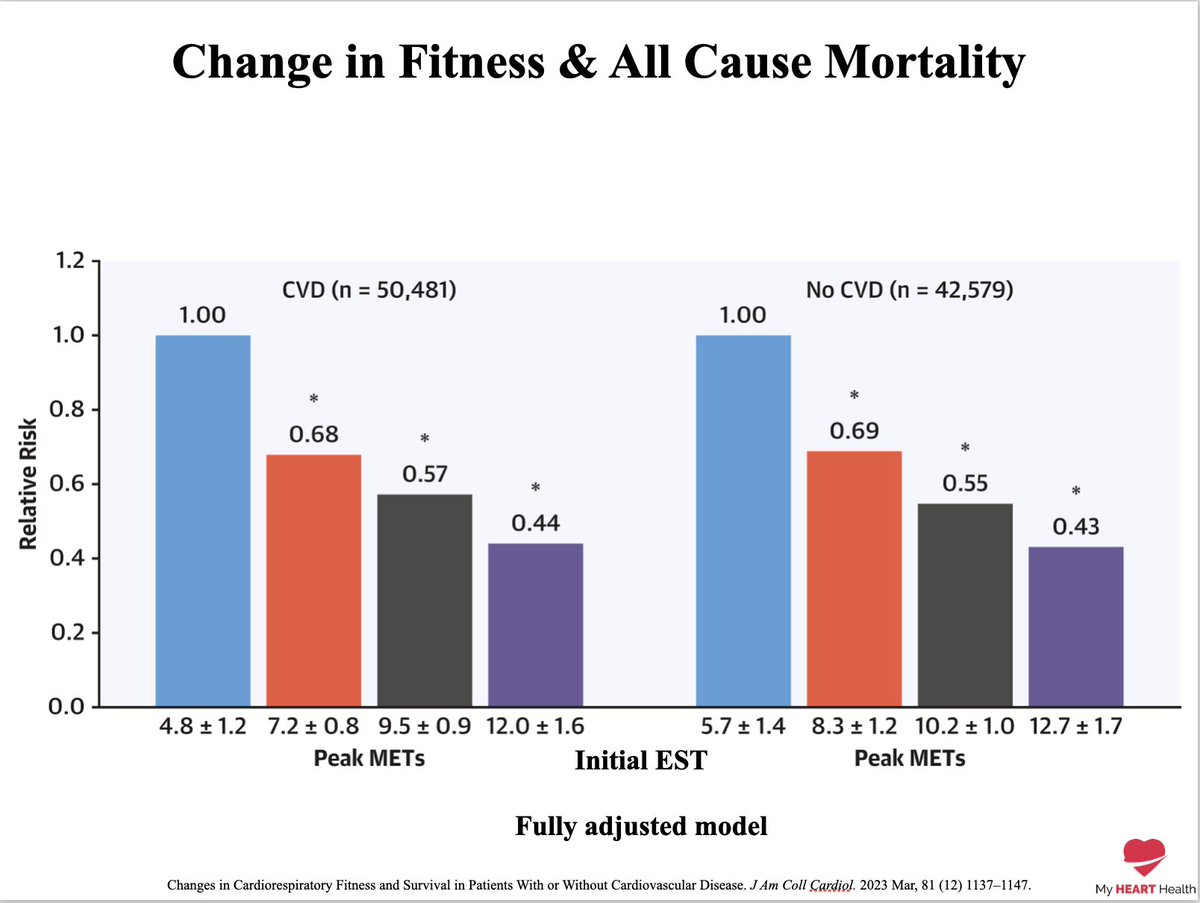
Those with the highest levels of fitness
Are about 56% less likely to die from heart disease over a 10 year period.
This includes people who already HAVE heart disease.
What are "good", "average" and "bad" numbers for fat oxidation?
Some good references in the table below from Randell et al. (https://t.co/asLQUexalU)
Anything north of ~0.5g/min or ~5kcal/min is a good, solid number for a "health and fitness athlete" to shoot for. Ideally, this should occur at ~60% VO2max.
As you can see, metabolically unfit individuals will have much lower numbers ~0.2-0.3g/min (~2 kcal/min) & often occurring at <50% VO2max!
Professional cyclists and long distance triathletes that I've tested (not shown on the table) are significantly higher than any of the numbers shown at ~0.8-1.1g/min (7-10kcal/min) at >70% VO2max!
That is, your typical professional Ironman triathlete has 4x the #FatBurning power of the average Joe Bagodonuts !
Being in the top 5% of V02 Max for the population means you are 5 times less likely to die over a 10-year time horizon compared to someone in the bottom 25%.
There is almost nothing medicine that offers that kind of survival advantage.
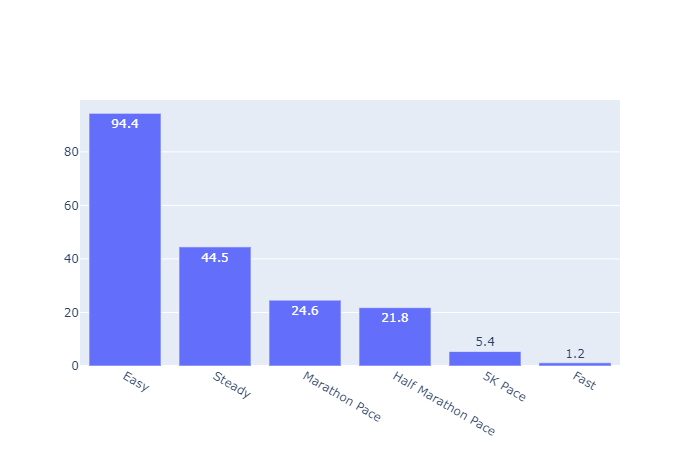
Diving in a little deeper to how Molly's typical 193km training week breaks down...
* Only 3% speed work each week! (5K pace or faster)
* ~13% in and around race pace &...
* Half of the volume each week eazzzy at LESS THAN 70% of 5K Pace!
https://t.co/uABmAlDnS8