Voice is not enough.
Judgment must be formed.
The Stewardship Academy is the first practical doorway into The Stewardship: a structured path for those who want to think more clearly, carry responsibility, and become fit for serious civic voice.
Formation before voice.
Start free:
https://t.co/CavgeqMkxb
A fascinating piece. Your “Heartware” argument goes directly to territory we’ve been building around at The Stewardship. As AI dissolves the firm, the deepest capabilities may one day flow not to office or status, but to those the systems learn to trust.
Our response:
https://t.co/i8bfYnmiJw
Perhaps the future is neither rule by inherited gentry nor mass politics mediated only by parties and media.
Imagine civic representation where every voice is heard, but public weight is shaped by formation, service, competence, and the trust of a real community.
Not less democracy, but better-formed democracy.
That is the civic architecture we're working to build at The Stewardship.
Digital ID should not be treated as a simple “for or against” question.
There may be narrow cases where identity, status or authorisation needs to be proven — adult, citizen, resident, qualified professional — and perhaps, in future, cases involving access to genuinely dangerous knowledge or existential-risk capability.
But that is very different from building a general permission layer over ordinary life.
If any such system is necessary, the public must be told plainly:
What is necessary?
Why is it necessary?
What problem does it solve?
What data is stored?
Who can access it?
Can usage be tracked?
Can access be revoked?
Is it linked to banking, employment, travel, speech, platforms or public services?
Where possible, privacy-preserving methods such as zero-knowledge proofs should be used: prove the necessary fact, not expose the whole person.
A free society may need proof of standing in some places.
It must not build a system where lawful citizens need permission to exist, speak, work, bank or participate.
This requires full public scrutiny before infrastructure becomes inevitability.
Digital ID should not be treated as a simple “for or against” question.
There may be narrow cases where identity, status or authorisation needs to be proven — adult, citizen, resident, qualified professional — and perhaps, in future, cases involving access to genuinely dangerous knowledge or existential-risk capability.
But that is very different from building a general permission layer over ordinary life.
If any such system is necessary, the public must be told plainly:
What is necessary?
Why is it necessary?
What problem does it solve?
What data is stored?
Who can access it?
Can usage be tracked?
Can access be revoked?
Is it linked to banking, employment, travel, speech, platforms or public services?
Where possible, privacy-preserving methods such as zero-knowledge proofs should be used: prove the necessary fact, not expose the whole person.
A free society may need proof of standing in some places.
It must not build a system where lawful citizens need permission to exist, speak, work, bank or participate.
This requires full public scrutiny before infrastructure becomes inevitability.
@theoldworldshow This is why formation matters.
A society cannot rely on wealth, status, or influence alone to produce good leadership. Those things must be disciplined by duty, restraint, judgment, and service.
Without formation, noblesse oblige collapses into mere self-interest.
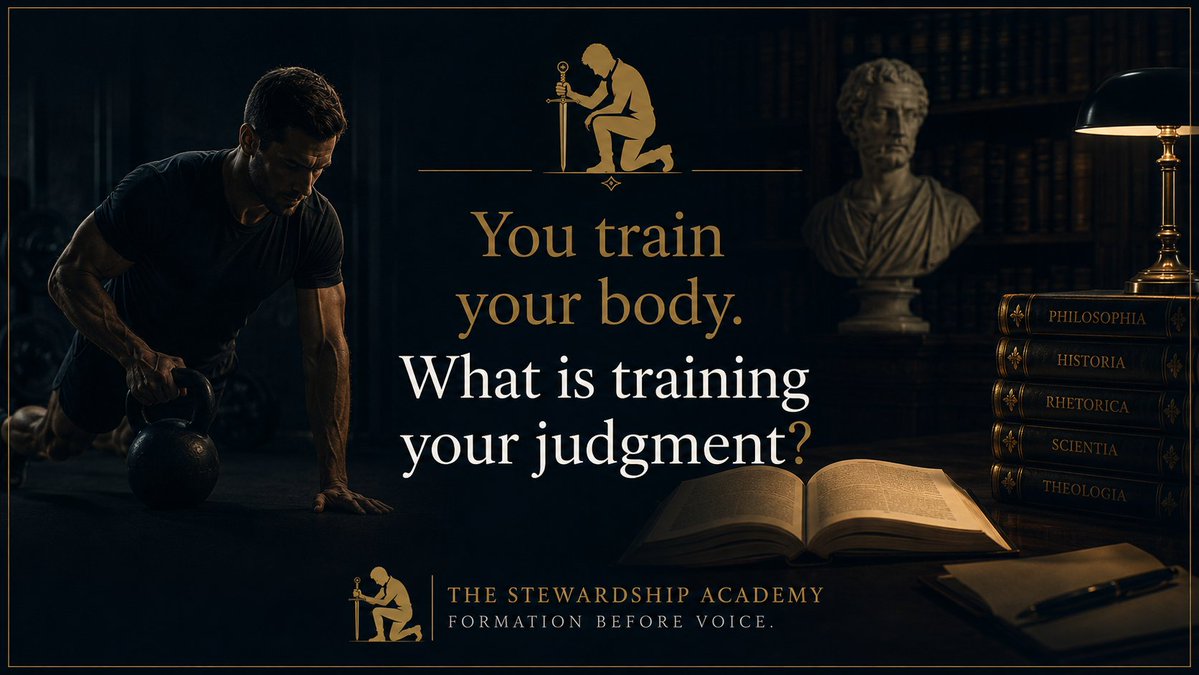
You train your body.
What is training your judgment?
A serious life needs more than strength, stamina, and appearance.
It also needs discipline of mind, responsibility, and character.
@DrPippaM@marksandspencer The hard question is not whether we can manufacture intelligence.
It is whether we can form the human being who knows what to do with it.
That is where “heartware” becomes more than metaphor. It becomes education, discipline, responsibility, judgment — formation.
We are looking for the first serious learners.
People willing to think more clearly, take responsibility more seriously, and begin the work of formation.
The Academy is open here:
https://t.co/nQFaTRAOW0
The Stewardship Academy is live.
Structured pathways.
AI-guided tuition.
Progression through the Apprentice Steward path.
Formation before voice.
Start with the free introduction:
https://t.co/nQFaTRAOW0
@HumbleFlow This is part of the reason we have founded our academy. To help restore some of the wisdom that has been lost. To restore the stewardship of Civilisation.
A civilisation cannot be carried only from the top.
It lives through formed people: parents, workers, teachers, builders, neighbours, leaders, citizens, and stewards.
No civilisation is stronger than the people who carry it.
The Apprentice Steward path begins with broad foundations:
history, language, philosophy, moral reasoning, practical competence, leadership, civic life, and more.
Formation begins with foundations strong enough to build upon.
The Stewardship Academy uses AI as tutor, examiner, and guide.
The aim is human judgment, not machine dependence.
Clearer thought. Deeper responsibility. Stronger people.
A vote is not the same thing as judgment.
A public platform is not the same thing as deliberation.
A strong opinion is not the same thing as stewardship.
Public voice matters too much to leave judgment unformed.
@YardleyShooting The leadership problem is real. But it sits on top of a deeper one: too many citizens have never been formed for serious judgment.
Better politics will require better voters, better citizens, and better people. That is the purpose of The Stewardship Academy.
The Academy is structured as a path, rather than a feed.
Learners move through branches, modules, steps, prerequisites, AI-guided tuition, reflection, and assessment.
The aim is steady formation over time.