Warren Buffett watched 16 geniuses lose $4.6 billion in 1998, then explained it in 1 sentence.
October 15, 1998. A lecture hall at the University of Florida.
A 68-year-old Buffett takes a student question about Long-Term Capital Management. 22 days earlier, the fund had nearly taken Wall Street down with it.
LTCM had 2 Nobel laureates on board, Myron Scholes and Robert Merton. It returned 43% in year 2 and 41% in year 3.
At the start of 1998 it held $4.7 billion of its own money. And $124.5 billion of borrowed money.
25 to 1.
Then Russia defaulted in August. In under 4 months, $4.6 billion was gone.
On September 23, Buffett, AIG and Goldman Sachs offered $250 million for the partners’ stake plus $3.75 billion in fresh capital. He gave John Meriwether under 1 hour. The deadline passed. That same day, 14 banks put in $3.625 billion under the eye of the Fed.
On stage, Buffett didn’t mock them.
He said they had about as high an IQ as any 16 people working together in one business in the country. 300 to 400 years of combined experience. Most of their net worth sat inside the fund.
Then he said it:
“To make money they didn’t have and didn’t need, they risked what they did have and what they did need.”
He offered a gun with a million chambers and 1 bullet. His answer: “I would not pull the trigger.”
The smartest room in finance lost to 1 ratio. 25 to 1.
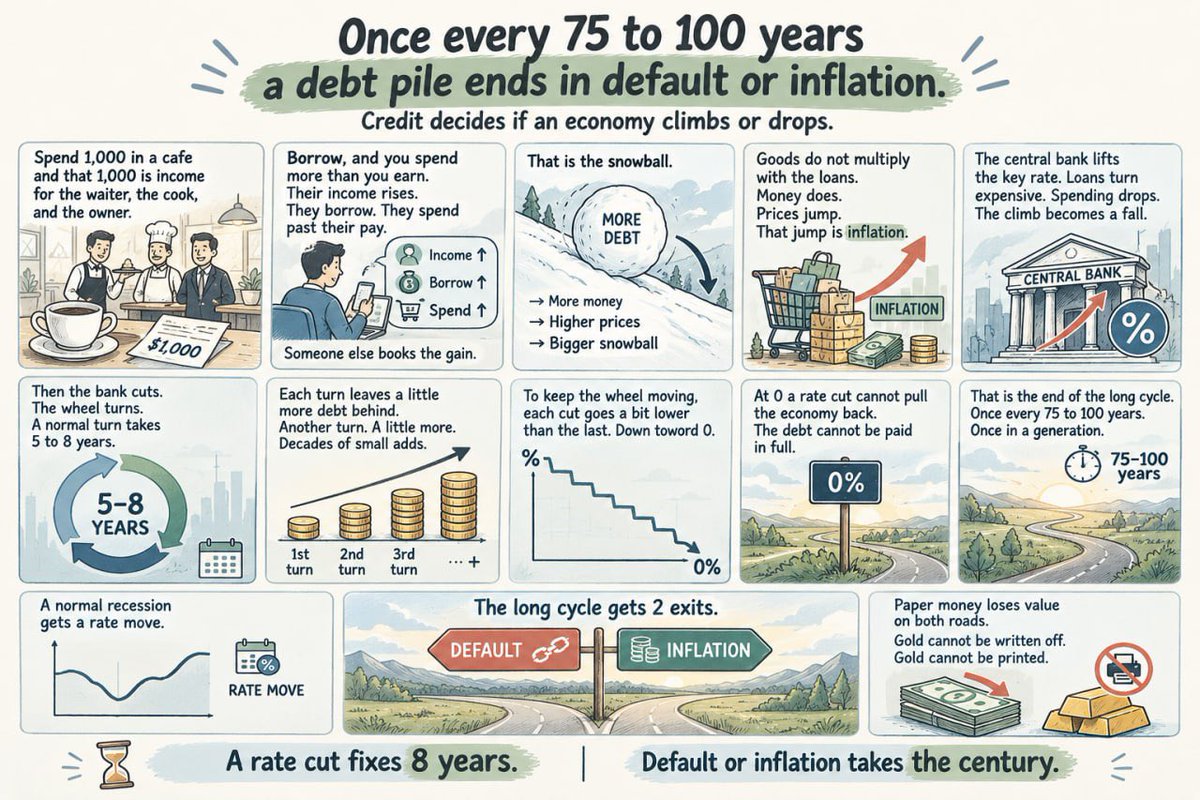
ONCE EVERY 75 TO 100 YEARS A DEBT PILE ENDS IN DEFAULT OR INFLATION.
Credit decides if an economy climbs or drops. Spend 1,000 in a cafe and that 1,000 is income for the waiter, the cook, and the owner.
Borrow, and you spend more than you earn. Their income rises. They borrow. They spend past their pay. Someone else books the gain.
That is the snowball.
Goods do not multiply with the loans. Money does. Prices jump. That jump is inflation.
The central bank lifts the key rate. Loans turn expensive. Spending drops. The climb becomes a fall.
Then the bank cuts. The wheel turns. A normal turn takes 5 to 8 years.
Each turn leaves a little more debt behind. Another turn. A little more. Decades of small adds.
To keep the wheel moving, each cut goes a bit lower than the last. Down toward 0.
At 0 a rate cut cannot pull the economy back. The debt cannot be paid in full.
That is the end of the long cycle. Once every 75 to 100 years. Once in a generation.
A normal recession gets a rate move. The long cycle gets 2 exits.
Default. Or inflation.
Paper money loses value on both roads. Gold cannot be written off. Gold cannot be printed.
A rate cut fixes 8 years. Default or inflation takes the century.
Foreign central banks’ gold share topped US Treasuries in 2025.
First time since 1996.
Crescat’s reserve chart shows the lines crossing that year. Gold’s share of foreign reserves moved back above Treasuries. Not a jewelry story. A reserve mix.
The buying pace had already jumped after 2022, when about $300 billion of Russian reserves were frozen inside the dollar system. The bonds stayed on the statement. They just stopped being usable.
Treasuries live on someone else’s rails. A bar in your own vault does not.
A large share of the buying never hits the public tape. World Gold Council estimates keep running ahead of what central banks report. China’s official adds are the visible clip. The gap under them does not get a press release.
The chart is the floor, not the ceiling.
The people who print the money raised the weight of the asset they cannot print. In 2025 gold took the top slot in foreign reserves from the bond that used to be the default.
US debt is $40.1 trillion.
$32.4 trillion is in the market.
$7.7 trillion is the government writing IOUs to its own trust funds.
The interest line is already above $1 trillion a year.
The deficit is still running close to $2 trillion.
That stack does not blow up on a Tuesday. The dollar is still the reserve unit, so the world keeps rolling Treasuries and Washington issues new paper to retire old paper.
The break is not a cable-news default.
The break is a buyer who stops treating the next auction as automatic.
Reserve managers have been answering that risk with metal.
Q1 official gold demand was 244 tonnes.
The noisy number is the $40.1 trillion.
The quiet number is who still wants the rollover.
The 30-year just printed 5.5%.
30-year mortgages are back near 7.5%.
That coupon will pull some gold flows. Western funds already took the income.
A 5% yield still pays in dollars. On a CPI basis the dollar has lost about 40% in 20 years. Since 2020 the haircut is roughly 23%.
Income inside a shrinking unit is still income.
It is not a reserve.
Q1 official gold demand was 244 tonnes anyway.
Funds and finance ministries are not solving the same problem.
Q1 official demand was 244 tonnes. Gold had already given back close to 30%.
That’s not the bid leaving. That’s the same bid paying less.
ETF holdings can bounce around. China’s official add was already 19 months in by late spring. Poland is still buying toward 700 tonnes.
Households stayed in deposits. Central banks didn’t.
Q1 244t is World Gold Council demand data, not a blog estimate.
The 19-month China streak was the reported official add, not jewelry demand.
That distinction is the whole post.
Gold’s 30% drawdown is being sold as a regime change. The official data does not agree.
The metal printed near $5,595 in late January. By midyear it had given back close to 30%. Spot then stabilized in the low-to-mid $4,000s. That is a violent tape. It is also a normal tape after 2025, when gold had already run 40–70% depending where you mark the low.
Melt-ups change holders. The buyer who arrived because the number was going up needs a new high to stay. The buyer who is filling a reserve slot will take the quieter print.
Q1 official demand: 244 tonnes, above the five-year quarterly average, and the tenth quarter in eleven with more than 200 tonnes. China was already on a 19-month reported add by late spring. Poland is still walking toward 700 tonnes.
A crash is when the bid disappears.
A correction is when the same bid pays less.
Q1 says this was the second one.
@FT China’s record gold imports show that official and retail demand remains extremely strong despite the 30% correction. Central banks aren’t buying for quick profits — they’re diversifying reserves amid geopolitical risks and fiat concerns. The bid is still there.
Ordinary savers are still sitting in deposits. States are buying gold.
Central banks added a net 244 tonnes in Q1 2026. China has been reporting reserve increases for more than a year and a half. That is not jewelry demand. That is reserve policy.
Gold hit ~$5,595 in January, then gave back almost 30%. A crash changes the buyer. A correction is the same buyer taking a lower number.
I wrote up why the official bid still matters, why $6,000 is a research marker not a promise, and why rising real yields are the real near-term risk.
Over the last 5–6 years, for me it’s first about protecting money from inflation, and only then about making more. Too much instability, so I prefer active management with tight control.
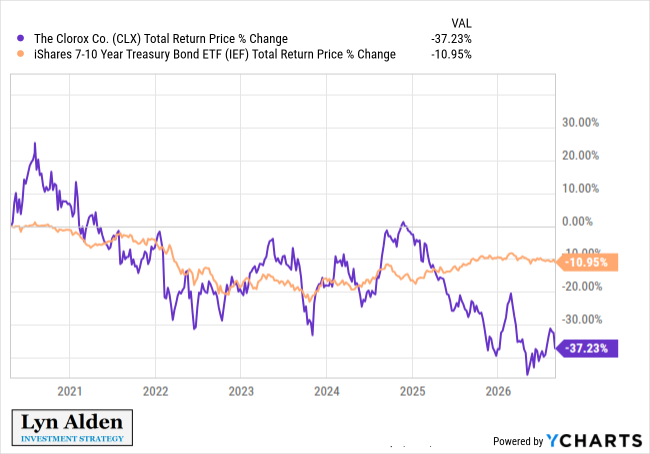
Someone dug this old gem up, so I checked the resulting outcome, 6+ years later.
The moral of the story is don't buy Clorox for 30x earnings and don't lend money to the government for a 0.6% yield.
If you do, you're gonna have a bad time.
I'm supporting Lombard to build the onchain Bitcoin Capital Markets through its Community Sale on Buidlpad Now! @Lombard_Finance@buidlpad https://t.co/EvjOGgMOKA
✨ Subscribe NOW to Enter the $BARD Lucky Draw! ✨
A chance to win undiluted $BARD allocations.
🥇 $20,000 for one winner
🥈 $1,500 each for ten winners
Note: Ensure to subscribe first and link your X
Time to be creative and follow the rules below ⬇️
@Gate_io scammed their users.
While the LA token was trading at $0.50–$0.60 on CEXs and DEXs, its price on Gate futures spiked to over $27. This anomaly liquidated many users, who lost their funds — and Gate refused to compensate them. Meanwhile, those who profited from the inefficiency freely withdrew. I personally lost $70,000 in this situation, and my account was hit with an additional -$100,000 overdraft. Gate reversed the artificially generated -$100,000, but chose not to refund the real $70,000 I lost.
https://t.co/XDa6uBl5d9 - You can check price on dex by this link and also check price on other CEX`s.
Share this tweet to help bring justice to the victims.
@zachxbt@cz_binance@benbybit@Han_Gate@laura_gateio @_pacelee @kevinlee_gate @SandraLouWeb3
What’s going on with $LA? 😳
It dumped hard, and GATE users made tens — even hundreds — of thousands 💰
If you caught it, you’re winning 🚀📉
#Crypto#LA#GATE
$LA on Gate was a textbook trap🤬
They let people win once on mispricing — next time, same setup, but this time: 30x squeeze
Shorts wrecked up to $27. Over $10M liquidated.
Classic casino play🥲
#lagrangedev#Gate#Crypto#Liquidations